Your traffic problem is starting earlier than the search results page.
A prospect asks an AI assistant for the best vendor, the safest workflow, the cheapest tool, or the most credible explanation. The assistant summarizes an answer. Your site may be technically indexed, but it is not mentioned. No click, no impression, no obvious failure in Search Console.
Teams think the problem is ai answer visibility. The real problem is that most websites were built for ranking pages, not for making answer-ready facts easy for AI systems to crawl, extract, validate, and cite.
That changes the conversation. This is not only a content calendar issue. It is a workflow problem across SEO, content, schema, engineering, analytics, and brand positioning. The practical question is not whether AI answer engines matter in 2026. The practical question is whether your site exposes the right information in a form machines can trust without a human clicking through your navigation.
Table of contents
Why ai answer visibility is now a workflow problem
The old SEO assumption breaks
Traditional SEO assumed a fairly stable chain: crawl, index, rank, click. You optimized a page, earned visibility, and users decided whether to visit. AI answer systems compress that chain. They may crawl or retrieve content, synthesize it with other sources, and produce an answer before the user sees a list of links.
The mistake teams make is treating this as another snippet format. It is not just a larger featured snippet. The answer engine is deciding which sources are legible enough to support a response. If your page buries the answer under vague copy, client-side rendering, conflicting schema, or unsupported claims, you are asking the model to do extra work.
Many sites have strong human-facing pages and weak machine-facing evidence. The homepage says the company is trusted. The product page says it is best in class. The blog post says it solves a pain point. But none of those pages clearly expose who the company serves, what the product does, what evidence supports it, and which question the page answers.
The new unit of work is an answer candidate
A useful way to think about it is this: every important page should contain at least one answer candidate. An answer candidate is a compact, crawlable, well-supported chunk of information that can be used in a generated response.
It does not have to be robotic. It does have to be unambiguous. For example, a page about pricing should answer what is charged, what changes the price, what is included, and what happens next. A page about a technical product should answer what it integrates with, what problem it solves, and what constraints matter.
If you are new to the distinction between SEO and answer-oriented optimization, the baseline is covered in What is AEO, and why it isn't SEO. The short version: SEO still matters, but AEO adds a second job. Your content must be usable by systems that answer instead of only rank.
Why this matters in 2026
In 2026, AI answers are not one interface. They show up in search features, chat assistants, browser agents, enterprise copilots, vertical research tools, and embedded product experiences. Some use live retrieval. Some use prebuilt indexes. Some cite sources visibly. Some do not.
That fragmentation makes the workflow harder. You cannot optimize for one bot and call it done. You need a site architecture that makes the right facts consistently available across crawlers, parsers, and answer formats.
Practical rule: Do not optimize pages for AI answers after publishing. Build answer readiness into the page template, content brief, schema plan, and QA checklist.
How AI answer engines actually consume your site
Crawling is permission plus usefulness
Crawling starts with access. Robots directives, server responses, rate limits, blocked user agents, login walls, geo rules, and security middleware all affect whether an AI crawler can fetch a page. But access is not the full story. A crawler can fetch a page and still get little useful information.
What breaks in practice is the gap between page availability and page extractability. A marketing page may return 200 OK, but the meaningful content is injected after scripts load. A documentation page may be public, but the important details sit inside collapsed UI components. A comparison page may be crawlable, but the answer is split across ten tabs.
For AI answer visibility, the page has to be both reachable and interpretable.
Answer systems prefer structure because structure lowers ambiguity. Headings, summaries, definitions, tables, FAQs, schema, author information, dates, and internal links all help machines understand what a page is about and how much trust to assign to it.
This does not mean every page should become an FAQ farm. It means the page should have a clear information hierarchy. If a human skims the headings and still cannot tell what the page proves, a machine parser will not magically infer it.
Good extraction design usually includes:
- One clear primary topic per page.
- Descriptive H2 and H3 headings.
- A direct answer near the top for the core question.
- Specific nouns instead of vague pronouns.
- Tables for comparisons and constraints.
- Updated dates where freshness matters.
- Schema that matches visible content.
Citation depends on confidence
Citation is a confidence problem. An answer engine is more likely to cite a page when the page looks authoritative for a specific claim. That confidence can come from topical focus, consistent entity information, original data, clear authorship, external references, or direct relevance to the query.
The practical question is: what claim should this page be trusted for? If the answer is everything, the page is probably trusted for nothing.
Related reading from our network: teams building product surfaces face similar discoverability constraints, and this guide on answer engine optimization product management frames AEO as a product shipping concern rather than a copywriting task.
Build an ai answer readiness architecture
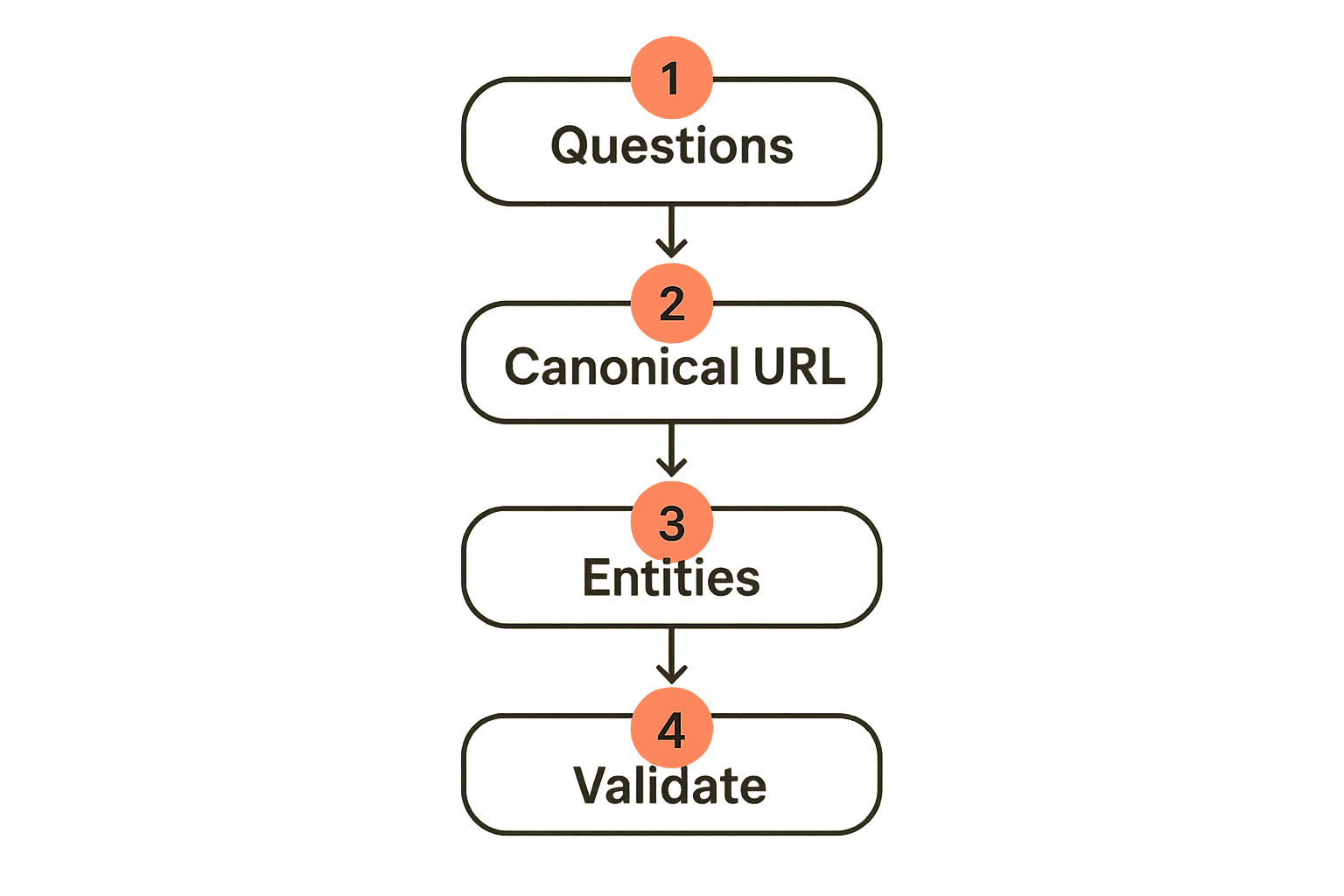
Inventory pages by question
Start with questions, not URLs. Take your top commercial, informational, support, and comparison queries. Then map each question to the page that should answer it. Many teams discover they have three pages that partially answer the same question and no page that answers it cleanly.
Your inventory should look like an operational table, not a keyword dump:
| What does the product do? | Product page | Vague positioning | Marketing | Rewrite intro |
| How does pricing work? | Pricing page | Missing constraints | Growth | Add answer block |
| Can AI crawlers access docs? | Docs index | Blocked assets | Engineering | Rendering check |
| Who is this for? | Use case page | No entity clarity | Content | Add schema and examples |
The goal is to identify the canonical answer source for each important question. If you cannot name the source, an AI answer system probably cannot either.
Map entities claims and proof
AI answer systems work heavily with entities: companies, products, people, categories, locations, standards, and concepts. Your site should consistently describe these entities across pages.
For each core page, map three things:
- Entity: the company, product, service, person, or concept being described.
- Claim: the specific statement you want the page to support.
- Proof: the visible evidence that makes the claim credible.
Example:
| CrawlProof | Audits AEO readiness | Reports crawler access, schema, content extraction, and positioning |
| llms.txt | Helps guide LLM crawlers | File is placed at site root and references important resources |
| Pricing page | Explains buying path | Lists plan details, limits, and next steps |
This is where generic marketing copy loses. An answer engine cannot cite enthusiasm. It can cite a clearly stated capability, constraint, or fact.
Decide what should be quotable
Not every sentence needs to be quotable. Some copy exists to persuade, guide, or differentiate. But each strategic page should contain passages that can survive being lifted into an answer.
Quotable content is specific, bounded, and context-safe. If an assistant repeats the sentence without the surrounding page, it should still be accurate.
Practical rule: Put the most citation-worthy fact in the first third of the page, then support it with structure, examples, and schema. Do not make crawlers hunt through brand copy for the answer.
Technical access controls that help or block AI crawlers
Robots rules are not a strategy
Robots.txt is a control surface, not an AEO strategy. It can allow, disallow, or guide crawlers, but it does not explain which pages matter or whether a fetched page is useful. Teams often inherit old robots rules from SEO migrations, staging blocks, aggressive bot controls, or security plugins. Those rules can silently block AI crawlers from important sections.
The mistake teams make is reviewing robots.txt only when something breaks. In an AI answer workflow, robots policies should be reviewed whenever you launch a major page type, restructure documentation, change CDN rules, or add bot protection.
A minimal review asks:
- Are important public pages blocked for known AI crawlers?
- Are CSS and JavaScript assets needed for rendering blocked?
- Are old disallow rules still relevant?
- Are staging or parameter rules accidentally broad?
- Do server logs show crawlers receiving 403, 429, or 5xx responses?
llms.txt belongs in the deployment workflow
The emerging llms.txt pattern gives site owners a way to point AI systems toward important resources, policies, and structured summaries. It is not a magic ranking file. It is a machine-readable signpost.
If you use it, treat it like infrastructure. Keep it versioned. Review it during releases. Make sure links are live. Keep descriptions short and factual. Do not stuff it with promotional copy.
A simple llms.txt might include:
# Example site guidance

## Core pages
- https://example.com/product - Product overview and capabilities
- https://example.com/pricing - Pricing model and plan limits
- https://example.com/docs - Technical documentation

## Policies
- https://example.com/robots.txt - Crawler access policy
- https://example.com/privacy - Privacy policy
For a deeper breakdown of the file pattern and how it differs from other machine-facing assets, see llms.txt and skill.md, explained.
JavaScript and paywalls create blind spots
Modern websites often hide important content behind JavaScript execution, personalization, consent modals, account gates, or interactive components. Humans can navigate this. Crawlers may not.
That does not mean you must remove dynamic UX. It means the canonical answer content should be available in the initial HTML or through a crawlable, stable rendering path. If the answer only appears after a user clicks a tab, filters a component, or logs in, it is not a reliable answer source.
What breaks in practice is support content and docs. Teams assume docs are public because users can see them. Then an AI crawler sees a shell, a loading spinner, or a blocked script. The page exists, but the answer does not.
Write the answer block first
Start important pages with a direct answer block. This is not a gimmick. It is a way to make the page's job explicit.
A strong answer block usually includes:
- What the thing is.
- Who it is for.
- When to use it.
- Key constraints or caveats.
- The next page to read.
Weak version:
Our platform helps modern teams unlock better outcomes with intelligent workflows.
Better version:
CrawlProof is an AEO audit tool for site owners, marketers, and developers. It checks whether AI crawlers and answer engines can access, parse, and understand a URL, including content extraction, schema markup, robots rules, AI-bot access, and page positioning.
The better version gives an AI answer system concrete nouns and relationships. It also helps humans.
Separate facts from persuasion
Marketing pages need persuasion. They also need extractable facts. The problem is mixing them until neither works.
Use this comparison when reviewing pages:
| Intro | Direct explanation of product or topic | Abstract brand promise |
| Proof | Named features, examples, policies, dates | Claims without evidence |
| Comparison | Clear table with constraints | One-sided adjectives |
| FAQ | Real buyer or user questions | Keyword-stuffed filler |
| CTA | Next step after answer | CTA before context |
This is not anti-brand. It is pro-clarity. Strong positioning becomes more valuable when the facts underneath it are legible.
Maintain source freshness
AI answer systems may prefer current sources for topics where freshness matters: pricing, product capabilities, regulations, software support, standards, security, and market comparisons. If your page has stale dates, outdated screenshots, or mismatched claims across pages, confidence drops.
Freshness is not only a published date. It is consistency across the site. If your pricing page says one thing, your FAQ says another, and your docs say a third, you have created an answer conflict.
Practical rule: For every page that should earn AI citations, assign a freshness owner and a review interval. Unowned content becomes stale infrastructure.
Schema metadata and machine readable context
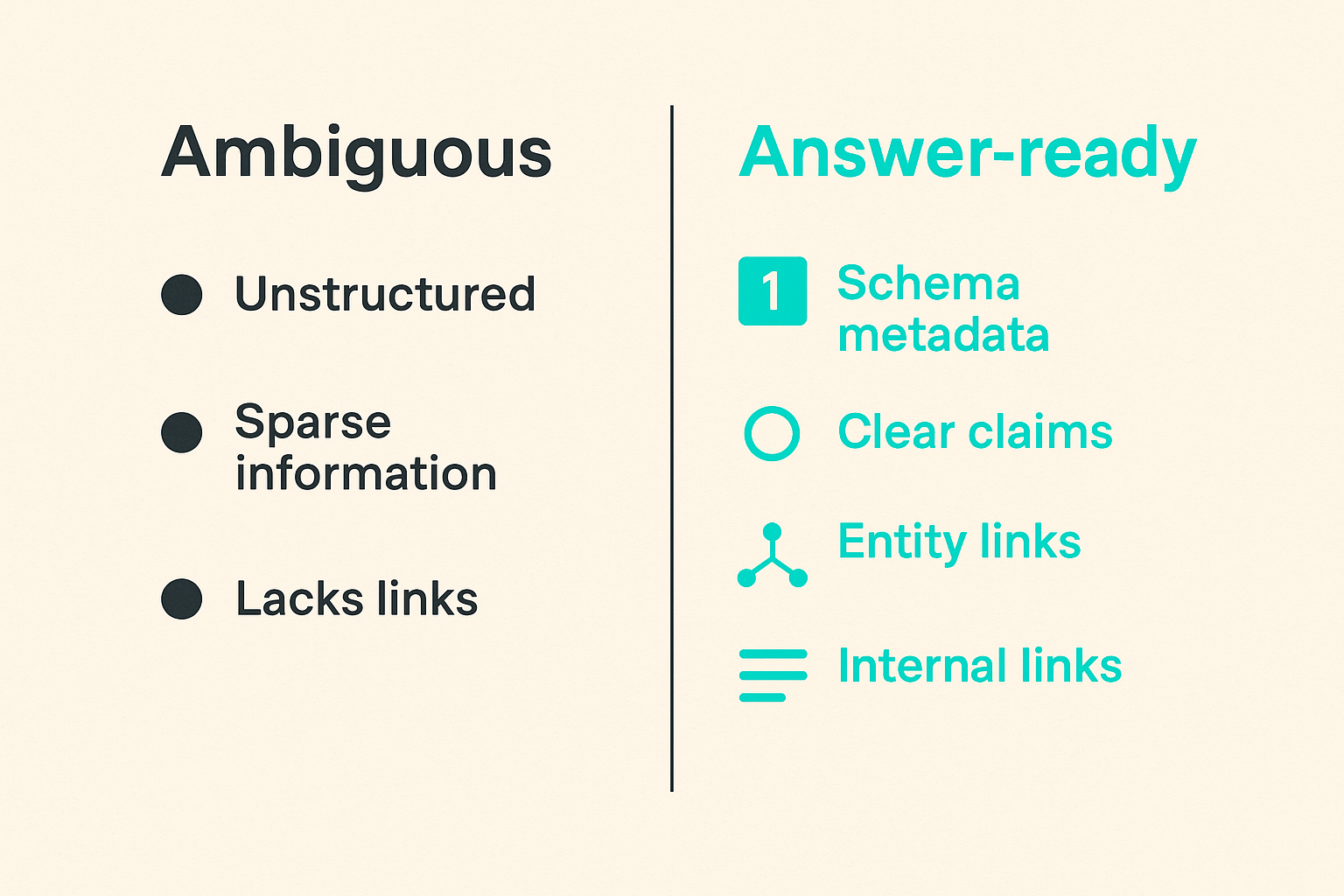
Use schema to reduce ambiguity
Schema markup does not guarantee citation. It helps machines understand what a page represents. That is still valuable because ambiguity is expensive for answer engines.
For AEO, schema should match visible content. If the page is an article, mark it as an Article. If it is a product, include product information that is actually present. If it is an FAQ, the visible questions and answers should match the markup. Misaligned schema can create more confusion than no schema.
Useful schema patterns often include:
- Organization for company identity.
- Product or SoftwareApplication for tools.
- Article or BlogPosting for editorial content.
- FAQPage where real FAQs exist.
- BreadcrumbList for site structure.
- Person for authors or experts.
Connect pages into an entity graph
One page rarely proves everything. Your site should connect related pages in a way that makes entity relationships obvious. A product page should link to docs, pricing, use cases, comparisons, and support material. Blog posts should link back to the canonical product or concept page when relevant.
Internal linking for AI answers is less about PageRank sculpting and more about context transfer. You are telling crawlers which page is the primary source and which pages support it.
A useful pattern:
- Concept page defines the category.
- Product page explains your implementation.
- Docs show technical details.
- Pricing page explains commercial terms.
- Case or example page shows proof.
When these pages contradict each other, the graph weakens. When they reinforce each other, the answer engine has a clearer source set.
Validate what crawlers can parse
Do not assume schema works because a plugin generated it. Validate the rendered page. Check whether the structured data appears in the final HTML, whether required fields are missing, whether duplicate schema blocks conflict, and whether the visible text supports the markup.
What breaks in practice is template drift. A developer updates a page layout, a CMS plugin changes output, or a content editor removes a visible FAQ while the schema remains. The page still looks fine to humans, but machine context is now wrong.
Related reading from our network: security teams see a similar visibility problem when AI-cited attack surface is not tied to ownership, as described in this piece on answer engine optimization threat hunting.
Measurement for ai answer systems
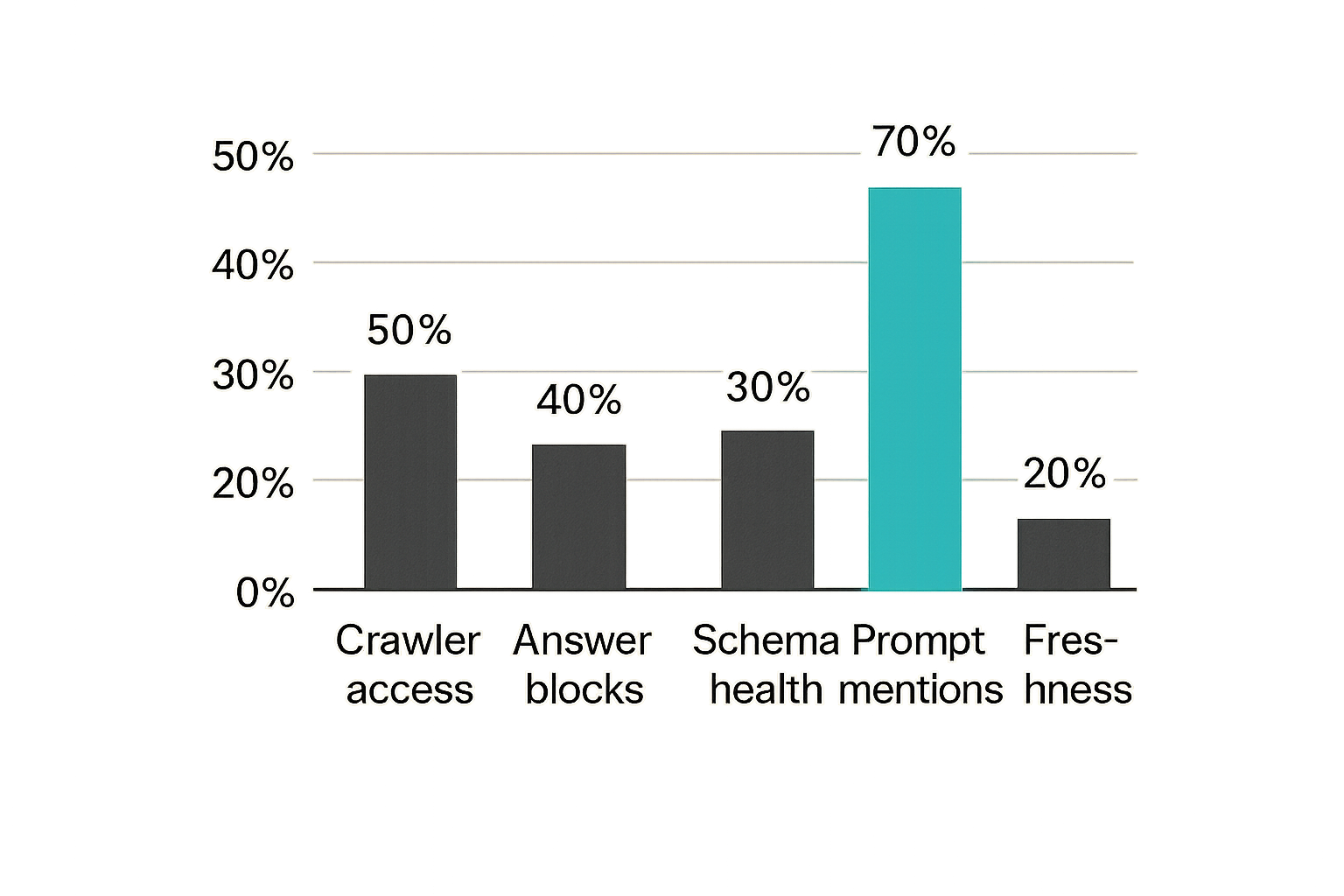
Track crawl access and extraction
You cannot manage AI answer visibility if you only look at rankings. You need measurement closer to the crawler and parser layer.
Start with these signals:
- Server log evidence of AI crawler visits.
- Status codes returned to known crawlers.
- Pages blocked by robots or middleware.
- Pages where main content is missing from rendered HTML.
- Schema errors or mismatches.
- Pages with weak or duplicated answer blocks.
This measurement will not be perfect. AI systems vary, and not all crawling behavior is transparent. But imperfect operational visibility is better than waiting for a traffic drop with no diagnosis path.
Test prompts like customer questions
Prompt testing is useful when it is disciplined. Do not ask only vanity questions like who is the best vendor. Build a prompt set from actual buyer, user, and support questions.
Examples:
- What tools help site owners audit AI crawler access?
- How do I check whether a page is ready for answer engines?
- What is the difference between AEO and SEO?
- How should I structure llms.txt for a marketing site?
- Which pages should be included in an AI crawler guidance file?
Run the same prompt set periodically across the AI answer surfaces your audience uses. Record whether your brand appears, whether competitors appear, which sources are cited, and whether the answer is accurate.
Build an answer visibility scorecard
A scorecard keeps the work from becoming anecdotal. It also gives non-technical stakeholders a way to understand progress.
A practical scorecard might include:
| AI crawler access pass rate | Shows whether pages can be fetched | Engineering |
| Extractable answer block coverage | Shows whether pages expose direct answers | Content |
| Schema validity | Shows machine-readable context health | SEO |
| Prompt mention rate | Shows market-level visibility | Growth |
| Citation accuracy | Shows whether answers describe you correctly | Brand |
| Freshness compliance | Shows whether claims are maintained | Content ops |
Do not overfit the first version. The goal is to create a shared operating picture.
What fails in production
The most common failures are boring. That is why they persist.
Teams ship a beautiful redesign that removes clear headings. They migrate docs and break internal links. They block unfamiliar bots with security middleware. They use schema that says one thing while the page says another. They publish thought leadership that never states the basic answer. They create five near-duplicate pages for the same question and no canonical source.
The mistake teams make is chasing AI answer visibility with more content before fixing the extraction path.
Common production failures include:
- Crawlable page, but important content rendered only after interaction.
- Strong article, but no clear author, date, or source context.
- Good product page, but no schema or inconsistent organization data.
- FAQ schema generated from hidden or outdated content.
- Robots rules copied from an old migration.
- llms.txt created once and never updated.
- Prompt testing done ad hoc with no baseline.
- No owner for answer accuracy after publication.
What works instead
What works is less dramatic and more operational. Make important pages easy to fetch. Make the answer easy to find. Make claims easy to verify. Make structure consistent. Measure the system.
A good AEO workflow has boring controls:
- Page briefs include the target question and answer block.
- Templates preserve semantic headings.
- Engineering reviews crawler access on major releases.
- Schema is validated against visible content.
- Content owners review high-value pages on a schedule.
- Prompt tests are logged, not casually discussed.
- Findings turn into tickets with owners.
Practical rule: If an AEO recommendation cannot become a ticket, checklist item, template change, or content brief requirement, it is probably not operational enough.
Ownership is the hidden dependency
AI answer visibility crosses teams. SEO may identify the opportunity. Content may write the page. Engineering may control rendering and bot access. Legal may approve claims. Brand may care about phrasing. Analytics may own measurement.
Without ownership, every issue becomes someone else's backlog.
Assign owners by layer:
| Crawl access | Engineering | Robots, server responses, bot rules, rendering |
| Answer content | Content or SEO | Direct answers, page structure, freshness |
| Entity consistency | Brand or product marketing | Names, descriptions, positioning |
| Schema | SEO or web team | Structured data accuracy and validation |
| Measurement | Growth or analytics | Prompt tests, scorecards, reporting |
That changes the conversation from should we do AEO to who owns which part of the system.
Implementation workflow for site teams
A 30 day rollout sequence
You do not need a six-month transformation to improve AI answer readiness. You need a controlled rollout.
- Pick 20 high-value questions. Use sales calls, support tickets, search queries, and product positioning as inputs.
- Map each question to one canonical page. If no page exists, mark it as a content gap.
- Crawl the URLs as a machine would. Check status codes, rendered content, headings, metadata, schema, and blocked assets.
- Add or rewrite answer blocks. Put the direct answer near the top and support it with examples or proof.
- Fix technical blockers. Address robots rules, JavaScript-only content, broken internal links, and server errors.
- Validate schema. Remove mismatches and add structured data where it reflects visible content.
- Create or update llms.txt. Link only to useful, stable resources.
- Run prompt tests. Record mentions, citations, omissions, and inaccuracies.
- Convert findings into tickets. Separate content fixes, template fixes, and infrastructure fixes.
- Review after release. Re-crawl, re-test prompts, and update the scorecard.
This sequence works because it avoids the giant audit trap. You learn from a manageable set of pages and then push patterns into templates.
Review cadence and QA checks
AEO work decays unless it is tied to existing publishing and release processes. Add checks where teams already work.
For content publishing:
- Does the page answer one primary question?
- Is the direct answer visible without interaction?
- Are claims specific and supported?
- Are dates and examples current?
- Does the page link to the right canonical sources?
For engineering releases:
- Did rendering change for important page types?
- Did bot protection rules change?
- Are crawlers receiving unexpected status codes?
- Did schema output change?
- Did navigation or internal links change?
For quarterly strategy:
- Which prompts mention us?
- Which competitors are cited instead?
- Which answer inaccuracies keep recurring?
- Which page types create the most crawler or extraction issues?
Handoff between SEO content and engineering
The handoff matters. Vague tickets like improve AI visibility do not get fixed. Engineers need observable failure conditions. Content teams need clear page-level requirements.
Bad ticket:
Make the pricing page better for AI.
Better ticket:
Pricing page main plan details are not present in initial HTML. Add server-rendered plan names, limits, and FAQ content. Validate that the rendered HTML contains the answer block and PricingPage-related schema matches visible text.
The better ticket names the page, the failure, the expected change, and the validation method.
Related reading from our network: payment and blockchain teams deal with similar machine-readable trust problems, and this article on answer engine optimization for blockchain shows how infrastructure details affect AI citation.
Where CrawlProof fits in your ai answer workflow
Audit before you rewrite
Most teams want to rewrite content first. Sometimes that is necessary. But if AI crawlers cannot access the page, if schema is broken, or if the page renders as an empty shell, rewriting the copy will not fix the system.
CrawlProof is built around the operational question: what can AI crawlers and answer engines actually find on this URL? The product looks at content, schema, robots rules, AI-bot access, and positioning so teams can separate writing problems from technical visibility problems. You can start from the main CrawlProof audit page when you need to see a URL the way AI crawlers do.
Use findings to prioritize fixes
A useful audit does not just say your AEO is weak. It should help prioritize.
If a page is blocked, fix access first. If content is accessible but vague, fix the answer block. If schema conflicts with visible content, fix structured data. If the page answers the wrong question, fix content strategy. If prompt tests cite a competitor, inspect what their cited page does more clearly.
This is the operating model:
| AI crawler blocked | Engineering | Review robots, WAF, CDN, rate limits |
| Main answer missing | Content | Add direct answer block |
| Schema mismatch | SEO or web | Align markup with visible content |
| Weak entity clarity | Brand or product marketing | Standardize names and descriptions |
| Stale claim | Content ops | Update or remove outdated statement |
Keep humans in the loop
AI answer optimization is not about writing for robots at the expense of people. It is about making true, useful information easier to verify. Humans still decide positioning, claims, evidence, and priorities.
The practical role of tooling is to expose what humans miss: blocked crawlers, invisible content, broken schema, inconsistent signals, and weak answer candidates. The judgment still belongs to the team.
Closing: treat ai answer as infrastructure
The practical takeaway
AI answer visibility is not a one-time content hack. It is a site reliability problem for discoverability. Your pages need to be reachable, parseable, structured, current, and worth citing.
The teams that handle this well will not be the ones publishing the most AI-themed blog posts. They will be the teams that build answer readiness into their templates, workflows, release checks, and measurement. They will know which pages answer which questions. They will know what crawlers can fetch. They will know where claims live and who owns them.
That is the shift. Treat ai answer performance as infrastructure, not decoration.
Try crawlproof.com
CrawlProof helps site owners and marketers understand how AI answer engines and LLM crawlers discover, parse, and cite their content. Try crawlproof.com.