Most teams are producing AI articles faster than their sites can explain them.
The publishing calendar looks busy. The CMS is full. The content brief mentions entities, FAQs, schema, and maybe a prompt workflow. But when an answer engine summarizes the market, your page is missing, misquoted, or treated like generic background noise.
Teams think the problem is writing more AI articles. The real problem is building a publishing system that answer engines can crawl, parse, evaluate, and cite without guessing.
That changes the conversation. This is not just a content quality issue. It is an architecture problem across page structure, technical access, source clarity, internal linking, schema, update cadence, and operational ownership.
Table of contents
Why AI articles are an architecture problem

The phrase AI articles gets used in two very different ways. Some people mean articles generated by AI tools. Others mean articles designed to be found, understood, and cited by AI answer engines. For website owners, the second meaning matters more.
If your business depends on organic discovery, the practical question is no longer only whether a human searcher clicks a blue link. It is whether an AI system can identify your page as a useful source when answering a question.
The old publishing model is not enough
The old model was simple enough to operationalize: choose a keyword, publish a page, add internal links, wait for rankings, update when traffic drops. That model still matters, but it is incomplete.
Answer engines do not experience your content like a visitor scrolling through a designed page. They may interact with cached HTML, extracted text, structured data, summaries, snippets, crawl permissions, and model-side retrieval pipelines. They may care less about your hero section and more about whether the page contains a clear answer, recognizable entities, current information, and source signals.
The mistake teams make is treating AI articles as a writing format instead of a retrieval format. A 2,000-word article can still be unusable if the answer is buried, the schema is vague, the page renders content only after scripts execute, or the canonical version conflicts with another page.
The new reader is partly a crawler
Your article now has multiple readers:
- A human buyer comparing options.
- A search crawler indexing the page.
- An LLM crawler evaluating whether the content can be used for retrieval or training-style ingestion.
- An answer engine looking for concise, attributable statements.
- Your own team trying to maintain the page six months later.
A useful way to think about it is this: an AI article is not a blog post with an AI label. It is a content object with a job. The job is to answer a known set of questions in a way that both people and machines can verify.
Practical rule: If a human editor cannot point to the exact claim, source, author context, update date, and intended query, an answer engine probably cannot infer them reliably either.
Related reading from our network: teams designing private systems face a similar visibility-versus-control problem in end to end encryption messaging architecture, where what matters is not the interface but the trust model underneath it.
What makes an AI article citeable
Citeable content is not the same as long content. It is not the same as optimized content. It is content that can be safely used as an answer source.
That sounds abstract, but in production it comes down to a few repeatable properties: clarity, specificity, extractability, freshness, and trust.
Answer shape beats prose volume
Most weak AI articles fail because they do not present answers in a stable shape. They wander through background, examples, filler, and repeated definitions without making the core answer obvious.
For answer engines, shape matters. A useful page should contain:
- A direct answer near the top.
- Clear H2 and H3 headings mapped to real questions.
- Short explanatory paragraphs after each heading.
- Lists or tables where comparison is the actual task.
- Distinct sections for process, edge cases, and limitations.
- A visible update date when freshness matters.
This does not mean every article should be a FAQ page. It means the page should expose its reasoning structure. If the article is about choosing invoicing software, the headings should reveal the workflow: billing model, approval flow, integrations, reconciliation, controls, and reporting. Related reading from our network: that same operator-first approach shows up in this guide to invoicing software workflow selection.
Evidence and entities need clean extraction
Answer engines need to understand what the page is about and why it should be trusted. That means entities should be explicit.
For example, a page about AI articles should make clear whether it discusses:
- AI-generated writing.
- Article optimization for answer engines.
- LLM crawler accessibility.
- Schema markup for content pages.
- Content governance and editorial workflows.
If you mix those ideas without defining the relationship, the page becomes semantically mushy. It may still rank for a broad keyword, but it becomes harder to cite for a precise answer.
Use entity-rich wording naturally. Name the standards, crawlers, formats, and concepts you actually discuss: robots.txt, llms.txt, structured data, Article schema, FAQPage schema where appropriate, canonical URLs, GPTBot, ClaudeBot, PerplexityBot, Google-Extended, server-side rendering, and author pages.
Practical rule: Do not make the model guess what your page is about. State the topic, scope, audience, date context, and limitations in plain HTML.
The AI article stack
An AI article is the visible output of a stack. If the stack is weak, the article becomes hard to discover or cite even when the writing is good.
The content layer
The content layer answers: what does this page say, who is it for, and what decision does it support?
This layer includes:
- Topic selection.
- Search and answer intent mapping.
- Editorial point of view.
- Examples and edge cases.
- Author and reviewer context.
- Internal links to canonical resources.
- Update schedule.
The content layer is where many teams over-focus. They improve intros, add more words, and rewrite titles. Sometimes that helps. But if the technical layer blocks extraction or the governance layer creates duplicate answers, better prose will not solve the system problem.
The technical access layer
The technical access layer answers: can crawlers and answer engines actually retrieve and interpret the page?
This includes:
- HTTP status codes.
- Canonical tags.
- Robots directives.
- AI crawler access rules.
- Rendered versus raw HTML content.
- Structured data validity.
- Internal link discoverability.
- Sitemap inclusion.
- Page speed and stability.
What breaks in practice is not always obvious. A page may look fine in a browser but serve thin HTML to crawlers. A CMS block may render the body text client-side. A consent banner may obscure content. A robots rule may allow Googlebot but block other AI crawlers. A canonical tag may point to a shorter category page.
The governance layer
The governance layer answers: who owns this article after it ships?
This is where mature teams separate themselves from content farms. They define who can publish, who reviews technical correctness, when claims expire, what happens when product positioning changes, and how content conflicts get resolved.
Governance sounds boring until two pages answer the same question differently. Then it becomes the difference between being cited and being ignored.
A practical governance file for AI articles can be simple:
- Page owner.
- Target answer intents.
- Primary entity list.
- Last reviewed date.
- Next review date.
- Source dependencies.
- Schema type used.
- Internal canonical page.
- Known exclusions or caveats.
Build AI articles around questions not keywords
The keyword still matters. But an answer engine usually responds to a question, comparison, or task. If your article is only built around a keyword, it may not match how the answer is assembled.
Map answer intents before drafting
Before writing, list the questions your page must answer. Do not start with twenty keywords. Start with the decisions your audience is trying to make.
For AI articles, the intent map might look like this:
- What are AI articles?
- Are AI articles content written by AI or content optimized for AI search?
- How should a site structure articles for answer engines?
- What schema helps AI crawlers understand content?
- How do llms.txt and robots.txt affect discovery?
- How should teams measure AI answer visibility?
- What mistakes cause AI-generated pages to be ignored?
Each question should map to a section, not just a sentence hidden in the body. If the question is important enough to target, it is important enough to make visible.
For a broader framing of how this differs from traditional SEO, see our explanation of what AEO is and why it is not just SEO.
Separate canonical answers from supporting posts
Many sites accidentally create answer conflicts. One blog post defines the concept. Another compares tools. A third has a glossary snippet. A fourth has an old definition from two years ago. All of them rank internally for the same phrase.
That is a problem for answer engines. If your own site gives multiple inconsistent answers, why should a retrieval system trust the latest one?
The fix is not to delete everything. The fix is to assign roles:
- One canonical article for the core answer.
- Supporting articles for use cases and comparisons.
- Glossary pages for short definitions.
- Product pages for commercial fit.
- Documentation pages for implementation details.
Then link between them intentionally. The canonical page should be the clearest source. Supporting pages should reinforce it, not contradict it.
Practical rule: Every important concept should have one canonical answer page and many supporting pages, not many competing answer pages.
Structure pages for AI crawlers and answer engines
Content teams often ask what to write. Developers often ask what to expose. The answer is both. AI articles need a page structure that preserves meaning across browsers, crawlers, and extraction systems.
Start with boring HTML. It works.
A crawler-friendly article page should expose the main content in the initial HTML whenever possible. The body text should not depend entirely on JavaScript hydration. Headings should follow a logical hierarchy. Navigation should not overwhelm the main content. Author, date, and organization details should be available as text, not only images.
A simple pattern works well:
<article>
  <header>
    <p>Updated June 10, 2026</p>
    <p>By CrawlProof Editorial</p>
  </header>
  <section>
    <h2>What the page answers</h2>
    <p>Direct answer in plain language.</p>
  </section>
</article>
Do not over-engineer this. If your main claim exists only inside a decorative card rendered by a frontend component after several scripts load, you have made a crawler problem for no editorial benefit.
Schema that clarifies not decorates
Schema markup should clarify what already exists on the page. It should not be used as a costume for thin content.
For AI articles, common schema considerations include:
- Article or BlogPosting for editorial content.
- Organization or Person for authorship context.
- FAQPage only when the page genuinely contains visible questions and answers.
- BreadcrumbList for site hierarchy.
- datePublished and dateModified when available.
- sameAs links for recognized entities where appropriate.
The mistake teams make is adding schema after the article is already structurally unclear. Schema cannot rescue a page that does not answer the question. It can help machines interpret a page that already has a clear purpose.
A minimal Article schema might include:
{
  "@context": "https://schema.org",
  "@type": "Article",
  "headline": "AI Articles in 2026",
  "dateModified": "2026-06-10",
  "author": {
    "@type": "Organization",
    "name": "CrawlProof"
  }
}
Crawler rules and llms txt
Robots rules are now part of content strategy. If you block important AI crawlers, you may reduce unwanted ingestion, but you may also reduce answer-engine visibility. If you allow everything without review, you may expose content in ways your legal or product team did not intend.
The practical question is not whether all AI crawlers are good or bad. The question is which crawlers you want to access which content, and whether your rules match that intent.
Emerging files like llms.txt are also becoming part of the conversation. They can help summarize important resources for AI systems, but they should not be treated as magic. They are hints, not a replacement for crawlable pages and coherent structure. For implementation detail, we have a practical guide to llms.txt and skill.md.
Workflow for publishing AI articles
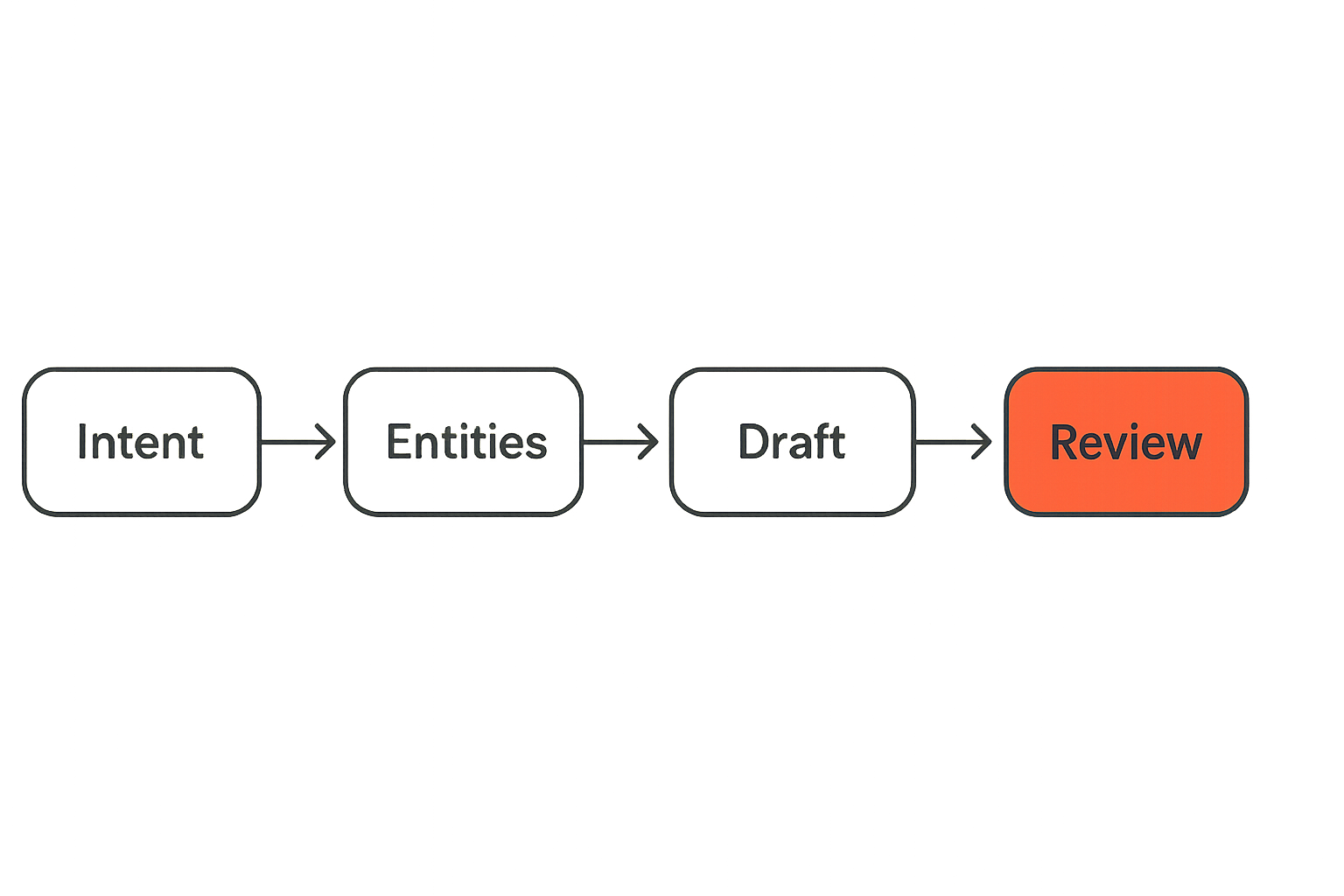
A good AI article workflow prevents the two most common problems: publishing content that is not technically discoverable, and shipping technically valid pages that do not answer anything useful.
Implementation sequence
Use a sequence that forces editorial, technical, and measurement work into the same process.
Define the answer intent.
- Write the primary question in one sentence.
- List secondary questions the page must answer.
- Decide whether the page is canonical or supporting.
Map entities and terms.
- List people, products, standards, crawlers, formats, and concepts.
- Decide which entities need definitions.
- Remove ambiguous wording where possible.
Draft the answer structure.
- Create H2s and H3s before writing paragraphs.
- Put the direct answer near the top.
- Use tables for comparisons and numbered lists for workflows.
Add source and trust signals.
- Include author or organization context.
- Add update dates.
- Link to relevant internal canonical pages.
- Clarify limitations and assumptions.
Validate technical access.
- Check status code, canonical, indexability, robots rules, and rendered HTML.
- Confirm the main article body appears in crawlable markup.
- Validate structured data.
Publish with monitoring.
- Submit or update sitemap entries.
- Watch logs where available.
- Track impressions, referrals, answer mentions, and crawler access patterns.
Review on a schedule.
- Re-check claims and screenshots.
- Update schema dates when the content actually changes.
- Resolve conflicts with newer pages.
This looks heavier than a normal blog workflow, but it prevents rework. It is cheaper to catch a bad canonical tag before publishing than to wonder three months later why the article is not being cited.
Editorial checklist
Before publishing, ask these questions:
- Can a reader understand the main answer in the first few paragraphs?
- Does each H2 answer a distinct question or decision point?
- Are examples specific enough to be useful?
- Are unsupported claims removed or softened?
- Does the page say what changed since the last update?
- Are internal links pointing to the right canonical pages?
- Is the article differentiated from existing content on the site?
- Would a crawler see the same core content as a human reader?
Practical rule: Do not publish an AI article until the editorial reviewer and the technical reviewer agree on what the page is supposed to be cited for.
Measurement for AI articles in 2026
Measuring AI articles is messy. Anyone promising perfect attribution across answer engines is overselling it. But messy does not mean unmeasurable.
What you can measure
You can measure several useful signals:
- Organic search impressions and clicks.
- Referral traffic from AI answer products when passed.
- Server log hits from known AI crawler user agents.
- Indexability and crawlability status.
- Structured data validity.
- Brand mentions in answer interfaces, where manually testable.
- Conversion paths that start from informational pages.
- Content freshness and review completion.
None of these alone proves that an AI article is winning. Together, they show whether the page is accessible, visible, and useful.
What you should not pretend to measure
Do not pretend you have a clean ranking report for every AI answer engine. The ecosystem changes too quickly, outputs vary by prompt, and personalization or retrieval context can alter responses.
Avoid dashboards that create false certainty. A weekly screenshot of one prompt can be useful as a qualitative check. It is not a universal visibility metric.
The better approach is to measure the inputs you control and the outputs you can observe. Did the crawler access the page? Is the content extractable? Is the answer clear? Are answer products sending traffic? Are sales or support conversations referencing the article? Are branded searches changing after publication?
A practical dashboard
A useful dashboard for AI articles does not need fifty widgets. It needs enough signal to drive action.
Track these fields per article:
| Crawlable status | Confirms bots can reach the page | Developer or SEO |
| Structured data status | Confirms machine-readable context | SEO or developer |
| Last reviewed date | Prevents stale claims | Content owner |
| Target answer intent | Keeps the page focused | Content strategist |
| Internal canonical link | Reduces duplicate answers | SEO |
| Known AI crawler hits | Shows access patterns | Developer |
| Search impressions | Shows traditional discovery | SEO |
| Assisted conversions | Connects article to business value | Marketing ops |
The goal is not to worship the dashboard. The goal is to make maintenance visible.
Related reading from our network: media and streaming teams face a different version of the same workflow problem, where the UI is only one piece of a larger system; this fubo streaming architecture guide is a useful adjacent example.
Common failure modes
Most AI article programs do not fail because one article is bad. They fail because the system rewards volume while hiding technical debt.
Thin AI generated pages
The obvious failure mode is mass-producing generic pages. These pages often have fluent paragraphs, weak claims, no examples, and no operational point of view.
They usually fail in recognizable ways:
- They define the topic without helping the reader act.
- They repeat common web summaries.
- They avoid tradeoffs.
- They contain no original examples or workflow detail.
- They have no clear owner or update cycle.
- They target overlapping keywords with near-duplicate pages.
AI-assisted drafting is not the issue by itself. The issue is publishing content without judgment. If the article does not contain expertise, constraints, or a decision framework, it is unlikely to become a preferred source.
Blocked or inconsistent access
Another common failure is technical inconsistency. The marketing team wants visibility, the legal team wants caution, the developer adds broad crawler blocks, and nobody reconciles the policy.
This creates strange outcomes. Your article may be indexable for traditional search but restricted for certain AI crawlers. Or your llms.txt file may point to URLs blocked elsewhere. Or your sitemap may list pages that canonicalize away from themselves.
The fix is ownership. Someone needs to maintain the crawler access policy as a business decision, not a random server configuration.
Beautiful pages with invisible content
Many modern sites make content extraction harder than necessary. The page looks polished, but the actual article is split across JavaScript components, accordion states, tabs, cards, and dynamic fragments.
What breaks in practice is simple: the crawler does not get a clean article. It gets navigation, fragments, boilerplate, and maybe a partial answer.
If a section is important for citation, make it visible in the document structure. Avoid hiding core answers behind interactions. Use progressive enhancement instead of making the article dependent on client-side rendering.
What works and what fails
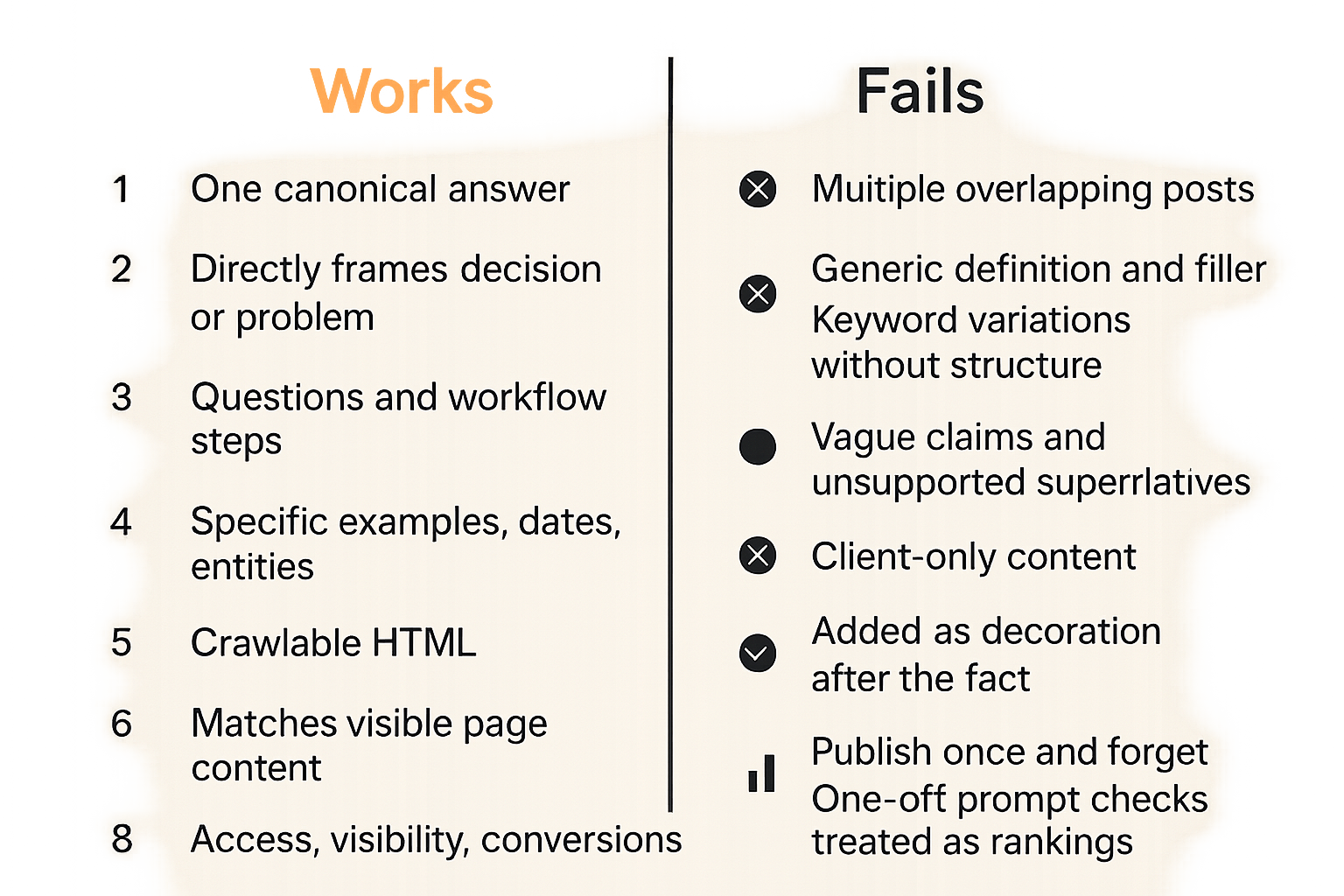
There is no magic format for AI articles. But there are clear differences between content that can be cited and content that just occupies a URL.
Comparison table
| Topic strategy | One canonical answer with supporting pages | Multiple overlapping posts with conflicting claims |
| Intro | Directly frames the decision or problem | Generic definition and filler |
| Headings | Questions and workflow steps | Keyword variations without structure |
| Evidence | Specific examples, dates, constraints, named entities | Vague claims and unsupported superlatives |
| Technical access | Crawlable HTML, valid canonicals, clear robots rules | Client-only content, blocked bots, broken canonicals |
| Schema | Matches visible page content | Added as decoration after the fact |
| Updates | Owned review cadence | Publish once and forget |
| Measurement | Access, visibility, mentions, conversions | One-off prompt checks treated as rankings |
The pattern is consistent. Good AI articles reduce ambiguity. Bad ones increase it.
Operational rules
A few rules make the program easier to run:
- Assign one owner per canonical topic.
- Keep a registry of canonical answer pages.
- Review crawler rules before major content launches.
- Use plain HTML for important answers.
- Add schema only after the page structure is clear.
- Track review dates in the CMS.
- Remove or merge pages that compete with the canonical answer.
- Keep examples current enough that a citation will not embarrass you.
This is not glamorous work. It is the publishing equivalent of clean infrastructure. The teams that win will not be the ones with the most AI-generated drafts. They will be the ones whose sites make the right answer easiest to retrieve.
Where CrawlProof fits
CrawlProof is built for the gap between what your team thinks is visible and what AI crawlers can actually find.
For site owners, SEOs, content strategists, and developers, that gap is where most AI article problems live. The page may look good in the CMS. It may pass a quick human review. But answer engines do not see your CMS preview. They see crawl rules, HTML, schema, links, and extractable text.
Audit before rewriting
The expensive mistake is rewriting content before checking whether the page is accessible and understandable. If a page is blocked, thin in raw HTML, missing schema, or canonicalized incorrectly, a rewrite may not fix the real problem.
An AEO audit should answer practical questions:
- Can major AI crawlers access the URL?
- What content is visible to crawlers?
- Is the main answer easy to extract?
- Are schema and metadata present and consistent?
- Are robots rules aligned with your visibility goals?
- Does the page compete with other pages on the same site?
CrawlProof helps site owners see these issues without turning every content review into a developer investigation. You can run an audit from CrawlProof and compare what the page looks like to a human with what crawlers are likely to find.
Turn findings into tickets
The useful output is not a vague score. The useful output is a prioritized to-do list your team can act on.
For example:
- Content team: move the direct answer higher on the page.
- SEO: fix conflicting canonical links.
- Developer: expose article body in server-rendered HTML.
- Legal or leadership: decide which AI crawlers should be allowed.
- Content strategist: merge duplicate articles into one canonical page.
That changes the conversation. Instead of arguing whether AI articles are good or bad, the team can ask whether each article is discoverable, extractable, differentiated, and maintained.
AI articles will keep evolving in 2026, but the operational foundation is already clear: write useful answers, expose them cleanly, control crawler access intentionally, and measure the parts of the system you can actually observe.
Try crawlproof.com
CrawlProof helps site owners and marketers understand how AI answer engines and LLM crawlers discover and cite their content. Try crawlproof.com.