Your pages may rank, load fast, and pass a normal SEO audit — then still disappear when a user asks ChatGPT, Perplexity, Gemini, Claude, or another answer engine for a recommendation.
That is the pain point behind ai optimization. Teams think the problem is that they need to “write for AI.” The real problem is that their site is not structured, accessible, or explicit enough for AI systems to retrieve, understand, compare, and cite it.
That changes the conversation. This is not a debate about replacing SEO. It is an architecture and workflow problem: crawler access, content extraction, schema, entity clarity, page intent, source trust, and feedback loops.
The practical question is simple: when an AI answer engine looks at your site, what can it actually see, and what can it confidently use?
Table of contents
Why AI optimization is an architecture problem
Teams usually start ai optimization in the wrong place. They ask writers to add more FAQs, ask developers to add schema somewhere in the template, or ask SEO teams to monitor a few chatbot answers manually.
That is not wrong work, but it is incomplete work. Answer engines do not evaluate a page the same way a human reader does. They retrieve, parse, chunk, summarize, compare, and sometimes cite. If any step breaks, the page may be present on the open web but functionally invisible to the answer system.
The old search workflow does not cover answer engines
Classic SEO assumes a fairly stable loop: crawl, index, rank, click. You optimize the page, earn visibility, and the user lands on your site.
Answer engines compress that loop. A user asks a question. The engine may retrieve documents, synthesize an answer, cite a few sources, and satisfy the user without a click. Your job is no longer only to win the blue link. Your job is to become a source the system can safely use.
That requires a different diagnostic sequence:
- Can the relevant AI crawler access the page?
- Can it extract the main content without rendering failure or template noise?
- Can it identify what the page is about and who it is for?
- Can it separate facts, claims, pricing, dates, opinions, and instructions?
- Can it cite the page as evidence for a specific answer?
If you cannot answer those questions, you are guessing.
The citation layer changes your content requirements
In search, a title tag can sell the click. In answer engines, the content itself has to survive summarization. Vague positioning, clever headlines, and long intros often get stripped away.
The content that performs tends to be specific: it names the category, explains the use case, states constraints, includes evidence, and gives the model enough context to decide when the source is relevant.
A useful way to think about it is this: your page is no longer only a destination. It is also a candidate input into another interface.
The operator view: inspect the pipeline
The mistake teams make is treating ai optimization like a content style guide. Operators should treat it like a pipeline:
- access control through robots and bot policies;
- server responses, redirects, canonicals, and rendering;
- structured data and metadata;
- visible page content and internal links;
- retrieval fit for likely prompts;
- validation against real answer behavior.
Practical rule: Do not start an AI optimization project by rewriting content. Start by proving that AI crawlers can access and extract the content you already have.
Related reading from our network: teams dealing with media delivery face a similar pipeline problem in Django streaming workflow architecture, where the UI is only one small part of what has to work in production.
AI optimization is not SEO with new labels
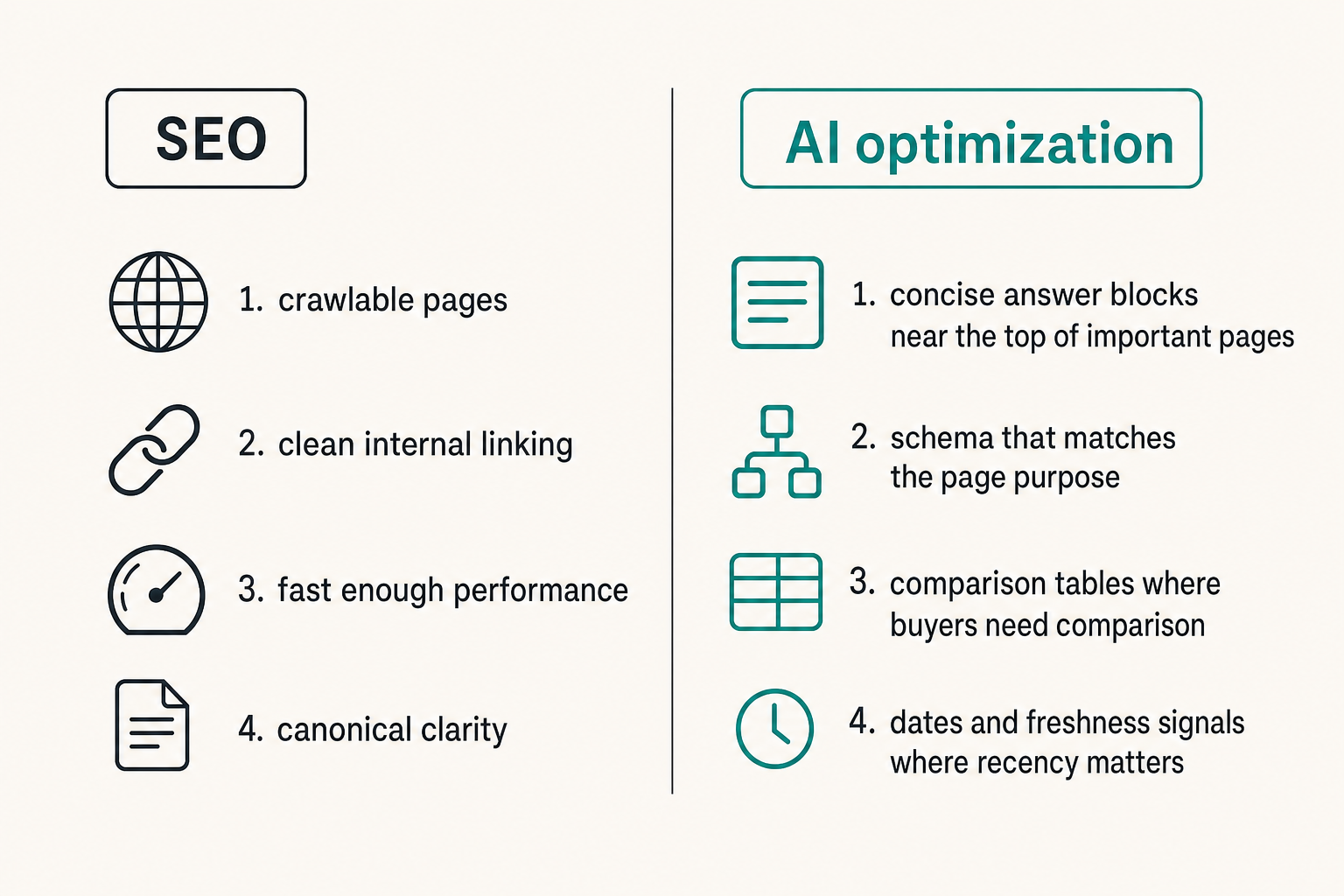
AI optimization overlaps with SEO, but it is not the same checklist with a different acronym. SEO gets your pages discovered and understood by search engines. AI optimization asks whether answer engines can use those pages as reliable source material.
If you want the broader distinction, our earlier primer on what AEO is and why it is not just SEO is a useful baseline. Here, the focus is the operating workflow.
Where SEO still matters
Most of the fundamentals still matter:
- crawlable pages;
- clean internal linking;
- fast enough performance;
- canonical clarity;
- descriptive titles and headings;
- authoritative content;
- topical coverage;
- useful backlinks and brand mentions.
AI systems are not magic. Many still rely on web indexes, search APIs, retrieval systems, and crawled corpora. If your site is a mess for normal crawlers, it will usually be a mess for AI systems too.
Where AI optimization adds new work
The new work is mostly about explicitness and machine usability. You need to make sure the page can answer a question without requiring the model to infer too much.
That means adding:
- concise answer blocks near the top of important pages;
- schema that matches the page purpose;
- comparison tables where buyers need comparison;
- dates and freshness signals where recency matters;
- author, organization, and product context;
- llms.txt or similar guidance files where appropriate;
- fewer hidden dependencies on client-side rendering.
This is not about stuffing “AI keywords.” It is about reducing ambiguity.
What fails when teams only rewrite copy
What breaks in practice is that copy changes do not fix access problems. A beautifully rewritten page can still be blocked by robots.txt, hidden behind JavaScript, duplicated across templates, or missing the entity signals an answer engine needs.
The common failure pattern looks like this:
- Marketing publishes “answer-friendly” content.
- Engineering does not change templates or structured data.
- Robots rules still block some AI crawlers.
- The content is present but poorly extractable.
- The team checks a chatbot manually and sees inconsistent results.
- Nobody knows whether the issue is access, content, retrieval, or trust.
Practical rule: If you cannot separate crawler access, extraction, content quality, and answer inclusion, you cannot debug AI visibility.
Map how AI crawlers reach your content
The first operational layer is crawler access. This is where many teams discover they have been making policy decisions accidentally.
Inventory crawler access before editing pages
Start with an inventory of crawler behavior and policy. At minimum, check:
- robots.txt rules;
- meta robots tags;
- x-robots-tag headers;
- CDN or WAF bot controls;
- login walls and consent layers;
- status codes for key URLs;
- canonical targets;
- sitemap coverage;
- whether AI-specific bots are allowed, blocked, or rate-limited.
Do not assume Googlebot access means GPTBot, ClaudeBot, PerplexityBot, or other AI crawlers have the same path. Bot policies are increasingly fragmented, and many teams inherit rules from old SEO, legal, or security decisions.
Robots rules need intent, not guesswork
Robots rules are not just technical configuration. They are a business decision about distribution. Some site owners want broad AI discovery. Others want selective access. Some want to block model training but allow search snippets or answer citations where supported.
Your policy should be intentional and documented. A simple internal note is often enough:
# Example policy note, not universal advice
# Allow major search crawlers for indexing.
# Allow selected AI answer crawlers for citation discovery.
# Block unknown aggressive bots at the WAF layer.
# Review quarterly as bot names and policies change.
The exact policy depends on your risk tolerance, content type, and business model. The important part is avoiding accidental invisibility.
JavaScript and rendering can hide the answer
Many modern sites ship the important content after hydration, fetch it from an API, or wrap it in interactive components. Human users see the page. Some crawlers may not.
Test a few key pages without assuming full browser rendering:
- view raw HTML;
- fetch with a simple user agent;
- compare server-rendered content to visible content;
- inspect structured data in the initial response;
- confirm that headings, body copy, pricing, product names, and FAQs exist before client-side scripts run.
If the answer-critical content only appears after JavaScript execution, treat that as a risk. Not every retrieval path will execute your app like a browser.
Make pages answer-ready without making them thin
AI optimization does not mean publishing short, robotic pages. It means making the answer easy to find while preserving depth.
Lead with the answer, then prove it
Many content teams bury the actual answer under brand setup, disclaimers, or keyword-heavy introductions. Answer engines reward clarity because retrieval systems need fast relevance signals.
A better structure is:
- direct answer or thesis;
- who it applies to;
- important caveats;
- supporting explanation;
- examples, tables, or implementation steps;
- proof points and source context.
For example, a product page should not only say “modern platform for growing teams.” It should state the category, the audience, the use case, and the differentiator in plain language.
Practical rule: If a reader cannot identify the page’s main claim in the first screen, an answer engine may not extract it cleanly either.
Expose entities, use cases, and boundaries
Answer engines need to understand what the page is about and when it should be used. That requires entity clarity.
For a software company, make these explicit:
- company name;
- product name;
- product category;
- target users;
- supported use cases;
- unsupported use cases;
- integrations;
- pricing model if public;
- geography or compliance limits if relevant.
Boundaries matter. “Best for small Shopify merchants” is more useful than “built for everyone.” “Does not handle custody” is more useful than leaving the model to guess.
Extraction-friendly content uses consistent structure. That does not mean bland content. It means predictable content.
Use:
- descriptive H2s and H3s;
- short answer blocks;
- tables for comparisons;
- lists for requirements and steps;
- captions or alt text for meaningful images;
- clear definitions where needed;
- updated dates where recency matters.
Avoid making critical claims only in images, carousels, accordions that are not rendered server-side, or video transcripts that are not published as text.
Related reading from our network: infrastructure teams evaluating decentralized compute run into the same need for explicit workflow boundaries in an Akash Network alternative workflow guide, especially when retries, validation, and ownership matter.
Schema, metadata, and llms.txt will not save weak content. They help crawlers and answer systems route, interpret, and prioritize content that is already useful.
Schema markup should disambiguate the page
Schema should describe what the page actually is. Do not add every schema type you can find. Add the types that reduce confusion.
Common useful patterns include:
Organization for the company entity;Product or SoftwareApplication for product pages;Article or BlogPosting for editorial content;FAQPage only when there are real questions and answers visible on the page;BreadcrumbList to clarify site structure;Person for author pages or expert-reviewed content.
Keep schema consistent with visible content. If the structured data says one thing and the page says another, you are creating ambiguity, not authority.
llms.txt is a navigation aid, not a ranking spell
llms.txt is an emerging convention for helping AI systems find important content and understand how to use a site. It is not a guaranteed ranking factor, and anyone selling it as a magic file is overreaching.
A practical llms.txt file should be boring:
# llms.txt example structure
# Site: ExampleCo
# Purpose: Documentation and product information for ExampleCo analytics software

## Key pages
- Product overview: https://example.com/product
- Pricing: https://example.com/pricing
- Documentation: https://example.com/docs
- Security: https://example.com/security

## Preferred summaries
ExampleCo provides analytics software for B2B SaaS teams tracking product usage and account health.
The point is routing. You are telling machines where the canonical explanations live. If you want a deeper breakdown, our guide to llms.txt and skill.md covers what to include and what to avoid.
Metadata should match the on-page claim
Title tags, descriptions, Open Graph fields, canonical URLs, and headings should align. Misalignment creates weak signals.
A common bad pattern:
- title tag targets “AI marketing automation software”;
- H1 says “Grow faster with intelligent workflows”;
- schema says
Organization only; - visible copy never explains the category;
- metadata describes features that are not on the page.
A stronger pattern:
- title names the category and product;
- H1 repeats the product’s role in plain language;
- schema identifies the software application;
- body copy explains target users and use cases;
- metadata summarizes the same claim without exaggeration.
Build the AI optimization workflow
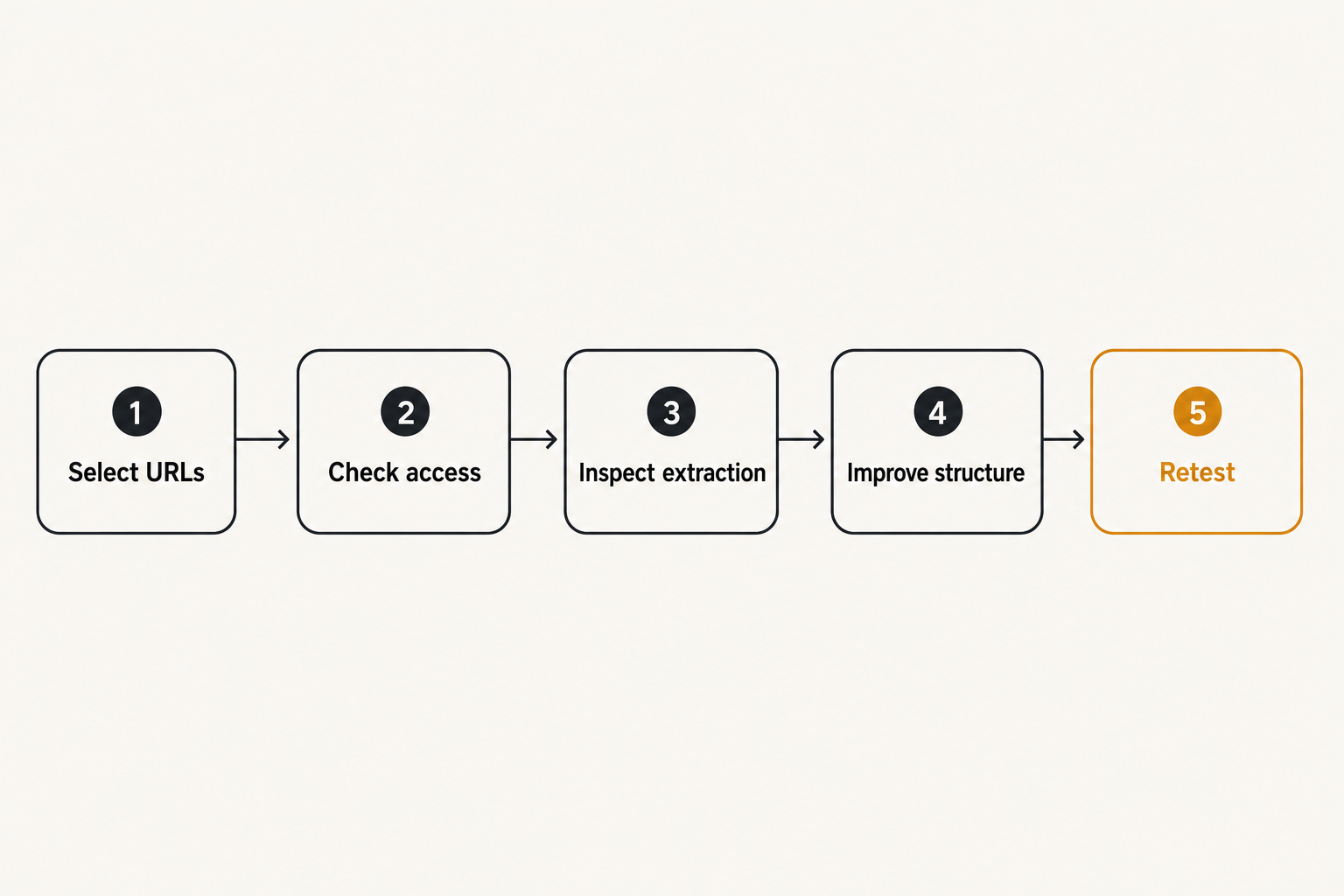
AI optimization becomes manageable when you turn it into a repeatable workflow. The mistake teams make is running one-off audits, making a few edits, and then waiting for answer engines to behave differently.
Start with crawlability, then content structure
Use a sequence that prevents wasted work:
- Select important URLs. Start with homepage, product pages, pricing, comparison pages, documentation, high-value blog posts, and category pages.
- Check access. Confirm status codes, robots rules, bot policies, canonical tags, and server-rendered content.
- Inspect extraction. Review what a crawler can read without relying on a full browser session.
- Validate structured data. Confirm schema is present, valid, and aligned with visible content.
- Rewrite for answer clarity. Add direct answers, use cases, constraints, and tables where helpful.
- Add routing files. Maintain sitemap quality and consider llms.txt for important canonical resources.
- Retest. Verify that the machine-readable version improved, not just the human page.
This order matters. Editing content before validating access is like optimizing a checkout form that cannot submit.
Before rolling a new pattern across hundreds of pages, test it on a small set. Compare before and after:
- raw HTML content;
- rendered content;
- schema output;
- heading hierarchy;
- answer block clarity;
- page summary generated from extracted text;
- likely prompts the page should answer.
If the extracted text does not contain the answer, no amount of visual polish helps.
Assign ownership across SEO, content, and engineering
AI optimization sits between teams. That is why it often stalls.
A workable ownership model:
- SEO owns query and prompt mapping, internal linking, metadata, and performance review.
- Content owns page structure, answer clarity, examples, and editorial quality.
- Engineering owns rendering, templates, schema implementation, robots rules, redirects, and monitoring.
- Legal or leadership owns policy decisions about AI crawler access and reuse.
Do not let “AI visibility” become an orphan metric. Give each layer a named owner.
Measure what answer engines can use
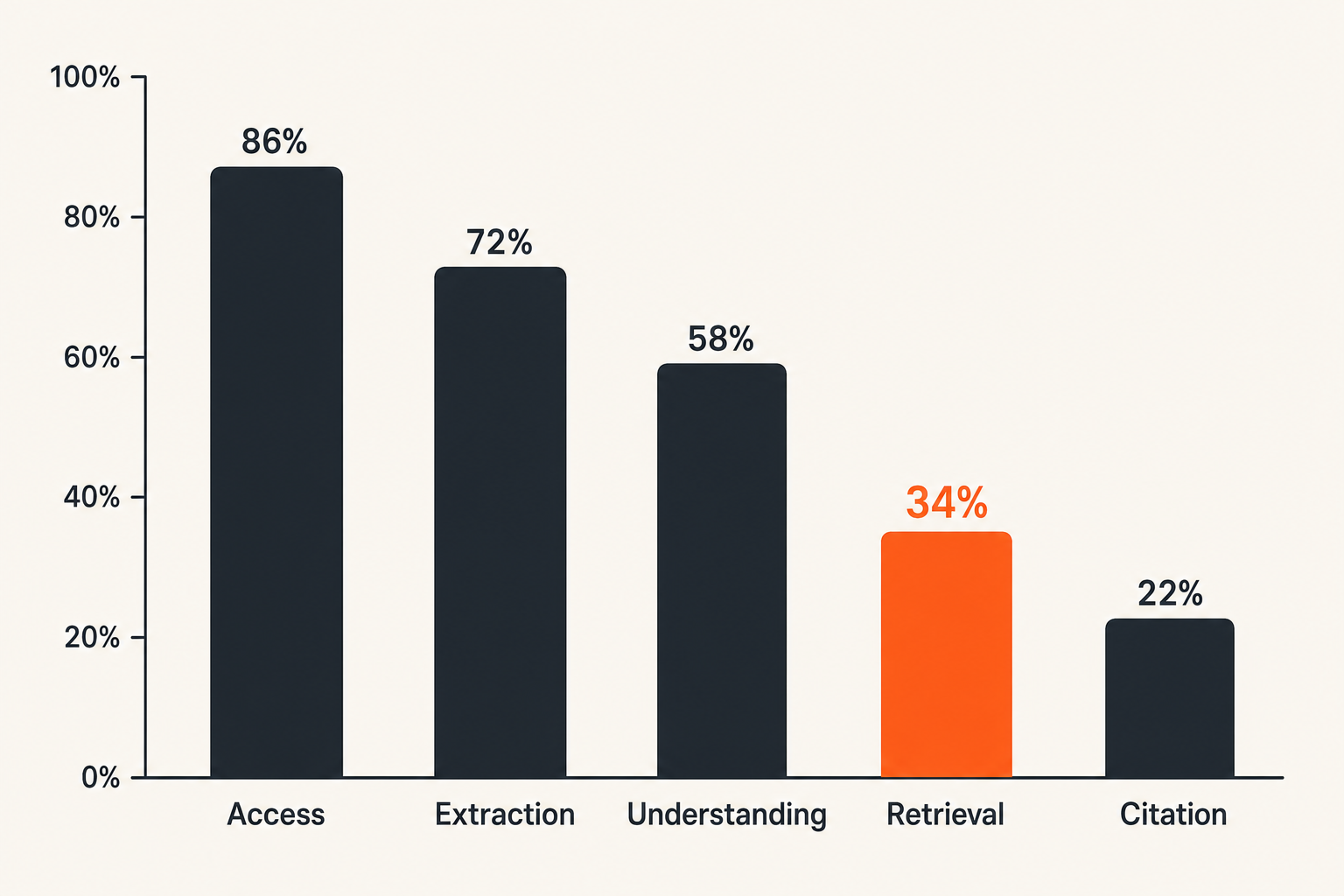
Measurement is still messy in 2026. There is no single universal console that tells you every time your site is used in every answer engine. So the practical approach is to measure the pipeline and sample the outputs.
Measure visibility as a pipeline, not one score
Break measurement into stages:
| Access | Can the crawler reach the URL? | Status code, robots policy, bot logs |
| Extraction | Can the main content be read? | Raw text, rendered text, schema output |
| Understanding | Is the page purpose clear? | Entities, headings, metadata alignment |
| Retrieval fit | Does it match likely prompts? | Prompt-to-page mapping |
| Citation | Is it cited or mentioned? | Manual tests, referral traces, answer monitoring |
| Conversion | Does visibility create value? | Assisted leads, branded searches, direct visits |
This framing stops teams from arguing over vague chatbot screenshots. You can identify where the pipeline breaks.
Track answer inclusion and citation quality
Manual answer testing is imperfect but useful if you make it consistent. Build a small test set of prompts for each important topic:
- informational prompts;
- commercial comparison prompts;
- “best tool for” prompts;
- problem-specific prompts;
- brand category prompts;
- alternative and competitor prompts.
Track whether your site is:
- absent;
- mentioned without citation;
- cited as a source;
- summarized accurately;
- mischaracterized;
- outranked by weaker sources.
The goal is not to obsess over one answer. The goal is to notice patterns.
Build a small prompt test set
A good prompt set is specific enough to be useful but small enough to maintain. For many teams, 25 to 100 prompts is plenty at the start.
Example categories:
Brand prompts:
- What is ExampleCo?
- Is ExampleCo an analytics platform?

Category prompts:
- Best product analytics tools for B2B SaaS
- Product analytics software for account health tracking

Comparison prompts:
- ExampleCo vs CompetitorA
- Alternatives to CompetitorB for SaaS teams

Problem prompts:
- How do I track feature adoption by account?
- How can customer success teams find expansion signals?
Run the same prompts periodically. Keep notes on answer quality, not just presence.
Common AI optimization failure modes
Most bad AI optimization programs fail for boring reasons. The site is not crawlable enough, the content is not explicit enough, or nobody owns the maintenance loop.
Blocking the crawlers you want to learn from you
Some teams block all AI crawlers by default, then ask why answer engines do not cite them. Others allow everything without understanding the reuse implications.
Both approaches can be wrong depending on the business. The failure is not blocking or allowing. The failure is having no documented policy.
Review bot rules with stakeholders who understand marketing, legal, security, and product strategy. Then implement the decision consistently across robots.txt, CDN rules, WAF settings, and application behavior.
Publishing generic answer pages at scale
The fastest way to pollute your own site is to generate hundreds of thin “AI answer” pages that restate obvious information. Answer engines already have generic text. They need sources with specificity.
Generic pages usually fail because they lack:
- firsthand information;
- product or domain expertise;
- original examples;
- constraints;
- comparison value;
- clear authorship;
- update discipline.
If a page does not add anything that a model could not already say, it is unlikely to become a valuable citation source.
Letting automation outrun review
Automation is useful for audits, schema checks, internal link suggestions, and page inventory. It is dangerous when it publishes claims at scale without review.
Common automation failures:
- schema says pages are FAQs when they are not;
- comparison pages make unsupported claims;
- outdated pricing gets repeated;
- generated summaries conflict with product positioning;
- duplicate answer blocks spread across the site;
- legal or compliance language is removed for clarity.
Practical rule: Automate detection and validation before you automate publication.
Related reading from our network: SaaS buyers face a parallel trust problem when using third-party evaluation sources, and this practical guide to software review sites in 2026 shows why source quality and workflow matter more than surface ratings.
What works and what fails in practice
AI optimization is still early, but the operational patterns are already clear. The teams making progress are not chasing hacks. They are making their sites easier to crawl, parse, understand, and cite.
What works
The reliable work is unglamorous:
- publish clear pages that answer specific questions;
- keep important content server-rendered or otherwise extractable;
- align title, headings, schema, and visible copy;
- add structured data where it clarifies page purpose;
- create comparison and use-case pages that are honest and specific;
- maintain llms.txt and sitemaps as navigation aids;
- monitor crawler access and answer inclusion;
- update old pages that still attract topical authority.
This is slower than prompt hacking, but it compounds.
What fails
The weak work looks productive in a project tracker but does not change machine usability:
- adding FAQ sections to every page regardless of intent;
- blocking AI crawlers accidentally;
- hiding key content in client-only components;
- publishing generic AI-written pages with no expertise;
- using schema that does not match the page;
- treating one chatbot response as proof of success or failure;
- changing copy without retesting extraction.
What breaks in practice is the handoff. Content teams ship text. Engineering ships templates. SEO reviews rankings. Nobody checks what the answer engine can actually read.
A practical comparison
| Cosmetic AI optimization | Add FAQs, mention AI topics, rewrite intros | Fails when access, extraction, and entity clarity are unchanged |
| Technical-only cleanup | Fix schema and robots but leave vague content | Helps crawling but may not create citeable answers |
| Content-only rewrite | Improve explanations without checking machine view | May help humans while crawlers still miss the answer |
| Workflow-based AI optimization | Audit access, structure content, validate extraction, monitor answers | Works because each failure point is visible and owned |
The workflow-based approach is not more complicated. It is just more honest about where visibility can fail.
How CrawlProof fits the AI optimization workflow
CrawlProof is built around the operator question behind ai optimization: what do LLM crawlers and answer engines actually find on your pages?
Audit what crawlers can actually find
A normal SEO audit may tell you about title lengths, missing alt text, and performance issues. Those still matter. But AI optimization needs a different view: AI crawler access, schema visibility, robots rules, answer-relevant content, and whether important positioning survives extraction.
That is where an AEO audit is useful. CrawlProof checks a URL from the perspective of AI discovery and reports what is visible, what is blocked, and what is unclear. You can run an audit from CrawlProof’s homepage when you want a practical read on how your page looks to AI crawlers.
Turn findings into a technical to-do list
The output should not be a vague score. A useful audit produces work items:
- update robots policy;
- expose hidden content;
- add or correct schema;
- clarify page purpose;
- add an answer block;
- fix canonical conflicts;
- improve metadata alignment;
- add llms.txt references for canonical pages.
This is the difference between “we should do AEO” and “engineering needs to change the template, content needs to rewrite the first section, and SEO needs to remap internal links.”
Close the loop after changes ship
AI optimization is not a one-time launch. Every template change, CMS migration, redesign, consent banner, WAF rule, or content refresh can change what crawlers see.
Retest after changes ship. Keep a short changelog. If answer inclusion improves, note what changed. If it gets worse, inspect the pipeline instead of guessing.
The operating model for AI optimization in 2026
AI optimization in 2026 is not about tricking models. It is about making your site a cleaner, more reliable source for answer systems that already influence discovery.
Treat answer engines as distribution systems
Answer engines are distribution systems with their own constraints. They need access, context, confidence, and source quality. They may not send the same traffic as classic search, but they shape what users learn before they ever visit a site.
That means the job is not only ranking. The job is source design.
Keep the workflow boring and repeatable
The teams that win will do the boring work consistently:
- choose the pages that matter;
- check AI crawler access;
- inspect extracted content;
- align schema and metadata;
- make answers explicit;
- test likely prompts;
- monitor citations and mischaracterizations;
- repeat after releases.
That is ai optimization without the hype. It gives website owners, SEO professionals, content strategists, and developers a shared workflow instead of another abstract channel to argue about.
Try crawlproof.com
CrawlProof helps site owners and marketers understand how AI answer engines and LLM crawlers discover and cite their content. Try crawlproof.com.