Your site can rank, load fast, and still be invisible to AI answer engines. That is the uncomfortable part. The crawler sees a page. The search console says it is indexed. The content team says the article answers the question. Then an assistant gives a competitor the citation.
Teams think the problem is analytics. The real problem is an analytical engine that connects crawler access, structured evidence, page meaning, and citation readiness into one operating workflow.
That changes the conversation. You are not asking whether traffic went up last month. You are asking whether a machine can fetch the page, identify the answer, trust the source, extract the entity, and cite it without guessing.
In 2026, answer engine optimization is less about chasing one ranking factor and more about building a system that proves your content is usable by AI crawlers and answer engines. The practical question is not what is an analytical engine. It is what should your analytical engine decide, who owns the fixes, and how do you know the change worked.
Table of contents
Analytical engine is not a synonym for analytics
Most website teams already have analytics. They have traffic charts, keyword tools, dashboards, rank trackers, and event data. Useful, but incomplete. Those tools mostly tell you what happened after a user or crawler interaction. They rarely tell you whether an AI system could understand the page well enough to use it as source material.
An analytical engine is different. In AEO, it is the decision layer that turns observations into actions. It pulls evidence from crawling, page structure, schema markup, server behavior, content extraction, and answer coverage. Then it tells the team what to fix.
AEO makes analysis operational
Answer engines do not browse like humans. They fetch, parse, compress, compare, and synthesize. A page that looks excellent in a browser can still fail machine consumption because the answer is buried, the schema is contradictory, the entity is unclear, or a bot rule blocks the wrong crawler.
That is why AEO needs an operational analytical engine. It should answer questions like:
- Can AI crawlers access the page without being blocked by robots rules, WAF behavior, or rendering problems?
- Is the primary answer extractable from the HTML without relying on hidden interaction?
- Do structured data and visible content agree?
- Does the page state who is responsible for the information?
- Are the strongest pages connected to the questions buyers actually ask assistants?
If you are still separating technical SEO, content strategy, and AI crawler access into different workstreams, you are creating handoff loss. AEO collapses those workstreams into one evidence loop. For background on the distinction, CrawlProof has a useful primer on what AEO is and why it is not just SEO.
Why this matters in 2026
The old search workflow was slow but visible. Publish a page, wait for indexing, watch rankings, adjust. AI answer engines compress that loop. They may cite a page, summarize it without a click, ignore it entirely, or use a third-party source that describes your category better than you do.
The mistake teams make is treating this as a content volume problem. More pages do not fix weak evidence. More schema does not fix unclear positioning. More dashboards do not fix inaccessible pages.
Practical rule: If the output of your analysis is not a prioritized fix with an owner, it is not an analytical engine. It is reporting.
A useful way to think about it is simple: analytics observes outcomes; an analytical engine drives decisions. For AEO, that decision is whether a page is ready to be discovered, interpreted, selected, and cited by machine systems.
Related reading from our network: teams building intelligence products face a similar shift from search wrappers to structured workflows in OSINT tools and agent-ready intelligence workflows.
What an analytical engine does in AEO
An AEO analytical engine has three jobs: collect evidence, interpret it, and trigger work. If it cannot do all three, it will drift into another dashboard nobody trusts.
It collects crawler evidence
The first layer is not content scoring. It is access evidence. Before you ask whether a page deserves to be cited, ask whether the systems likely to evaluate it can retrieve the right version.
Good evidence includes:
- HTTP status codes by bot type and user agent.
- Robots.txt rules and whether they affect AI-related crawlers.
- Canonical tags and redirect chains.
- Rendered versus raw HTML differences.
- Schema extraction results.
- Page speed and server responses under crawler-like access.
- Whether important content appears in initial HTML or only after scripts execute.
What breaks in practice is that teams inspect a page in a normal browser and assume crawlers see the same thing. They often do not.
It turns content into machine-readable signals
The second layer is interpretation. AEO is not only about being crawlable. The page has to communicate what it is about in a way that survives extraction.
That means the analytical engine should evaluate:
- Entity clarity: company, product, author, category, location, topic.
- Answer specificity: whether the page answers concrete questions directly.
- Evidence proximity: whether claims sit near supporting details.
- Structured data consistency: whether schema matches visible content.
- Source authority cues: author, update date, references, policy pages, organization details.
- Internal context: links to related pages that help machines understand the site graph.
The point is not to make content robotic. The point is to make important facts unambiguous.
It produces decisions, not dashboard noise
A dashboard that says 63 pages have weak schema is not enough. A useful analytical engine says the pricing page has invalid Organization schema, the comparison page hides its strongest answer in an accordion, and the category guide is blocked for one AI crawler class.
Then it assigns work:
- Developer fixes access, markup, rendering, redirects, and templates.
- SEO fixes canonicalization, indexability, internal links, and technical structure.
- Content fixes answer coverage, source clarity, and page positioning.
- Legal or leadership reviews claims, proof, and sensitive language.
Practical rule: The unit of work in AEO is not a keyword. It is a page-question-evidence combination.
That one shift makes the engine practical. You stop asking whether the site is optimized in general. You ask whether this page is the best machine-readable answer for this question.
Analytical engine architecture for AI visibility
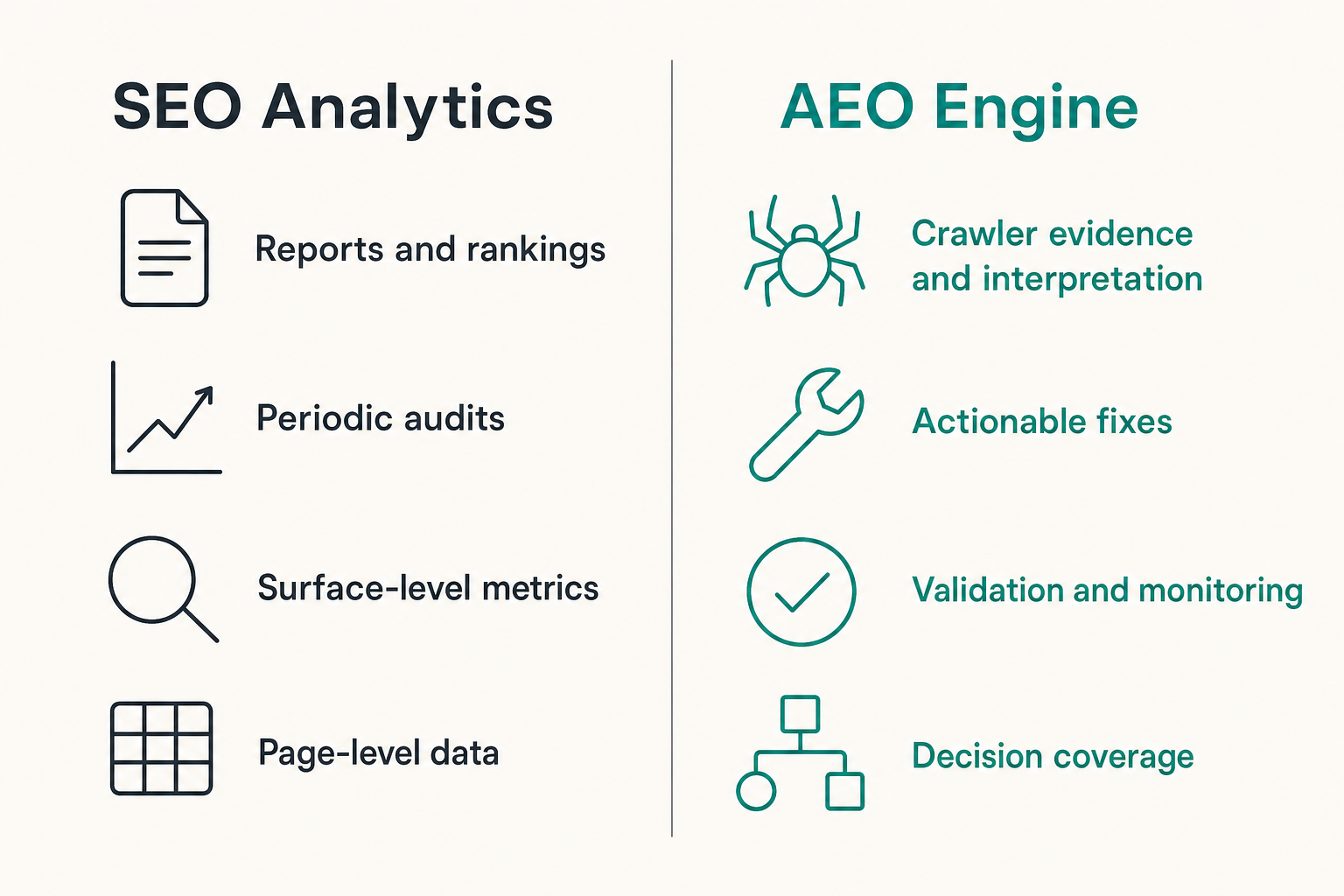
The architecture does not need to be complicated. It does need to be explicit. AEO fails when teams treat analysis as a once-a-quarter audit instead of a pipeline that runs whenever pages, templates, bot rules, or content strategy change.
Input layer: access, pages, and crawl rules
Start with the raw inputs. Your analytical engine should know which URLs matter and how they behave under crawler-like conditions.
Minimum inputs:
- Sitemap URLs and priority page lists.
- Robots.txt and bot-specific directives.
- llms.txt or other AI crawler guidance files where used.
- Server responses by user agent.
- HTML snapshots before and after rendering.
- Schema markup extraction.
- Canonical tags and hreflang where relevant.
- Internal links and content hubs.
Do not begin with every URL if the site is large. Begin with the pages that answer commercial, support, comparison, product, category, and brand questions. The goal is not full crawl vanity. The goal is decision coverage.
Interpretation layer: entities, schema, and intent
The interpretation layer asks what a machine can infer. This is where traditional SEO tools often become thin. They may show title tags and rankings, but not whether an answer engine can confidently identify the page as a source.
The engine should classify pages by intent:
- Definition or explainer.
- Product or service page.
- Comparison page.
- How-to page.
- Pricing or policy page.
- Local or directory page.
- Support or troubleshooting page.
Then it should map the page to entities and questions. If your cybersecurity product page, fintech checkout guide, or SaaS comparison article never states the buyer problem in a direct answer block, the engine should flag that. Machines reward clarity because clarity reduces synthesis risk.
Action layer: fixes, owners, and validation
The action layer is where most programs fall apart. Someone runs an audit. Everyone agrees it is important. Then nobody owns the exact fix.
Your engine should output tickets or tasks with:
- URL.
- Problem statement.
- Evidence found.
- Recommended change.
- Owner.
- Risk level.
- Validation method.
- Date retested.
Example:
- URL: /pricing
- Issue: Primary pricing explanation only appears after JavaScript interaction.
- Impact: Answer engine may not extract pricing model accurately.
- Owner: Front-end developer and content lead.
- Fix: Add static summary above interactive component.
- Validation: Re-crawl raw HTML and rendered HTML; confirm summary is visible in both.
That is an analytical engine in operator language. It turns ambiguity into work.
Signals the analytical engine should measure
AEO does not have one magic score. It has signal groups. Some are technical. Some are editorial. Some are trust-oriented. The analytical engine should make those signals inspectable instead of hiding them behind a black-box number.
Crawlability for LLM bots
Crawlability is still the first gate. If a bot cannot access the page, the rest is theory.
Check:
- Robots.txt allow and disallow rules.
- Whether AI bot user agents are treated differently.
- WAF, CDN, and rate-limit behavior.
- HTTP status stability.
- Redirect chains.
- Canonical consistency.
- Noindex tags or headers.
- Content delivered to raw HTML versus rendered DOM.
The practical question is whether your crawler policy matches your business intent. Some sites deliberately restrict AI bots. That is a business decision. The problem is accidental blocking, where security or performance settings quietly prevent discovery.
Citation readiness and answer coverage
Citation readiness is about whether the page can be used as a reliable source. A page is more citeable when the answer is direct, scoped, and supported.
Look for:
- A clear answer near the top of the page.
- Specific claims instead of vague positioning.
- Dates on time-sensitive content.
- Author or organization identity.
- Supporting details close to the claim.
- Internal links to deeper evidence.
- A concise summary that can be extracted without losing context.
This is where content teams need to be slightly less clever. Brand voice matters, but answer engines do not reward mystery. If the page takes 900 words to say what the product does, a model may choose a clearer competitor.
Schema, llms.txt, and source clarity
Schema markup is not decoration. It is a contract between the visible page and machine interpretation. If the schema says one thing and the page says another, you have introduced doubt.
Useful schema patterns include Organization, Article, Product, FAQPage where appropriate, BreadcrumbList, LocalBusiness, SoftwareApplication, and Review when legitimate. Do not add schema you cannot support in visible content.
llms.txt is still emerging, but it is useful as routing and explanation. It can point AI systems to important documentation, summaries, policies, and content hubs. CrawlProof has a practical explainer on llms.txt and skill.md if you need the file-level basics.
Practical rule: Schema and llms.txt should reduce ambiguity. If they create a second version of the truth, they hurt the engine.
Workflow: build an analytical engine for AEO
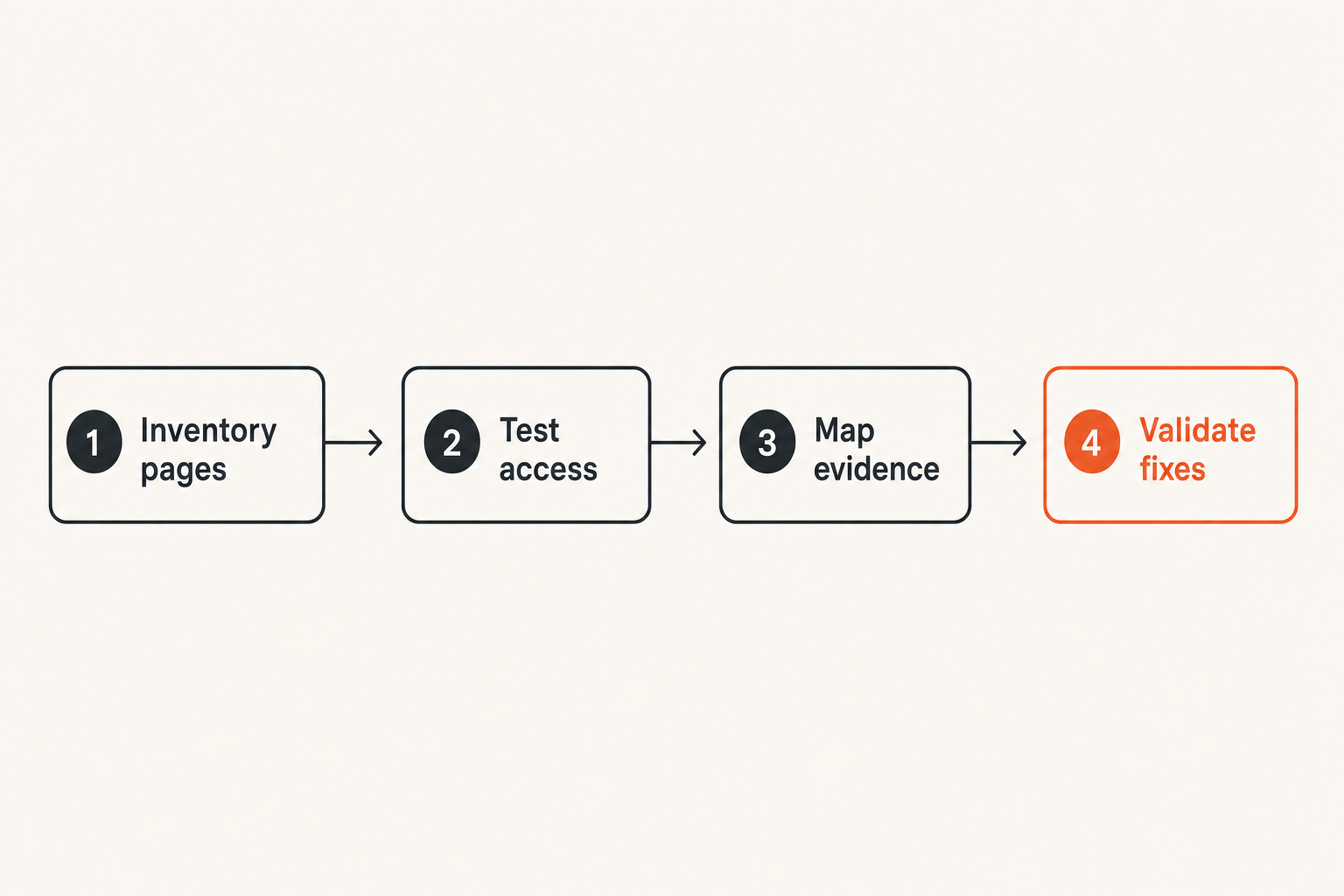
You do not need a six-month platform project. You need a disciplined workflow that can start small and become more automated over time.
Step 1: inventory the pages that matter
Start with business-critical pages, not the whole site.
Prioritize:
- Homepage and main product or service pages.
- Category pages that define what you sell.
- Comparison pages that influence buying decisions.
- High-performing SEO pages that already earn traffic.
- Support or documentation pages that answer real customer questions.
- Trust pages such as about, privacy, terms, security, author, and contact.
For each page, capture the target question. Do not list only keywords. Write the question a buyer or assistant would ask.
Example:
- Bad: analytical engine keyword.
- Better: what should an analytical engine measure for answer engine optimization?
- Better still: how can a website owner know whether AI crawlers can understand and cite a page?
This forces the engine to evaluate usefulness, not only presence.
Step 2: test machine access
Next, test how the page behaves for crawler-like requests. Use multiple perspectives:
- Standard browser view.
- Raw HTML fetch.
- Rendered DOM extraction.
- Mobile and desktop variants.
- Important bot user agents where policy allows.
- Blocked and allowed path checks from robots.txt.
Store snapshots. AEO debugging is painful when teams cannot reproduce what the machine saw last week.
A simple implementation sequence:
- Pull priority URLs from sitemap and manual business list.
- Fetch each URL with a standard user agent and an AI-crawler-like user agent.
- Save status code, redirects, final URL, canonical, noindex state, and raw HTML length.
- Extract title, meta description, headings, schema types, and visible text sample.
- Compare against rendered output.
- Flag mismatches, blocked paths, missing answer sections, and schema conflicts.
- Create tickets only for issues tied to business-critical questions.
Related reading from our network: independent consultants face a similar channel problem, where the right answer is not one platform but a stack of evidence and distribution paths, as covered in freelance websites in 2026.
Step 3: map questions to evidence
Once access works, map each page to the questions it should answer. This is the editorial core of the engine.
For each question, identify:
- The direct answer.
- The supporting evidence.
- The entity being described.
- The page section where the answer appears.
- The schema or metadata that reinforces it.
- The internal pages that provide more depth.
If you cannot point to the answer, the answer engine probably cannot either. Do not assume a model will infer your positioning from scattered paragraphs.
Step 4: validate changes after release
Validation is where mature teams separate themselves. They do not ship AEO fixes and hope. They re-run the same tests and compare evidence.
Validation should confirm:
- Access changed as expected.
- The important answer appears in extractable text.
- Schema validates and matches visible content.
- Canonicals remain stable.
- Internal links point to the intended support pages.
- No unrelated template change broke other page types.
AEO work has regression risk. A developer can fix schema and accidentally remove content from server-rendered HTML. A security change can block crawlers. A CMS plugin can rewrite canonical tags. The engine exists to catch that.
What breaks when teams implement it badly
Most AEO failures are not mysterious. They come from disconnected tooling and unclear ownership.
Dashboard theater
Dashboard theater happens when teams confuse visibility with control. They add scores, colors, and trend lines, but no one can explain the next fix.
Symptoms:
- Every issue is rated medium.
- Reports list hundreds of pages with no business priority.
- The same warning appears for months.
- Content, SEO, and development teams each maintain separate truth.
- Leadership sees charts but no improvement plan.
What works is a short issue queue tied to pages that matter. The engine should suppress noise, not celebrate it.
Many sites now have layered access control: robots.txt, CDN rules, WAF settings, server-side rendering, bot protection, and consent tools. Any layer can break AI crawler access.
Common failures:
- Robots.txt allows Googlebot but blocks other useful crawlers by accident.
- CDN bot rules challenge non-browser requests.
- Important content appears only after a client-side event.
- llms.txt points to stale or redirected URLs.
- Schema references deleted pages or wrong entity names.
- Canonical tags point away from the page intended to be cited.
The mistake teams make is assigning all of this to SEO. Some of it belongs to SEO. Much of it belongs to engineering, infrastructure, and security.
Content that reads well but cannot be cited
Human-readable content is not automatically citeable. A narrative case study may be persuasive to a buyer and still weak for AI extraction if it never states the category, outcome, constraints, and source clearly.
A citeable page usually includes:
- A direct answer to the primary question.
- A plain-language definition where relevant.
- A scoped claim that does not overreach.
- Clear entity names.
- Updated dates for changing topics.
- Supporting context near the claim.
Practical rule: If a sentence would be dangerous when quoted alone, rewrite it or add nearby context.
This is not about writing for bots instead of people. It is about writing so both can understand the same evidence.
SEO analytics versus an AEO analytical engine
SEO analytics and an AEO analytical engine overlap, but they are not the same operating model. Treating them as identical is how teams miss the new failure modes.
Different object being optimized
Traditional SEO often optimizes pages for rankings, snippets, and organic clicks. AEO optimizes source material for machine selection and citation. That does not replace SEO. It adds another consumption layer.
The object changes from ranking position to answer usability. A page can be useful to an answer engine even when it does not generate a click every time. That is frustrating for attribution, but it is the direction the interface is moving.
Different feedback loop
SEO feedback loops are usually query, rank, impression, click, conversion. AEO feedback loops are more fragmented:
- Was the page accessible?
- Was the answer extractable?
- Was the source trusted enough?
- Was the page cited, summarized, or ignored?
- Did the answer engine choose a competitor source?
- Did brand demand or assisted discovery change later?
Measurement is imperfect. That is why the engine should emphasize controllable readiness signals rather than pretending attribution is clean.
Comparison table
| Primary question | How did pages perform in search? | Can machines access, understand, and cite our content? |
| Main inputs | Rankings, impressions, clicks, backlinks | Crawl evidence, schema, content extraction, bot access, answer coverage |
| Main output | Reports and optimization ideas | Prioritized fixes with owners and validation |
| Failure mode | Chasing keywords without intent | Producing content machines cannot trust or parse |
| Owner model | Often SEO-led | Shared by SEO, content, development, and infrastructure |
| Best cadence | Weekly or monthly reporting | Continuous checks plus release validation |
A useful way to think about it: SEO analytics tells you how the market responded. The AEO engine tells you whether your site is eligible to be a useful source in the first place.
Practical implementation patterns
The best AEO implementations are boring in the right way. They use clear files, valid markup, repeatable crawls, and issue ownership. Hype-heavy teams tend to chase prompts and ignore infrastructure.
Schema as a contract
Use schema to reinforce what the page already says. Do not use it to smuggle in claims.
What works:
- Organization schema that matches footer, about page, and contact details.
- Article schema with real author, headline, date published, and date modified.
- Product or SoftwareApplication schema where the page actually describes the product.
- Breadcrumb schema that matches visible navigation.
- FAQ schema only where the page contains real question-answer content.
What fails:
- Generic schema applied across every template without page-specific truth.
- Review markup without visible reviews.
- Author fields that point to non-existent profiles.
- Dates that never update while the article claims current-year relevance.
- Multiple schema blocks that disagree about the same entity.
Treat schema validation as a release check, not a one-time SEO task.
llms.txt as routing, not magic
llms.txt should help machines find the most useful version of your knowledge. It will not rescue a weak site. It can, however, make your intended source map clearer.
Good entries can point to:
- Product documentation.
- Category explainers.
- Pricing and policy pages.
- Content hubs.
- API docs.
- Company background.
- Support resources.
Keep the file small enough to be useful. If you dump every URL into it, you have recreated a noisy sitemap. If you point it to outdated pages, you create trust problems.
Logs, snapshots, and reproducible tests
AEO debugging needs evidence. Store what your engine saw.
At minimum, keep:
- Timestamped fetch results.
- User agent used.
- Status code and redirects.
- Raw HTML snapshot or text extraction.
- Rendered text extraction where available.
- Schema extraction result.
- Robots and llms.txt state at the time of test.
- Diff against prior crawl.
This makes cross-functional work easier. Developers can reproduce rendering issues. Content teams can see missing answers. SEO can verify canonical and schema behavior. Leadership can understand why a fix matters.
Related reading from our network: payment teams deal with a different domain, but the same state-machine discipline appears in crypto checkout architecture for high-risk merchants, where webhooks, settlement, and reconciliation matter more than the checkout UI.
Ownership, metrics, and operating cadence
An analytical engine without ownership becomes shelfware. The workflow has to match how your team ships changes.
Who owns what
A practical ownership model:
- SEO owns crawl policy interpretation, canonical strategy, page prioritization, and search-to-answer mapping.
- Content owns answer clarity, evidence quality, freshness, and page structure.
- Development owns rendering, schema implementation, templates, performance, and release checks.
- Infrastructure owns CDN, WAF, rate limits, bot handling, and server logs.
- Leadership owns business priorities and risk tolerance around AI crawler access.
This does not mean every issue needs a committee. It means the engine routes work to the right person.
Metrics worth reviewing
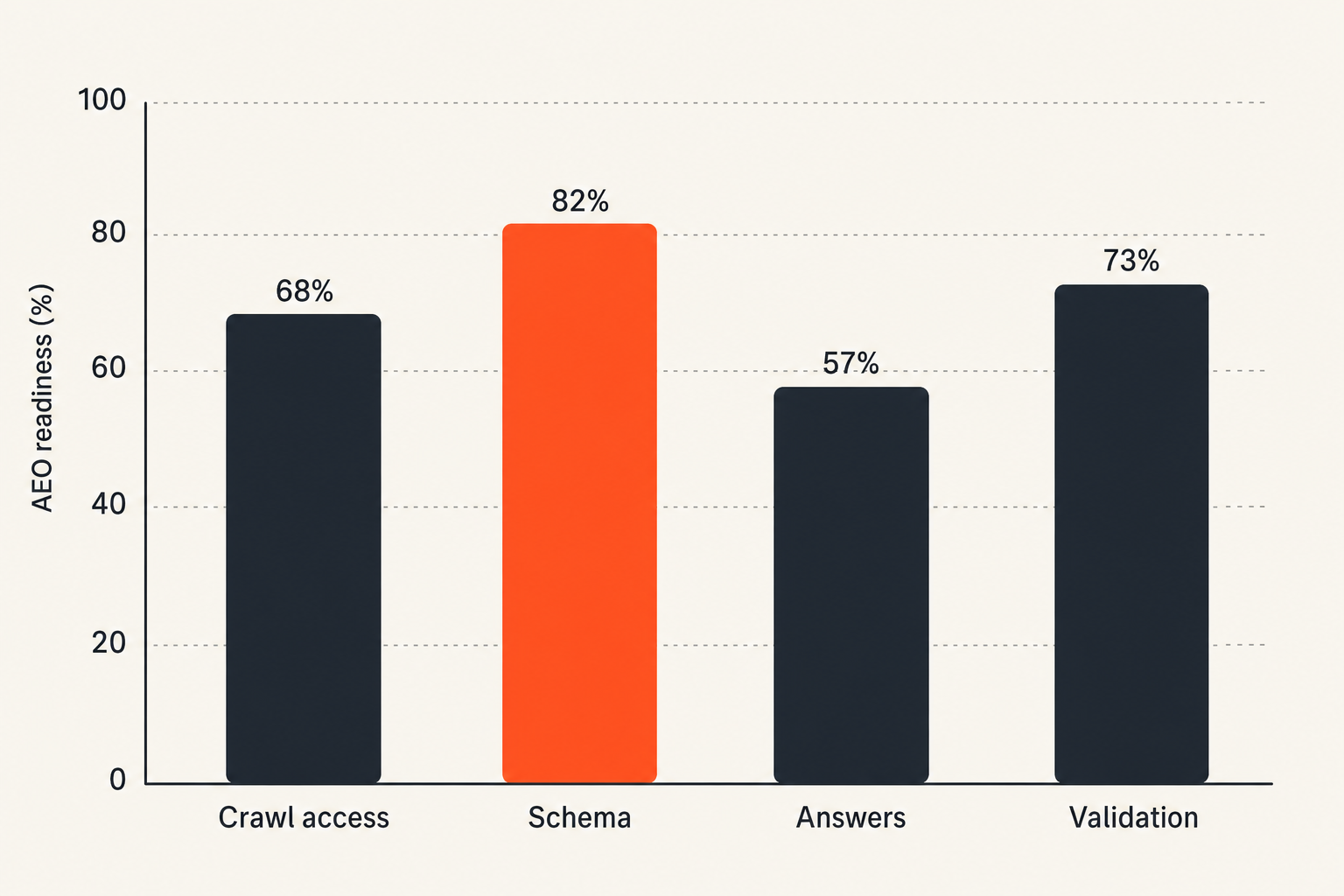
Avoid one grand AEO score as the only metric. Use a small set of operational metrics:
- Priority pages crawlable by allowed AI-related bots.
- Priority pages with valid and consistent schema.
- Pages with direct answer coverage for mapped questions.
- Pages with extractable content in raw HTML or reliable rendering.
- Critical bot access regressions after releases.
- llms.txt links that resolve cleanly.
- Open issues by owner and business priority.
- Time from issue detection to validation.
These are controllable. They do not pretend to measure every AI answer. They measure whether your site is technically and editorially prepared.
Weekly, monthly, and quarterly cadence
Cadence keeps the engine alive.
Weekly:
- Review new critical issues.
- Validate recently shipped fixes.
- Check high-priority page regressions.
- Assign owners for unresolved access or schema problems.
Monthly:
- Revisit question-to-page mapping.
- Update stale content on current-year topics.
- Review competitor citations manually for key prompts.
- Improve internal links around high-value answer hubs.
Quarterly:
- Reassess crawler access policy.
- Audit templates and schema patterns.
- Review whether llms.txt points to the right source set.
- Decide which new page types need engine coverage.
The operating cadence matters because AEO is not static. CMS changes, product pages change, bot policies change, and answer engines change how they evaluate sources.
CrawlProof sits in the evidence layer of this workflow. The job is not to replace your SEO strategy or content team. The job is to show what AI crawlers and answer engines can actually find on your pages, where your signals are weak, and which issues deserve attention.
Audit first, then prioritize
The mistake teams make is debating AEO strategy before checking basic evidence. Are the right pages accessible? Does schema validate? Is important content visible to machine extraction? Are AI crawler instructions clear or contradictory?
An audit changes the meeting. Instead of opinions, the team works from observed behavior.
For site owners who want to see the crawl, schema, robots, AI-bot access, and positioning issues in one place, CrawlProof is built around that inspection layer.
Use product output as shared evidence
The best use of an AEO audit is cross-functional. Send the output to the person who can fix the issue, not just the person who requested the report.
Examples:
- Developer gets rendering and schema problems.
- SEO gets canonical, robots, and page targeting issues.
- Content strategist gets missing answer coverage and unclear positioning.
- Founder or marketing lead gets the priority view of what affects discovery.
That is the practical role of the product inside the analytical engine: turn a vague AI visibility concern into a specific, testable work queue.
Put the analytical engine to work
An analytical engine for AEO is not a buzzword if it changes how your team operates. It should connect crawler access, structured data, content clarity, and business priority into a repeatable workflow.
Teams think the problem is understanding every answer engine algorithm. The real problem is proving that your own site is eligible to be understood and cited. You cannot control every model decision. You can control whether your pages are accessible, coherent, structured, and supported by evidence.
Final checklist
Use this as the starting point:
- Identify the pages that matter commercially and strategically.
- Map each page to the questions it should answer.
- Test raw HTML, rendered content, bot access, canonicals, and status codes.
- Validate schema against visible page content.
- Use llms.txt as a concise routing layer where appropriate.
- Store snapshots so issues are reproducible.
- Assign every fix to an owner.
- Re-test after release.
- Review readiness metrics on a regular cadence.
If your analytical engine does those things, it is doing useful work. If it only produces charts, it is not enough.
The closing point is simple: analytical engine strategy for AEO is an architecture and workflow problem. Build the evidence loop first. The optimization decisions get much clearer after that.
Try crawlproof.com
crawlproof.com helps site owners and marketers see how AI answer engines and LLM crawlers discover, parse, and cite their content. Try crawlproof.com