Your content can rank, get crawled by Google, and still disappear when a user asks an AI assistant for an answer. That is the uncomfortable part of answer AI in 2026.
Teams think the problem is writing more AI-friendly copy. The real problem is that answer engines do not consume your site like a human scanning a landing page. They crawl, parse, summarize, compare, and decide whether your page is safe enough to cite.
That changes the conversation. This is not just a copywriting exercise. It is an architecture and workflow problem across content, SEO, engineering, and analytics.
The practical question is simple: when an AI answer engine visits your site, can it understand what you are authoritative on, extract the answer cleanly, verify the supporting facts, and cite the right URL?
Table of contents
Answer AI is an architecture problem, not a writing trick
Why this matters in 2026
AI answer engines have changed the top of funnel. A user no longer has to click ten blue links, compare snippets, and build their own answer. They ask a question and receive a synthesized response. Sometimes that response cites sources. Sometimes it does not. When it does cite sources, the cited pages tend to be the ones that are easy to crawl, easy to summarize, and easy to trust.
The mistake teams make is treating answer AI as another content format. They brief writers to add FAQs, put a question in the H1, or rewrite introductions in a more conversational tone. Those things may help, but they do not fix the underlying system.
If your canonical tags are inconsistent, your important content is hidden behind scripts, your schema says one thing while the page says another, and your site gives no machine-readable map of priority pages, better paragraphs will not save you.
A useful way to think about it is this: classic SEO tried to make pages discoverable in a search index. Answer engine optimization tries to make pages usable as evidence inside a generated answer. If you want the shorter version of that distinction, our earlier guide on what AEO is and why it is not just SEO covers the strategic shift.
The output is citation readiness
Citation readiness is not a vanity score. It means a page has the operational properties an answer engine needs:
- The page can be accessed by relevant crawlers.
- The primary answer is visible in the HTML or reliably rendered.
- The entity, topic, author, date, and organization are unambiguous.
- The page has structured data that matches the visible content.
- The claim being made is supported by examples, definitions, steps, or references.
- The URL is canonical, stable, and not buried behind duplicate variants.
Practical rule: optimize for extractability before persuasion. AI systems need to understand the answer before they can decide whether it is worth citing.
This is where many teams get stuck. Marketing wants conversion pages. SEO wants traffic pages. Product wants docs. Legal wants caveats. Answer engines want a clear source they can quote or summarize. The job is not to pick one. The job is to design pages and workflows so those needs do not fight each other.
How answer AI crawlers read your site
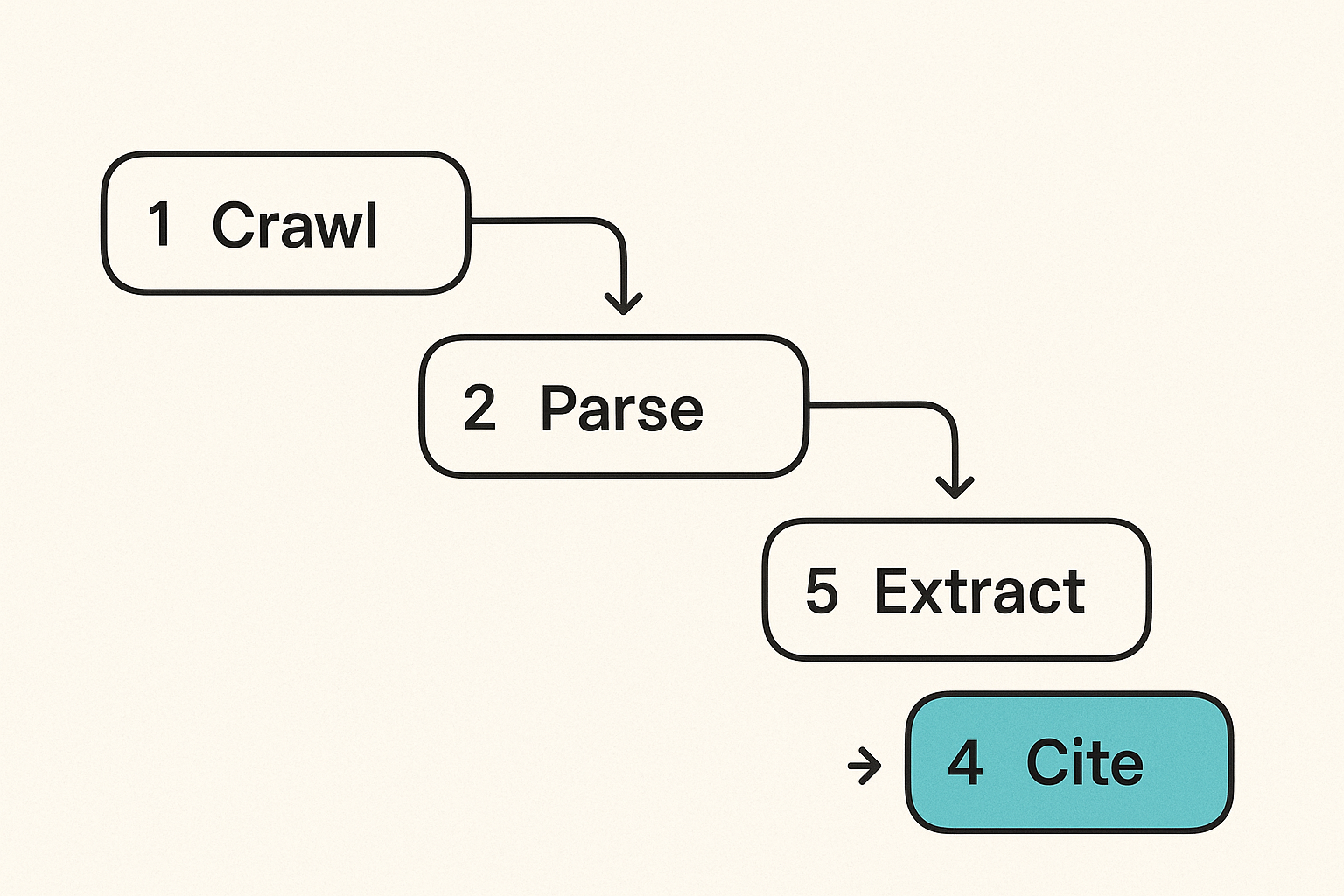
Crawlers need clean paths
An answer AI crawler is not a single thing. Different systems use different crawlers, retrieval layers, indexes, partnerships, browser-like renderers, and post-processing pipelines. You do not control that full chain. You do control the signals your site exposes.
What breaks in practice is usually basic:
- Important pages are blocked by robots.txt because someone copied an old rule.
- Documentation is available only after client-side rendering.
- Product pages contain the answer in tabs that are not visible in initial HTML.
- Canonical tags point to generic category pages instead of the specific answer page.
- The XML sitemap exists, but priority pages are missing or stale.
- Server responses vary by user agent in ways the team never tested.
Teams often talk about AI crawlers as if the main decision is allow or block. That is too narrow. The better question is: what route should an AI crawler take through your content, and what should it find at each stop?
For example, a B2B SaaS site may want AI systems to understand:
- The category it belongs to.
- The problems it solves.
- The use cases it supports.
- The industries it serves.
- The evidence behind claims.
- The pricing or buying constraints that matter.
If those answers are scattered across hero copy, blog posts, support pages, and JavaScript components, the crawler may technically access the site but still fail to assemble a usable answer.
Rendered content still creates risk
Modern crawlers can often render JavaScript, but relying on that is an operational bet. The more rendering required, the more ways extraction can fail. Hydration errors, delayed API calls, personalization, cookie banners, geo variants, and anti-bot tooling can all change what the crawler sees.
This does not mean every site must be static HTML. It means your answer-critical content should not depend on fragile browser behavior.
Practical rule: if a sentence is essential for being cited, make it available without requiring a user interaction, login, personalization event, or late API call.
For developers, this usually means server-rendering core content, testing raw HTML output, validating status codes, and making sure critical metadata is present before client-side enhancements run. For marketers, it means knowing that the visual page is not the only page. There is also the crawler-visible page, and that version is what answer AI systems may judge.
Build a source-of-truth content model
Separate answer pages from demand pages
A demand page tries to move a prospect. An answer page tries to resolve a question. They can overlap, but they are not the same object.
The mistake teams make is forcing every topic into a commercial landing page. Those pages often lead with positioning, social proof, calls to action, and category language. That can work for humans who already understand the problem. It often works poorly for AI systems trying to extract a direct answer.
An answer-ready site usually needs several page types:
- Definition pages for core concepts.
- Comparison pages for alternatives.
- Process pages for how something works.
- Use-case pages for specific jobs.
- Evidence pages for data, examples, policies, or methodology.
- Product pages for what you sell.
The source-of-truth model defines which page owns which answer. Without that, five pages compete to explain the same concept, each with slightly different wording. An answer engine then has to choose between duplicate or conflicting sources from your own domain.
A practical content model might look like this:
| Definition | Explain what a concept means | Turning it into a sales pitch |
| Comparison | Clarify tradeoffs | Hiding weaknesses or constraints |
| Use case | Map problem to workflow | Staying too generic |
| Documentation | Provide implementation detail | Blocking crawlers or requiring login |
| Product | Explain fit and conversion path | Making claims without source context |
Related reading from our network: teams using AI to scale publishing run into similar routing and review problems, and this guide to human in the loop AI publishing workflow architecture is a useful adjacent read if your content operation is becoming more automated.
Put facts where machines can verify them
Answer engines are sensitive to unsupported claims. Not in a moral sense. In a retrieval sense. If a page says your product is best, fastest, trusted, or enterprise-grade, but provides no structured explanation, examples, constraints, or corroborating detail, the page is harder to use as evidence.
Facts should be close to the claim they support. If you say a product supports a workflow, show the steps. If you say a standard matters, explain how to implement it. If you say a tool detects an issue, name the inputs it checks.
This is especially important for content strategists. The goal is not longer content. The goal is denser evidence. A short, specific section can be more useful to an answer engine than a long article filled with generalities.
For answer AI visibility, each priority page should answer these questions clearly:
- What is this page about?
- Who is it for?
- What question does it answer?
- What claims does it make?
- What evidence supports those claims?
- What should the reader do next?
Technical access: robots, llms.txt, and schema
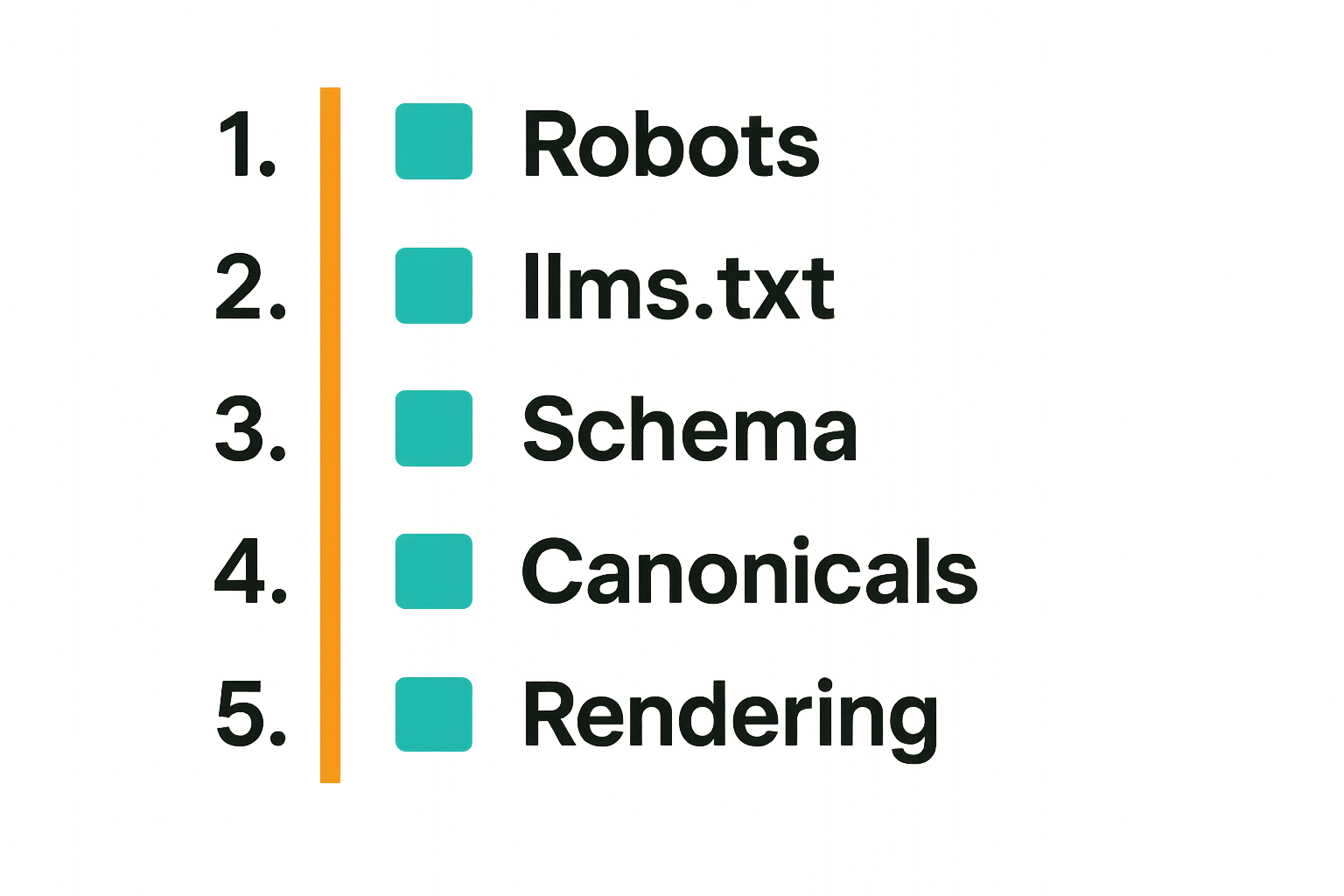
Robots rules should be intentional
Robots.txt is still one of the first places to look. It is not glamorous, but it controls access. Many sites have accumulated rules from migrations, staging environments, faceted navigation fixes, or old SEO experiments. Those rules can accidentally block the pages you now want AI crawlers to inspect.
Do not treat robots.txt as a legal policy document, a security boundary, or a set-and-forget SEO artifact. Treat it as routing configuration for crawlers.
A simple review should check:
- Which user agents are allowed or blocked.
- Whether important content directories are disallowed.
- Whether sitemap locations are declared.
- Whether staging or parameter rules are too broad.
- Whether AI-specific crawler policies match business intent.
Practical rule: crawler access should be a deliberate product decision, not a leftover from the last site migration.
The point is not to allow everything. Some teams have good reasons to restrict certain bots or sections. The point is to know what you are doing and validate the result from the crawler perspective.
llms.txt is a routing layer
llms.txt is emerging as a way to tell AI systems which pages, documents, or resources are important for understanding your site. It is not a magic ranking file. It is closer to a curated map.
A useful llms.txt file should be boring and explicit. It can point to core docs, concept pages, product explanations, policies, and canonical resources. It should not be a dumping ground for every URL on the site.
Example structure:
# Example company

> Short description of what the company does and who it serves.

## Core resources
- /answer-engine-optimization
- /docs/crawler-access
- /pricing
- /methodology

## Product context
- /features/schema-audit
- /features/ai-crawler-visibility
The file does not replace sitemaps, schema, or good information architecture. It complements them. If you are deciding what to include and how to keep it clean, our practical explainer on llms.txt and skill.md is a good next step.
Schema should match visible content
Schema markup gives machines a structured representation of your page. The failure mode is treating schema as a place to say things the page does not clearly say.
If your schema names an author, the page should show the author. If your FAQ schema includes questions, those questions should be visible. If your Organization schema describes the business, the same identity should be consistent across your about page, footer, social profiles, and knowledge panels where relevant.
Schema is not decoration. It is a contract between the visible page and the machine-readable page.
For answer AI work, prioritize:
- Organization schema for entity clarity.
- Article or BlogPosting schema for editorial content.
- FAQPage schema only when FAQs are genuinely visible and useful.
- Product or SoftwareApplication schema where appropriate.
- Breadcrumb schema for hierarchy.
- SameAs links when they are accurate and maintained.
The mistake teams make is installing a plugin and assuming schema is solved. In practice, plugins often generate incomplete or generic markup. The operational job is to inspect what is actually emitted on important URLs and compare it with the visible page.
The answer-ready page template
Lead with the answer block
Most web pages make users work too hard for the answer. They open with brand positioning, context, clever lines, or category setup. That can be fine for a campaign page. It is weak for answer extraction.
An answer-ready page should make the primary answer obvious near the top. Not necessarily in one sentence, but in a concise block that defines the topic, gives the direct answer, and sets boundaries.
A practical opening structure:
- Direct answer to the query.
- One sentence on why it matters.
- One sentence on who it applies to.
- A short list of the components or steps.
- A link or CTA only after the answer is complete.
This structure helps humans too. Nobody complains when a page answers the question quickly.
For example, a page targeting answer AI might open by saying that answer AI is the practice of making a site understandable, extractable, and citable by AI answer engines. Then it should immediately explain the system components: crawler access, structured data, source-of-truth content, evidence, and measurement.
Add proof, constraints, and entity context
Answer engines need context to avoid overgeneralizing. Your page should state where the answer applies and where it does not.
Good constraints sound like this:
- This applies to public marketing sites, not private app content.
- This assumes the business wants AI crawlers to access priority pages.
- This does not guarantee citation in every AI system.
- This should be reviewed after CMS migrations or template changes.
Those statements may feel less marketable, but they make the page more trustworthy. They tell an answer system that the content is specific rather than inflated.
Entity context matters too. AI systems need to connect your site to a clear organization, product, author, location, category, and topic. If your brand name appears inconsistently, your about page is thin, and your authors are anonymous, the system has less to work with.
Related reading from our network: local and community publishing teams face a similar trust problem, where content has to preserve routing, follow-up, and context; this piece on AI publishing community building is a useful comparison.
A workflow for producing answer AI content
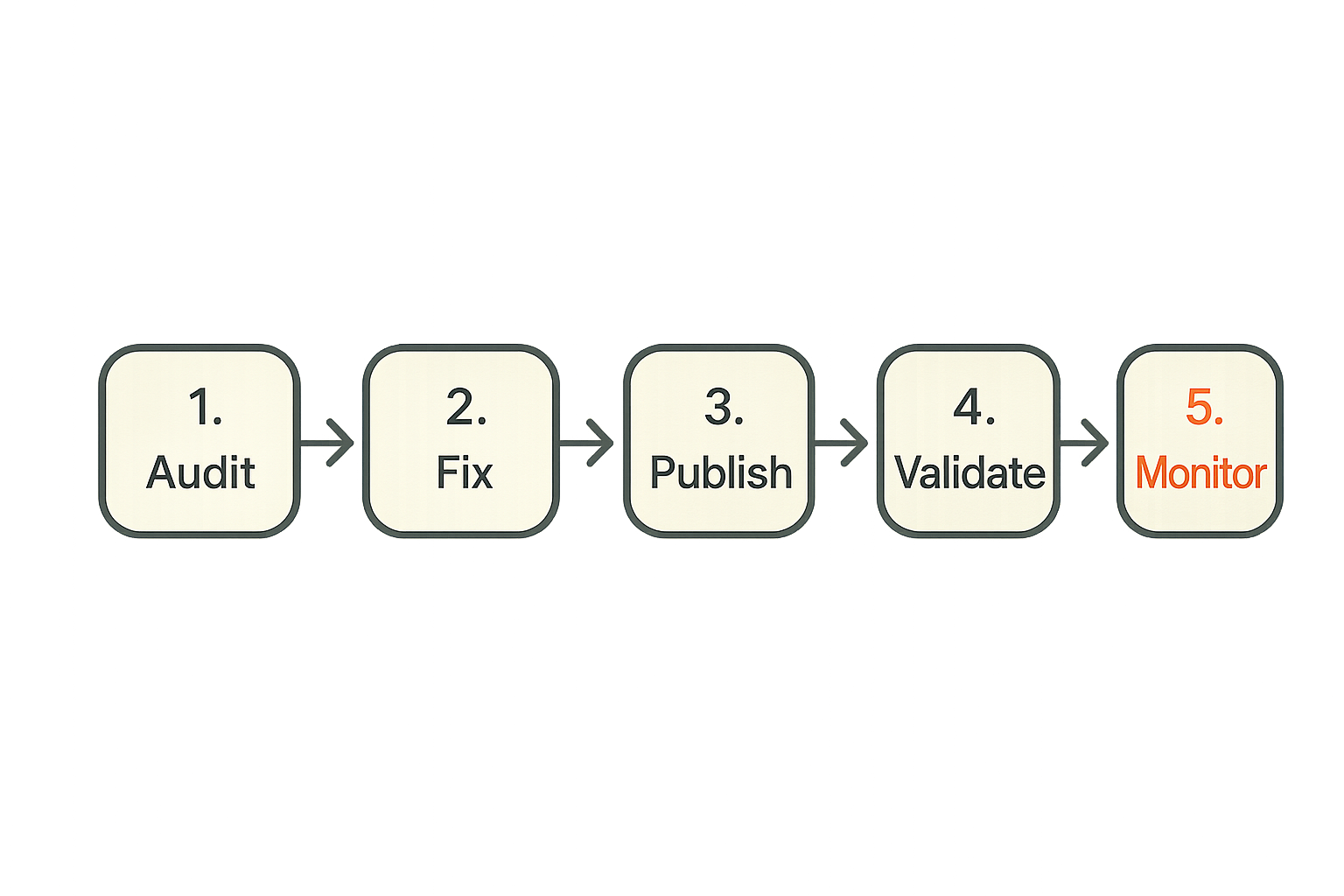
The implementation sequence
The practical question is not whether you should care about answer AI. If organic discovery matters to your business, you already should. The practical question is how to operationalize it without creating another disconnected SEO checklist.
Use a repeatable workflow:
- Pick the answer set. Identify 20 to 50 questions your site should be cited for. Include definitions, comparisons, implementation questions, and buying questions.
- Map each answer to one canonical URL. Do not let five URLs compete for the same answer unless they serve clearly different intent.
- Audit crawler access. Check robots.txt, status codes, canonical tags, sitemap inclusion, redirects, and raw HTML visibility.
- Audit extraction quality. Confirm the direct answer, supporting facts, author or organization context, and schema are visible and consistent.
- Rewrite for answer structure. Add concise answer blocks, headings, steps, tables, constraints, and examples.
- Update llms.txt and sitemaps. Route crawlers to the most important pages instead of making them infer priority.
- Validate after publish. Re-crawl the URL, inspect rendered and raw content, and test whether the page can be summarized accurately.
- Monitor citations and referrals. Track whether AI systems mention, cite, or send traffic to the URL over time.
This workflow matters because answer AI work touches multiple systems. Content changes are not enough if templates hide the content. Technical fixes are not enough if the page makes vague claims. Analytics are not enough if nobody knows what question the page was supposed to win.
Ownership across content, SEO, and engineering
Most failures are ownership failures. The content team writes the page. The SEO team adds metadata. Engineering owns the template. Analytics owns reporting. Nobody owns the crawler-visible answer.
A better ownership model assigns responsibilities clearly:
- Content owns the answer, evidence, examples, and editorial accuracy.
- SEO owns intent mapping, canonical strategy, internal links, and structured data requirements.
- Engineering owns rendering, performance, status codes, templates, and crawler access.
- Analytics owns referral tracking, log analysis, and citation monitoring.
- Leadership owns policy decisions around AI crawler access and content licensing.
Practical rule: every priority answer should have one owner, one canonical URL, and one validation path.
Related reading from our network: payment and entitlement systems have the same state problem in a different domain, and this guide to AI publishing cryptocurrency payment architecture is a useful analogy for why workflows need reconciliation, not just a front-end experience.
Measurement: what to track when rankings are not enough
Crawlability signals
Classic rank tracking is incomplete for answer AI. You still need search data, but you also need to know whether AI-relevant crawlers can access and interpret your site.
Track operational signals such as:
- Important URLs returning 200 status codes.
- Canonicals pointing to the intended URL.
- Raw HTML containing the primary answer.
- Structured data validating without critical errors.
- Robots.txt allowing the crawlers you intend to allow.
- llms.txt present, reachable, and curated.
- Sitemap entries matching priority pages.
- Server logs showing crawler visits where available.
These are not vanity metrics. They are failure detection. If an important page drops out of the sitemap or a template change removes schema, you want to know before traffic or citations disappear.
A simple scorecard can help:
| Access | 200 response, not blocked | Blocked, redirected, or unstable |
| Extraction | Answer visible in HTML | Answer hidden behind interaction |
| Structure | Schema matches page | Generic or conflicting schema |
| Routing | Sitemap and llms.txt point to URL | Priority URL omitted |
| Identity | Clear organization and author context | Ambiguous or inconsistent entity |
Citation and referral signals
Citation measurement is messier. AI answer engines do not all report traffic consistently, and some citations produce awareness without a clean referral. Still, teams can track directional signals.
Look for:
- Referrals from AI assistants and answer engines where visible.
- Branded search lift around topics where AI systems mention you.
- Manual spot checks for priority prompts.
- Sales or support mentions where prospects say they found you through an AI tool.
- Changes in crawl logs after publishing answer-ready pages.
- Pages that receive impressions or traffic from long, conversational queries.
Do not overfit to one tool or one prompt. AI responses vary by user, geography, time, model, and retrieval source. The goal is not perfect rank tracking. The goal is to understand whether your site is becoming more usable as a source.
The mistake teams make is asking for a single answer AI dashboard that proves everything. In production, you usually need a blended view: technical accessibility, content quality, structured data, logs, referrals, and manual validation.
Common failure modes that break answer AI visibility
What fails
Answer AI projects fail when teams bolt tactics onto a messy site. The common patterns are predictable.
First, they publish AI-generated content at scale without a source-of-truth model. The site grows, but topical authority gets diluted. Pages repeat each other. Internal links become random. The answer engine sees volume, not clarity.
Second, they add schema without governance. Markup drifts from the page. Old authors remain in JSON-LD. FAQ schema appears on pages without visible FAQs. Product schema describes features that are no longer sold.
Third, they block or confuse crawlers. Security tools challenge bots. Robots rules are too broad. Redirect chains pile up. Important content sits behind tabs, modals, or client-side calls.
Fourth, they measure only rankings. The team celebrates position changes while AI assistants cite competitors that have clearer definitions, better documentation, or cleaner entity signals.
Fifth, they treat llms.txt as a magic file. They add it once, include too many URLs, never update it, and expect citations to appear. That is not a workflow. It is a hope file.
What works
What works is less exciting and more durable.
Start with your highest-value questions. Map them to canonical URLs. Make the answer obvious. Add evidence. Validate raw and rendered content. Keep schema honest. Give crawlers a clean route. Measure whether the system stays intact after changes.
This is not a one-time optimization pass. It becomes part of content operations. Every new strategic page should ship with an answer brief, schema requirements, canonical mapping, crawler-access validation, and a post-publish audit.
A practical pre-publish checklist:
- Does this page own a specific answer?
- Is the answer visible near the top?
- Are claims supported by details or examples?
- Is the page accessible in raw HTML or reliable rendering?
- Does schema match the visible content?
- Is the URL canonical and included in the sitemap?
- Should the URL be referenced in llms.txt?
- Is there a plan to measure citations, referrals, or logs?
Practical rule: do not publish answer AI content until you know what answer it owns and how a crawler will verify it.
Comparison: classic SEO vs answer engine optimization
Different optimization target
Classic SEO and answer engine optimization overlap, but they are not identical. SEO often optimizes for rankings, snippets, clicks, and landing-page performance. AEO optimizes for being selected as a source inside an answer.
That difference changes page design. A page built only for search traffic may delay the answer to increase engagement. A page built for answer engines makes the answer extractable early, then provides depth, proof, and next steps.
| Primary goal | Rank and earn clicks | Be understood, trusted, and cited |
| Content structure | Keyword and intent coverage | Direct answer plus evidence |
| Technical focus | Indexability and performance | Crawlability, extractability, schema, routing |
| Measurement | Rankings, impressions, clicks | Access, citations, referrals, prompt visibility |
| Page risk | Thin or over-optimized content | Vague, unsupported, or hard-to-extract claims |
| Workflow | Publish and optimize | Audit, publish, validate, monitor |
The point is not to abandon SEO. The point is to extend it. Search engines, answer engines, and LLM retrieval systems all reward clarity in different ways. A well-structured page can serve all three better than a bloated page written for one channel.
Different operating cadence
SEO teams often work in campaigns: keyword research, content production, technical cleanup, link building, reporting. Answer AI work needs a tighter maintenance loop because small technical changes can affect machine interpretation.
Template updates, CMS migrations, cookie tools, bot rules, schema plugins, and content refreshes can all change what crawlers see. If answer visibility matters, validation should happen after those changes, not once per year.
A useful cadence:
- Weekly: monitor priority pages for access, status, and schema errors.
- Monthly: review new and updated pages for answer ownership.
- Quarterly: refresh llms.txt, sitemaps, and entity signals.
- After every major release: validate raw HTML, rendered content, and crawler access.
This is where developers become important to AEO. Content teams can define the answer, but engineering controls whether the answer survives templates, rendering, and deployment.
Where CrawlProof fits in an answer AI workflow
Use audits before rewrites
Most teams start by rewriting pages. That feels productive, but it can waste time if the real issue is crawler visibility, schema mismatch, or blocked access.
CrawlProof is built around a simpler idea: inspect the page the way AI crawlers and answer engines may experience it, then decide what to fix. Before rewriting a priority URL, you want to know whether the page exposes the right content, whether structured data is present, whether robots rules create problems, and whether emerging AI routing files are helping or missing.
That is why an audit-first workflow matters:
- Audit the current URL.
- Identify crawler, schema, and content extraction gaps.
- Prioritize fixes by business value.
- Ship template, metadata, and content changes.
- Re-audit after publish.
- Monitor whether the page remains answer-ready.
CrawlProof is not a replacement for content strategy or engineering judgment. It is a way to make the invisible parts visible, especially for teams that know SEO basics but are new to AI indexing. The broader CrawlProof blog covers adjacent notes on AEO, schema, crawler behavior, and emerging standards as this ecosystem changes.
If you own a site, the useful question is not whether AI will change discovery. It already has. The useful question is whether your site is structured so answer AI systems can find, understand, and cite the work you have already done.
Try crawlproof.com
CrawlProof helps site owners and marketers see how AI answer engines and LLM crawlers discover, parse, and cite their content. Run an audit and see what your pages expose today: Try crawlproof.com.