A site can rank well in search and still be almost useless to an answer engine. That is the uncomfortable cal ai problem most website teams are starting to run into in 2026.
The homepage looks fine. The blog has traffic. The robots file is not obviously broken. Then a prospect asks an AI assistant for the best vendor, guide, product, calculator, or local option in your category, and your site is absent or summarized badly.
Teams think the problem is cal ai as a keyword, a tool, or a new content format. The real problem is whether your site exposes the right facts, structure, permissions, and proof in a way AI crawlers and answer systems can reliably use.
That changes the conversation. You are not optimizing for a blue link only. You are designing a content and crawl architecture that can be discovered, interpreted, cited, and kept current across systems you do not control.
Table of contents
What cal ai means for website operators in 2026
Not a magic keyword
The mistake teams make is treating cal ai like a surface-level naming problem. They ask whether they should add the phrase to headings, publish a glossary page, or chase a few AI-search tools. That is usually too shallow.
For website operators, cal ai is better treated as a working model for AI visibility: can a crawler reach the page, can an answer engine extract the useful answer, and can the system justify citing you instead of a competitor or a marketplace summary?
If you already understand SEO basics, the shift is not that everything you know is obsolete. It is that the consumption layer has changed. The user may never click the result. The AI answer may compress ten pages into one paragraph. Your job is to make your source easy to use without letting the model invent the important parts.
If the broader concept is still new, the practical baseline is covered in what is AEO: answer engine optimization is about becoming usable input for answer systems, not just ranking on a results page.
The CAL model: crawl, answer, legitimacy
A useful way to think about it is CAL:
- Crawl: AI crawlers and search systems can access the right URLs without being blocked by robots rules, authentication, broken rendering, or accidental noindex policies.
- Answer: pages expose direct, extractable answers to common user questions, with enough surrounding context to avoid bad summaries.
- Legitimacy: the site provides evidence, identity, freshness, schema, policies, authorship, and source clarity so an answer engine has a reason to trust and cite it.
That is not a formal standard. It is an operator checklist. It keeps the conversation away from vague AI hype and toward the architecture you can actually fix.
Practical rule: If an AI system can crawl your page but cannot identify the answer, the entity, and the evidence, you have visibility without usability.
Why SEO alone misses the issue
Classic SEO often optimizes pages for ranking, click-through, and keyword coverage. Those still matter. But answer engines introduce different failure modes.
A page can have strong title tags and backlinks while its key pricing detail is buried in a tab. A product page can rank while its eligibility constraints are hidden in JavaScript. A blog post can get traffic while the actual answer is split across five paragraphs of intro copy.
The practical question is not whether SEO is dead. It is whether your existing SEO workflow can detect when the machine-readable version of the page is weaker than the human-designed version.
The architecture behind cal ai visibility
The crawl layer
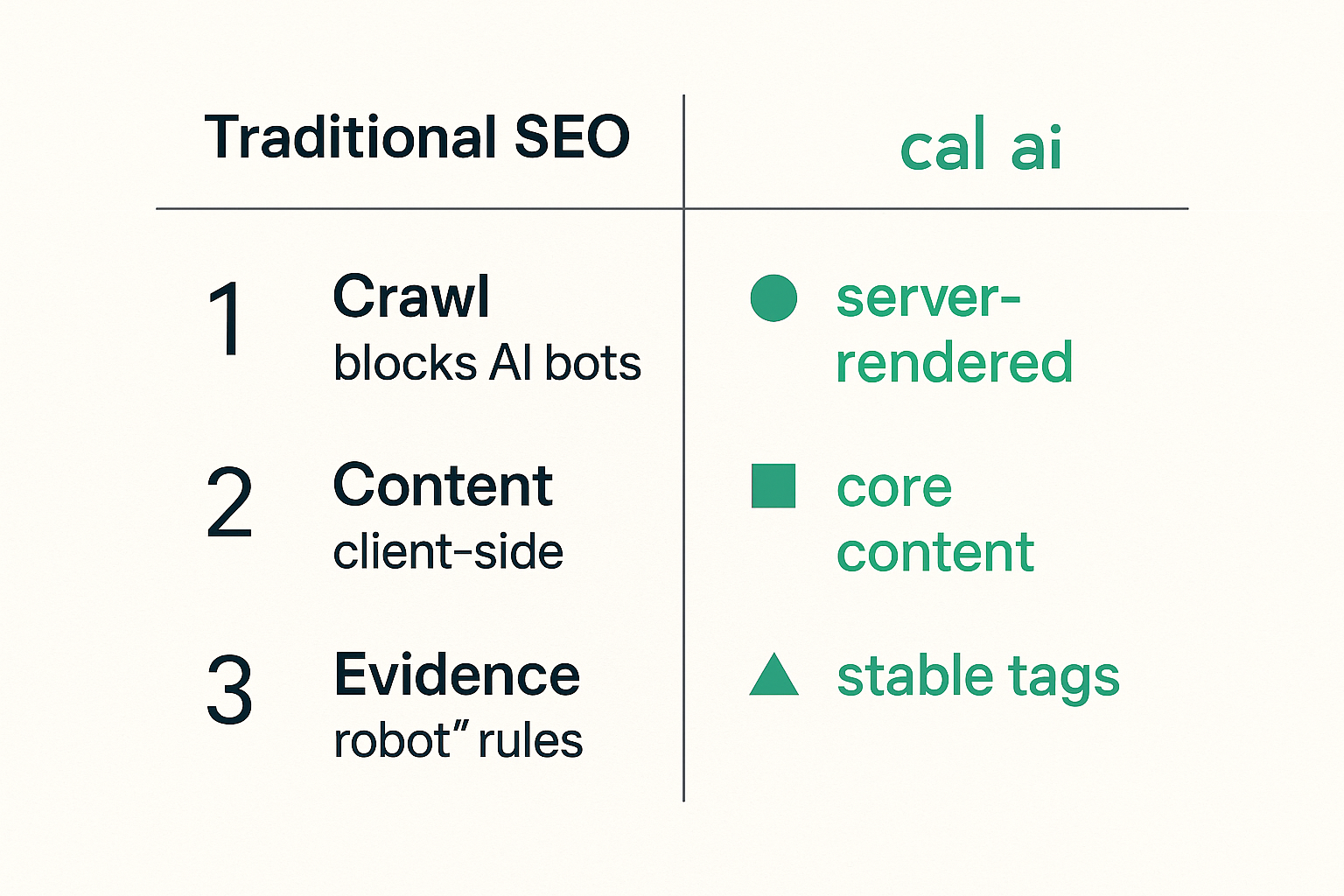
The crawl layer answers a basic question: what does an AI crawler actually receive when it requests your URL?
This is where many sites fail quietly. Common issues include blocked AI user agents, CDN rules that challenge unfamiliar bots, client-side rendering that delays primary content, canonical tags pointing away from the best answer page, and robots rules copied from old SEO experiments.
Do not assume that because Googlebot can access a page, every AI crawler can. Different bots behave differently. Some respect robots rules. Some identify themselves clearly. Some fetch limited assets. Some may rely on search indexes instead of direct crawl. You do not control all of that, but you can remove avoidable ambiguity.
A crawl-ready page has server-rendered or reliably rendered core content, clean status codes, stable canonicals, accessible metadata, and no accidental gatekeeping around content that should be public.
The content layer
The content layer answers the next question: once the system has the page, can it extract a useful answer?
This is not the same as keyword density. It is about structure and proximity. The answer should be close to the heading that introduces the question. Definitions should be direct. Product claims should connect to proof. Comparisons should name the alternatives. Limitations should not be hidden in legal copy three clicks away.
For example, a page about an integration should not only say that your platform supports modern workflows. It should say which integration, what data moves, what triggers the connection, what permissions are required, and what fails if the connection is unavailable.
Answer engines reward boring clarity more than clever brand copy. That does not mean every page should read like documentation. It means the page needs enough explicit structure that a machine can avoid guessing.
The evidence layer
The evidence layer is where citation becomes possible. Answer systems need sources that look stable, attributable, and current.
Evidence can include schema markup, author information, organization details, last-updated dates, product specifications, policy pages, comparison tables, original research, examples, code snippets, screenshots, changelogs, and consistent entity naming across the site.
Here is the operational difference:
| Crawl | Can search engines index it? | Can AI crawlers and answer systems retrieve the useful version? | Bot blocks, JS rendering gaps, wrong canonicals |
| Content | Does it target the keyword? | Does it answer the user question directly and unambiguously? | Fluffy intros, hidden facts, unclear entities |
| Evidence | Does the page look authoritative? | Can the answer engine justify citing this source? | No schema, stale dates, missing proof, weak source identity |
That changes the conversation from content volume to content reliability.
Build pages AI systems can parse
Put the answer near the asset
If a user asks an answer engine a question, the model needs a concise, extractable answer. Your page should make that easy.
For a product page, put the core use case, audience, differentiator, pricing model, and constraints close to the top. For a tutorial, put the required inputs, expected output, and failure cases before the long walkthrough. For a comparison page, state the comparison criteria before the opinions.
The mistake teams make is placing the most useful sentence after a brand story, a hero animation, three benefit blocks, and a customer quote carousel. Humans may scroll. Crawlers and summarizers may not preserve the same emphasis.
A simple pattern works:
- Short answer under the H1 or first H2.
- Bullets for who it is for, when to use it, and when not to use it.
- Table for specifications or comparison points.
- Examples that use real entity names.
- Updated date near material claims.
Practical rule: The sentence you want an answer engine to quote should exist on the page exactly as a human would understand it.
Use stable entities and names
AI systems are entity-driven. If your site refers to the same thing five different ways, you create unnecessary uncertainty.
Pick stable names for your company, product, categories, services, locations, integrations, authors, and frameworks. Use those names consistently in headings, schema, navigation, alt text, and internal links. If a product was renamed, explain the relationship directly instead of pretending history did not happen.
This matters for cal ai because answer engines stitch facts together. They compare your site with directories, reviews, social profiles, documentation, and third-party pages. Inconsistent names can make your product look like multiple products or make a competitor appear more canonical.
Do not hide critical content behind interaction
Interactive design is not the enemy. Hidden dependency is.
Tabs, accordions, calculators, filters, personalization, cookie banners, and geo-specific content can all create extraction problems. The issue is not whether a human can eventually see the content. The issue is whether the important facts are available in the initial or reliably rendered document, and whether they are linked from stable URLs.
If a calculator produces an important answer, include explanatory static content around it. If a filter page represents a high-intent query, give it a crawlable URL and a summary. If a pricing table changes by region, explain the rule and provide stable region-specific pages where appropriate.
What fails is treating the UI as the content system. The UI is only one consumer. AI crawlers, search indexers, feed readers, accessibility tools, and internal search all need durable content structure underneath.
Schema, feeds, and llms.txt are routing controls
Schema describes the page contract
Schema markup does not magically make a weak page authoritative. It tells machines what the page is claiming to be.
Use schema to clarify organization identity, article metadata, product details, reviews when legitimate, FAQs when they are truly present on the page, breadcrumbs, authors, events, software applications, and local business information. Keep it aligned with visible content. Do not mark up claims the page does not actually support.
The practical question is: if an AI system extracts facts from your page, can schema reduce ambiguity? If yes, add it. If schema only exists to stuff extra claims into JSON-LD, it will eventually create trust problems.
llms.txt guides crawler intent
llms.txt is part of a broader movement toward making sites easier for language models to navigate. It is not a replacement for robots.txt, sitemaps, canonical tags, or good content. It is a guide layer.
A useful llms.txt file points AI systems toward canonical explanations, docs, policies, examples, and high-value summaries. It should be maintained like navigation, not treated like a one-time novelty file. For implementation details, the breakdown of llms.txt and skill.md is a good companion to this workflow.
The mistake teams make is publishing an llms.txt file that links every blog post equally. That creates another messy sitemap. The better move is to curate the pages you actually want models to use as source material.
Keep generated feeds boring
Feeds, sitemaps, API docs, and generated indexes should be boring. Boring is good. It means stable, predictable, parseable, and easy to diff.
Do not over-design machine-facing files. Avoid vague labels, inconsistent date formats, missing canonical URLs, or auto-generated descriptions that say nothing. Make sure your sitemap reflects the URLs that matter. Make sure your docs and content hubs do not send crawlers into duplicates, thin tags, or deprecated pages.
Practical rule: Machine-facing navigation should be curated, stable, and dull. If it needs a brand explanation to make sense, it is probably too clever.
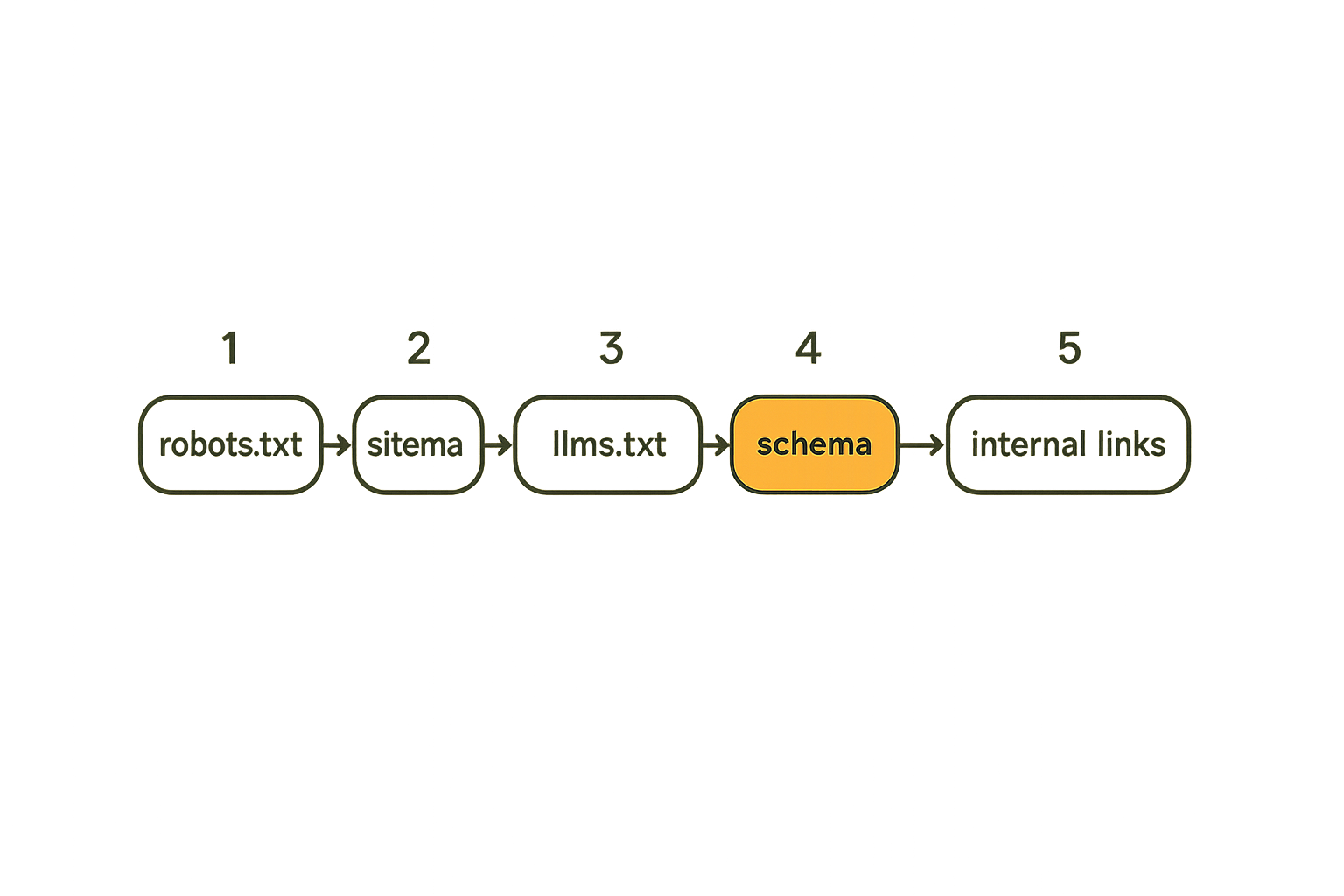
A basic routing sequence looks like this:
- robots.txt defines broad access boundaries.
- XML sitemaps list indexable canonical URLs.
- llms.txt points language models to priority explanatory resources.
- Schema clarifies what each page represents.
- Internal links reinforce which pages are canonical for each entity or question.
Cal ai measurement: what to log and inspect
Bot access is not enough
Cal ai measurement starts with access, but it cannot stop there.
You should know whether known AI crawlers are requesting your pages, which sections they hit, what status codes they receive, and whether security rules treat them differently from search bots. But a successful 200 response does not prove that the page was useful.
You also need to inspect the rendered page, extracted text, metadata, schema, canonical signals, and internal links. In production, many visibility problems hide in the gap between browser view and crawler view.
Examples:
- The human page shows pricing, but the crawler output does not.
- The schema names an old product line.
- The canonical points to a generic category instead of the detailed answer.
- The page loads core content only after an API call blocked by the bot policy.
- The best summary exists in an image with weak alt text.
Citation paths matter more than impressions
Search impressions are familiar. AI citation paths are less mature, but they are more useful for this problem.
You want to understand which pages are likely to become source material for answer engines. Those are often not the same pages that historically brought the most organic traffic. Documentation, comparison pages, definitions, pricing explainers, original research, and policy pages can become disproportionately important because they supply facts other pages only paraphrase.
For adjacent reading from our network: Answer Engine Optimization Product Management looks at a similar problem from the product team side, where product surfaces must be shipped in a way AI systems can understand and recommend.
A practical scorecard
A useful scorecard should be simple enough to run repeatedly. If it requires a quarterly strategy deck, it will not survive.
| AI bot access | Priority URLs return clean 200 responses | Bots challenged, blocked, redirected, or served thin content | Engineering |
| Extracted answer | Core answer appears in plain text near relevant heading | Answer only appears in image, tab, script, or vague copy | Content |
| Entity clarity | Product, company, author, and category names are consistent | Multiple names with no explanation | Marketing |
| Schema alignment | JSON-LD matches visible page content | Schema contains stale or unsupported claims | SEO or dev |
| Freshness | Updated dates match material changes | Old dates on pages with time-sensitive claims | Content ops |
| Source trust | Author, organization, policies, and evidence are clear | Anonymous claims and weak proof | Leadership |
This is not about chasing a perfect score. It is about finding the small set of fixes that make your site less ambiguous to answer systems.
A practical cal ai implementation workflow
Inventory the pages that should answer questions
Start with the pages that should represent your business in an AI answer. Do not start by auditing every URL.
Build a working list of:
- Homepage and core positioning pages.
- Product or service pages.
- Pricing and packaging pages.
- Comparison and alternative pages.
- Documentation and how-to guides.
- FAQ and policy pages.
- High-intent blog posts.
- Original data, reports, tools, or calculators.
For each page, write the question it should answer. If you cannot write the question, the page may be serving navigation or brand support rather than answer extraction. That is fine, but do not confuse the two.
Normalize the facts AI systems need
Next, create a fact layer. This can be a spreadsheet, CMS fields, structured content model, or internal knowledge base. The format matters less than consistency.
Track the facts answer systems are likely to need:
- Official company name.
- Product names and aliases.
- Category labels.
- Primary use cases.
- Audience or customer profile.
- Pricing model and constraints.
- Locations served.
- Integrations.
- Security or compliance claims.
- Support boundaries.
- Last reviewed date.
This prevents every page from inventing its own version of the business. It also makes updates safer. When pricing, positioning, or product names change, you know which pages and schema blocks need revision.
Validate from the crawler view
The implementation sequence should be boring and repeatable:
- Select a priority page and define the question it should answer.
- Fetch the URL as a normal crawler and inspect status code, redirects, canonical, robots directives, and rendered text.
- Compare extracted text with the human-visible page.
- Check whether the target answer appears in plain text near a relevant heading.
- Validate schema against visible content.
- Confirm internal links point to the canonical supporting pages.
- Add or update llms.txt references for priority resources.
- Re-fetch and document the before and after state.
- Turn unresolved issues into engineering, content, or policy tickets.
Related reading from our network: Answer Engine Optimization Threat Hunting uses a security workflow lens, but the operational idea is similar: visibility only matters when signals are routed to owners who can act.
What breaks when teams implement it badly
The crawler can fetch but cannot trust
This is the most common failure mode. The server returns the page, but the page does not provide enough evidence to be cited confidently.
Thin author pages, missing organization details, unsupported claims, stale dates, and vague superlatives all weaken trust. So does inconsistency between schema and visible content. If the page says one thing and structured data says another, you have created a reconciliation problem for machines.
What breaks in practice is that answer engines may use your content for background understanding but cite someone else. The competitor with the cleaner, more explicit source becomes the quote, even if your product is better.
The snippet is correct but stale
AI systems are sensitive to stale content because stale facts create bad answers. If your old comparison page says a feature is coming soon, while your product page says it launched last year, you have a freshness conflict.
The same issue shows up with pricing, eligibility, integrations, compliance claims, office locations, and availability. Website teams often update the obvious page and forget the surrounding content network.
A practical fix is to identify facts that expire and attach review owners to them. Pricing pages, integration lists, policy explanations, and competitor comparisons should have review dates that mean something internally, not just decorative updated labels.
Support absorbs the ambiguity
Bad cal ai architecture eventually becomes a support problem.
Users arrive with expectations formed by AI summaries. If those summaries are based on unclear, stale, or contradictory site content, support has to unwind the confusion. Sales teams answer questions that the site should have handled. Content teams get blamed for inaccurate AI answers even when the real issue is fragmented source material.
The failure is not only technical. It is operational. No one owns the path from public source content to AI-generated expectation.
Practical rule: If your site leaves room for a plausible but wrong summary, assume an answer engine will eventually produce it.
Ownership: who runs cal ai work
Marketing owns positioning
Marketing should own the language that defines the company, product, category, audience, and value proposition. That includes deciding which pages are canonical for which questions.
This does not mean marketing should control robots rules or deploy schema by hand. It means marketing is accountable for clarity. If the product is for agencies, say that. If it is not for enterprise procurement teams, say that too. Ambiguity may feel safer in copy, but it is expensive in answer systems.
Marketing also owns the content map: which pages should explain, compare, prove, and convert. Without that map, engineering can make pages crawlable but not strategically useful.
Engineering owns access and rendering
Engineering owns whether the public content is actually available to crawlers. That includes rendering, status codes, CDN behavior, redirects, robots.txt, sitemaps, performance, and structured data implementation.
The mistake teams make is assigning all AI visibility work to SEO and content. SEO cannot fix a WAF rule that blocks AI bots. Content cannot fix a React app that ships an empty shell to non-browser clients. Developers need clear tickets, not vague requests to improve AEO.
Good engineering tickets are specific:
- Priority URLs should return 200 for approved AI crawler user agents.
- Product summary content should exist in server-rendered HTML.
- JSON-LD should use the canonical product name and current dateModified field.
- Pricing FAQ content should not require client-side interaction to appear.
Legal and support own constraints
Legal, compliance, and support should be involved where claims, policies, safety, and customer expectations matter.
This is especially important for regulated products, financial services, healthcare, security tooling, marketplaces, and any business with eligibility rules. If you do not state constraints clearly, answer systems may summarize your offer too broadly.
Related reading from our network: Jobs Hiring Immediately Near Me is in a different niche, but it shows the same trust problem in a labor-market context: AI workflows need clear constraints, screening signals, and source quality or users act on weak information.
What works, what fails, and how to prioritize
What works
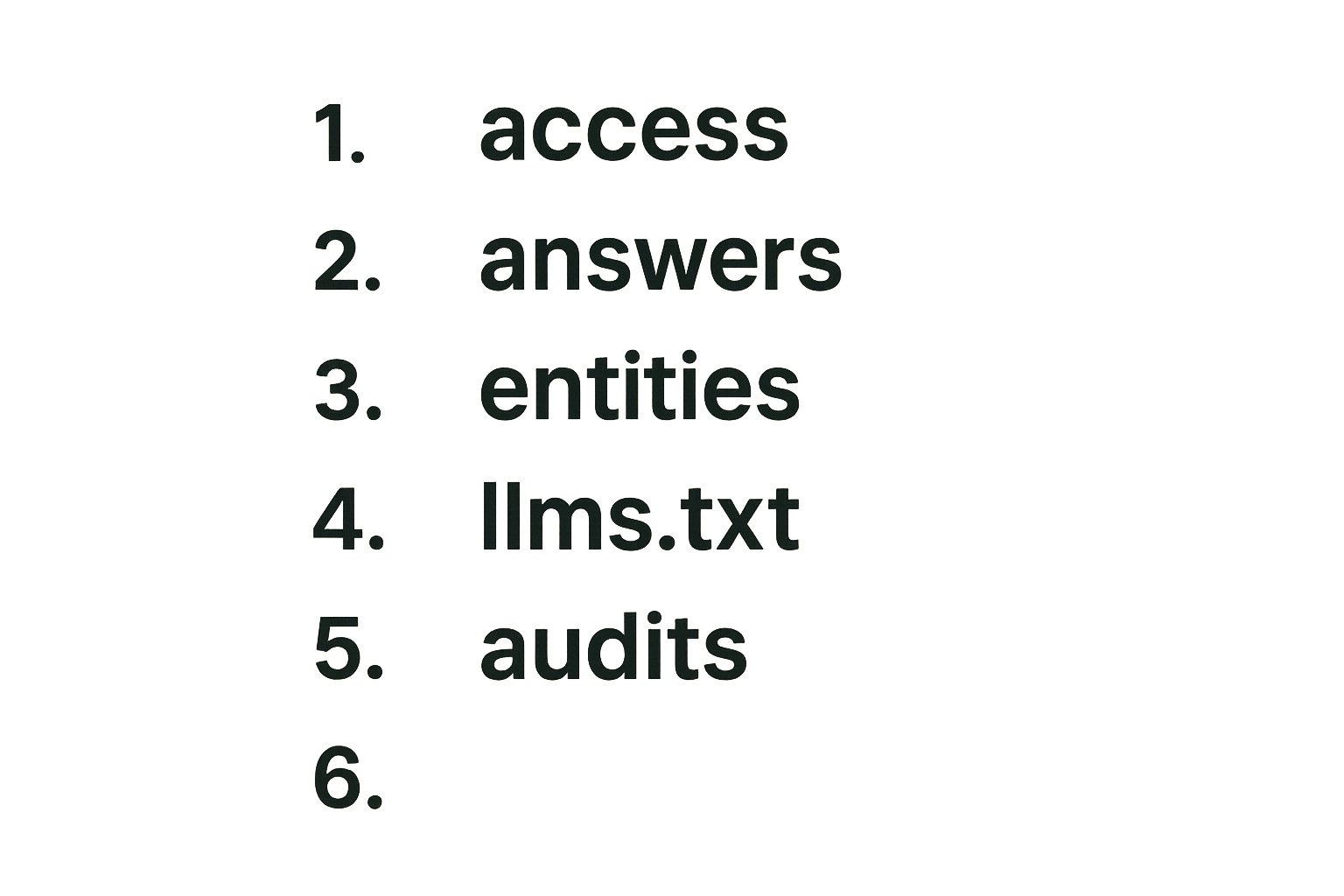
What works is usually unglamorous:
- Clear canonical pages for important questions.
- Direct answers near relevant headings.
- Consistent entity names across content and schema.
- Server-rendered core content.
- Clean robots and sitemap behavior.
- Curated llms.txt references.
- Freshness workflows for volatile facts.
- Comparison tables that state criteria explicitly.
- Evidence attached to claims.
- Regular crawler-view audits.
This is the operator version of cal ai. You are not trying to trick an answer engine. You are reducing ambiguity so that a system can use your site without guessing.
What fails
What fails is also predictable:
- Publishing generic AI-written pages that add no source value.
- Treating schema as a hidden claim-stuffing layer.
- Blocking unfamiliar bots without reviewing business impact.
- Building interactive pages with no crawlable fallback.
- Creating llms.txt once and never maintaining it.
- Letting old blog posts contradict current product pages.
- Using five names for one product.
- Measuring only traffic while ignoring source usability.
The worst version is a site that looks sophisticated to humans but fragmented to machines. It has polished design, clever messaging, and no stable answer layer.
Priority order
If you are starting from zero, do not boil the ocean. Prioritize like this:
- Fix access for the pages you actually want cited.
- Make the core answer visible in plain text.
- Normalize entity names and page titles.
- Align schema with visible content.
- Add curated llms.txt guidance.
- Refresh stale pages that contain volatile claims.
- Build a repeatable audit loop.
This order matters. Adding llms.txt before the pages are clear does not solve the problem. Adding schema before the facts are correct can make the problem worse. Publishing more content before fixing source ambiguity simply creates more places for answer engines to get confused.
Where CrawlProof fits into the workflow
See what AI crawlers actually receive
CrawlProof is built around a simple premise: before you optimize for answer engines, you need to see your site the way AI crawlers see it.
That means looking beyond the browser screenshot. You need to inspect content availability, schema, robots behavior, AI-bot access, page positioning, and the practical to-do list that falls out of those signals. The goal is not to produce another abstract score. The goal is to find the specific issues preventing a page from being discovered, parsed, trusted, or cited.
Turn audits into tickets
The product-fit for cal ai work is straightforward. Site owners and marketers need a way to translate AEO concerns into operational fixes.
An audit should tell content teams where the answer is missing, SEO teams where schema or internal linking is weak, and developers where crawlers are blocked or served incomplete content. That is the workflow gap most teams feel: everyone agrees AI visibility matters, but no one has a clean queue of fixes.
CrawlProof helps make that queue visible. It is for website owners, SEO professionals, content strategists, and developers who need to understand what LLM crawlers and answer engines can actually find, not what the site appears to say in a polished browser session.
Closing the loop
The closing loop is what matters. Run an audit, fix the highest-impact pages, re-check the crawler view, update the content map, and keep volatile facts under review.
Cal ai will not be solved by one plugin, one prompt, or one content sprint. It is a maintenance workflow for the answer-engine era. The teams that win will be the teams that make their best source material accessible, explicit, current, and easy to cite.
Try crawlproof.com
CrawlProof helps site owners and marketers see how AI answer engines and LLM crawlers discover, parse, and cite their content. Try crawlproof.com