Most teams hear Charles Babbage Analytical Engine and think they are about to read a history lesson. That is the wrong frame. For website owners, SEO teams, content strategists, and developers in 2026, the useful lesson is not nostalgia. It is architecture.
Teams think the problem is getting AI answer engines to notice their pages. The real problem is giving those systems a site that behaves like a machine-readable engine instead of a pile of human-facing documents.
That changes the conversation. The practical question is not whether your article is clever, long, or keyword-rich. The practical question is whether a crawler, parser, retriever, summarizer, and citation system can discover your page, understand the claims, connect them to entities, verify the evidence, and decide that your page deserves to be referenced in an answer.
The Charles Babbage Analytical Engine matters because it separated storage, processing, instructions, and output long before modern software teams used those words. A good AEO workflow needs the same separation. If your site mixes claims, navigation, JavaScript rendering, schema, product positioning, and legal disclaimers into one messy surface, AI systems may crawl it but still fail to use it.
Table of contents
Why the Charles Babbage Analytical Engine matters for AEO in 2026
Teams think the problem is visibility
Most AEO conversations start too late. A team publishes a page, waits for search traffic, asks an AI assistant a few prompts, and then wonders why the assistant cites competitors instead. The conclusion is usually shallow: we need more content, more schema, more mentions, more authority.
Sometimes that is true. Often it is not the root problem.
The mistake teams make is treating answer engine optimization as a publishing tactic. They assume the page exists, therefore it is available. They assume the answer is written, therefore it is extractable. They assume the schema validates, therefore it is meaningful. In production, those assumptions fail constantly.
A useful way to think about it is that AI answer engines do not consume your website the way a motivated buyer does. They operate through a pipeline: discover, fetch, render, parse, segment, embed, retrieve, reason, summarize, cite. Every stage can lose information. Every stage can distort context. Every stage can decide your page is not worth using.
If your team is still getting oriented, the distinction matters because AEO is not just renamed SEO. SEO historically optimizes for ranking a document in a results page. AEO optimizes for being useful inside a generated answer where the page may become a citation, a source passage, or a supporting fact.
The real problem is machine-readable execution
The Charles Babbage Analytical Engine was designed around execution. It was not just a table of numbers. It was a proposed system with memory, operations, instructions, and output. That is why it still matters as a mental model.
A modern website has the same problem. It cannot only store content. It must expose content in a way that machines can reliably operate on.
That means your site needs:
- Stable pages for important entities, products, services, authors, and definitions.
- Clean crawl paths that do not depend on fragile client-side interactions.
- Structured data that matches visible content.
- Clear claim boundaries, so systems can tell what you assert versus what you mention.
- Evidence blocks, examples, tables, and definitions that can survive extraction.
- Freshness signals that do not conflict across page copy, metadata, sitemaps, and schema.
Practical rule: If a human has to infer the most important meaning from layout, brand tone, or visual hierarchy, an AI crawler may miss it or flatten it into generic text.
That is the Babbage lesson. The system is only useful if the instructions and the data can be read consistently.
The analytical engine as a content architecture model
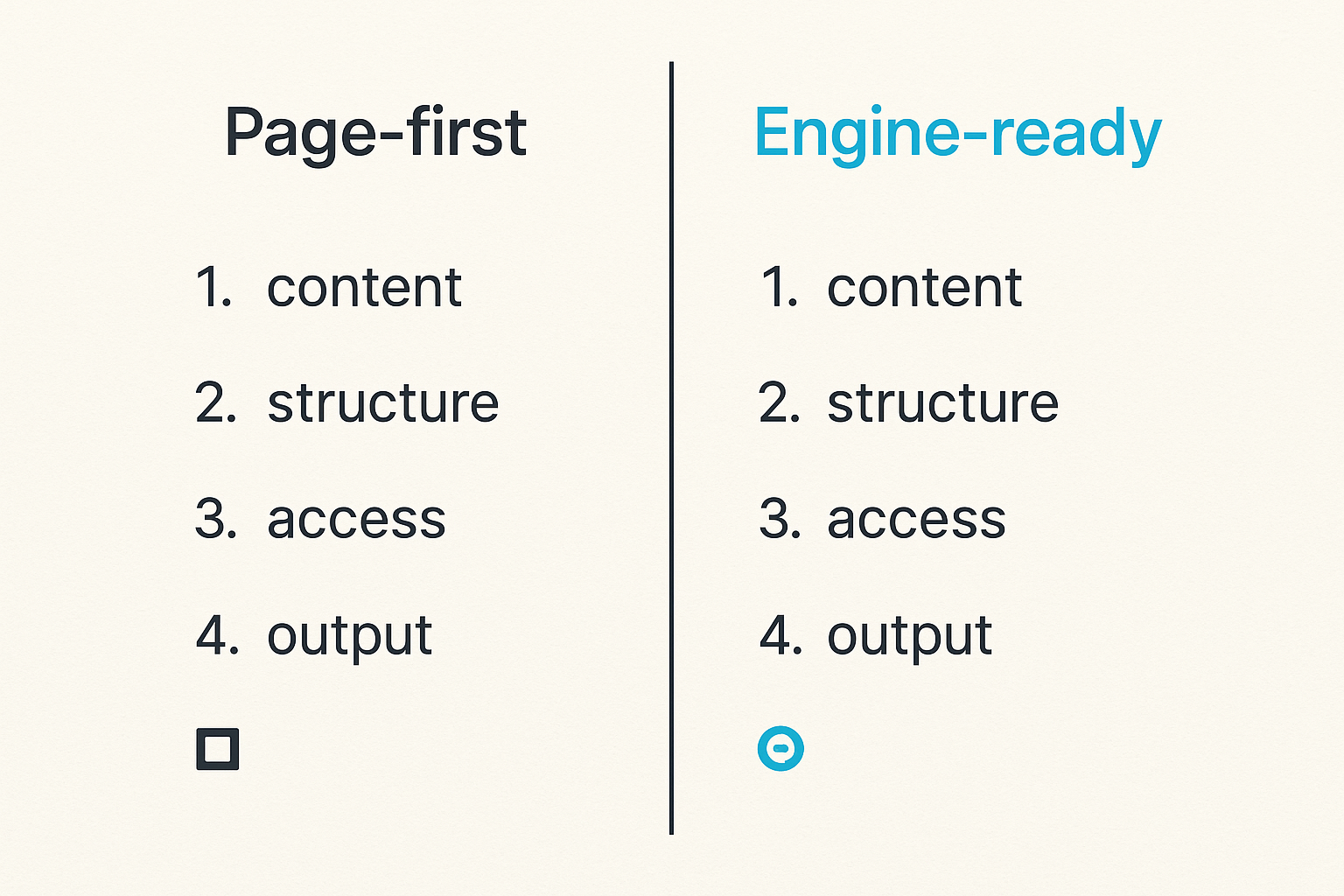
Store, mill, control, output
The Analytical Engine is usually described through four ideas: a store for memory, a mill for calculation, a control mechanism using punched-card concepts, and output for results. You do not need to be a computing historian to use this model. You need to map it to your website.
For AEO, the equivalent looks like this:
| Store | Your canonical content, entities, facts, documentation, product data | The model cannot find stable source material |
| Mill | Parsing, rendering, extraction, retrieval, summarization | Important meaning gets lost during processing |
| Control | Schema, internal links, robots rules, sitemaps, llms.txt-style guidance | Crawlers receive weak or conflicting instructions |
| Output | Snippets, cited passages, answer summaries, recommendations | The assistant cites someone else or summarizes you badly |
The point is not that websites are computers in a literal sense. The point is that useful machine systems need separation of concerns. If your content store is weak, schema cannot save it. If your control layer blocks crawlers, brilliant copy will not be retrieved. If your output layer is vague, assistants will paraphrase your brand into mush.
Related reading from our network: teams thinking about protocols and conventions in AI systems face a similar vocabulary problem, and this piece on standards, specs, schemas, contracts, and conventions is adjacent to the same architecture tradeoff.
Why separation of concerns still matters
AEO gets sloppy when teams collapse everything into page copy. They add an FAQ section because someone said assistants like FAQs. They paste JSON-LD because a plugin offered it. They add an AI policy page because competitors did. None of that is wrong by itself, but it fails when there is no architecture behind it.
A practical AEO architecture separates four layers:
- Content layer: what the site actually says.
- Structure layer: how the information is organized and related.
- Access layer: what crawlers can fetch, render, and index.
- Validation layer: how the team proves machines see the intended information.
What breaks in practice is that each layer usually has a different owner. Content sits with marketing. Schema sits with SEO or a plugin. Rendering sits with engineering. Robots and CDN rules sit with whoever last touched infrastructure. Nobody owns the end-to-end machine interpretation path.
Practical rule: Do not ask whether a page has schema. Ask whether the content, schema, crawl rules, canonical URL, and visible answer all agree.
That question forces the team to inspect the whole engine.
From pages to instructions: how AI crawlers process your site
Discovery is not comprehension
A crawler can discover a URL and still fail to understand the page. It can fetch HTML and still miss content injected after interaction. It can parse visible copy and still misunderstand which entity owns a claim. It can read schema and still ignore it if the markup contradicts the page.
This is why many site owners get frustrated. They check server logs and see AI bots. They search their brand in an assistant and see outdated language. They ask a category question and a competitor appears. The crawler touched the site, but the answer engine did not use the site well.
The mistake teams make is treating crawl access as binary. Allowed or blocked. Indexed or not indexed. In reality, machine consumption has quality levels.
A rough ladder looks like this:
- URL discovered.
- HTML fetched.
- Important content rendered.
- Main content separated from navigation and boilerplate.
- Entities and claims extracted.
- Page associated with topic clusters and source credibility.
- Passages retrievable for relevant prompts.
- Page selected as a citation candidate.
- Passage used accurately in a generated answer.
Each step can fail silently.
Your site needs predictable interfaces
Predictable interfaces are not just for APIs. Your website needs them too.
For AI crawlers, predictable interfaces include XML sitemaps, clean canonicals, consistent title patterns, readable headings, stable URLs, useful internal links, schema that matches the page, and crawler guidance files where appropriate. Emerging files such as llms.txt are not magic, but they are part of the control layer. If you use them, they should point machines toward high-value source material instead of becoming another neglected checklist item. CrawlProof has a practical explainer on llms.txt and skill.md if your team is deciding what belongs in those files.
The practical question is not whether every AI system obeys every hint. They will not. The question is whether you reduce ambiguity for the systems that do look.
A predictable interface says:
- Here are the canonical pages.
- Here are the topics we cover.
- Here are the pages that define our products or services.
- Here is the structured data that supports those pages.
- Here is what should be ignored as utility, navigation, or duplication.
That changes the conversation from hoping AI systems understand you to actively designing for machine interpretation.
What the Charles Babbage Analytical Engine teaches about schema
Schema is the punch card layer
The Charles Babbage Analytical Engine used the idea of external instructions. For websites, schema markup is one part of that instruction layer. It tells machines what kind of thing a page represents and how important pieces relate.
But schema is not a trophy. It is not enough that a testing tool says valid. Valid markup can still be useless, misleading, or too shallow.
Common weak schema patterns include:
- Organization schema that omits sameAs profiles, contact points, or clear brand identity.
- Article schema with no meaningful author, date, or topic relationship.
- Product schema that conflicts with visible pricing, availability, or naming.
- FAQ schema generated from thin questions nobody actually asks.
- Breadcrumb schema that does not match the real information architecture.
The punch card analogy is useful because instructions only work when they correspond to the machine and the material. If the card says one thing and the mechanism does another, the output is unreliable.
Practical rule: Treat schema as an instruction layer, not a decoration layer. If it does not clarify entity, claim, author, date, product, or relationship, it may not help answer engines.
Entity consistency beats decorative markup
Answer engines are entity machines. They need to know what a page is about, who produced it, what claim is being made, which product or service is referenced, and how those items connect to known concepts.
Entity consistency shows up in boring places:
- Your company name is written the same way across title tags, schema, footer, social profiles, and about pages.
- Authors have stable pages or bios where expertise is visible.
- Product names do not change between landing pages, docs, help center pages, and pricing pages.
- Category pages link to detailed supporting pages instead of standing alone as vague marketing copy.
- Dates are maintained when claims depend on freshness.
Decorative markup fails because it does not resolve ambiguity. A page with many schema types but unclear content is like an engine with extra levers and no fuel.
The better pattern is boring and reliable. Define your important entities. Link them. Mark them up. Keep the visible content aligned. Then test what a crawler can actually extract.
Build an AEO workflow around machine interpretation
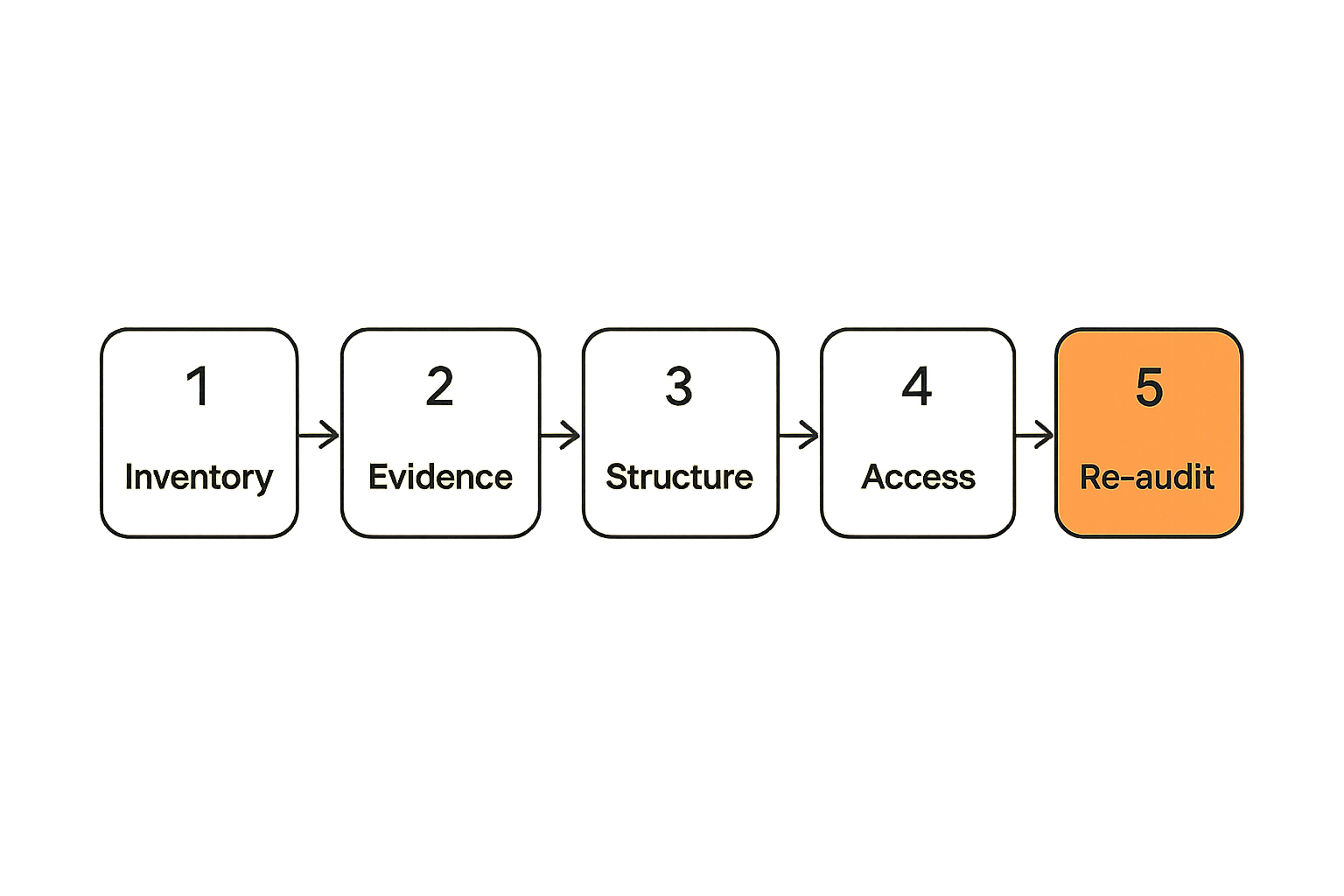
Step 1: map the answer inventory
Before rewriting pages, map the answers your site should be eligible to provide. This is where AEO becomes operational instead of theoretical.
A simple answer inventory includes:
- Commercial questions: who is this for, what does it cost, when should I choose it?
- Comparison questions: how does this differ from alternatives?
- Implementation questions: how do I set it up, integrate it, or maintain it?
- Risk questions: what can go wrong, what are the constraints, what should I avoid?
- Evidence questions: why should someone trust this source?
Do not start with keywords only. Start with answer roles. A page may rank for a query and still be useless as an answer source if it has no concise claim, no supporting evidence, and no clear entity relationship.
A practical workflow:
- List the 25 to 100 prompts where your site should be a credible source.
- Map each prompt to an existing canonical page.
- Mark gaps where no page gives a complete answer.
- Identify pages with good human copy but poor machine structure.
- Prioritize pages tied to revenue, support deflection, or brand risk.
Related reading from our network: if you manage content production with contractors or small teams, this AI-assisted freelance workflow piece on proof, outreach, and delivery systems is a useful adjacent reminder that repeatable workflows beat one-off effort.
Step 2: expose evidence and structure
Once the answer inventory exists, improve the page architecture. This does not always mean adding more words. Often it means making the existing information easier to extract.
What works:
- Put direct answers near the relevant heading.
- Use tables when comparing features, requirements, limits, or options.
- Put definitions close to the terms they define.
- Separate claims from examples.
- Include implementation steps in ordered lists.
- Link from summary pages to deeper source pages.
- Add schema that reflects the visible content.
What fails:
- Long introductions before any answer appears.
- Generic FAQs detached from the main topic.
- Hype phrases that do not say anything verifiable.
- Important details trapped in images, tabs, accordions, or scripts.
- Schema generated from templates without page-specific meaning.
The goal is not to write for robots instead of people. The goal is to write for people in a way that machines can safely decompose.
Step 3: validate crawler access
Validation is where many AEO projects become real. You need to test what machines can fetch and extract, not just what a browser shows your team.
Check the basics:
- Robots.txt does not block important crawlers unintentionally.
- AI-relevant pages are present in sitemaps.
- Canonical tags point to the intended URL.
- Server responses are stable and not geo-locked or bot-hostile by accident.
- Important content appears in rendered HTML, not only after clicks.
- Structured data parses and matches visible claims.
- Internal links expose priority pages within a few crawl steps.
The mistake teams make is validating only once. AEO validation should run after site migrations, CMS changes, theme updates, CDN rule changes, JavaScript framework changes, and major content rewrites. Otherwise the engine drifts.
What breaks when teams implement AEO badly
Thin summaries without source depth
The fastest way to look answer-ready is to add summaries. The fastest way to fail answer engines is to add summaries without source depth.
A generated answer needs confidence. If your page says the same shallow thing as everyone else, it may be retrieved but not selected. If your answer is concise but unsupported, it may be ignored for a source with better examples, clearer authorship, fresher data, or stronger internal references.
Thin AEO content often has these symptoms:
- Every paragraph could appear on a competitor site with the brand name swapped.
- Claims are broad but not operational.
- The page lacks examples, edge cases, or constraints.
- No author, editor, date, or evidence trail is visible.
- The page answers what but not when, why, how, or what breaks.
Answer engines are not perfect judges of quality, but they are very good at finding redundant language. If your page only restates consensus, it gives the system little reason to cite you.
Blocked bots, broken canonicals, and stale snippets
The more technical failures are usually less visible to content teams.
What breaks in practice:
- A CDN challenge blocks non-browser crawlers from important pages.
- A robots rule copied from staging blocks sections that should be crawlable.
- Canonical tags point to generic category pages instead of detailed sources.
- JavaScript renders key content after events crawlers do not trigger.
- Schema dates are updated automatically while visible page content is old.
- Multiple pages compete with near-identical answers and no canonical hierarchy.
- The llms.txt file points to old URLs or marketing pages instead of source pages.
These failures are frustrating because each one looks small. Together they make the site untrustworthy to machines. The page might exist, the copy might be strong, and the crawler might still choose another source.
Practical rule: AEO failures are often pipeline failures. Do not diagnose them only by reading the page. Inspect fetchability, rendering, structure, internal links, and extracted meaning.
Comparison: SEO pages versus answer-ready pages
The wrong comparison is human versus machine
A bad AEO strategy creates a false choice: write for humans or write for machines. That is not how this works. Pages that answer clearly, cite evidence, organize entities, and expose structure are usually better for humans too.
The wrong comparison is human versus machine. The useful comparison is implicit versus explicit.
Traditional SEO pages often rely on implicit cues. A human can scan the design, infer what matters, click around, and build context. AI systems can do some of that, but the pipeline is lossy. The safer architecture makes the important relationships explicit.
The useful comparison is implicit versus explicit
| Main answer | Buried after brand intro and keyword setup | Direct answer under a precise heading |
| Evidence | Implied by confident copy | Examples, dates, source context, constraints |
| Entity clarity | Brand and product mentioned inconsistently | Stable names, sameAs links, organization and product schema |
| Comparisons | Narrative paragraphs only | Tables with dimensions and tradeoffs |
| Implementation | Described generally | Ordered steps, requirements, failure modes |
| Internal links | Built for navigation and link equity | Built for entity relationships and source depth |
| Freshness | Updated date in template | Visible maintained date plus updated claims |
| Crawler control | Robots and sitemap treated as SEO chores | Access rules reviewed as part of AEO validation |
This table is not an argument against SEO. It is an argument against stopping at SEO. Ranking a page and making a page usable inside generated answers are related but not identical jobs.
Related reading from our network: media and infrastructure teams hit similar architecture issues when content, access, and delivery systems drift, as this guide to streaming, torrents, IPTV, and home media architecture shows in a different niche.
Metrics that matter for AI answer visibility
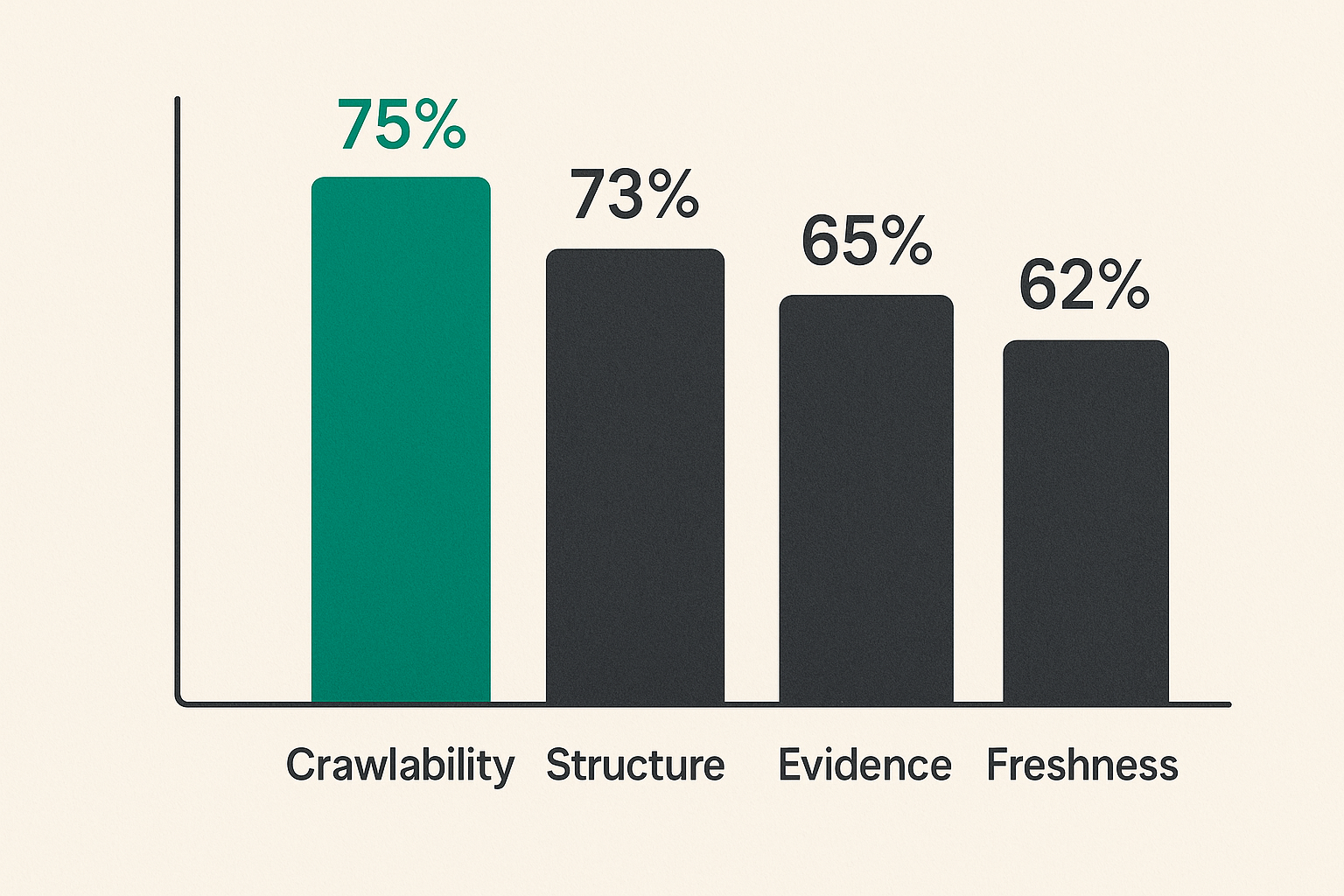
Crawlability signals
AEO measurement is still messy. You cannot get a complete dashboard from every answer engine showing every retrieval event and every citation decision. So you need proxy metrics that measure the pipeline.
Start with crawlability signals:
- Important pages return 200 status codes consistently.
- Sitemaps include canonical answer pages.
- Robots rules allow the crawlers you intend to allow.
- Server logs show fetches without excessive errors.
- Page content renders without requiring login, location, or interaction.
- HTML contains meaningful main content, not just an app shell.
- Internal links expose key pages from hubs and related articles.
These are not glamorous metrics, but they prevent wasted content work. If an answer engine cannot reliably fetch and parse the page, ranking-style content improvements are premature.
A useful review cadence is monthly for stable sites and after every deploy for sites with frequent CMS, rendering, or routing changes. You do not need a giant process. You need a repeatable check that catches silent regressions.
Citation readiness signals
Citation readiness is harder but more interesting. You are asking whether a page is likely to be used as a source when an answer engine assembles a response.
Look for:
- Clear answer blocks under relevant headings.
- Strong topical alignment between title, H1, headings, copy, and schema.
- Distinctive examples or implementation details.
- Visible authorship or organizational accountability.
- Internal links to deeper evidence pages.
- Comparison tables or decision frameworks.
- Updated dates where freshness matters.
- Low duplication between your own pages.
You can also run manual prompt tests, but do not over-trust them. AI answers vary by system, user context, location, date, and retrieval behavior. A prompt test is a sample, not a measurement system.
The practical approach is to combine three views:
- Technical crawl and render checks.
- Page-level extraction and schema checks.
- Prompt sampling across priority answer roles.
If all three improve, you are probably making the site more answer-ready even before citations become consistent.
Governance: who owns the AI-readable layer
Content owns claims
AEO governance starts with claims. Content teams should own what the site says, what it can prove, and what it should not overstate.
This includes:
- Definitions and positioning.
- Product capabilities and limitations.
- Comparison language.
- Author and editorial standards.
- Update cadence for time-sensitive pages.
- Evidence and examples.
The mistake teams make is delegating AEO entirely to technical SEO or engineering. That produces crawlable pages with weak claims. Answer engines may understand the page perfectly and still decide it is not useful.
Content owners need to think like maintainers of a source library. If an assistant quotes one paragraph out of context, will the claim still be accurate? If a competitor changes its product, is your comparison still fair? If a date appears in schema, does the visible page justify freshness?
Developers own access and structure
Developers own the parts that content teams cannot reliably fix inside a CMS: rendering, routing, templates, schema generation, canonical logic, redirects, robots rules, and performance constraints.
This does not mean every developer needs to become an AEO strategist. It means the website platform should not sabotage machine interpretation.
Engineering should provide:
- Templates that preserve semantic headings.
- Components that expose text in HTML when possible.
- Schema fields tied to real CMS data.
- Safe defaults for canonical URLs and metadata.
- Deploy checks for robots, sitemap, and rendering regressions.
- Clear documentation for how important page types are generated.
The best teams create a shared checklist. Content defines the source. SEO defines the retrieval and answer opportunity. Engineering makes the machine-readable path reliable. Leadership decides which answer spaces matter commercially.
That changes the conversation from who owns AEO to who owns each layer of the engine.
Where CrawlProof fits in the workflow
Audit before rewriting
Most teams rewrite too early. They see weak AI visibility and assume the words are wrong. Sometimes the words are fine. The crawler path is wrong. The schema is thin. The canonical points to the wrong URL. The page renders poorly. The important answer is buried in layout noise.
CrawlProof is built for the audit step: see your site the way AI crawlers and answer engines see it. That means checking what is discoverable, what is blocked, what schema exists, what content is visible, and where machine interpretation may fail.
This is the operator-friendly sequence:
- Pick a revenue-relevant or authority-relevant URL.
- Audit the URL for AI crawler access and answer readiness.
- Separate technical blockers from content gaps.
- Fix access, structure, and schema before rewriting large sections.
- Re-audit after changes to confirm the machine-readable layer improved.
If the audit says machines cannot see the right content, more copy is not the first fix. If the audit says the page is visible but vague, then content work becomes the priority.
Turn findings into fixes
A useful AEO audit should produce actions, not anxiety. The output should help teams decide whether to edit copy, adjust schema, fix robots rules, improve internal links, or create a better source page.
Good findings are specific:
- The page is crawlable, but important content is injected after interaction.
- Organization schema exists, but the brand entity is inconsistent.
- The article answers the topic, but the answer appears too late and lacks extractable evidence.
- The sitemap includes duplicate variants and omits the canonical guide.
- The page has FAQ markup, but the visible FAQ does not support the main answer intent.
That is where CrawlProof fits architecturally. It is not a replacement for content judgment, technical SEO, or engineering ownership. It gives those teams a shared inspection layer so they can stop arguing from screenshots and start fixing the machine path.
Closing: the Charles Babbage Analytical Engine lesson for modern sites
Architecture wins over decoration
The Charles Babbage Analytical Engine is useful to AEO teams because it forces an uncomfortable point: machines need architecture, not vibes. A website that looks polished to humans can still be hard for AI crawlers to parse. A page with valid markup can still be a poor source. A blog with hundreds of posts can still fail to expose the few answers that matter.
The lesson is not to turn your site into a technical artifact nobody wants to read. The lesson is to make the human-readable and machine-readable layers agree.
Your content store needs depth. Your processing path needs clean HTML and stable rendering. Your control layer needs schema, sitemaps, robots rules, canonicals, and crawler guidance that point in the same direction. Your output layer needs concise, accurate, extractable answers.
The practical next step
Do not start by asking whether your site has enough AI content. Ask whether your site behaves like an engine.
Can machines find the right URLs? Can they fetch the page without friction? Can they parse the main content? Can they identify entities, claims, dates, and relationships? Can they retrieve a passage that actually answers the question? Can they cite you without distorting what you meant?
That is the practical Charles Babbage Analytical Engine lesson for modern sites: separate the parts, test the workflow, and fix the layer that is actually broken. In the closing reality of AEO, the teams that win will not be the ones adding the most surface-level AI labels. They will be the ones building sites that answer engines can reliably operate on.
Try crawlproof.com
CrawlProof helps site owners and marketers see how AI answer engines and LLM crawlers discover, parse, and cite their content. Try crawlproof.com