Most website teams still treat AI crawler visibility as a content problem. Add better schema. Publish clearer pages. Create an llms.txt file. Wait for answer engines to notice.
That is only half the work. CI/CD security llm crawlers is now an operational problem because AI-facing files are shipped through the same pipelines as product code, landing pages, redirects, robots rules, and structured data.
Teams think the problem is getting LLM crawlers to discover the right content. The real problem is making sure the content, metadata, access rules, and crawler instructions being discovered are actually the ones your business intended to publish.
That changes the conversation. AEO is no longer just copywriting plus technical SEO. It is release management for machine-readable trust signals.
Table of contents
Why CI/CD security llm crawlers is an architecture problem
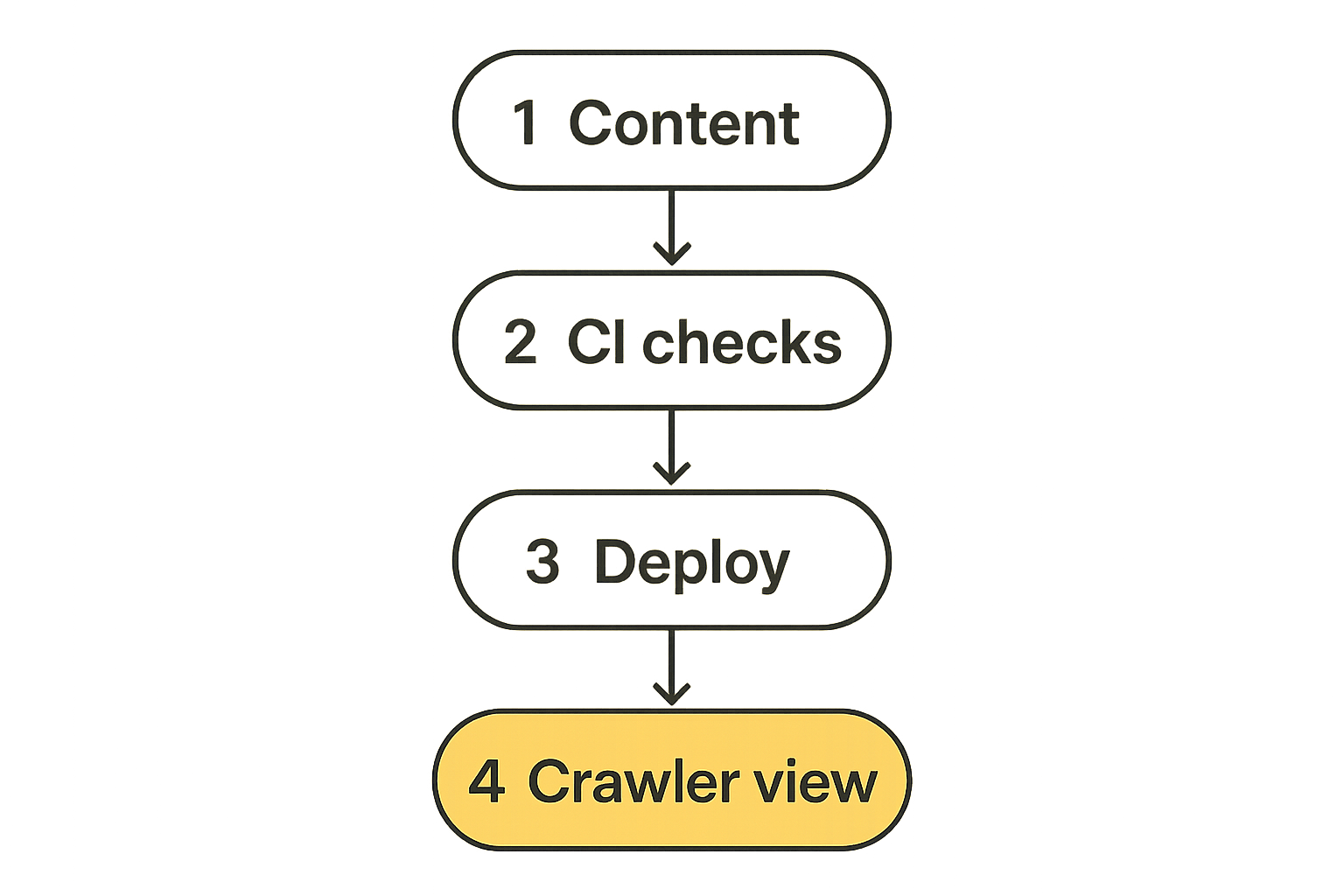
AI indexing turns SEO files into production assets
In classic SEO, a bad meta description or stale sitemap was annoying. It could hurt rankings, confuse users, or create crawl waste. But the damage path was usually indirect.
With AI answer engines, your structured content, crawler instructions, and machine-readable summaries can shape how systems understand your brand, products, pricing, support boundaries, and expertise. That means files like robots.txt, sitemap.xml, llms.txt, schema markup, canonical tags, and API-generated content feeds should be treated as production assets.
The mistake teams make is separating AEO work from release discipline. A marketer edits a template. A developer changes a build plugin. A CMS extension rewrites schema. A static site generator upgrade changes output paths. Nobody intended to alter AI crawler access, but the deployed site tells crawlers something different.
Practical rule: If a file can influence what an answer engine discovers, cites, ignores, or summarizes, it belongs in your release control model.
The crawler does not know your release intent
LLM crawlers do not know that yesterday's deployment was meant to update only a pricing paragraph. They see the final rendered site, HTTP headers, linked data, robots policies, redirects, and page content.
If a deployment accidentally blocks a crawler from your documentation, exposes a staging page, duplicates outdated product claims, or removes organization schema, the crawler has no context. It consumes what is visible.
The practical question is not, "How do we make AI crawlers visit us?" The better question is, "How do we make sure every crawler-visible signal is intentional, reviewed, and verifiable after release?"
That is a CI/CD security question.
Where LLM crawler signals live in your delivery pipeline
The files and routes that influence AI discovery
LLM crawler behavior is affected by more than blog content. The AI-facing surface area usually includes:
robots.txt rules and user-agent-specific directivesllms.txt or similar AI guidance files- XML sitemaps and sitemap indexes
- JSON-LD schema for organization, article, product, FAQ, and breadcrumb entities
- Canonical and hreflang tags
- Rendered HTML after hydration or edge rewriting
- Markdown source files used by documentation systems
- Content APIs feeding headless CMS pages
- Redirect maps and route manifests
- HTTP status codes, cache headers, and noindex directives
A useful way to think about it is this: AEO assets are not a folder. They are an output graph. Some files are hand-authored. Some are generated. Some are assembled at the edge. Some change when dependencies change.
That output graph needs the same visibility you expect for application behavior.
The hidden dependencies behind clean AEO output
Most teams can point to the person who wrote a page. Fewer can point to the thing that generated the final schema block.
Common dependencies include CMS plugins, SEO frameworks, static site build scripts, localization tooling, tag managers, analytics scripts, CDN workers, and deployment environment variables. Any of those can change crawler-visible output.
For site owners and marketers, this is where the risk becomes operational. You may approve a content brief, but the pipeline decides what ships. If a package update changes structured data formatting, your AEO strategy changes even if the visible copy looks the same.
The team at vu1nz.com often frames this kind of issue as a software supply chain problem: the deployed artifact matters more than the team's intention.
The threat model for CI/CD security llm crawlers
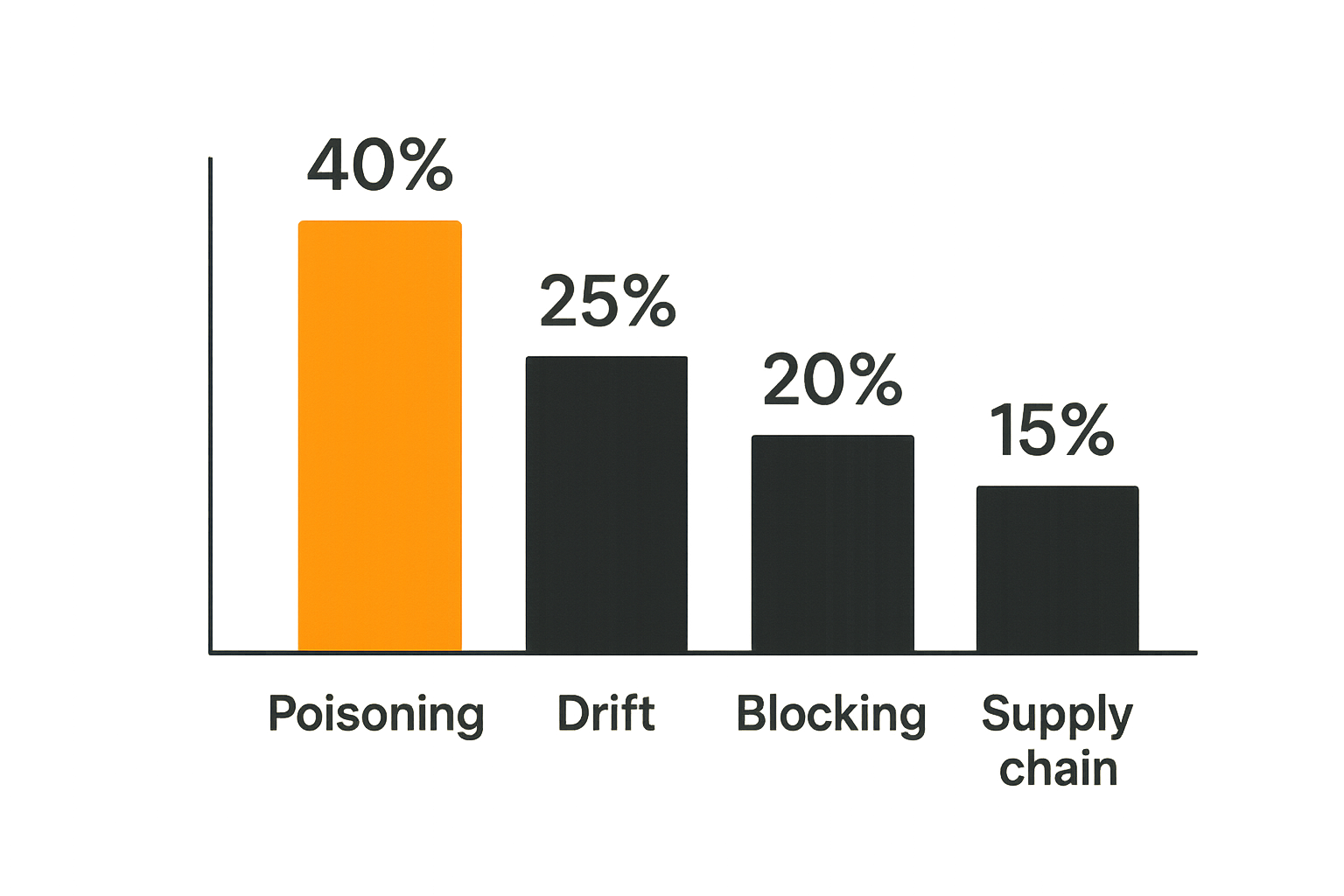
Content poisoning and prompt-adjacent manipulation
Content poisoning is not always dramatic. It can be a small change in a footer, a hidden block in documentation, a manipulated FAQ answer, or a generated paragraph that injects misleading claims.
For LLM crawlers, the risk is that compromised or low-quality content becomes part of a model's retrieval context, answer summary, or citation pathway. This is especially relevant for brands publishing technical docs, legal guidance, product comparisons, financial content, medical content, or security advice.
What breaks in practice is trust attribution. If your domain publishes the poisoned content, downstream systems may treat it as your statement.
Prompt-adjacent manipulation is also worth watching. You are not "prompting" a crawler in the same way a user prompts a chatbot, but you may publish instructions, summaries, or machine-readable guidance intended for AI systems. Those files should be reviewed like code, not casual copy.
Not every failure is an attack. Many are boring deployment mistakes.
A template change removes Article schema. A staging Disallow: / rule reaches production. A noindex header gets inherited from a test environment. A CDN rule blocks unfamiliar user agents. A migration changes canonical URLs. A content model drops author fields.
Individually, these look like SEO bugs. In an answer engine environment, they can become discoverability failures. You may still have great content, but the machine-readable path to that content is degraded.
Practical rule: Treat crawler access rules as security-sensitive configuration, not as text files anyone can patch at the end of a launch.
Supply chain compromise in static site builds
Static sites feel safe because there is no runtime database query on every request. But the build pipeline can still be compromised.
A malicious dependency can modify generated HTML. A compromised build token can alter content at deploy time. A poisoned package can inject outbound links or hidden text. A rogue plugin can expose draft content. A CI secret can leak API access to a headless CMS.
For LLM crawlers, the issue is not just user harm. It is persistence. Bad output can be crawled, cached, summarized, and quoted after you have already fixed the site.
That is why CI/CD security llm crawlers should include artifact verification, dependency review, and post-deploy checks.
What breaks when teams implement AI crawler support badly
The robots file becomes a bottleneck
The robots file often starts as an SEO artifact and slowly becomes a policy layer. Marketing wants more AI visibility. Legal wants restrictions. Engineering wants to protect internal routes. Security wants to avoid exposing sensitive paths.
If nobody owns the policy, robots.txt becomes a bottleneck and a dumping ground.
The failure mode is predictable: emergency edits, contradictory user-agent rules, stale comments, and production changes made outside review. Then nobody knows why a crawler is blocked or allowed.
Schema changes ship without review
Schema markup looks harmless because users rarely see it. That is exactly why it needs review.
Structured data can make claims about pricing, availability, authorship, ratings, product identity, support contacts, and organizational relationships. If schema is generated from CMS fields, a small content modeling change can alter many pages at once.
The practical risk is silent drift. Your visible page says one thing. Your JSON-LD says another. AI systems may parse the structured version more cleanly than the visible one.
Generated content bypasses normal controls
Many teams are adding AI-assisted summaries, programmatic comparison pages, auto-generated FAQs, and templated landing pages. Some of this is useful. Some of it is thin content at scale.
The security issue is that generated content often bypasses the editorial and release controls applied to normal pages. It may be created by a script, pushed through an API, and deployed with minimal human review.
For AEO, this is dangerous because machine-readable content can be consumed quickly and broadly. If generated pages are inaccurate, duplicated, or contaminated by untrusted inputs, LLM crawlers may still discover them.
A secure release workflow for AI crawler assets
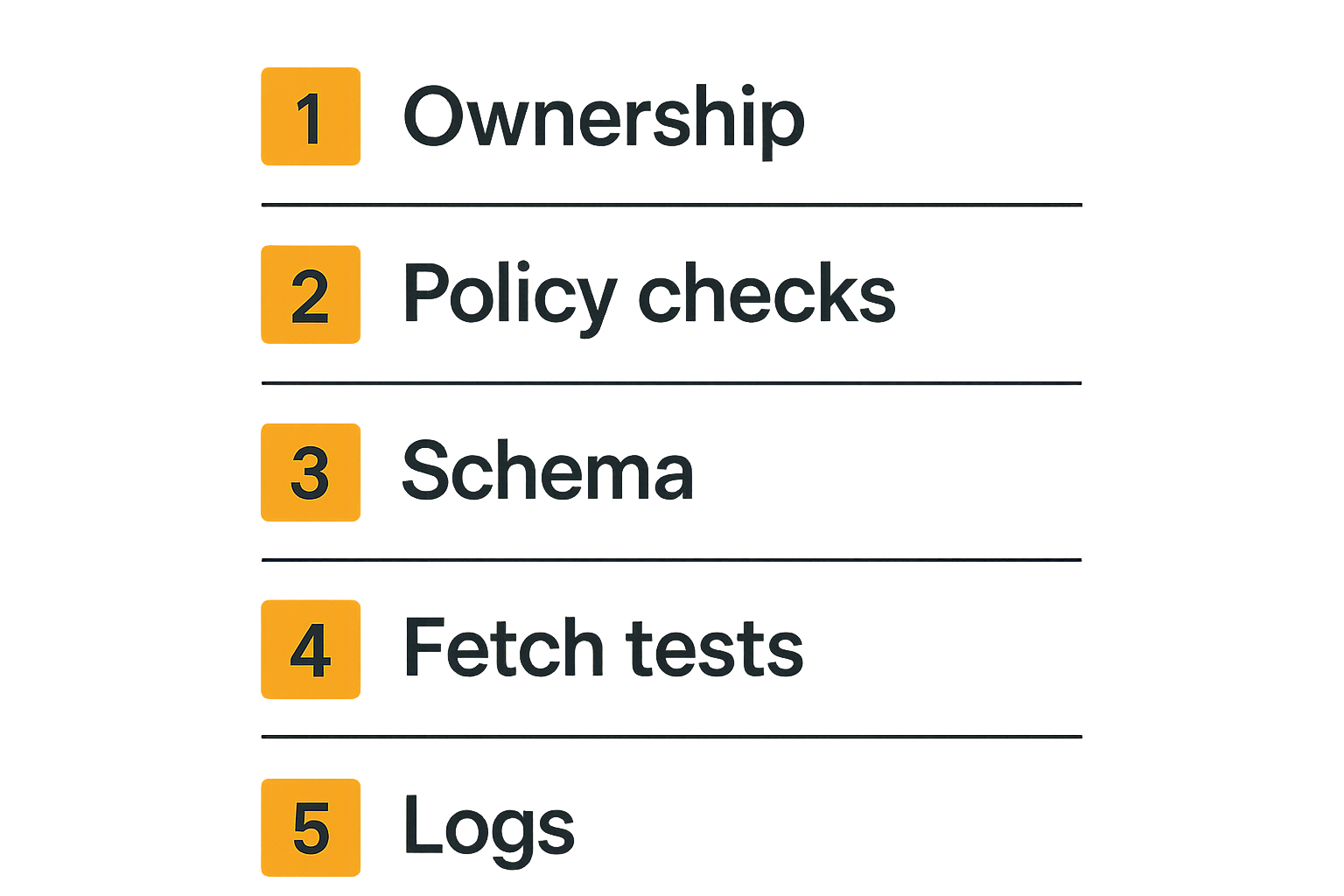
Step 1 define owned AI-facing assets
Start by listing the assets that affect AI crawler discovery. Do not begin with tools. Begin with ownership.
A simple inventory should include:
- Asset name, such as
robots.txt, llms.txt, article schema, or sitemap index. - Source of truth, such as Git, CMS, build script, CDN config, or plugin.
- Business owner, usually marketing, content, product, or legal.
- Technical owner, usually engineering, platform, or web operations.
- Security concern, such as access control, poisoning, secret exposure, or policy drift.
- Validation method, such as schema tests, diff checks, crawler simulation, or log review.
This inventory does not need to be fancy. A spreadsheet is better than tribal knowledge. The goal is to stop treating AI crawler visibility as a side effect.
Step 2 add policy checks before deploy
Once the assets are known, add checks in CI before deployment. These checks should fail builds when crawler-visible output violates policy.
Examples:
checks:
  robots:
    require_review_for:
      - "Disallow: /"
      - "User-agent: GPTBot"
      - "User-agent: Google-Extended"
  schema:
    validate_jsonld: true
    required_types:
      - Organization
      - WebSite
      - Article
  llms:
    require_codeowners: true
    max_file_size_kb: 100
  headers:
    block_production_noindex: true
The point is not the exact syntax. The point is to convert crawler policy into testable release criteria.
Practical rule: If an AEO decision matters to the business, encode it as a deploy check instead of relying on someone to remember it during launch week.
Step 3 verify crawler-visible output after deploy
Pre-deploy checks are necessary but not enough. CDN rules, edge functions, middleware, personalization, and caching can change what crawlers actually receive.
A secure workflow includes post-deploy verification:
- Fetch key URLs with representative crawler user agents.
- Confirm expected status codes, canonical tags, schema blocks, and robots behavior.
- Compare rendered HTML against the build artifact where possible.
- Check that AI guidance files return the correct content and cache headers.
- Review logs for unexpected blocks, spikes, or crawl failures.
- Alert owners when output differs from the approved release.
This is where many AEO programs are still immature. They validate the page in a browser, but not the machine-facing response.
Controls that work in practice
Version control and code owners
The simplest durable control is to put AI-facing policy files under version control and require review from the right owners.
That includes robots.txt, llms.txt, redirect maps, schema templates, sitemap generators, and crawler-specific configuration. If these live in a CMS, export or snapshot them so changes are visible.
Code owners are useful because they prevent silent edits by well-meaning people outside the decision path. A robots change may need marketing, engineering, and legal approval. A schema template change may need SEO and development review.
This is not bureaucracy. It is production hygiene.
Schema validation and diff review
Schema validation should happen at two levels.
First, validate syntax. JSON-LD should parse. Required fields should exist. Types should match your content model.
Second, review semantic diffs. Did author change? Did product availability disappear? Did organization identity split across pages? Did FAQ answers change from specific to vague? Did canonical URLs shift?
A comparison table helps clarify the difference:
| JSON syntax validation | Broken markup and invalid JSON | Misleading but valid claims |
| Required field checks | Missing author, date, type, or URL | Incorrect values in present fields |
| Rendered HTML diff | Unexpected template or content changes | Policy intent behind the change |
| Crawler fetch test | CDN, header, and user-agent differences | Long-term citation impact |
| Log monitoring | Real crawler behavior after release | Content quality by itself |
The mistake teams make is stopping at syntax. Valid schema can still be wrong.
Secrets scanning and dependency hygiene
AI crawler assets often connect to systems that hold sensitive data: CMS APIs, content warehouses, analytics tools, personalization engines, and documentation repositories.
Security basics still apply:
- Scan source and build artifacts for secrets.
- Pin and review dependencies that generate HTML or schema.
- Use least-privilege tokens for CMS publishing.
- Separate staging and production credentials.
- Avoid exposing draft APIs through sitemap or crawler guidance files.
- Review build logs for leaked URLs or tokens.
For static sites and headless CMS workflows, pay special attention to build-time secrets. A secret leaked into generated JavaScript, source maps, markdown, or static JSON can be indexed before anyone notices.
What works and what fails
What works for durable AEO security
What works is boring, explicit, and repeatable.
Good teams define the expected crawler-visible output, test it before deploy, verify it after deploy, and monitor real crawler behavior. They keep policy files in reviewable systems. They treat schema as a data contract. They know who can change AI guidance files. They have rollback paths when crawler access breaks.
A useful operating model looks like this:
- Marketing defines which pages and entities should be discoverable.
- SEO defines crawl and structured data requirements.
- Engineering implements and tests the output.
- Security reviews abuse cases and release permissions.
- Support and legal flag content that should not be summarized loosely.
That model works because it separates intent from mechanics while keeping both connected.
What fails in production
What fails is treating AI crawler optimization as a one-time setup.
Common failures include:
- Adding
llms.txt once and never validating it again. - Letting plugins generate schema without diff review.
- Blocking or allowing crawler user agents through emergency edits.
- Publishing AI-generated summaries without source traceability.
- Assuming a browser view equals crawler-visible output.
- Allowing staging or draft content into sitemaps.
- Ignoring logs until traffic or citations change.
The bigger failure is lack of ownership. When AEO output breaks, marketing blames engineering, engineering blames the CMS, and security says they were never asked to review the change.
That is not a tooling problem. It is a workflow problem.
Monitoring LLM crawler behavior after release
Log patterns worth tracking
Once AI-facing assets are shipping through CI/CD, logs become part of the feedback loop.
Track crawler requests to important routes: home page, product pages, documentation, pricing, comparison pages, support content, robots.txt, llms.txt, and sitemaps. Watch for status codes, cache behavior, redirect chains, and sudden changes in request volume.
Useful log questions include:
- Are known AI crawlers reaching the pages we expect?
- Are they being served 200 responses or blocked by 403, 404, or 5xx errors?
- Are they fetching stale cached versions after deployment?
- Are they hitting parameterized or duplicate URLs?
- Are they discovering pages that should remain out of AI-facing surfaces?
- Did crawl behavior change after a release?
Avoid pretending that every user agent string is reliable. Some crawlers identify clearly. Others do not. Some bad actors spoof. Logs are signals, not absolute truth.
Validation signals for answer engine optimization
AEO validation should combine technical checks with business review.
Technical signals include schema presence, crawl accessibility, sitemap freshness, canonical consistency, response integrity, and successful retrieval of AI guidance files. Business signals include whether cited pages are the right pages, whether summaries reflect current positioning, and whether important entities are consistently described.
The practical question is: if an answer engine used your site today, would it receive the current, approved, context-rich version of your content?
If the answer is unknown, the AEO workflow is incomplete.
Ownership model for marketers developers and security
Marketing owns intent
Marketing and content teams should own the question of what the business wants answer engines to understand. That includes priority pages, entity descriptions, product positioning, audience language, and citation-worthy resources.
They should not have to become CI/CD experts. But they do need visibility into what shipped and whether machine-readable output still matches the strategy.
This is where many site owners need better reporting. A content team cannot manage AEO if the only feedback is a raw deployment log or a vague traffic chart.
Engineering owns release mechanics
Engineering owns the pipeline, templates, build scripts, route behavior, performance, and deployment integrity.
For CI/CD security llm crawlers, engineering should provide guardrails:
- Pull request checks for AI-facing assets
- Preview environments that show rendered schema and crawler files
- Build failures for unsafe crawler policy changes
- Rollbacks for broken AEO output
- Post-deploy fetch tests using representative user agents
Engineering does not need to decide every crawler policy. But it should make unsafe changes hard to ship accidentally.
Security owns abuse cases
Security teams should define what could go wrong.
That includes content poisoning, compromised CMS accounts, malicious dependency updates, exposed drafts, leaked secrets, unauthorized policy edits, and deceptive crawler handling. Security should also review who can publish machine-readable instructions intended for AI systems.
The key is proportionality. Not every blog edit needs a security meeting. But changes to crawler policy, schema generation, content ingestion, and AI-facing guidance deserve stronger controls.
How CrawlProof fits the workflow
Making AI crawler visibility observable
CrawlProof's role in this architecture is not to replace your CMS, CI/CD pipeline, or SEO team. It is to make the AI crawler layer visible enough that site owners can manage it intentionally.
For AEO, the hard part is often not creating another page. It is understanding how LLM crawlers and answer engines interact with what you already publish. Which files are discoverable? Which pages are machine-readable? Which crawler rules are helping or hurting? Where does schema markup support the content, and where does it drift?
When that visibility is missing, teams overcorrect. They either block too much because they are nervous, or expose everything because they want citations. Neither is a strategy.
Connecting AEO decisions to release discipline
The better model is to connect AEO decisions to release discipline.
Use CrawlProof to understand crawler behavior, AI-facing standards, schema readiness, and llms.txt opportunities. Use your CI/CD pipeline to control how those decisions reach production. Use post-deploy monitoring to verify that crawlers receive the intended output.
That combination matters because AEO is moving quickly. Standards are emerging, crawler behavior changes, and teams are still learning what answer engines reward. The durable advantage is not chasing every rumor. It is building a workflow that can adapt without losing control.
Closing checklist for CI/CD security llm crawlers
Questions to answer before the next deploy
Before your next website release, ask these questions:
- Which files and routes influence LLM crawler discovery?
- Who can change
robots.txt, llms.txt, schema templates, sitemaps, and redirects? - Are crawler policy changes reviewed by the right owners?
- Do CI checks validate schema, noindex rules, robots behavior, and AI guidance files?
- Can you compare crawler-visible output before and after deployment?
- Do logs show whether AI crawlers can reach priority content?
- Are generated pages traceable to approved sources?
- Can you roll back a broken AI crawler configuration quickly?
If those answers are unclear, your AEO program depends too much on luck.
The operator view
CI/CD security llm crawlers is not about making SEO slower. It is about preventing avoidable damage as AI indexing becomes part of how users discover and evaluate brands.
Teams think the problem is persuading answer engines to see them. The real problem is shipping clean, intentional, trustworthy signals every time the site changes.
That is the operator view: content strategy, crawler policy, structured data, and release security are now connected. Treat them that way and AI discovery becomes manageable. Ignore the connection and every deployment can quietly rewrite what answer engines learn about you.
Try crawlproof.com
CrawlProof helps website owners understand AI crawler behavior, AEO readiness, schema markup, and emerging standards like llms.txt. Try crawlproof.com.