Most teams approach community building AEO like it is a content distribution problem. They launch a forum, start a Slack group, publish a few customer quotes, and hope answer engines notice the activity.
That usually fails.
Teams think the problem is visibility. The real problem is evidence architecture. AI answer engines need accessible, durable, specific proof that your site is connected to real questions, real expertise, and real outcomes. A community can generate that proof, but only if the workflow captures it, structures it, and makes it crawlable.
This matters more in 2026 because search is no longer just a list of blue links. AI answer engines summarize, compare, recommend, and cite. The practical question is not whether community matters. It is whether your community activity becomes answer-ready material that crawlers, retrieval systems, and users can understand.
Table of contents
Answer engines need resolvable evidence
A useful way to think about community building AEO is this: your community is not the ranking factor. Your community is the evidence factory.
Answer engines do not cite a Discord server because it feels active. They cite pages, passages, entities, structured data, and sources they can retrieve. If the best answers live inside closed channels, video calls, private onboarding threads, or unstructured chat logs, the public web sees almost none of it.
The mistake teams make is treating community activity as automatically visible. It is not. A community manager may see the same question asked twenty times. A support lead may know which objections actually block purchase. A product expert may have explained a complex workflow in a customer call. Unless that knowledge becomes a stable URL with clear context, answer engines cannot reliably use it.
Practical rule: If a community answer cannot be found, parsed, attributed, and refreshed, it is not an AEO asset yet.
This does not mean publishing every thread. It means designing a path from real conversation to crawlable evidence.
The community layer sits between content and reputation
Traditional SEO usually separates content production from reputation building. Content teams publish pages. PR teams earn mentions. Community teams run events, groups, and customer programs.
AEO collapses those boundaries. Answer engines look for confidence across sources and formats. They may see your documentation, your comparison pages, your product pages, user discussions, expert commentary, and third-party mentions as parts of one trust picture.
That changes the conversation. Community building AEO is not about adding a forum widget. It is about connecting:
- recurring user questions
- expert answers
- customer proof
- documentation updates
- schema and entity clarity
- crawler access rules
- content refresh workflows
The community layer becomes the operating surface where unknown demand turns into answerable content. The value is not chatter. The value is validated demand plus specific answers.
| Content calendar only |
Publishing volume |
Pages drift away from real questions |
Weak specificity |
| Community only |
Engagement |
Useful answers stay trapped in threads |
Low crawlability |
| Community building AEO |
Evidence workflow |
Questions become structured assets |
Stronger answer readiness |
Crawlers read pages but systems infer trust
AI crawlers and answer engines need retrievable content, but retrieval is only part of the system. The model also needs enough context to decide whether the retrieved content is useful. It may weigh clarity, consistency, topical coverage, source reputation, freshness, and whether the answer appears to match real user intent.
Community helps because it creates demand-side language. Customers and practitioners ask questions differently than internal marketers. They mention edge cases, integrations, budgets, failure modes, constraints, and alternatives. Those details are exactly what many generic pages lack.
What breaks in practice is the translation step. Teams collect community insights, then flatten them into vague marketing copy. The source question was concrete, but the published page becomes broad. Answer engines are already full of broad text. They need passages that resolve specific prompts.
For example, a weak page says a platform supports teams of all sizes. A useful answer says how permissions work when an agency manages multiple client workspaces, who owns billing, and what happens when a client leaves. Community language exposes those details.
AI citations favor durable and specific answers
Nobody can guarantee a citation in an AI answer engine. The systems are changing, and the inputs vary by query. But in production, many cited sources share a practical pattern: they answer a specific question on a stable page with enough surrounding context to be trusted.
Community can produce those assets faster than a purely top-down editorial process because it reveals what people are actually trying to solve. The key is to avoid mistaking raw conversation for finished content.
What works:
- pages that answer one clear question
- examples taken from real use cases
- clear authorship or editorial ownership
- dates and update history where freshness matters
- links to related documentation or product context
- schema that clarifies the type of content and entities involved
What fails:
- anonymous thin threads with no accepted answer
- pages built from copied chat transcripts without editing
- community posts that contradict official docs
- content hidden behind login walls but referenced publicly
- promotional quote pages with no operational detail
Practical rule: Community content becomes AEO value when it is edited into a durable answer, not when it is merely posted.
Inventory where useful answers already happen
Before creating anything new, map the places where your audience already asks and answers questions. For a site owner, that may include support tickets, sales calls, comments, webinars, customer Slack groups, GitHub issues, product reviews, local meetups, agency client calls, and internal implementation notes.
The point is not to scrape everything into a content machine. The point is to identify recurring patterns. Community building AEO starts with demand classification.
Create a simple inventory with these fields:
- source channel
- question or problem statement
- user role
- urgency
- current answer location
- whether the answer is public
- whether the answer is accurate
- whether the answer deserves a canonical page
This is also where the perspective of the team at d0rz.com, which focuses on sustaining real communities and local networks, is useful: a community signal only matters when it survives outside a launch moment.
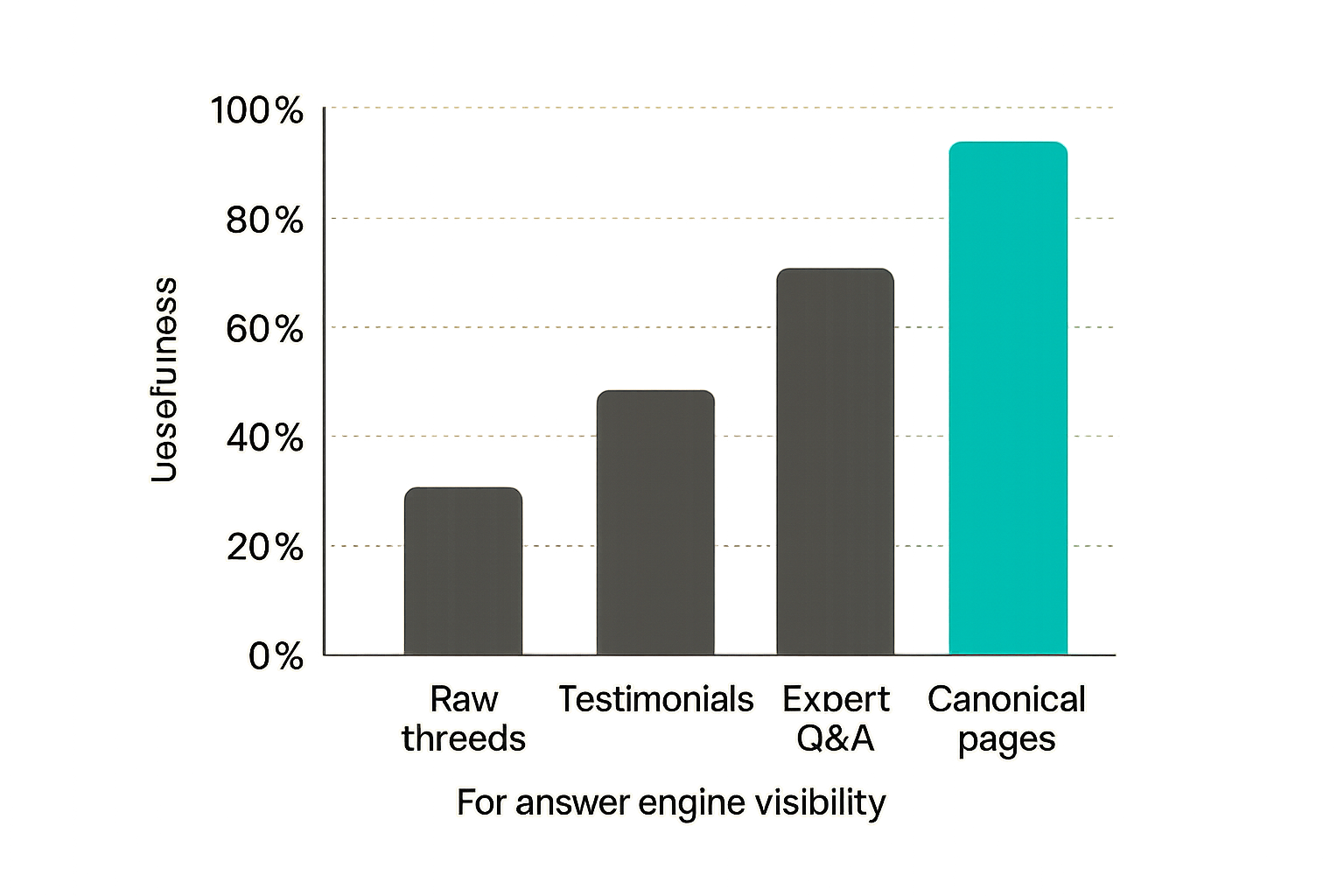
Not all community material is equally useful for answer engines. A testimonial can support trust, but it rarely answers a technical query by itself. A heated forum thread may reveal a real problem, but it may need editorial cleanup before it helps users.
Separate community evidence into four buckets:
- Demand signals: repeated questions, objections, comparisons, and how-to needs.
- Expertise signals: practitioner explanations, accepted answers, implementation examples, troubleshooting notes.
- Trust signals: named customers, partner participation, event activity, public endorsements.
- Risk signals: confusion, outdated answers, wrong assumptions, repeated support escalations.
The mistake teams make is only publishing trust signals. They collect quotes and logos, then wonder why answer engines cite competitors for how-to questions. Promotion says people like you. Proof explains what you know.
Decide what should be crawlable
Community building AEO requires editorial judgment. Some community spaces should stay private. Some threads should be summarized. Some answers should become documentation. Some should be excluded entirely.
A practical policy might look like this:
- Public and indexable: edited Q&A pages, help articles, case studies, glossary entries, event recaps with substantive notes.
- Public but noindex: thin announcements, short event registration pages after expiration, duplicate community summaries.
- Private: customer-only discussions, support tickets, sensitive implementation details, unapproved member contributions.
- Removed or consolidated: outdated answers, duplicate threads, inaccurate advice.
Practical rule: Do not make a community space crawlable just because it exists. Make the best version of the answer crawlable.
Turn recurring questions into canonical pages
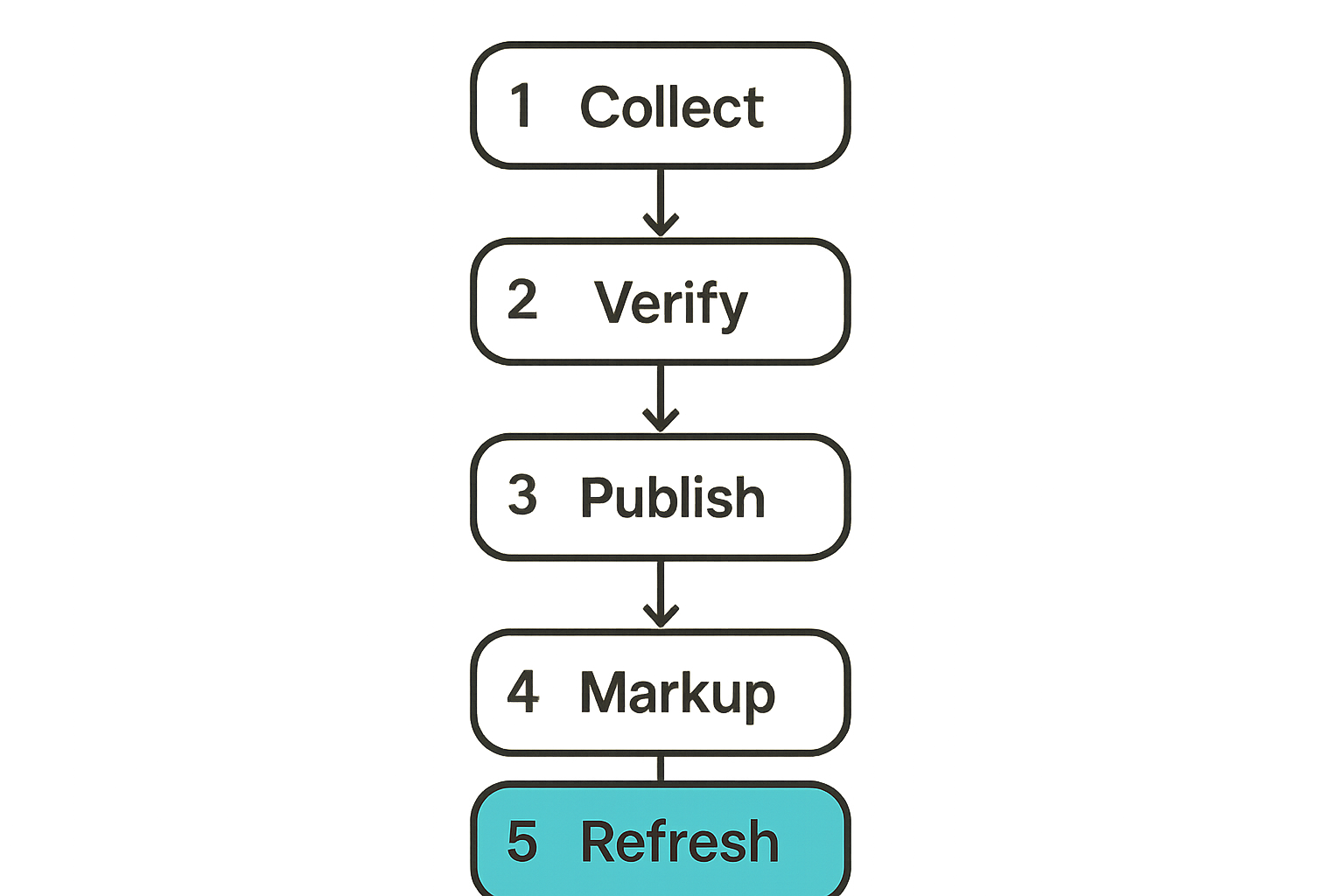
The most reliable community-to-AEO workflow is simple: recurring question, canonical answer, supporting proof, refresh loop.
If ten customers ask whether your analytics tool works with server-side tagging, do not bury the answer in a forum thread. Create a canonical page that explains support, limitations, setup steps, common errors, and related integrations. Link to it from the thread. Update the thread if needed. Now the public conversation and the official answer reinforce each other.
This is especially important for answer engines because they need a clean retrieval target. A messy thread may contain the answer on comment 37. A canonical page places the answer in the first few sections and gives crawlers a stable URL.
Good canonical assets include:
- question-led explainer pages
- implementation guides
- comparison pages grounded in real decision criteria
- troubleshooting pages based on repeated issues
- use-case pages with operational detail
- glossary pages tied to your actual category language
Preserve context names and constraints
Generic answers perform poorly because they do not resolve the hidden conditions inside a query. Community conversations reveal those conditions. Preserve them.
Instead of writing only about how to choose a CMS, write about how a small editorial team chooses a CMS when developer time is limited and AI crawlers need clean rendering. Instead of saying schema helps answer engines, explain which schema clarifies authorship, products, FAQs, organizations, events, and how those choices affect retrieval.
Context to preserve:
- audience type: founder, SEO lead, developer, local business owner, agency strategist
- environment: WordPress, headless CMS, Shopify, custom app, static site
- constraint: limited budget, legal review, multilingual pages, gated community, stale docs
- decision moment: evaluation, implementation, migration, troubleshooting, renewal
- outcome: fewer support tickets, clearer citation path, better answer eligibility
That specificity is not padding. It is how answer engines match passages to long-form prompts.
Keep one source of truth
Community building AEO gets messy when the same answer exists in five places. A forum answer says one thing. A help article says another. A sales deck has an older claim. A schema field points to a deprecated URL. The answer engine has no reason to trust the cluster.
The fix is ownership. Every important question should map to one canonical answer owner. That owner may be support, product marketing, SEO, developer relations, or documentation. The team does not matter as much as the rule: one answer, many distribution points.
A simple pattern works:
- Community thread identifies the question.
- Subject expert drafts or verifies the answer.
- Editor turns it into a canonical page.
- Developer or SEO adds schema, internal links, and crawl directives.
- Community manager links back to the page from relevant threads.
- Owner reviews the page on a defined cadence.
This prevents community from becoming another pile of conflicting content.
AEO fails quietly when crawlers cannot access the content you expect them to use. JavaScript-heavy pages, blocked paths, login walls, infinite-scroll threads, missing canonical tags, broken pagination, and inconsistent rendering can all hide community evidence.
The practical question is: can an AI crawler retrieve the answer without acting like a human member?
Check the basics:
- important pages return stable 200 responses
- content is present in server-rendered HTML or reliably rendered
- canonical tags point to the preferred URL
- pagination is crawlable
- internal links expose important community-derived assets
- robots rules do not block answer-ready pages
- expired or low-quality community pages are not competing with canonical answers
If your best content lives behind a sign-in wall, create public summaries or official answer pages. Do not leak private content. Do not expect crawlers to join your community.
Use schema where it clarifies entities
Schema does not make weak content strong. It clarifies what a page is and which entities matter. In community building AEO, schema is useful when it helps answer systems understand authorship, organization, events, products, FAQs, how-to steps, reviews, and relationships between pages.
Use schema to support the page type, not to decorate it. A community-sourced troubleshooting guide may fit HowTo markup if it has real steps. A page answering common buying objections may fit FAQPage if the questions and answers are visible on the page and maintained. A local community event recap may use Event information when the event details are part of the content.
A lightweight checklist:
- Organization details are consistent across the site.
- Author or reviewer information is visible where expertise matters.
- FAQ content matches the visible page text.
- How-to steps are complete and not promotional fragments.
- Product and service entities use consistent naming.
- SameAs references are used carefully, not as a dumping ground.
Practical rule: Add schema to make a strong page easier to interpret. Do not use schema to pretend a weak page is authoritative.
Treat llms.txt as routing not magic
Emerging standards like llms.txt are useful because they can help point AI systems toward important content and explain how a site wants to be understood. But llms.txt is not a substitute for crawlable pages, clean information architecture, or maintained answers.
A practical llms.txt approach for community building AEO might include:
# llms.txt example
/about
/docs
/guides/community-sourced-faq
/guides/implementation-playbooks
/resources/answer-engine-optimization
The file should route crawlers toward high-signal assets, not every page on the site. If your community produces a lot of content, llms.txt can help separate official, curated, answer-ready resources from raw discussion.
What fails is treating llms.txt like a submission form that forces inclusion. It does not. It is a routing hint. The underlying pages still need quality, access, context, and freshness.
Moderate for answer quality not just behavior
Most community moderation focuses on spam, abuse, and tone. That matters, but AEO needs another layer: answer quality.
A polite but wrong answer can create trust debt. A popular but outdated workaround can keep appearing in search and AI results long after the product changed. A community manager may close the thread because the behavior was fine, while the content remains misleading.
Moderation for AEO means asking:
- Is there an accepted or verified answer?
- Is the answer still current?
- Does the thread need a canonical summary?
- Should the old answer be noindexed, redirected, or edited?
- Does the page contain enough context for someone outside the community?
This is not about sanitizing all discussion. It is about preventing low-quality public artifacts from becoming the version answer engines see.
Create attribution and consent rules
Community content involves people. If you turn member contributions into public pages, you need rules for attribution, consent, and privacy. This is especially important for local networks, professional communities, and customer groups where people may share operational details.
A practical policy should define:
- when a member quote can be used publicly
- whether names, company names, or roles are included
- how private discussions are summarized
- who approves customer examples
- how corrections are handled
- how contributors can request removal or updates
Trust is operational. If members feel mined for content, the community gets worse. If the community gets worse, the evidence gets worse. AEO inherits that decline.
Define what never becomes indexable
Not every useful conversation belongs in the public index. Support escalations, security issues, pricing exceptions, private customer data, legal questions, and member-only strategy discussions often provide insight without being publishable.
The right workflow is to extract the generalized lesson, then publish a safe and useful version. For example, a private support ticket about a failed migration can become a public troubleshooting guide that removes customer details but keeps the steps and failure pattern.
A governance table can keep teams aligned:
| Repeated setup question |
How-to guide |
Product or support |
Indexable |
| Customer quote |
Case study section |
Customer approval |
Indexable |
| Private support thread |
Generalized troubleshooting page |
Support and legal if needed |
Indexable summary only |
| Thin discussion |
None or merged FAQ |
Community manager |
Noindex or consolidate |
| Sensitive issue |
Internal note |
Security or legal |
Blocked or private |
Measure crawlability before citations
Teams often jump straight to the question they care about: are answer engines citing us? That is important, but it is too late in the chain. First measure whether the assets can be discovered, rendered, parsed, and understood.
Start with operational checks:
- Are AI crawlers visiting the answer-ready pages?
- Are important pages blocked by robots rules?
- Are canonical pages receiving internal links from relevant community discussions?
- Are schema fields valid and consistent?
- Are important community-derived pages included in your llms.txt routing?
- Are duplicate threads competing with the canonical answer?
Citation tracking matters, but it should sit on top of crawl and content health. If crawlers cannot reach the page, citation analysis is mostly guesswork.
Watch entity coverage and query classes
Do not measure community building AEO only by individual keywords. Answer engines respond to prompts, comparisons, tasks, and conversational queries. Group your measurement by query class.
Useful query classes include:
- definition and category questions
- best tool or vendor comparisons
- implementation how-to prompts
- troubleshooting prompts
- local or community-specific recommendations
- integration and compatibility questions
- risk, cost, and limitation questions
Then map each class to the community evidence supporting it. If your community discusses integrations every week but your site has no integration Q&A pages, there is a gap. If your product pages claim broad support but your community reveals narrow constraints, there is a trust problem.
Build a simple answer engine review cadence
AEO is not set-and-forget. Community discussions evolve, products change, and answer engines update. Build a review cadence that is small enough to survive.
Monthly review:
- sample priority prompts in major answer engines
- record whether your site appears or is cited
- check whether the cited page is the preferred page
- identify incorrect or outdated summaries
- compare prompts against community questions
Quarterly review:
- refresh canonical answers with new community evidence
- consolidate duplicate threads
- update schema and llms.txt routing
- audit crawler access and rendering
- retire low-quality public pages
The goal is not perfect visibility. The goal is a feedback loop where real community demand improves answer-ready assets over time.
The forum ghost town problem
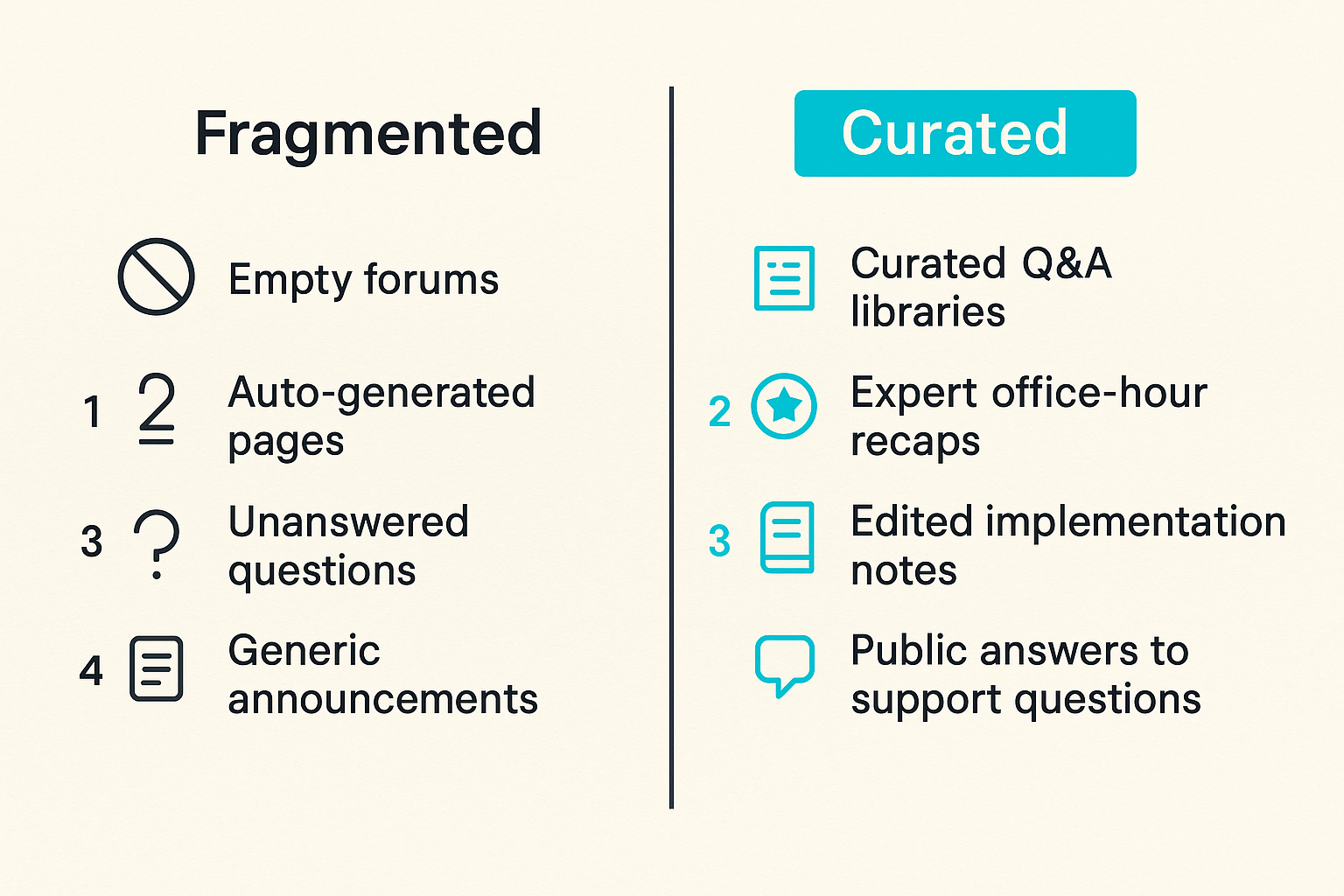
The most visible failure mode is the empty or low-quality community hub. A company launches a public forum because someone heard community helps AEO. Three months later it has a dozen unanswered posts, thin announcements, and spam. Now the site has created public evidence of neglect.
The fix is not to force a bigger launch. The fix is to start from existing demand. If your audience already asks questions in support, webinars, social comments, local meetups, or customer calls, build from those signals. Publish curated answers before opening a broad public forum.
What works:
- curated Q&A libraries
- expert office-hour recaps
- edited implementation notes
- public answers to repeated support questions
- small communities with clear participation roles
What fails:
- empty forums indexed by default
- auto-generated community pages
- unanswered questions visible to crawlers
- generic announcements posing as discussion
The fragmented answer problem
Another common failure is fragmentation. The same question gets answered in a help center, a blog post, a forum thread, a webinar recap, and a sales FAQ. Each answer is slightly different. Internal links are inconsistent. Schema points nowhere useful. The AI system retrieves whichever page seems available, not necessarily the best page.
The practical solution is canonical ownership. Choose the preferred answer page and make all other touchpoints support it. Threads can link to it. Webinars can embed it. Blog posts can summarize and point to it. The page itself should mention when it was last reviewed.
Fragmentation is especially damaging for technical topics. If one page says a feature supports API access and another says it is coming soon, the answer engine may summarize uncertainty. That is not an AI problem. That is an information architecture problem.
The manufactured authority problem
Some teams try to manufacture community signals. They seed fake questions, publish shallow expert roundups, create anonymous praise, or generate forum posts at scale. This is usually obvious to users, and it is risky for answer engines too.
AEO does not reward the appearance of community as much as teams hope. Thin, repetitive, promotional material adds noise. Worse, it can dilute the strong pages that actually deserve attention.
The better path is slower but more defensible: collect real questions, answer them well, show your working, and keep the material current. Real community building creates language and proof that competitors cannot easily copy.
Practical rule: If a community signal would not help a real buyer or practitioner make a better decision, do not expect it to help answer engines for long.
Implementation workflow for site owners and SEO teams
Phase 1 collect and classify demand
Start with a two-week evidence sprint. Do not build new pages yet. Collect questions and issues from the places where your audience already interacts with you.
- Export or manually sample support tickets, community threads, sales objections, webinar questions, and comment sections.
- Group them by intent: learn, compare, implement, troubleshoot, validate, buy.
- Mark repeated questions and high-value edge cases.
- Identify whether a good public answer already exists.
- Assign each gap an owner.
Keep the classification lightweight. A spreadsheet is enough. The outcome should be a prioritized list of answer assets, not a 60-page research deck.
Phase 2 publish mark up and route
Once you know the demand, create the answer layer. This is where SEO, content, community, and developers need to work together.
A practical publishing sequence:
- Draft the canonical answer using the real question as the opening frame.
- Add expert review so the answer is correct and current.
- Include the operational details that appeared in community conversations.
- Link from relevant community threads or summaries to the canonical page.
- Add schema only where it matches visible content.
- Confirm robots, canonicals, rendering, and internal links.
- Add important curated assets to llms.txt routing where appropriate.
- Monitor crawler access and page changes.
This is the point where community building AEO becomes a system. The community is not separate from the website. It feeds the website, and the website feeds back better answers.
Phase 3 refresh from real feedback
After publishing, watch what happens. Do community members still ask the same question? Do support tickets decrease or become more specific? Do AI answer engines cite the intended page or a weaker page? Do crawlers visit the content after it is updated?
Refresh triggers should include:
- product or pricing changes
- repeated confusion in comments or support
- new integration behavior
- outdated screenshots or steps
- incorrect AI summaries
- new terminology from the community
The best AEO programs treat community feedback as maintenance input. This is less glamorous than launching new content, but it is where durable visibility comes from.
See what AI crawlers can actually reach
Community building AEO depends on crawler access. If you cannot see how AI crawlers interact with your site, you are operating blind. Logs, robots rules, rendering behavior, and important URL paths all matter.
CrawlProof helps site owners and marketers understand how AI crawlers discover and access their content. In this workflow, that means checking whether community-derived assets are visible to the systems you care about. It also means spotting when valuable answer pages are blocked, buried, duplicated, or technically ambiguous.
The point is not to chase every bot. The point is to know whether your answer-ready pages are reachable.
Validate schema and answer ready pages
Schema is easy to add and easy to misuse. CrawlProof is useful when teams need to connect structured data decisions to actual AEO operations. If a page is built from community questions, the schema should clarify the page, not inflate it.
Use tooling to validate:
- whether schema matches visible content
- whether entity names are consistent
- whether answer pages have clean titles and headings
- whether canonical URLs are correct
- whether important pages are discoverable through internal links
- whether llms.txt points to high-signal content
That gives content teams and developers a shared operating picture. The editor can improve the answer. The developer can fix access. The SEO lead can prioritize the assets most likely to matter.
The product-fit is architectural. CrawlProof does not create a community for you. It helps make sure the assets your community produces are visible, structured, and understandable to answer engines.
For many teams, that is the missing layer. They have the conversations. They have the expertise. They may even have strong content. What they lack is a way to verify that AI crawlers can discover the right pages and that emerging standards are implemented intentionally.
Community building AEO works best when the workflow is connected end to end: demand, answer, markup, crawler access, measurement, refresh.
The practical takeaway
Community building AEO is not a tactic you bolt onto a content calendar. It is an evidence workflow for answer engines.
The community gives you real questions. Your experts turn those questions into accurate answers. Your website gives those answers stable URLs, structure, and internal context. Your technical layer makes them accessible to AI crawlers. Your measurement loop tells you what to refresh.
That is the system. It is less exciting than claiming a new ranking hack, but it is much more useful. In the closing analysis, community building AEO is about making the best human knowledge around your brand discoverable, trustworthy, and maintainable.
Try crawlproof.com
CrawlProof helps site owners understand AEO, AI crawler behavior, schema markup, and llms.txt so answer engines can discover and cite the right content. Try crawlproof.com.