Most site teams are trying to optimize for AI answer engines with the wrong mental model. They treat it like a new ranking game: write more content, add more keywords, publish more pages, and hope ChatGPT, Perplexity, Gemini, or Claude picks them up.
Constrained optimization is a better way to think about the problem. In the first 100 words, that sounds abstract. In practice, it is simple: your content can only be cited if a chain of constraints is satisfied first.
Teams think the problem is visibility. The real problem is eligibility.
If an LLM crawler cannot access the page, if the answer is buried behind rendering, if the schema contradicts the copy, if your entity is unclear, or if the page lacks a concise answer block, then the model may never get to the point where quality matters. That changes the conversation. AEO is not just content strategy. It is a workflow for removing blockers between your site and the systems that summarize the web.
Table of contents
Why constrained optimization fits AEO better than ranking theory
The objective is not one number
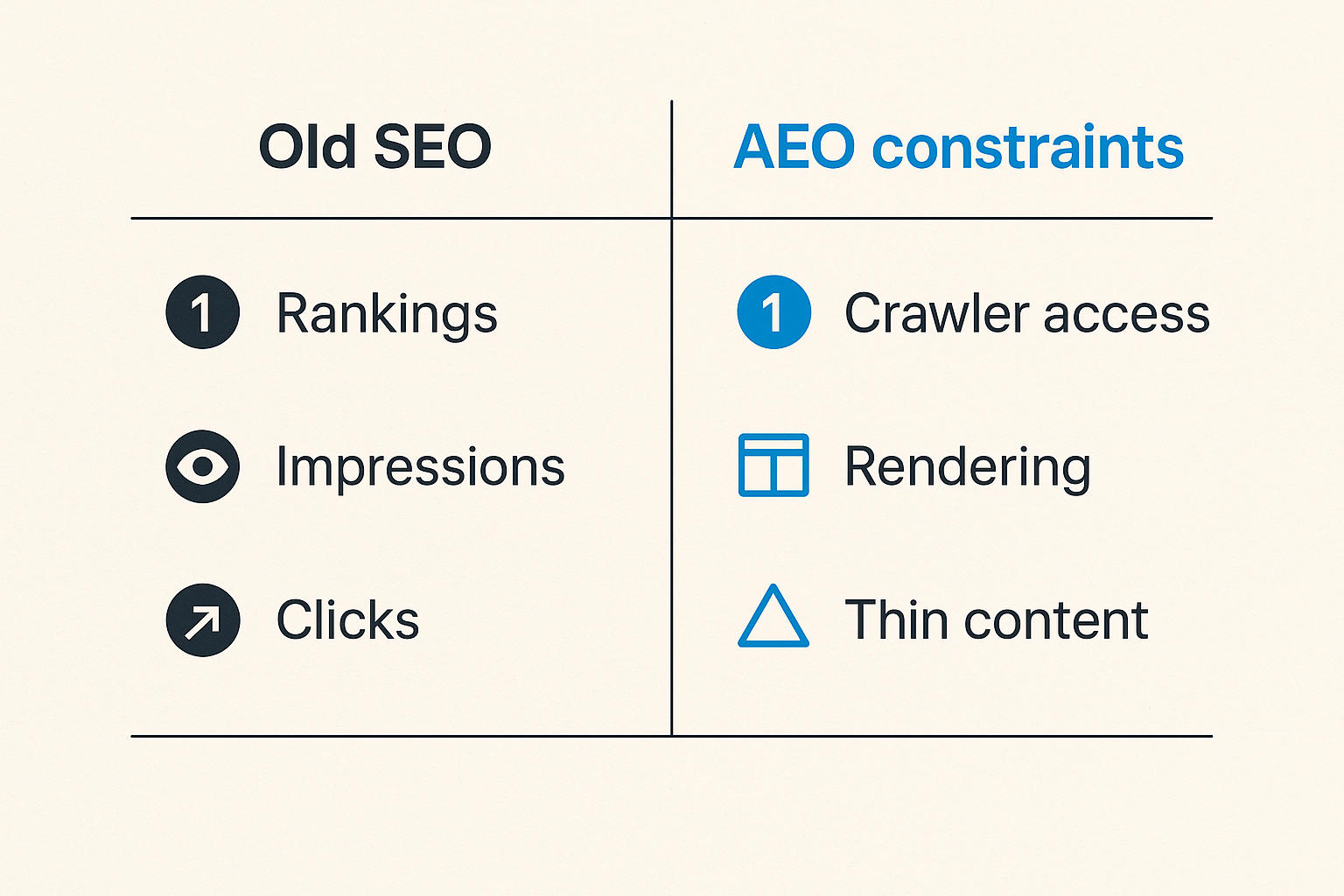
Traditional SEO trained teams to look for a single outcome: rank higher for a keyword. That was never the whole story, but it was at least easy to operationalize. You could track position, impressions, clicks, and conversions.
AI answer engines work differently. A page may be discovered, summarized, used as background, cited directly, cited indirectly, ignored, or overwritten by another source. The objective is not just position. It is being a reliable input to an answer.
A useful way to think about it is this: your page has to pass several gates before it can become a citation. Some gates are technical. Some are editorial. Some are trust-related. Some are about whether your content is structured enough for extraction.
That makes AEO a constrained optimization problem. You are not maximizing everything. You are improving the highest-impact variable that is currently blocked by the tightest constraint.
The constraints decide whether you can be cited
The mistake teams make is starting with more content. More pages do not help if the important pages cannot be crawled, parsed, trusted, or matched to an answer intent.
Common constraints include:
- AI crawler access in robots.txt or CDN rules
- Server-side rendering versus client-only content
- Thin answer sections that require too much inference
- Missing or conflicting schema markup
- Unclear authorship, organization, or product entity signals
- Duplicated claims across pages with no canonical source
- Weak internal linking to the page that should be authoritative
- Content that answers a broad topic but not a precise user question
Practical rule: Do not optimize the page until you know which constraint is stopping the page from becoming a usable answer source.
Why this matters in 2026
In 2026, AI search is no longer a side channel. Many buyers, researchers, journalists, and operators ask answer engines for summaries before they visit a website. That does not make classic SEO obsolete. It makes the top of funnel less visible and more dependent on machine interpretation.
If your content is not accessible to LLM crawlers, it may be absent from AI-generated answers. If it is accessible but poorly structured, it may be paraphrased badly. If it is structured but unsupported, a competing source may be cited instead.
If your team is still mapping the basics, start with what AEO changes compared with SEO. The practical question after that is not whether AEO matters. It is how to build a repeatable system for making pages eligible to be used.
Define the objective before changing the site
Choose the answer you want to be eligible for
Constrained optimization starts with an objective function. For AEO, that objective should be specific enough to test.
Bad objective: get mentioned by AI.
Better objective: make our pricing page eligible as a cited source when a user asks which B2B email verification tools support monthly billing.
Better objective: make our guide the clearest source for how dental clinics should prepare for a HIPAA risk assessment.
Better objective: make our comparison page crawlable, extractable, and supported with schema so answer engines can cite it for product category research.
Notice the difference. You are not optimizing a vibe. You are optimizing a page for a class of answer tasks.
Separate visibility from usefulness
Visibility means the system can discover the content. Usefulness means the system can extract an answer that is accurate, concise, and attributable.
Many sites pass the first test and fail the second. The crawler sees the page, but the answer is spread across a hero section, a pricing table, a modal, an FAQ accordion, and a support article. Humans can figure it out. Machines may not.
The practical fix is to separate page goals into layers:
- Discovery: can relevant crawlers reach the URL?
- Extraction: can the main answer be read without interaction?
- Attribution: can the source, organization, author, date, and entity be understood?
- Corroboration: do schema, headings, copy, and internal links agree?
- Maintenance: can the team keep the answer current?
Related reading from our network: teams building client acquisition systems face a similar constraint problem when choosing platforms, proof assets, and repeatable workflows in this guide to freelance website platform stacks.
Turn goals into machine-readable checks
AEO goals should produce checks that a technical or content owner can verify. For example:
- The target URL is indexable and not blocked for major AI crawlers.
- The primary answer appears in static HTML or reliably rendered HTML.
- The page has one clear H1 and descriptive H2 sections.
- The entity described on the page matches Organization, Product, Service, Article, FAQ, or HowTo schema where appropriate.
- The claim you want cited is backed by visible evidence on the same page or a linked primary source.
- The page includes a short answer block that can stand alone without the full article.
This is where constrained optimization becomes operational. You can assign checks, validate them, and track whether constraints are being removed.
Map the constraints AI systems actually see
Crawl access and bot permissions
The first constraint is access. This sounds obvious, but it breaks constantly in production.
Sites block AI bots at the CDN layer, in robots.txt, with user-agent filtering, or through rate-limit rules that were designed for abuse control but catch legitimate crawlers. Some teams block all AI bots for legal or brand reasons. That may be a valid policy. But it should be an intentional tradeoff, not an accidental configuration.
A simple robots.txt pattern might look like this:
User-agent: GPTBot
Allow: /

User-agent: ClaudeBot
Allow: /

User-agent: PerplexityBot
Allow: /

User-agent: *
Disallow: /admin/
Disallow: /checkout/
This is not universal advice. Some companies should restrict access to parts of the site. The point is that access rules are constraints. If you block the crawler, you cannot later complain that the crawler did not cite you.
Extractability and page rendering
What breaks in practice is not always access. It is extraction.
A page can return 200 OK and still be a bad input. Heavy JavaScript, delayed content hydration, tabbed layouts, infinite scroll, cookie walls, and interactive comparison tables can hide the exact content an answer engine needs.
For AEO, ask a blunt question: if a crawler sees the page without behaving like a patient human, does it still receive the main answer?
Content that matters should not live only in:
- A collapsed accordion with no server-rendered text
- A client-side pricing widget
- A PDF with no HTML summary
- A carousel slide
- An image without text alternative
- A gated resource with no useful public abstract
Schema, entities, and corroboration
Schema does not make weak content strong. It reduces ambiguity when the content already has a clear purpose.
Use schema to confirm what the page is, who published it, what product or service it describes, when it was updated, and which questions it answers. Avoid treating schema as a keyword injection surface.
For many AEO pages, useful schema types include:
- Article or BlogPosting
- FAQPage when there are real questions and answers
- Organization
- Product or Service
- BreadcrumbList
- HowTo when the page is actually procedural
The constraint is not whether schema exists. The constraint is whether schema agrees with the visible page.
Practical rule: If schema says something the user cannot verify on the page, remove it or make the page support it.
Build a constrained optimization workflow for AEO
Step 1 baseline crawler visibility
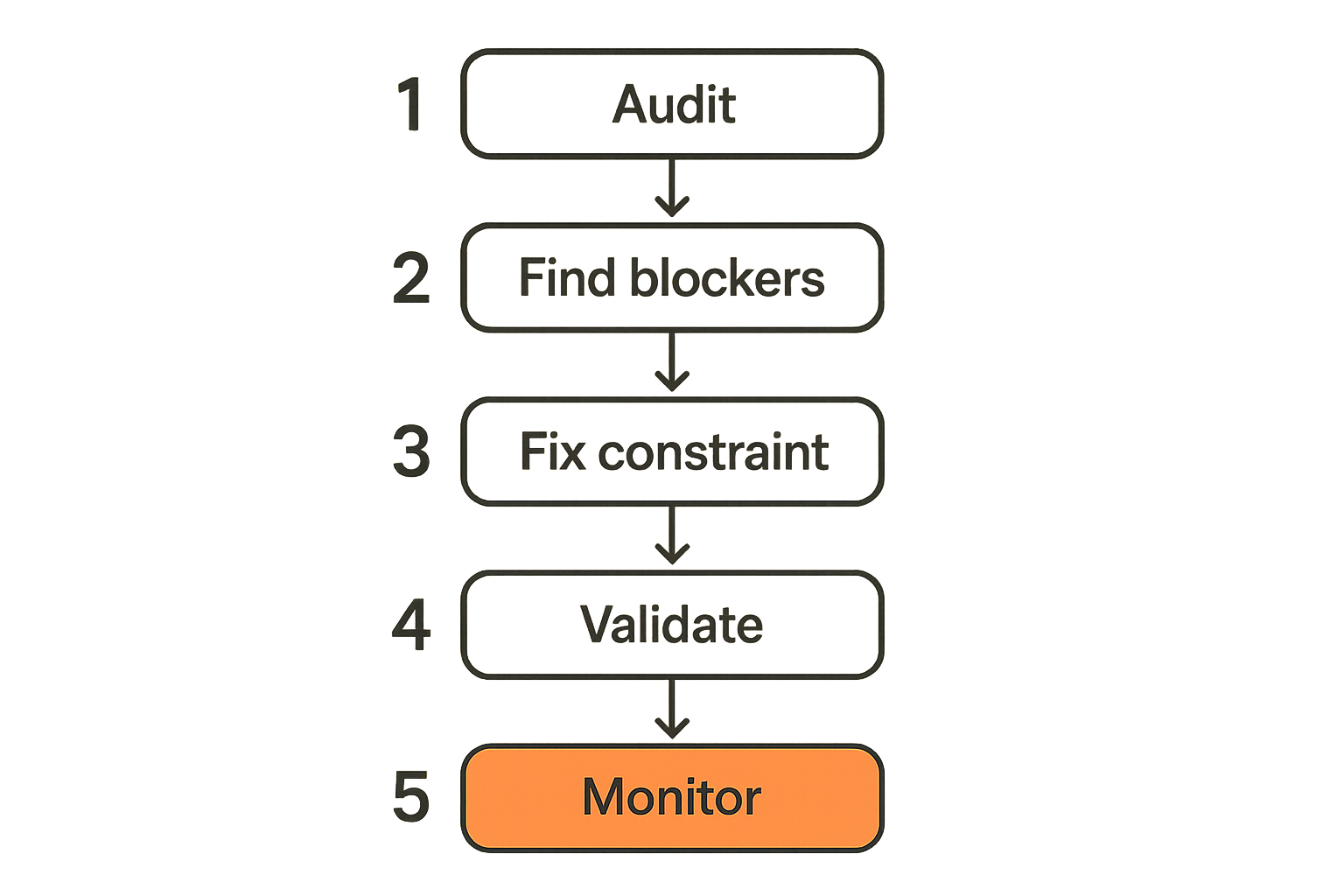
Start with a baseline audit before editing content. Otherwise, you will not know whether improvements came from better copy, better access, better schema, or luck.
A baseline should capture:
- HTTP status and redirects
- robots.txt rules for common AI crawlers
- meta robots directives
- canonical tags
- rendered versus raw HTML content
- title, description, headings, and internal links
- schema presence and errors
- answer blocks and FAQs
- page freshness signals
This is where an AEO audit differs from a normal content review. You are looking at the page as a machine input, not as a landing page.
Step 2 identify citation blockers
After baseline, sort issues by whether they block citation eligibility.
High-priority blockers:
- Page is not reachable by crawlers you care about
- Important text is not extractable
- Canonical points to a weaker or irrelevant page
- The page has conflicting entity information
- The answer is not stated directly anywhere
Medium-priority blockers:
- Schema is incomplete but not misleading
- The answer exists but is too verbose
- Internal links do not clearly indicate authority
- Page lacks updated date or source context
Low-priority items:
- Minor wording preferences
- Decorative metadata changes
- Schema fields that add no clarity
The mistake teams make is treating every audit item as equal. Constrained optimization requires ranking constraints by impact.
Step 3 change one constraint at a time
If you rewrite the article, change templates, add schema, update robots.txt, and alter internal links in one sprint, you will not know what mattered.
A better sequence:
- Fix access and rendering first.
- Add or correct schema only after the visible content is stable.
- Add answer modules to the target page.
- Strengthen internal links from relevant pages.
- Re-run the audit and compare results.
- Then update broader editorial structure.
This is slower than a content dump. It is also easier to debug.
Related reading from our network: workflow tools have the same lesson. This breakdown of Asana project management software argues that teams should design the workflow before building the board, which is also the right order for AEO.
Step 4 validate with repeatable audits
AEO work without validation becomes superstition. You need a repeatable process that checks the same signals over time.
Validation should answer:
- Did access change?
- Did the rendered content change?
- Did schema become clearer or noisier?
- Did the target answer become easier to extract?
- Did the page become more authoritative inside the site structure?
- Did support tickets, sales questions, or brand mentions reveal missing facts?
Practical rule: If you cannot re-run the check, it is not an optimization workflow. It is a one-off edit.
What works when optimizing for answer engines
Build answer modules, not just articles
Long articles can perform well, but answer engines often need compact, attributable statements. Add answer modules inside longer pages.
An answer module can include:
- A direct answer in 40 to 80 words
- A short list of conditions or exceptions
- A source or methodology note
- A date or freshness marker
- Links to deeper supporting pages
Example structure:
### Short answer
Our product supports monthly billing for all paid plans. Annual billing is optional and discounted. Enterprise contracts may include custom terms.

### Details
- Monthly billing applies to Starter, Growth, and Pro.
- Invoices are available in the billing portal.
- Taxes depend on billing location.
This helps both humans and machines. It also forces the team to clarify what the page is actually saying.
Put evidence near the claim
AI systems tend to reward content that is easy to verify. That does not mean every paragraph needs a footnote. It means important claims should have visible support nearby.
For a product page, support might be screenshots, feature tables, docs links, changelog notes, or pricing details. For a research page, it might be methodology. For a local business page, it might be service areas, credentials, operating hours, and reviews.
The practical question is: could a system extract the claim and its support from the same page without guessing?
Use llms.txt as routing, not magic
Files like llms.txt can help crawlers understand which pages are intended as important AI-readable resources. They are not a replacement for accessible pages, clear schema, or strong content.
A minimal llms.txt might point to high-signal pages:
# crawlproof.com example

## Core pages
- /about
- /pricing
- /blog/what-is-aeo
- /docs/ai-crawler-access

## Best summaries
- /guides/answer-engine-optimization
- /guides/schema-for-ai-search
If you are deciding what belongs there, this guide to llms.txt and skill.md is the adjacent piece to read. The key point is routing. Give crawlers a map, but make sure the destination pages are worth reading.
What fails in constrained optimization projects
Teams often test a dozen prompts and panic when the answer engine does not mention them. That is useful as a symptom, not as a strategy.
Prompt outputs vary by model, user context, retrieval layer, freshness, and phrasing. If the underlying page is inaccessible or ambiguous, prompt testing just produces noisy disappointment.
What works is testing the input layer first. Can crawlers access the content? Can the answer be extracted? Is the claim supported? Is the entity clear? Once those constraints pass, prompt testing becomes more meaningful.
Overloading pages with schema
Schema abuse is the AEO version of keyword stuffing. Teams add every possible type, duplicate fields, stuff descriptions, and mark up content that does not exist visibly on the page.
What breaks in practice is trust. If schema and content diverge, machines have to decide which signal to believe. Even if there is no direct penalty, you have introduced ambiguity.
Use schema to make the obvious explicit. Do not use it to make the unsupported appear true.
Treating robots rules as a legal memo
Robots.txt is a technical access control hint, not a full policy framework. It matters, but it is not enough to express commercial, legal, or licensing preferences around AI use.
Marketing, legal, and engineering need to agree on the tradeoff:
- Which AI crawlers should access public marketing content?
- Which areas should remain blocked?
- Are docs, support pages, and pricing pages treated differently?
- Who approves changes to bot access rules?
- How are CDN and robots rules kept aligned?
The mistake teams make is letting default security or CDN settings decide the AEO strategy by accident.
Comparison: unconstrained SEO versus constrained AEO
Where traditional SEO still helps
AEO is not a reason to throw away SEO fundamentals. Fast pages, strong internal links, clear headings, useful content, authoritativeness, and crawlable architecture still matter.
The difference is that AI answer engines may not send a click before creating value from your content. That means your source has to be legible before the visit. The page must communicate the answer, entity, and supporting context clearly enough to be summarized.
Where AEO changes the operating model
Traditional SEO often rewards scale. Publish more useful pages, capture more long-tail searches, and improve conversion paths.
AEO rewards source clarity. A smaller number of well-structured, well-supported, machine-readable pages can be more useful than a large library of overlapping posts.
That changes the operating model from volume to constraint removal. You still need content. But you also need technical validation, schema discipline, crawler access decisions, and answer-level ownership.
The comparison table
| Primary goal | Rank for more queries | Become eligible for specific answer tasks |
| Main unit | Keyword page | Answer source page |
| Technical focus | Indexability and speed | Access, rendering, extraction, schema alignment |
| Content focus | Comprehensive coverage | Direct answers with support nearby |
| Measurement | Rankings, clicks, impressions | Constraint pass rate, citation readiness, brand accuracy |
| Common failure | Publishing without differentiation | Passing crawl but failing extraction or trust |
| Team model | SEO owns most changes | Marketing, engineering, content, and legal share constraints |
Related reading from our network: even checkout optimization has constrained tradeoffs, where a coupon workflow only works if exclusions, stacking, and final totals are handled correctly, as shown in this Walgreens coupon code workflow.
Measurement: metrics that survive model changes
Constraint pass rate
Model behavior changes. Retrieval systems change. Interfaces change. A useful AEO measurement system should track inputs you can control.
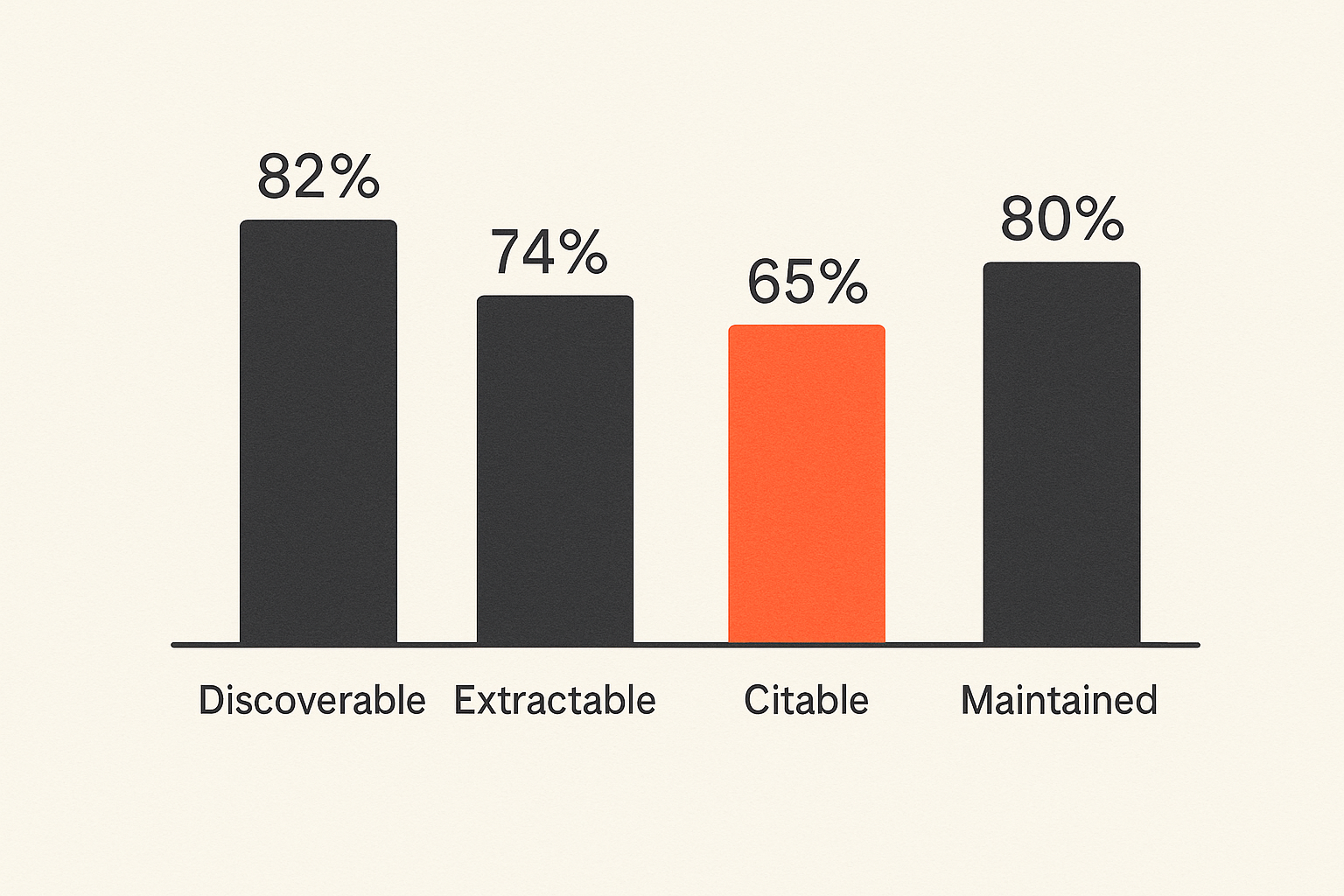
Constraint pass rate is the percentage of target pages passing defined checks:
- AI crawler access allowed where intended
- Main answer extractable
- Schema valid and aligned
- Canonical correct
- Entity clear
- Internal links pointing to the authoritative page
- Freshness signal present
This is not a vanity metric. It tells you whether your site is becoming easier to use as a source.
Citation readiness
Citation readiness is a page-level judgment: if an answer engine needed a source for this topic, would this page be a good candidate?
A simple scoring model can use four buckets:
- Discoverable: the page can be found and fetched.
- Extractable: the main answer is visible and readable.
- Trustworthy: the claim is supported and attributable.
- Maintained: the page appears current and owned.
Do not overfit the score. The goal is to prioritize work. A page with a beautiful score and no strategic answer target is less valuable than a commercially important page with two obvious blockers.
Support and correction loops
AEO measurement should include feedback from sales, support, and brand monitoring. If customers ask questions that your site supposedly answers, your answer may not be clear enough. If answer engines summarize your pricing or policy incorrectly, your source material may be ambiguous.
Create a correction loop:
- Capture repeated questions from sales and support.
- Map each question to a target page.
- Check whether the page answers it directly.
- Add or update an answer module.
- Validate crawlability and schema.
- Recheck after the next content update cycle.
This is where AEO becomes an operating system, not a publishing tactic.
Implementation details for developers and content teams
A practical audit sequence
Here is a compact implementation sequence that works for most sites:
- Pick 10 to 25 commercially important pages.
- Assign one answer target to each page.
- Check robots.txt, meta robots, canonical, and status codes.
- Compare raw HTML to rendered HTML.
- Extract headings, main text, links, and schema.
- Identify whether the target answer appears clearly.
- Add or rewrite answer modules.
- Fix schema only after the visible content is correct.
- Strengthen internal links to the authoritative page.
- Re-run the audit and document changed constraints.
The practical question is not whether you can do this once. It is whether your team can repeat it every time a template, CMS plugin, CDN rule, or content policy changes.
Content teams can make pages much easier for AI systems without writing robotic copy.
Patterns that work:
- Use descriptive H2 and H3 headings.
- Put the direct answer before nuance.
- Keep definitions close to the concept being defined.
- Add tables for comparisons and eligibility criteria.
- Use bullets for constraints, steps, and exceptions.
- Add dates to pages where freshness matters.
- Use one canonical page for each important claim.
Patterns that fail:
- Teasing the answer until the bottom of the page
- Using vague headings like Overview or Learn more
- Splitting one answer across too many components
- Repeating the same claim with different wording on many pages
- Hiding details in images or downloads
Practical rule: Write for humans, but structure for extraction. If the answer cannot be lifted cleanly, it is not ready for answer engines.
Guardrails for technical changes
Developers do not need to become SEO writers. But they do need guardrails because small technical changes can break AEO.
Add checks to release workflows:
- Did a template change remove server-rendered body copy?
- Did a new cookie banner hide content?
- Did the CDN start blocking known AI crawler user agents?
- Did a CMS plugin change canonical tags?
- Did a schema update duplicate or contradict page fields?
- Did an accordion or tab component preserve text in HTML?
For larger sites, these checks belong in CI, scheduled audits, or release QA. For smaller sites, a monthly crawl and a checklist may be enough.
Ownership: who fixes which constraint
Marketing owns the answer target
Marketing should decide which answer tasks matter. That includes commercial intent, buyer questions, category definitions, comparison pages, and brand positioning.
Marketing owns questions like:
- What should we be cited for?
- Which pages are authoritative for those answers?
- Which claims need support?
- Which pages are outdated or duplicated?
- Which answer gaps show up in sales calls?
Without this ownership, engineering may fix technical issues on pages that do not matter.
Engineering owns access and rendering
Engineering owns whether the page can be fetched, rendered, and parsed. This includes robots rules, CDN behavior, server responses, JavaScript rendering, schema implementation, sitemap health, and template structure.
Engineering should not be asked to optimize vague AEO goals. Give them constraints to remove:
- GPTBot is blocked on these pages.
- The pricing table is not present in rendered HTML.
- Product schema conflicts with visible page copy.
- Canonicals point to outdated URLs.
- FAQ content is hidden behind client-only rendering.
That changes the conversation from opinion to implementation.
Leadership owns tradeoffs
Some constraints are business decisions, not SEO tasks.
Should AI crawlers be allowed to access your documentation? Should pricing pages be available for summarization? Should gated reports have public abstracts? Should legal approve policy pages before they are made easier for AI systems to quote?
Leadership owns the tradeoff between exposure and control. AEO cannot answer that for you. It can only make the implications visible.
Where an AEO audit fits
CrawlProof fits at the validation layer. The job is not to promise citations. No honest tool can do that across every model and retrieval system. The useful job is to show what AI crawlers and answer engines can actually find, and what they miss.
Use an audit before a content sprint to find constraints. Use it after technical changes to catch breakage. Use it before launching important pages so the team is not guessing whether the page is visible, extractable, and structured.
That is the architectural role: make crawler access, schema, robots rules, content extraction, and positioning visible enough for operators to act.
When to re-run validation
Re-run validation when any of these change:
- CMS templates
- JavaScript rendering approach
- CDN or WAF settings
- robots.txt or bot policy
- schema plugins
- navigation and internal linking
- pricing, product, or policy pages
- major article updates
AEO work decays because sites change. Constrained optimization is not a one-time audit. It is a maintenance loop around the pages you expect answer engines to understand.
The closing point is simple: constrained optimization gives AEO teams a way to stop chasing hype and start removing the real blockers between content and citation eligibility.
Try crawlproof.com
crawlproof.com helps site owners and marketers understand how AI answer engines and LLM crawlers discover, interpret, and cite their content. Run an audit and see your site the way AI crawlers do: Try crawlproof.com.