Most site owners do not have an AI visibility problem because they picked the wrong headline. They have a prioritization problem. The content team wants new articles. The SEO team wants schema. The developer wants to fix rendering and crawl rules. Leadership wants to know why the brand is not showing up in AI answers.
That is where convex optimization becomes useful. Not because your website can be reduced to a perfect equation. It cannot. The mistake teams make is treating answer engine optimization as a guessing game instead of a constrained workflow.
Teams think the problem is writing content that sounds good to ChatGPT, Perplexity, Gemini, or whatever answer interface is in front of the buyer this month. The real problem is choosing the next best improvement across crawl access, extractability, structured data, evidence, freshness, and brand authority while working inside limited budget and engineering time.
That changes the conversation. Convex optimization gives AEO teams a practical way to think about tradeoffs: define the objective, identify the variables you can actually change, respect constraints, and improve the system in the direction that reduces loss. In 2026, that is a better mental model than chasing a generic AI SEO checklist.
Table of contents
Why convex optimization belongs in an AEO conversation
Not because search is a clean equation
Convex optimization is a formal mathematical field. In the strict sense, it deals with objective functions where a local optimum is also a global optimum. That is powerful when the system is well-defined.
AEO is not that clean. AI answer engines are built from retrieval systems, ranking layers, model behavior, citation heuristics, freshness checks, safety filters, and product-specific policies. You do not control that stack. You usually cannot observe the full pipeline either.
So the practical question is not whether AEO is literally convex. It is not. The practical question is whether convex optimization gives operators a better workflow than random acts of content.
It does.
A useful way to think about it is this: you are not solving the whole AI search ecosystem. You are optimizing your own site under constraints so answer engines can find, understand, trust, and cite the right pages.
Because your site has constrained variables
Your site has variables you can change:
- Page structure
- Internal linking
- Crawl permissions
- Server-side rendering
- Schema markup
- Author and organization evidence
- Answer formatting
- Freshness signals
- Canonicals and duplicate handling
- Topic coverage
- Supporting examples and data
Your site also has constraints:
- Engineering capacity
- CMS limitations
- Legal review
- Brand voice
- Product accuracy
- Existing SEO traffic
- Crawl budget and bot access rules
- Support team capacity
That is exactly where optimization thinking helps. Instead of asking what is the perfect AI SEO strategy, ask which variable gives the highest expected improvement without violating the constraints.
Practical rule: If a recommendation does not identify the variable, the constraint, and the expected behavior change, it is not an AEO plan. It is a suggestion.
The business decision behind the math
For most teams, AEO work competes with normal SEO, paid acquisition, product marketing, and web development. You need a way to decide whether to rewrite pages, add schema, open crawler access, publish comparison content, update stale guides, or fix JavaScript rendering.
Convex optimization reframes that as a portfolio problem. You are allocating effort across improvements that reduce the distance between your current website and a citeable answer source.
If you are new to the distinction, the short version is that AEO is not just SEO with a new label. SEO often optimizes for ranked blue-link discovery. AEO optimizes for inclusion in generated answers, summaries, and cited recommendations.
That difference matters because the answer engine does not need to send traffic to use your content. It may summarize, cite, mention, or ignore you. The business problem is visibility inside the answer layer.
Convex optimization for answer engine optimization: the working model
Objective function: become the citeable answer
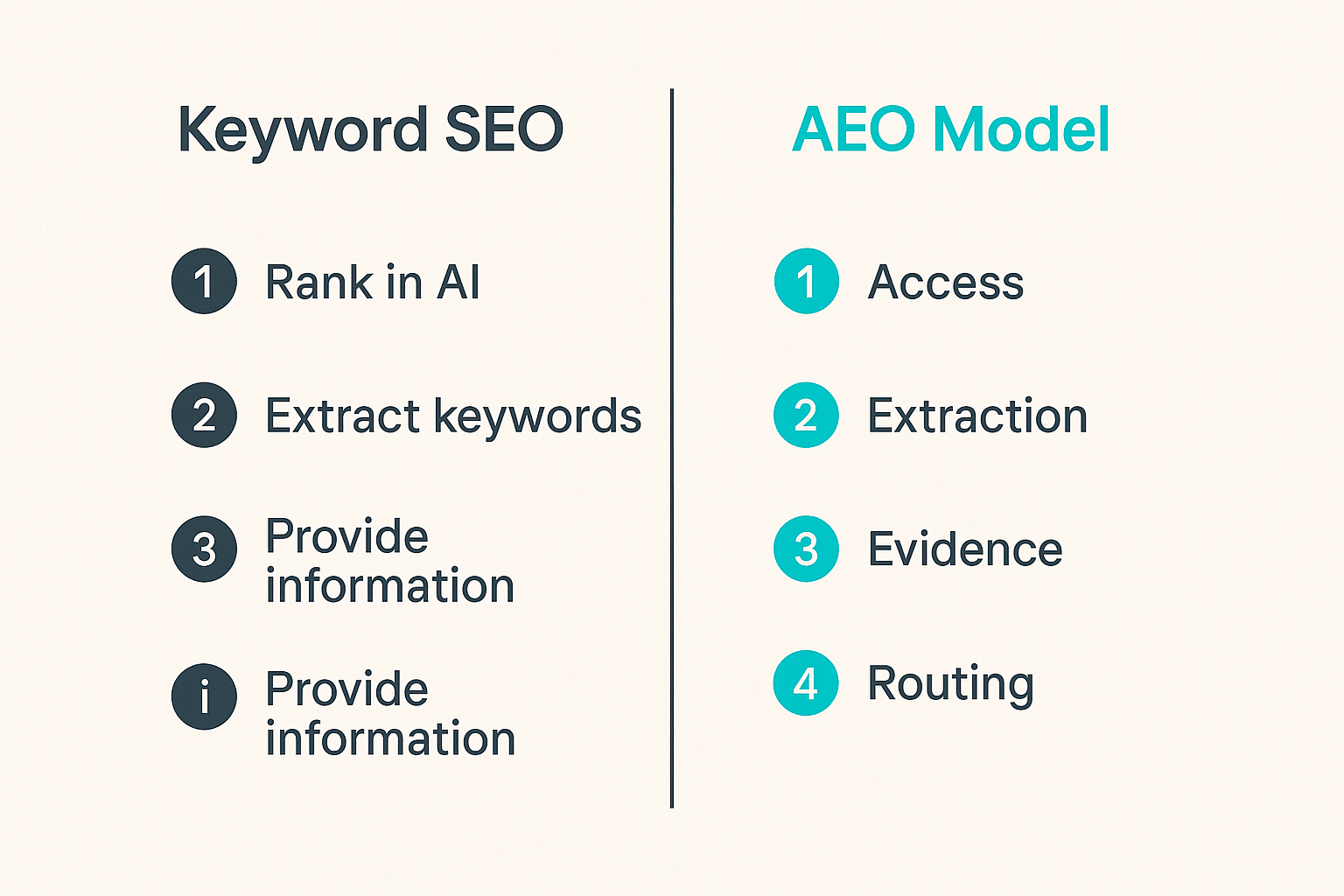
In optimization language, the objective function defines what you are trying to maximize or minimize. For AEO, the objective is not simply more traffic. The objective is to increase the probability that an AI answer engine selects your page as a useful source for a specific class of questions.
A practical objective might be:
- Increase citation probability for commercial-intent questions
- Increase inclusion in answer summaries for category definitions
- Improve extraction of pricing, features, policies, or how-to steps
- Reduce ambiguity when the model compares your product to alternatives
- Make expert evidence easy to identify and attribute
This is where teams get sloppy. They say they want to rank in AI. That is not operational. What query set? Which pages? Which answer format? Which buyer stage? Which citation behavior?
Practical rule: Optimize for answer inclusion by query class, not for AI visibility as a vague brand goal.
Variables: content, schema, access, evidence
The variables in the model are the parts of the site you can change. You can group them into four buckets:
| Access | Whether crawlers can fetch the page | Fix robots rules, bot blocking, redirects | Developer or technical SEO |
| Extraction | Whether the answer is easy to parse | Add direct answer blocks, tables, summaries | Content strategist |
| Evidence | Whether claims look attributable | Add author info, sources, org schema, dates | Marketing or editorial |
| Routing | Whether crawlers find the best page | Internal links, sitemaps, llms.txt, canonicals | SEO and developer |
The mistake teams make is over-investing in one bucket. A perfectly written page that an AI crawler cannot access is invisible. A crawlable page with vague claims is weak evidence. A schema-rich page with no answer structure may still be hard to extract.
Convex optimization thinking pushes you to improve the limiting factor first.
Constraints: budget, risk, brand, crawler behavior
Constraints are not excuses. They are part of the system.
A legal team may not allow strong comparative claims. A CMS may prevent clean schema deployment. A developer team may not support server-side rendering this quarter. A brand team may reject terse answer blocks because they feel too utilitarian.
Fine. Work inside the constraints. Do not pretend they do not exist.
For adjacent architecture thinking, teams building AI agent infrastructure face a similar constraint problem around routing, validation, and execution. Related reading from our network: AI agents cloud computing architecture.
The AEO version is simpler but still real: route crawlers to the right source, validate that they can read it, and reduce uncertainty in the answer layer.
What AI answer engines actually optimize against
Retrieval before reasoning
Before an answer engine can cite you, it has to retrieve you. That sounds obvious, but many AEO failures happen here.
If the page is blocked, slow, heavily client-rendered, hidden behind scripts, duplicated with bad canonicals, or buried outside the site architecture, the model may never get to the reasoning stage. The answer engine cannot summarize content it never reliably sees.
What breaks in practice is that teams test pages in a browser and assume bots see the same thing. Often they do not. A human sees a polished page. A crawler sees partial HTML, missing body content, no structured data, or a redirect chain that makes the page less attractive to fetch.
Retrieval gets the page into the candidate set. Extraction determines whether the answer engine can pull useful facts from it.
Pages written only for human persuasion often bury the answer. They start with a story, add brand language, use vague section labels, and avoid direct statements. That may be fine for a sales page. It is poor for answer extraction.
AEO-friendly pages make the core answer visible:
- Put the direct answer near the top
- Use descriptive H2 and H3 headings
- Include tables for comparisons
- Break processes into numbered steps
- Keep claims close to evidence
- Add dates where freshness matters
- Use consistent names for products, entities, and features
This does not mean writing for robots. It means reducing ambiguity.
Confidence before visibility
AI systems are conservative when they have multiple plausible sources. If your page says something useful but another page says it more clearly, with stronger evidence and easier attribution, the other page may win.
Confidence comes from repeated signals: crawlable content, structured data, clear authorship, consistent entity names, external references, internal support, and recent updates.
Local networks have the same trust problem in a different form: routing only works when ownership and follow-up are designed into the system. Related reading from our network: AI agents asks and offers in local networks.
For AEO, the equivalent is making your content accountable. Who wrote it? What organization stands behind it? When was it updated? What exact question does it answer? What supporting pages confirm it?
Build an AEO scoring system without pretending it is science
Pick dimensions that operations can change
A scoring system is useful only if it drives action. Do not create a 70-factor spreadsheet no one can maintain. Pick dimensions that map to fixes.
A simple AEO score can use five dimensions:
- Crawl access: can major bots fetch the page without friction?
- Render completeness: is the main content visible in fetched HTML or reliable rendered output?
- Answer clarity: is the target question answered directly?
- Evidence quality: are claims supported with authorship, dates, schema, and sources?
- Routing strength: do internal links, sitemaps, and optional AI-facing files point to the page?
Score each from 0 to 3. Keep notes. The score itself is not the asset. The diagnosis is.
Not all dimensions matter equally for every page. A glossary article may need answer clarity and schema. A product comparison page may need evidence and freshness. A pricing page may need extraction and trust more than long-form depth.
Here is a practical comparison:
| Keyword-first SEO | Rankings for target phrases | Familiar process and tools | May not produce citeable answer blocks |
| Content-volume AEO | More pages for more prompts | Easy to scale with AI writing | Creates thin pages with weak evidence |
| Technical-only AEO | Crawl and schema fixes | Concrete engineering tasks | Does not fix unclear claims or missing answers |
| Convex optimization model | Highest-impact constraint first | Balances content, access, and evidence | Requires judgment and measurement discipline |
This is not a claim that the fourth approach is mathematically perfect. It is an operating discipline. You are looking for the bottleneck that limits citation probability.
Use scores to prioritize, not to decorate dashboards
Scores become theatre when they are not tied to decisions. If a page scores 9 out of 15, what happens next? If the answer is nothing, stop scoring.
Use the model to sort pages into work queues:
- Fix now: high-value page with access or extraction blocker
- Improve next: crawlable page with weak answer clarity
- Monitor: good page with uncertain citation behavior
- Leave alone: low-value page or page with no realistic answer target
Practical rule: An AEO score should create a work order, a watch item, or a deliberate no-action decision.
The convex optimization workflow for site owners
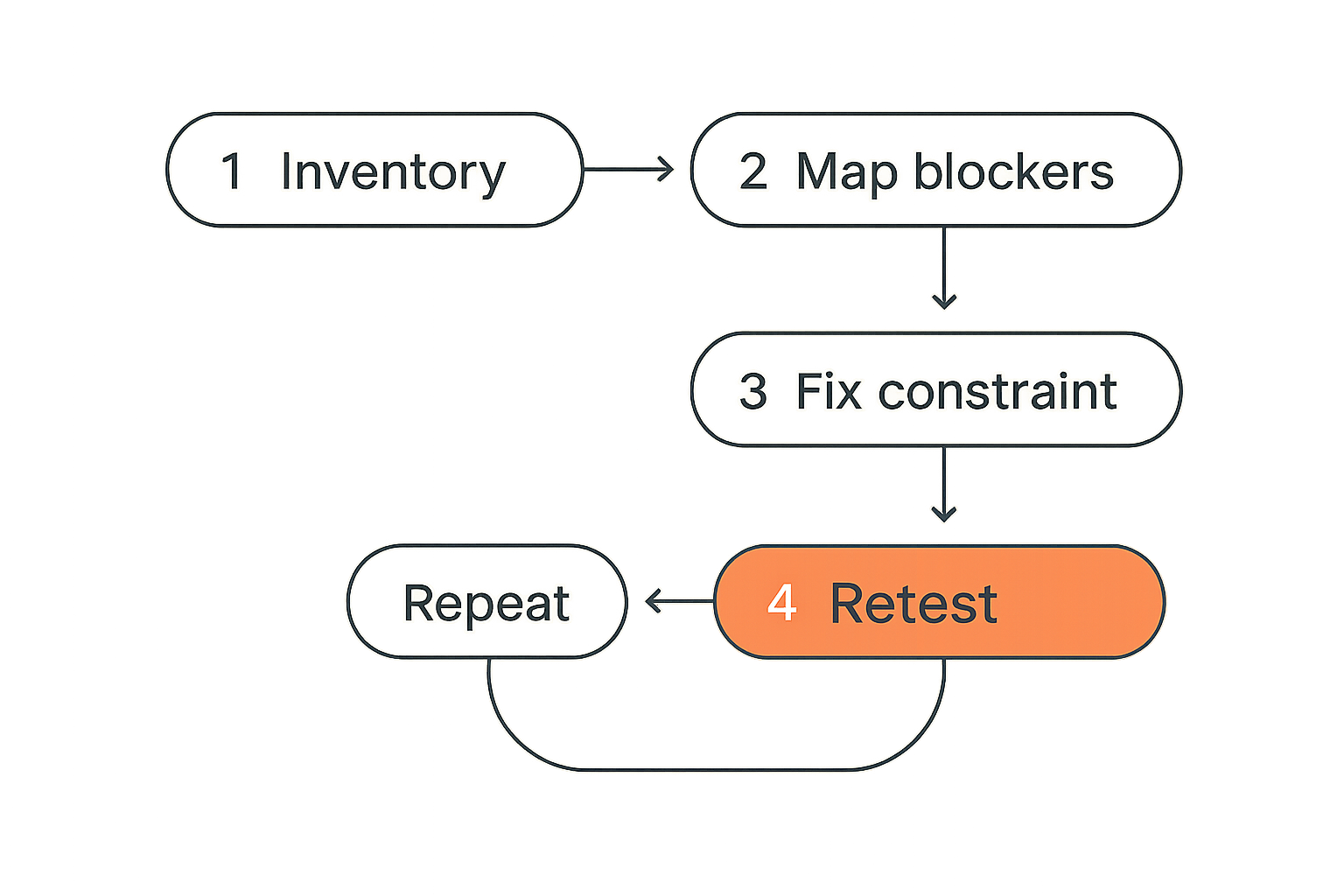
Step 1: inventory answer targets
Start with questions, not pages. Build a list of prompts and answer situations where your site should be eligible:
- What is the best tool for a specific use case?
- How does a technical process work?
- What are the requirements for a task?
- Which vendor supports a particular workflow?
- How do two approaches compare?
- What steps should a buyer take before implementation?
Then map each target to the best page on your site. If there is no page, that is a content gap. If there are five competing pages, that is a routing problem.
The practical question is whether the answer engine can identify the canonical page for the question.
Step 2: map constraints and blockers
For each target page, identify the current bottleneck. Use this sequence:
- Check whether bots can access the URL.
- Check whether the main content is visible without fragile rendering.
- Check whether the page directly answers the target question.
- Check whether schema reinforces the entity, author, organization, and content type.
- Check whether internal links and sitemaps route crawlers to the page.
- Check whether freshness, dates, and update history are visible.
- Check whether the page has enough evidence to support its claims.
Do not rewrite the page before you know the blocker. If the blocker is robots access, content changes are wasted. If the blocker is vague answer structure, schema alone will not rescue it.
Step 3: run small changes and measure crawler visibility
A convex optimization mindset favors incremental improvement. You change one cluster of variables, then measure whether the system moved in the right direction.
A typical sprint might look like this:
- Select 10 high-value pages tied to commercial or category questions.
- Run an AEO audit for crawl access, schema, content extraction, and AI-bot visibility.
- Categorize each page by primary constraint.
- Apply the smallest useful fix.
- Re-test fetchability and extractability.
- Watch answer engines and referral patterns over time.
- Promote repeatable fixes into templates.
This is slower than publishing 100 AI-generated pages. It is also less likely to create a mess your team has to unwind later.
What works when optimizing pages for AI citation
Make the answer easy to lift
Answer engines prefer content that can be summarized without guessing. That means your page should contain concise, self-contained answer units.
Good answer blocks often include:
- A direct definition or recommendation
- A short list of requirements
- A table comparing options
- A step-by-step workflow
- A clear limitation or caveat
- A source, author, or organizational context
For example, instead of a section titled Our Approach, use a section like How to implement schema for AI answer engines. The second heading tells the system what the content does.
This is not keyword stuffing. It is semantic clarity.
Prove ownership and expertise
AI answer engines need to decide whether your content is a reliable source. You can help by making ownership obvious.
Useful evidence includes:
- Organization schema
- Author or reviewer information
- Updated dates
- Product documentation links
- Real examples from implementation
- Clear policy and support pages
- Consistent entity names across the site
If your page makes strong claims without ownership, it asks the answer engine to take a risk. Many systems will choose a safer source.
Practical rule: Every important claim should be close to a credibility signal: author, organization, date, source, example, or structured data.
Keep freshness visible
Freshness matters more for some topics than others. AI crawler behavior, bot user agents, schema patterns, and answer engine citation behavior change quickly. A stale page can still rank in traditional search, but lose relevance in AI answers.
Make update history visible when the topic changes over time. Refresh examples. Remove outdated tool names. Update screenshots and implementation notes. If a standard is emerging, say so instead of pretending the ecosystem is settled.
This matters for files such as llms.txt too. If you maintain an AI-facing routing file, treat it as operational infrastructure, not a one-time marketing artifact. We have a practical explainer on llms.txt and skill.md if your team is deciding what these files should contain.
What fails: local maxima, thin automation, and crawler blind spots
Local maxima in SEO habits
A local maximum is a point that looks good nearby but is not the best possible outcome. In AEO, local maxima show up when teams keep improving what they already know how to improve.
Common examples:
- Adding more keywords to a page that already answers poorly
- Publishing more articles when existing pages are not crawlable
- Expanding word count when the answer needs a table
- Adding schema without fixing entity inconsistency
- Refreshing dates without updating substance
These actions feel productive because they resemble familiar SEO work. But they may not reduce the real loss function: the gap between the site and a citeable answer source.
Automation that optimizes the wrong surface
AI content tools can help with outlines, summaries, metadata drafts, and content operations. They can also flood a site with generic pages that look plausible and say very little.
The failure mode is not automation itself. The failure mode is automating before defining the objective function.
If the goal is citation, generated content must still answer a specific question, demonstrate evidence, align with the entity model, and fit the site architecture. Otherwise, it increases page count while reducing trust.
The same pattern appears in autonomous CI/CD workflows: speed without permissions, validation, and failure handling becomes a liability. Related reading from our network: AI agents GitHub Actions security.
For AEO, fast publishing without crawl and evidence controls creates a content supply chain problem.
Technical rules that block the answer layer
Some of the worst AEO failures are accidental:
- Robots rules block AI crawlers the team intended to allow
- CDN bot protection challenges non-browser fetches
- JavaScript hides primary content from simple fetchers
- Canonicals point to weaker pages
- Pagination hides important supporting content
- Schema is injected late or inconsistently
- Sitemaps omit high-value pages
- Paywalls or interstitials obscure answer content
What breaks in practice is ownership. SEO assumes engineering controls it. Engineering assumes SEO reviewed it. Content assumes the page is live, so it must be discoverable. No one checks the answer-engine view.
Implementation details for developers and technical SEOs
Schema as machine-readable evidence
Schema does not guarantee citation. It helps machines identify entities, relationships, authorship, content type, and sometimes actions or products. Treat it as evidence packaging.
A minimal AEO-friendly page might include:
page_type: Article or Product or FAQPage
organization: consistent legal or brand entity
author: named person or editorial team
date_published: visible and accurate
date_modified: updated when substance changes
main_entity: the topic the page answers
same_as: authoritative profiles where appropriate
breadcrumb: site hierarchy
The practical implementation rule is consistency. If your organization name appears five different ways across schema, footer, about page, and social profiles, you create entity ambiguity.
llms.txt as a routing hint, not a magic key
llms.txt is best understood as a routing hint for AI systems and tools that choose to read it. It can point to important pages, documentation, policies, and summaries. It does not force an answer engine to cite you.
Use it to reduce friction:
- Identify high-value resources
- Point to documentation or canonical explainers
- Clarify what the site is about
- Avoid sending AI crawlers into low-value areas
- Keep it updated as your site changes
Do not put secrets, private strategy, or unsupported claims in it. Do not assume every crawler respects it. Do not use it as a substitute for normal crawlability, sitemaps, internal links, and schema.
Logging, rendering, and crawl diagnostics
Developers should verify what crawlers actually receive. At minimum, inspect:
- Server logs for AI-related user agents where available
- Status codes and redirect chains
- HTML response completeness
- Rendered versus raw content differences
- Schema presence in fetched output
- Cache behavior by user agent
- Bot protection and rate limiting rules
A simple diagnostic question catches many problems: if a non-browser fetch requests this URL, does it receive the main answer, the metadata, and the structured data in a stable format?
If not, fix the delivery path before rewriting the prose.
Measurement: from rankings to answer inclusion
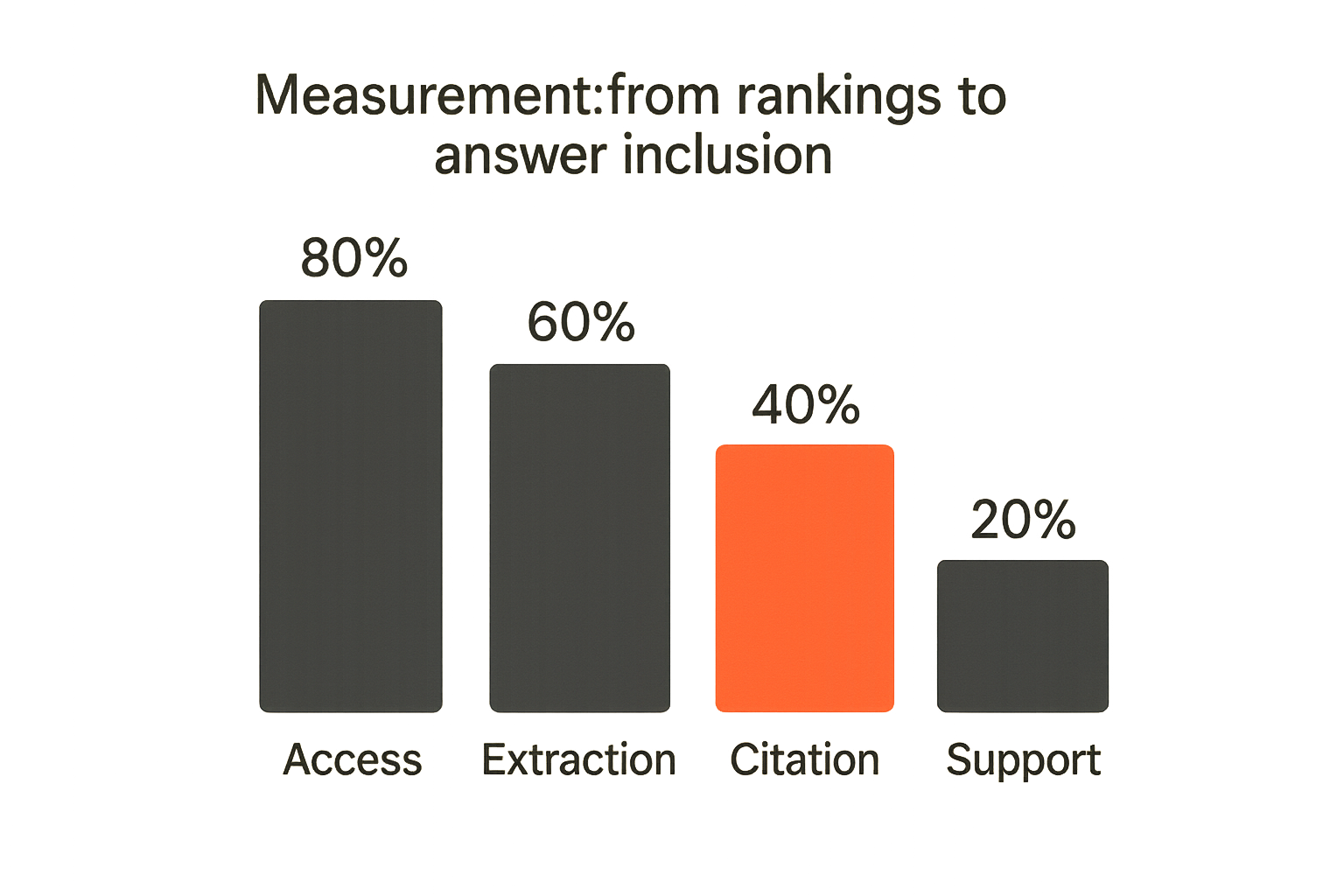
Track access, extraction, and citation separately
Traditional SEO measurement often starts with rankings and traffic. AEO needs a wider funnel. Track three layers separately:
- Access: can AI crawlers and answer systems fetch the content?
- Extraction: can the target answer be identified and summarized?
- Citation: does the answer engine mention, cite, or recommend the page?
Do not collapse these into one metric. If access fails, citation cannot happen. If extraction fails, the page may be fetched but ignored. If citation fails despite good access and extraction, the issue may be authority, competition, freshness, or answer fit.
This layered measurement is where convex optimization becomes practical. You are not guessing. You are finding where the loss occurs.
Compare before and after changes
AEO experiments are noisy. Answer engines vary by interface, location, personalization, freshness, and query wording. That does not mean measurement is impossible. It means you need a controlled workflow.
Use a before-and-after log:
- Target query or prompt
- Target URL
- Baseline access status
- Baseline extraction notes
- Baseline answer behavior
- Change made
- Date deployed
- Retest result
- Follow-up action
Keep the sample small enough to inspect manually. A spreadsheet with 30 important prompts can be more useful than a dashboard with 10,000 unverified AI visibility impressions.
Decide when to stop optimizing
Optimization has opportunity cost. Some pages are worth heavy work. Others are not.
Stop or pause when:
- The page is accessible, extractable, and well-supported, but answer inclusion remains unlikely due to stronger competitors
- The target query has low commercial value
- The fix would require disproportionate engineering effort
- The answer engine consistently cites more authoritative primary sources
- The page already supports buyers well through other channels
This is not defeat. It is allocation discipline. Convex optimization is as much about not working on the wrong thing as it is about finding the next improvement.
Audit the constraints before rewriting the site
CrawlProof is built for site owners and marketers who need to see their pages the way AI crawlers and answer engines see them. In the convex optimization model, it helps identify the current constraint before the team spends time on the wrong fix.
That may be crawl access. It may be missing schema. It may be weak answer extraction. It may be a robots rule, a rendering issue, or unclear positioning. The point is not to produce another vanity score. The point is to expose the bottleneck.
If you are trying to operationalize AEO, CrawlProof can audit what AI crawlers can actually find on a URL so the team can decide whether the next move is technical, editorial, or structural.
Turn findings into an operating cadence
The strongest teams will not treat AEO as a one-time cleanup. They will build a cadence:
- Identify high-value answer targets.
- Audit the current pages.
- Fix the primary constraint.
- Re-test crawler visibility and extraction.
- Update templates and publishing rules.
- Repeat as answer engines and crawler behavior change.
That is the operator version of convex optimization for AEO. Define the objective. Find the constraint. Move in the direction that reduces loss. Avoid local maxima. Validate the result.
The closing point is simple: convex optimization will not magically make AI answer engines cite your site, but it gives your team a disciplined way to decide what to fix next.
Try crawlproof.com
CrawlProof helps site owners and marketers understand how AI answer engines and LLM crawlers discover, parse, and cite their content. Run an AEO audit and see the constraints before you rewrite the site.
Try crawlproof.com