Dynamic creative optimization sounds like a growth-team lever: show the right headline, offer, proof point, or CTA to the right visitor. In production, it often becomes a crawlability problem.
A human sees a polished page. A search crawler sees one version. An LLM crawler may see another version, no version, or a stripped-down shell with the useful evidence hidden behind JavaScript, cookies, geolocation rules, consent banners, or experiment logic.
Teams think the problem is personalization. The real problem is state management for public knowledge.
That changes the conversation. If AI answer engines are going to discover, summarize, and cite your content, dynamic creative optimization has to be designed as an architecture and workflow decision, not a last-mile marketing trick. The practical question is not whether you should personalize. It is how you personalize without removing the stable facts, schema, and citation paths that answer engines need.
Table of contents
Dynamic creative optimization is now an AEO architecture problem
Dynamic creative optimization, or DCO, is usually discussed in the context of ads, landing pages, and conversion rate optimization. The system chooses creative elements based on audience, channel, device, location, behavior, or experiment assignment.
That framing is too narrow in 2026. Website owners are no longer optimizing only for a human visitor arriving from a blue link. They are also optimizing for answer engines that crawl, extract, cluster, and cite pages inside AI-generated responses.
If your best explanation appears only for one segment, after hydration, after consent, or after an experiment script fires, it may not become part of the answer-engine view of your site.
Why DCO breaks differently in answer engines
Classic SEO mostly taught teams to ask whether Google can index the page. AEO forces a more operational question: can an AI crawler identify the page topic, claims, supporting evidence, author or brand context, and next-best source without relying on a fragile browser session?
A dynamic page can pass a normal human review and still fail this test. The HTML may contain almost no text. The canonical version may be generic. The strongest proof may be injected after a personalization API responds. The product comparison table may be visible only to visitors from a paid campaign.
The mistake teams make is assuming that visible equals available. In answer-engine optimization, availability depends on what the crawler can request, render, parse, and trust.
What should remain stable across variants
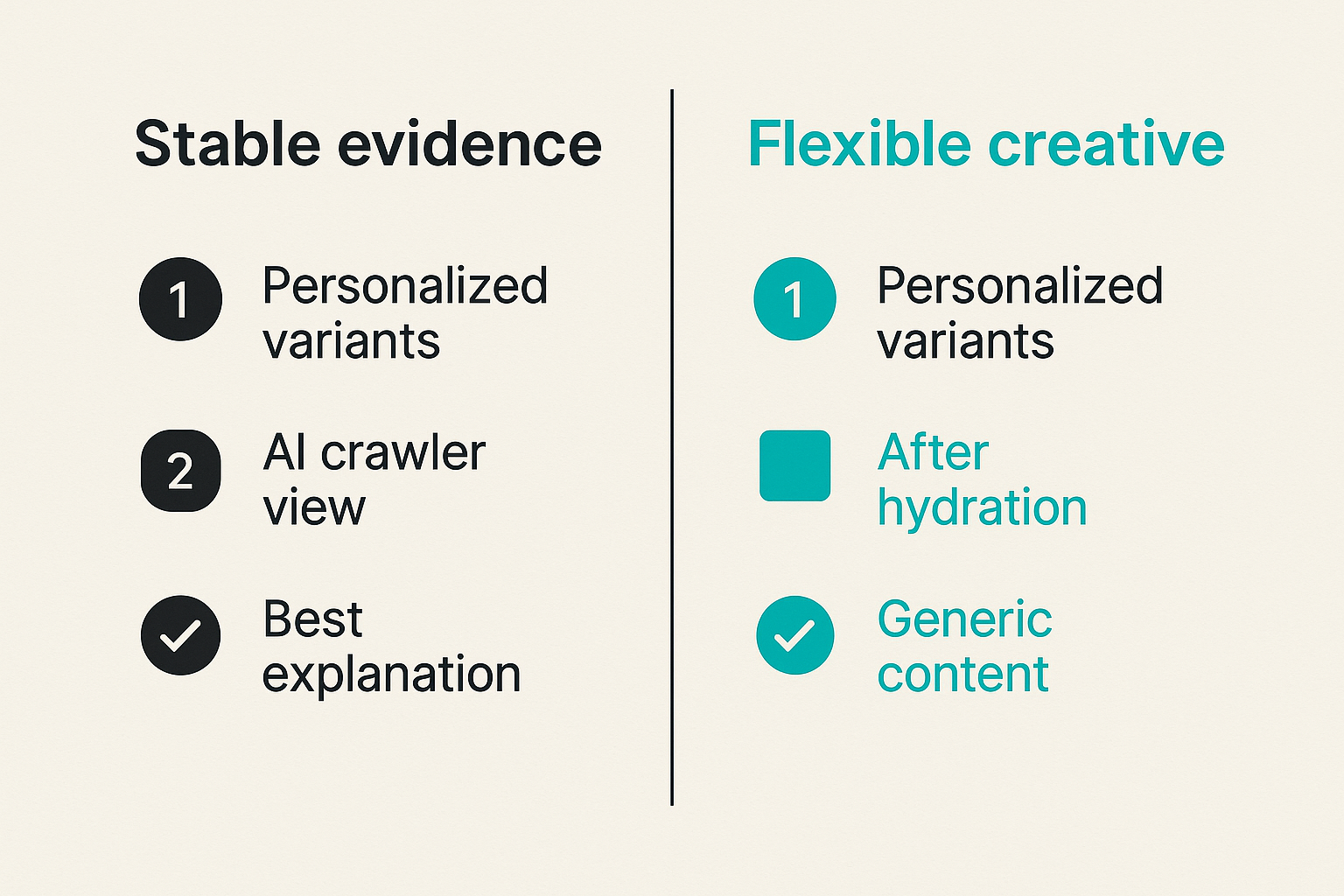
Personalization can change emphasis. It should not change the public record of what the page is about.
A useful way to think about it is this: every page needs a stable evidence layer and a flexible presentation layer. The evidence layer contains the facts answer engines need. The presentation layer adapts framing for humans.
Stable elements usually include:
- Primary topic and page purpose
- Core claims and definitions
- Product or service positioning
- Pricing ranges or plan logic, if public
- FAQs and supportable answers
- Organization, author, and contact context
- Schema markup and canonical references
- Links to durable supporting pages
Practical rule: personalize the path through the evidence, not the existence of the evidence.
Where SEO assumptions stop working
Traditional SEO tolerated a lot of page-level ambiguity because ranking systems had many signals to fall back on. Answer engines are less forgiving when they need to generate a direct answer and decide what to cite.
If a page says different things to different users, the answer engine has to infer the durable truth. If the page hides detail behind interaction, the answer engine may summarize the shallow version. If schema says one thing and rendered content says another, the system may ignore both.
For a primer on the broader shift, CrawlProof has a practical breakdown of what AEO is and why it is not just SEO. Dynamic creative optimization sits directly inside that shift because it changes what different readers can observe.
The crawlable baseline is the contract
The safest DCO architecture starts with a boring rule: the default page must be useful before personalization runs.
Not beautiful. Not maximally converting. Useful.
The crawlable baseline is the version a crawler, first-time visitor, privacy-restricted browser, or failed script execution can understand. It is your contract with machines and humans when state is unknown.
Build one canonical evidence layer
Your canonical evidence layer is the durable, crawlable substance of the page. It can live in server-rendered HTML, static generation, edge-rendered content, or a hybrid architecture. The implementation matters less than the outcome: the important content is present without requiring a fragile sequence of client-side events.
A good baseline page answers:
- What is this page about?
- Who is it for?
- What claim is being made?
- What proof supports that claim?
- What should a reader do next?
- What related pages deepen the answer?
The baseline does not need every possible persona-specific paragraph. It does need enough specificity that an answer engine can cite it confidently.
Keep personalization additive
Additive personalization means the dynamic system enhances a complete page instead of replacing it.
Good additive changes include:
- Reordering proof blocks by industry
- Swapping examples while keeping the core explanation intact
- Changing CTA copy based on intent
- Showing relevant case-study cards
- Emphasizing a feature set without removing the full feature context
Risky replacement patterns include:
- Rendering a blank page until audience detection completes
- Hiding all FAQs except segment-specific ones
- Replacing the headline and core claim on every traffic source
- Serving drastically different schema by segment
- Removing internal links for some variants
Practical rule: if a personalization service fails, the page should degrade into a clear answer, not a loading skeleton.
Separate presentation from facts
The cleanest DCO systems treat factual content as shared objects and creative treatments as wrappers around those objects.
For example, a SaaS page may have one verified claim: The platform supports audit exports in CSV and JSON. Different segments can frame that claim differently. A developer visitor may see API language. A compliance visitor may see audit language. But the underlying claim remains identical.
That separation prevents variant drift. It also makes schema, content QA, and crawler validation easier because you are not asking every experiment to become a new source of truth.
Dynamic creative optimization for AEO needs a content model
Dynamic creative optimization for AEO works best when content teams stop managing pages as blobs. Pages need components with roles, constraints, and owners.
Without a content model, DCO becomes a pile of conditional snippets. Somebody adds a hero variant. Somebody else adds industry proof. A third person adds a geo-specific claim. Six months later nobody knows which version answer engines are likely to see.
Map claims before variants
Start with claims, not creative.
A claim map defines what the site is allowed to say and where support lives. It does not have to be complicated. A spreadsheet can work at the beginning.
Useful columns include:
| Claim | Supports llms.txt review | Defines the factual unit |
| Source page | /features/ai-crawler-audit | Gives crawlers a durable reference |
| Evidence | Checks bot access and schema | Prevents unsupported copy |
| Owner | Product marketing | Assigns maintenance |
| Allowed variants | Technical, executive, agency | Controls personalization |
| Schema impact | SoftwareApplication feature | Keeps markup consistent |
This is not bureaucracy. It is how you avoid publishing ten personalized claims that cannot all be true at the same time.
Use blocks, not page chaos
DCO should operate on named blocks with clear jobs:
- Hero promise
- Problem framing
- Evidence block
- Use-case block
- FAQ block
- Comparison block
- CTA block
- Related resources block
Each block should have a default version and approved variants. More importantly, each block should have rules about what cannot change.
For example, the FAQ block may allow different ordering by persona but require the same canonical questions to remain available in HTML. The proof block may allow industry-specific examples but require at least one general proof point to appear for every visitor.
Design for citation snippets
Answer engines cite concise, extractable passages more easily than sprawling interactive layouts. That does not mean writing robotic content. It means giving machines clean units to quote or summarize.
Citation-friendly blocks usually have:
- A descriptive subheading
- A direct answer in the first sentence
- Supporting detail in the next two or three sentences
- A nearby internal link to the deeper source
- Matching schema where appropriate
This matters for DCO because variants often optimize for persuasion and accidentally remove quotable clarity. A clever headline may convert. A clear paragraph gets cited.
Related reading from our network: teams building independent acquisition channels face a similar proof-and-platform problem in freelance website selection for beginners, where the visible profile is only one part of the operating system.
What AI crawlers actually struggle with
AI crawlers are not one uniform user agent with identical rendering behavior. Some fetch raw HTML. Some render JavaScript. Some follow links selectively. Some respect robots directives strictly. Some may discover pages through sitemaps, citations, links, or external mentions.
The operational point is simple: dynamic creative optimization increases the number of possible page states, and crawlers will not necessarily see the state your marketing team considers canonical.
JavaScript and delayed rendering
Client-side rendering is not automatically bad. But delayed rendering creates risk when the meaningful content arrives only after multiple dependencies:
- The base HTML loads.
- The app bundle downloads.
- The personalization script identifies the visitor.
- The experiment service assigns a variant.
- The content API returns blocks.
- The browser hydrates the page.
What breaks in practice is not one of these steps. It is the chain. A crawler may stop after step one or three. A timeout may leave the page half-rendered. A privacy rule may block the identification call.
If the page has no useful server-rendered baseline, the answer engine may see a thin shell.
Cookie and location gates
Many DCO systems depend on cookies, IP location, referrer, or paid campaign parameters. Human visitors usually arrive with some context. Crawlers often do not.
That creates default-state bias. The crawler may always see the generic version, the US version, the unknown visitor version, or the no-consent version.
This is especially important for companies with region-specific offers or regulated claims. If your page has materially different content by market, your architecture needs durable regional URLs or crawlable alternates. Do not rely only on runtime location detection.
Variant drift and thin pages
Variant drift happens when personalized versions slowly diverge from the canonical page. One segment gets new proof. Another segment keeps outdated copy. A third loses the internal links because a test removed a section.
The result is a site that looks fine in aggregate but inconsistent at the machine level.
Use this comparison when reviewing a DCO plan:
| One static page | Easy to crawl and maintain | May underperform for different intents |
| Fully dynamic page | Flexible targeting | High risk of thin crawler states |
| Additive DCO on a stable baseline | Personalized but still crawlable | Requires content governance |
| Separate URLs for major intents | Strong clarity and analytics | Needs canonical and duplication discipline |
The practical answer is usually not pure static or pure dynamic. It is a stable baseline plus controlled variation.
A practical implementation workflow
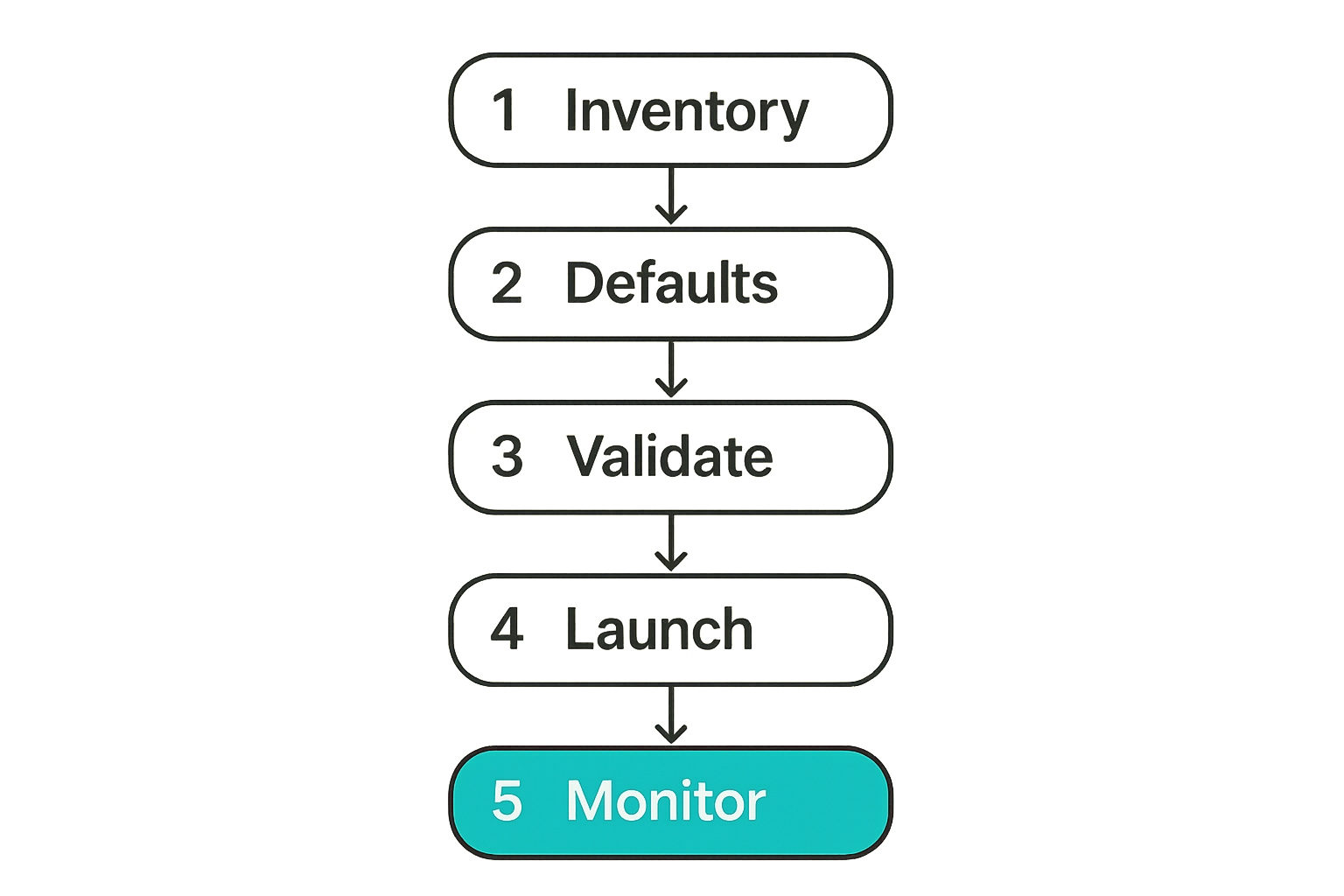
Dynamic creative optimization becomes manageable when you treat it as a publishing workflow. The goal is not to slow marketing down. The goal is to prevent every campaign from changing the machine-readable identity of the page.
Here is a sequence that works for many content and growth teams.
Step 1 inventory the decision points
List every place the page changes based on state. Do not limit the inventory to obvious A/B tests.
Include:
- Audience segment
- Traffic source
- Campaign parameter
- Geography
- Language
- Device
- Login state
- Consent state
- Returning visitor status
- Experiment assignment
- Time-limited offers
For each decision point, record what changes: headline, body copy, proof, pricing, links, schema, forms, CTA, or entire sections.
The mistake teams make is auditing only what appears in the CMS. DCO logic often lives in tag managers, edge middleware, personalization platforms, feature flags, and frontend code.
Step 2 define crawler-safe defaults
For every dynamic block, define a crawler-safe default. This is not necessarily the highest-converting version. It is the most accurate, durable, and broadly useful version.
A crawler-safe default should:
- Explain the page topic without audience detection
- Include the primary claim and proof
- Avoid unsupported superlatives
- Link to durable supporting resources
- Match the canonical URL and schema
- Work without cookies or local storage
- Render within normal fetch and timeout constraints
Practical rule: the default state is not a fallback afterthought. It is the version most machines will judge you by.
Step 3 validate every published state
Before launch, test the page in multiple states. At minimum, review:
- Raw HTML with scripts disabled.
- Rendered page with no cookies.
- Rendered page with consent declined.
- Rendered page for each major segment.
- Page fetched with known AI crawler user-agent assumptions where your tooling supports it.
- Schema output for default and variant states.
- Internal links visible in the rendered DOM.
- Canonical, robots, and meta directives.
This is where many teams need better tooling. Browser QA is not enough because answer engines do not behave like a patient human with a fresh Chrome session.
Adjacent teams in cloud and AI infrastructure run into the same validation issue at a different layer: Related reading from our network: cloud computing company architecture choices shape routing, reliability, and observability long before the user sees the interface.
Schema, llms.txt, and machine-readable context
DCO changes visible content. Schema and crawler guidance describe what the page means. When those two layers disagree, answer engines have to choose which signal to trust.
For AEO, you want boring consistency. The page content, structured data, canonical tags, internal links, sitemap, robots rules, and AI crawler guidance should tell the same story.
Schema should describe the stable page
Structured data should reflect the stable, public content of the page. If you use Product, SoftwareApplication, FAQPage, Article, Organization, BreadcrumbList, or WebPage schema, make sure the markup is aligned with what a crawler can actually read.
Do not mark up FAQs that are hidden from the default page. Do not publish ratings or claims in schema that are absent from content. Do not swap schema aggressively by campaign segment unless you have a very clear reason and validation process.
Schema is not a secret channel for claims. It is a machine-readable summary of visible truth.
llms.txt should route crawlers to durable sources
Emerging files such as llms.txt give site owners a way to point AI systems toward useful, durable resources. They do not fix broken content architecture, but they can reduce ambiguity when used well.
If you maintain dynamic landing pages, llms.txt can help identify canonical explainers, documentation, product pages, pricing pages, or policy pages that should be treated as stable references. CrawlProof has a practical explainer on llms.txt and skill.md if your team is deciding what belongs in those files.
The key is to route machines toward durable sources, not temporary campaign states.
Do not personalize structured data blindly
Personalized schema sounds clever until it creates contradictions.
Common bad patterns include:
- FAQ schema that changes by UTM parameter
- Product schema that changes offer details without durable regional URLs
- Article schema with different headlines by persona
- Organization schema injected by a third-party widget
- Breadcrumb schema that does not match the visible navigation
What works is a conservative schema layer based on the canonical evidence layer. If a variant changes only framing, the schema usually should not change. If a variant changes the actual offer, consider whether it deserves a separate URL, canonical rule, or regional page.
Measurement changes when the reader is an answer engine
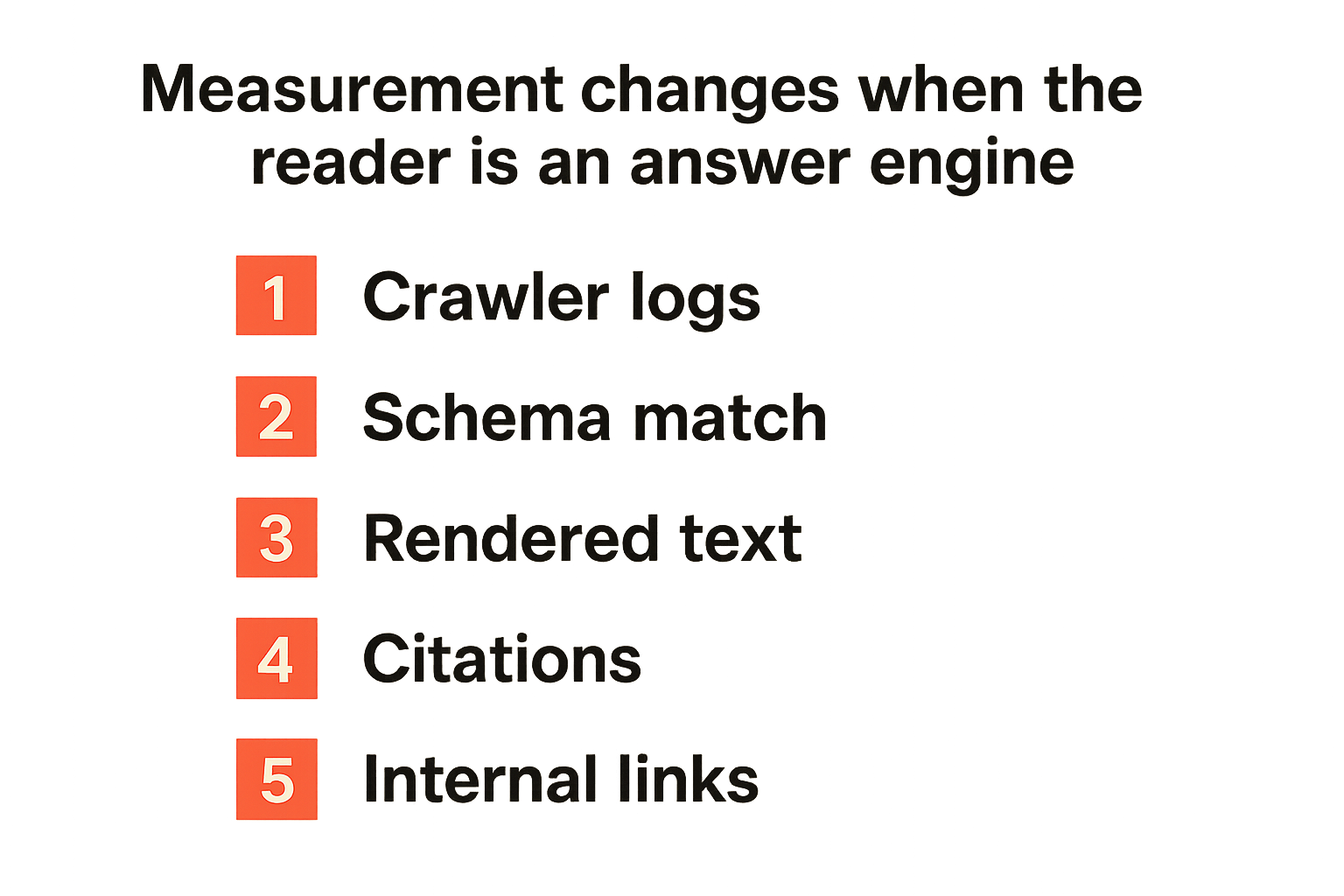
DCO teams usually measure clicks, conversion rate, revenue per visitor, engagement, and experiment lift. Those metrics still matter. They just do not tell you whether answer engines can understand and cite the page.
For AEO, you need visibility metrics before conversion metrics.
Track exposure, not just clicks
Answer engines can influence demand without sending the same kind of clickstream search used to send. A user may ask an AI assistant for recommendations, read a summary, and only later search your brand directly.
That makes page exposure harder to measure. Still, you can track leading indicators:
- AI crawler access in logs
- Pages requested by known AI user agents
- Whether important pages are crawlable without JavaScript
- Presence of your brand in answer outputs during manual tests
- Citation consistency across answer engines
- Schema validity and rendered content availability
- Internal links discovered from crawler-accessible pages
These are not perfect attribution metrics. They are operational health metrics.
Log crawler access by variant
If your DCO platform can assign variants server-side or at the edge, log which variant was served to crawler-like requests. If it cannot, log the default state and validate separately.
Useful log fields include:
| URL | Identifies the page state being tested |
| User agent | Helps separate crawlers, browsers, and bots |
| Render path | Server, edge, client, or static |
| Variant ID | Shows what creative was served |
| Consent state | Explains missing scripts or content |
| Status code | Catches redirects, blocks, and errors |
| Canonical URL | Detects conflicting identity signals |
| Schema hash | Flags unexpected structured data changes |
The point is not to chase every bot. The point is to know whether your public knowledge layer is stable.
Compare answer quality before conversion rate
Before judging a DCO rollout only on conversion lift, ask whether answer quality improved, stayed stable, or degraded.
A simple review process:
- Pick ten high-intent questions your page should answer.
- Ask them in the answer engines your audience uses.
- Record whether your brand appears, is cited, or is summarized accurately.
- Compare before and after the DCO change.
- Inspect the cited page state for missing proof or conflicting copy.
If conversions rise but answer quality falls, you may be trading near-term campaign performance for long-term discoverability.
Common failure modes in dynamic creative optimization
Most DCO failures are not caused by bad intent. They are caused by unclear ownership. Marketing owns the message. SEO owns crawlability. Developers own rendering. Analytics owns experiments. Nobody owns the machine-readable truth across all variants.
That is where dynamic creative optimization becomes fragile.
The empty shell problem
The empty shell problem is the classic failure mode: the initial HTML contains a root div, a few scripts, and not much else. Humans with modern browsers see the page. Crawlers that do not execute the full chain see almost nothing.
This is especially risky on pages that target high-value answer queries. If the page is supposed to explain pricing, compare products, define a method, or answer a regulatory question, do not hide the answer behind client-side personalization.
What works:
- Server-render primary content
- Static-generate evergreen pages
- Hydrate interactive components after content loads
- Keep core FAQs in HTML
- Render internal links as normal anchors
What fails:
- Requiring a personalization API before any copy appears
- Loading proof through a blocked third-party script
- Injecting links only after user interaction
- Using images for text-heavy proof blocks
The over-segmented proof problem
Segmentation can improve relevance. Over-segmentation can erase shared authority.
If every audience gets a different proof block, answer engines may never see the complete pattern of expertise. Worse, some variants may be too thin to support the claim they make.
A better model is shared proof plus segment-specific examples. Keep one durable explanation of why the claim is true. Then add examples for agencies, ecommerce teams, SaaS teams, publishers, or developers.
Related reading from our network: privacy and security teams deal with the same workflow discipline when they choose secure messaging apps around threat models and validation, not just the visible chat interface.
The experiment cleanup problem
Experiments rarely die cleanly. A test ends, but the tag remains. A variant loses, but a snippet stays in the container. A campaign page is unpublished, but the personalization rule still fires on a related URL.
For AEO, stale experiments are dangerous because they can keep serving outdated claims to crawlers long after humans stop noticing them.
Build cleanup into the workflow:
- Every experiment has an owner
- Every variant has an expiration date
- Winning copy is merged into the content model
- Losing copy is removed from runtime systems
- Schema is revalidated after cleanup
- Logs are checked for unexpected variant serving
Practical rule: if a variant can be served, it must be governed like published content.
Product fit and next steps for crawlproof.com
Dynamic creative optimization is useful. It just needs guardrails. The teams that win with it will not be the teams with the cleverest headline swaps. They will be the teams that preserve a crawlable, consistent evidence layer while adapting the experience for real visitors.
That is the AEO version of the problem.
When CrawlProof fits
CrawlProof is built for site owners and marketers who need to see what AI crawlers and answer engines can actually find on their pages. That includes content, schema, robots rules, AI-bot access, and positioning.
If you are running DCO, an audit should answer practical questions:
- Is the default page useful without personalization?
- Can important content be found by crawler-like requests?
- Does schema match visible content?
- Are AI crawler rules accidentally blocking key pages?
- Do internal links expose the right durable sources?
- Are dynamic variants creating conflicting signals?
You can run an AEO audit from CrawlProof to see your site closer to the way AI crawlers see it.
What to audit before you personalize
Before launching or expanding DCO, audit the boring parts:
- Raw HTML content
- Rendered DOM content
- Schema consistency
- Canonical tags
- Robots and meta directives
- Sitemap inclusion
- llms.txt guidance
- Internal link visibility
- Core FAQs and definitions
- Variant-specific claims
This is not anti-personalization. It is the operating discipline that lets personalization coexist with answer-engine visibility.
If the baseline is weak, DCO will amplify the weakness. If the baseline is strong, DCO can route different visitors through the same durable truth.
Try crawlproof.com
crawlproof.com helps site owners and marketers understand how AI answer engines and LLM crawlers discover, parse, and cite their content.
Try crawlproof.com
Dynamic creative optimization should make your pages more useful to humans without making them less legible to machines. In 2026, that is the real workflow.