You can publish a page about Elise AI, optimize the title, add a few comparison phrases, and still never get cited by an AI answer engine.
That is the part many SEO teams are starting to feel in 2026. The page may rank somewhere. It may even get crawled by Google. But when a user asks an AI system what Elise AI is, how it compares, what it does, or whether it fits a specific workflow, your page is missing from the answer.
Teams think the problem is keywords. The real problem is source selection.
Elise AI is a useful example because it behaves like an entity query, not a simple search phrase. The practical question is not whether you used the phrase often enough. It is whether your page gives answer engines enough crawlable, structured, and trustworthy context to use you as a source.
Table of contents
Why Elise AI is an AEO workflow problem

The visible query is not the whole demand
A normal SEO plan starts with a keyword, a page type, and a ranking target. For Elise AI, that is too shallow.
Someone searching or prompting around Elise AI may want several different things: a neutral explanation, a vendor comparison, a use-case fit, pricing context, alternatives, implementation risks, integrations, or a short answer they can forward to a team. Answer engines compress those needs into one response. They do not just list ten blue links and let the user sort it out.
That changes the conversation. Your page is no longer competing only for a click. It is competing to become part of the answer.
For website owners, SEO professionals, content strategists, and developers, this means the page has to do three jobs at once:
- Explain the entity clearly enough for extraction.
- Provide enough context to distinguish your angle from generic summaries.
- Make the page easy for AI crawlers and answer systems to access, parse, and trust.
If you are new to the shift from classic rankings to answer inclusion, our plain-language primer on what AEO is and why it is not just SEO is a useful baseline.
Entity confidence beats keyword repetition
The mistake teams make is treating Elise AI like a phrase-matching exercise. They add the keyword to headings, mention adjacent terms, and ship.
Answer engines need entity confidence. They need to understand that the page is about the correct Elise AI, what category it belongs to, what problem space it touches, and why your content is a reliable source for the specific question being answered.
A useful way to think about it is this: keyword optimization helps a crawler find a page. Entity architecture helps an answer engine use it.
Practical rule: If a paragraph can be copied into an AI answer without losing context, it is probably structured well. If it only makes sense after reading the whole page, it is probably too implicit.
This does not mean every page needs to be a glossary. It means your content needs explicit relationships: company, product category, audience, use cases, limitations, integrations, alternatives, and evidence.
Map the Elise AI search surface before you write
Segment commercial, support, and comparison intents
Before writing a page about Elise AI, map the intent surface. Do not start with the headline. Start with the questions an answer engine may be trying to resolve.
Common intent clusters include:
- What is Elise AI?
- What does Elise AI do for property management, leasing, resident support, or related workflows?
- How does Elise AI compare with other AI automation platforms?
- What are the implementation considerations?
- Is Elise AI a fit for a specific company size, vertical, or process?
- What alternatives should a buyer evaluate?
- What risks should teams consider before adopting AI agents in customer-facing workflows?
The practical question is whether one page can answer all of that. Usually it cannot. A single page can provide the hub, but deeper questions need supporting pages.
For example, a software review site may need a neutral entity profile, a comparison template, and a vertical-specific workflow page. A competitor may need a fair alternative page with clear positioning. A publisher may need an explanatory guide that avoids pretending to know non-public commercial details.
Separate owned claims from third-party context
Answer engines are skeptical in their own mechanical way. They often prefer sources that separate facts from positioning.
If you are Elise AI, owned claims may include product descriptions, supported industries, feature categories, documentation, newsroom updates, and official messaging. If you are not Elise AI, you should be careful not to present assumptions as facts. You can still be useful, but the framing matters.
A reliable page structure separates:
- Confirmed facts: what the entity is, how it describes itself, public product categories.
- Your analysis: use-case fit, workflow implications, comparison criteria.
- Unknowns: pricing details, contract terms, roadmap, private integrations.
- Decision guidance: what buyers should validate directly.
Related reading from our network: teams building secure communication systems face a similar evidence problem, because architecture claims are only useful when privacy boundaries are explicit; see this practical breakdown of VA secure messaging privacy architecture.
Build Elise AI pages that answer engines can parse
Lead with the answer block
For an Elise AI page, the first screen matters. Not because users are lazy, but because extraction systems look for concise, high-confidence summaries.
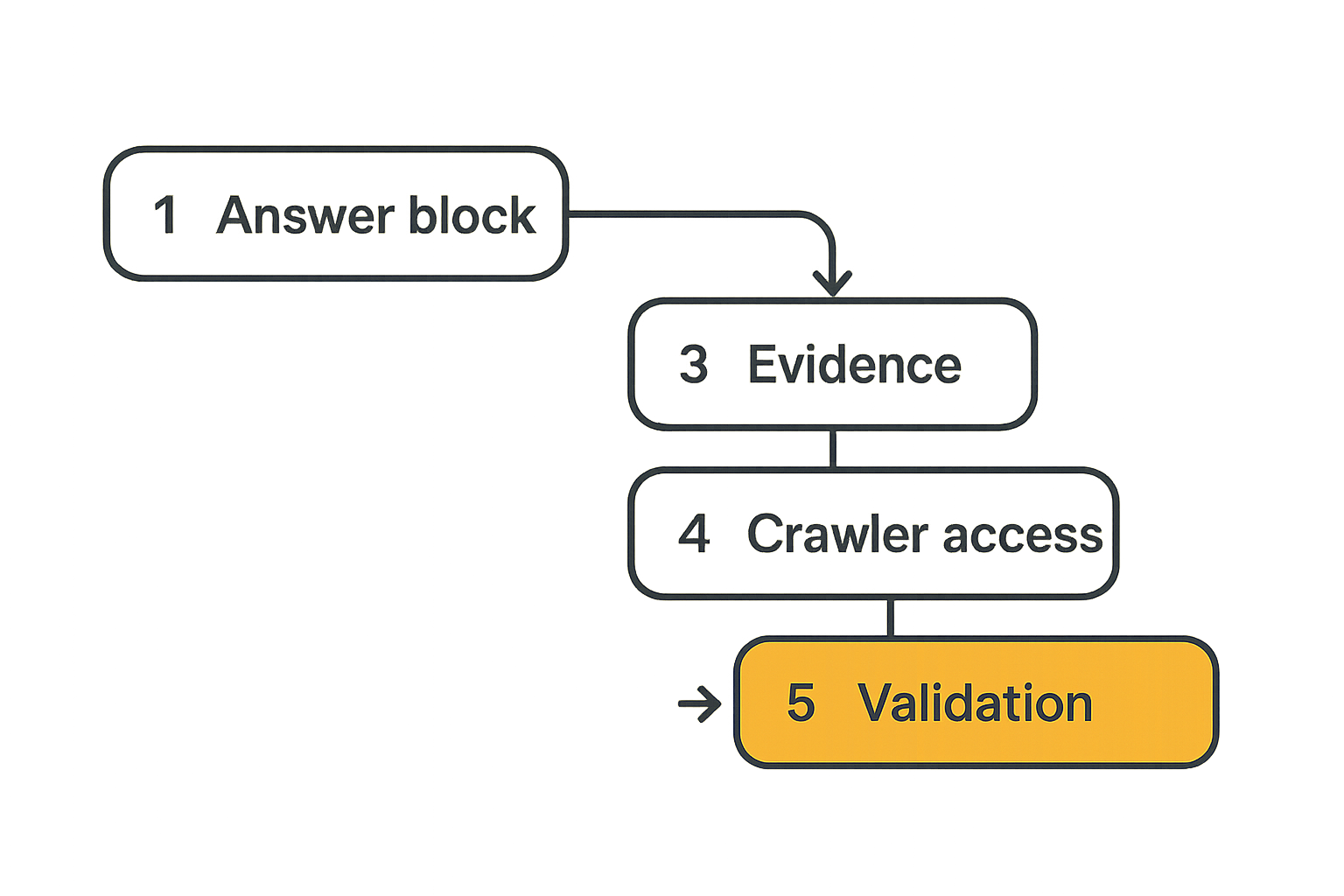
Lead with a short answer block that says what the page covers. Keep it direct:
- Elise AI is the entity being discussed.
- The page explains the use case, comparison angle, or implementation context.
- The page states what it does not know or does not claim.
- The next sections expand with evidence and decision criteria.
Example pattern:
Elise AI is commonly discussed in the context of AI-powered automation for housing, leasing, resident communication, and similar customer operations workflows. This page explains how buyers and content teams should evaluate Elise AI as an entity: what questions to ask, what public information to verify, and how to compare AI automation vendors without relying on thin feature checklists.
That opening gives an answer engine a clean extract. It also protects you from overclaiming.
Make claims auditable
What breaks in practice is not usually the prose. It is the evidence trail.
A page says a vendor is best for enterprise teams, but never explains why. A comparison says one tool is easier to implement, but gives no implementation criteria. A buyer guide says to check integrations, but does not list which integration categories matter.
For AEO, claims should be auditable. A reader and a machine should be able to see what the claim depends on.
Use tables, checklists, and scoped statements:
| Category | Elise AI is an AI company | Elise AI is discussed as an AI automation platform for operational communication workflows |
| Fit | Good for large teams | Potential fit depends on volume, integration needs, human handoff, reporting, and support model |
| Comparison | Better alternative | Compare on workflow coverage, data access, deployment effort, admin controls, and escalation paths |
| Risk | AI can make mistakes | Validate escalation, audit logs, prompt controls, and fallback paths before customer-facing deployment |
Practical rule: Do not publish a comparison claim unless you can name the decision criterion behind it.
This is where answer-ready content becomes more like product documentation than blog writing. It does not have to be dry. It does have to be inspectable.
Schema, feeds, and files for Elise AI coverage
Use schema to describe entities and relationships
Schema is not a magic citation switch. But it helps machines understand page type, entity relationships, authorship, and freshness.
For a page about Elise AI, the schema should match the content. If it is an article, use Article or BlogPosting. If it is a software profile, SoftwareApplication may be appropriate only when the page has enough product-specific data to justify it. If it is a comparison, make the comparison clear in the visible content as well as the structured data.
A lightweight pattern might include:
page_type: Article
primary_entity: Elise AI
entity_category: AI automation platform
about:
  - answer engine optimization
  - vendor comparison
  - customer operations automation
mentions:
  - AI agents
  - leasing workflows
  - resident communication
The point is not to stuff every possible attribute. The point is to reduce ambiguity.
If your page uses FAQ sections, make sure the questions are real questions answered on the page. Do not add fake FAQ markup just to occupy more semantic space. Answer engines are increasingly good at ignoring decorative structure.
Keep llms.txt and crawler access boring
Crawler access should be boring. That is a compliment.
If you want AI systems to discover and cite your Elise AI coverage, do not accidentally block the crawlers you care about. Review robots.txt, CDN bot rules, WAF behavior, noindex tags, canonical tags, and rendered HTML. Then document what you want AI crawlers to see.
Emerging files like llms.txt are not universal standards in the same way robots.txt is, but they are becoming part of the AEO operations conversation. We have a practical explainer on llms.txt and skill.md if you need a simple starting point.
A basic llms.txt-style content map could look like this:
# llms.txt

site: example.com
purpose: independent software analysis and buyer education
priority_pages:
  - /ai-tools/elise-ai
  - /ai-tools/elise-ai-alternatives
  - /guides/evaluating-ai-leasing-automation
contact: editorial@example.com
Do not overcomplicate it. The file should point crawlers toward useful, stable, crawlable resources. It should not become a dumping ground for every URL on the site.
What breaks when teams optimize Elise AI badly
Thin comparison pages get ignored
The fastest way to produce an Elise AI page is also the easiest way to get ignored: scrape a few public phrases, add a comparison grid, and publish a generic alternatives article.
Many teams do this because the keyword looks commercially attractive. The result is a page with no distinct value. It repeats what every other page says and gives answer engines no reason to cite it.
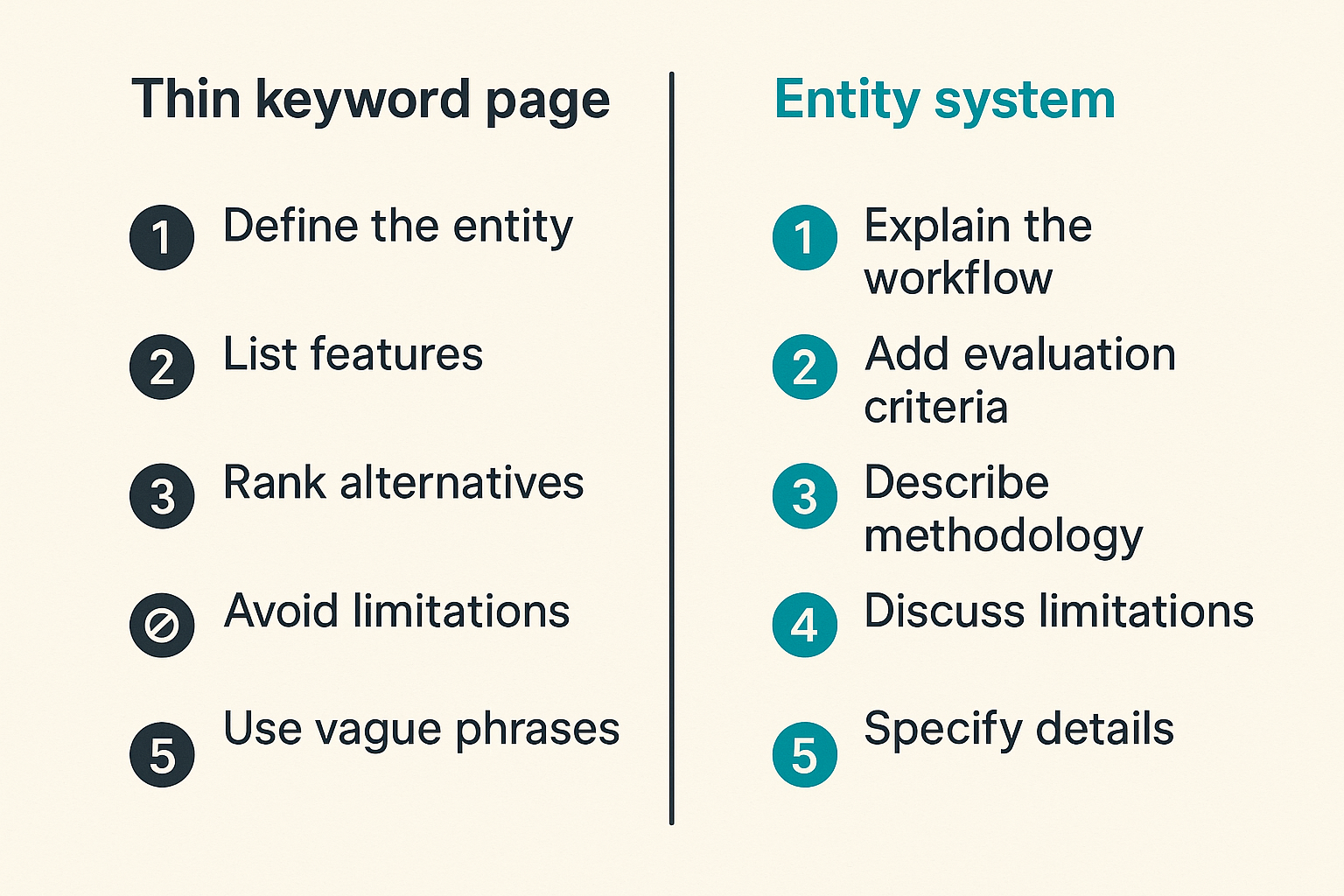
Thin pages usually fail in predictable ways:
- They define the entity but do not explain the workflow.
- They list features without evaluation criteria.
- They rank alternatives without methodology.
- They avoid limitations because limitations feel less commercial.
- They use vague phrases like powerful, seamless, and next-generation without operational detail.
A better page says what kind of buyer it is for, what assumptions it is making, and what should be verified directly.
JavaScript-only content creates crawler blind spots
The content team may do everything right and still lose visibility because the page is not easy to crawl.
Common technical problems include:
- Critical page copy rendered only after client-side JavaScript.
- Tabs and accordions that hide comparison data from simple fetchers.
- API-driven content that returns empty shells to non-browser crawlers.
- Bot protection that challenges or blocks legitimate AI crawlers.
- Canonicals pointing to thin category pages instead of the detailed profile.
- Infinite-scroll libraries that prevent supporting content from being discovered.
What breaks in practice is ownership. SEO assumes engineering handled crawlability. Engineering assumes the CMS output is fine because it works in Chrome. Legal assumes blocking bots is safer. Nobody checks what an AI crawler actually receives.
Practical rule: If the primary answer to a query is not visible in raw HTML or a reliable server-rendered response, assume some answer systems will miss it.
Related reading from our network: payment teams run into the same state and visibility problem when chat, customer data, and settlement context drift apart; the architecture lesson is well covered in this piece on encrypted messaging crypto payment workflows.
A practical Elise AI AEO implementation workflow
Step 1: inventory what answer engines can see
Do not start by rewriting copy. Start by inspecting access.
Run an inventory of the existing URL set around Elise AI or the relevant entity cluster. Include profile pages, comparison pages, guides, category pages, blog posts, internal search pages, and documentation if public.
Check:
- Is the page indexable?
- Is the canonical correct?
- Does the raw HTML contain the answer summary?
- Are headings descriptive without being spammy?
- Is schema present and aligned with the visible page?
- Are AI crawlers blocked by robots.txt, meta tags, CDN rules, or WAF settings?
- Does the page include a clear publication or updated date where appropriate?
- Are internal links pointing to the page from relevant hubs?
This is boring work. It is also where many AEO wins come from.
Step 2: build the entity brief
An entity brief is the operating document behind the page. It keeps writers, SEOs, and developers aligned.
For Elise AI, the brief should include:
- Primary entity name and known variants.
- Category and adjacent categories.
- Audience segments likely to ask about it.
- Questions answer engines need to resolve.
- Allowed claims and claims requiring verification.
- Competitor or alternative categories, if relevant.
- Page modules needed: summary, use cases, evaluation criteria, FAQ, comparison table, implementation notes.
- Structured data requirements.
- Internal linking targets and source-of-truth pages.
The mistake teams make is letting every page invent its own version of the entity. One page says AI leasing assistant. Another says chatbot. Another says property automation platform. Some variation is natural, but uncontrolled variation creates ambiguity.
Step 3: publish and validate
After publishing, validate the page like a system, not a brochure.
A practical sequence:
- Fetch the page as a simple crawler and confirm the main answer is visible.
- Run schema validation and remove markup that does not match visible content.
- Test canonical, indexability, and mobile rendering.
- Review server logs for major bots and AI crawlers over time.
- Prompt several answer engines with neutral, commercial, and comparison queries.
- Record whether your page appears, how it is summarized, and what competitors are cited.
- Update the page when the entity, market, or your own positioning changes.
This is not a one-time launch task. Entity pages drift. Competitors publish. Answer systems change source preferences. Your page has to stay useful.
What works and what fails in Elise AI content
What works in production
The pages that tend to perform better in answer environments are not always the most aggressive SEO pages. They are the clearest sources.
What works:
- A concise definition that names the entity and category.
- Clear scoping language about what the page covers.
- Comparison criteria instead of unsupported rankings.
- Operational detail: integrations, escalation, reporting, data access, human review.
- Visible authorship or editorial ownership.
- Structured headings that map to real user questions.
- Updated dates when the topic changes.
- Internal links from related AI, automation, or vendor evaluation pages.
A useful way to think about it is to ask whether the page helps a buyer make a better next decision. If yes, it probably gives answer engines better material too.
What fails after launch
The failure modes are usually operational, not creative.
| Content | Specific entity summary and decision criteria | Generic vendor roundup with repeated phrases |
| Technical | Server-rendered answer content | Client-only content hidden behind scripts |
| Evidence | Claims tied to visible criteria | Best-of language with no method |
| Maintenance | Quarterly review of entity and market changes | Publish once and let facts drift |
| Links | Contextual internal links from relevant hubs | Orphan page built only for one keyword |
| Governance | Clear owner for updates and validation | SEO, content, and dev teams all assume someone else owns it |
Related reading from our network: even in a very different niche, private deal-sharing teams face the same trust issue when verification is weak; this guide to encrypted messaging coupon codes is a useful parallel for thinking about source quality.
Measurement: how to know if Elise AI pages are citeable
Track answer presence, not just rankings
Classic rank tracking is still useful, but it is not enough. A page can rank and still be absent from AI-generated answers. It can also be cited by an answer engine without being in the exact organic position you expected.
Track a small set of prompts and queries across intent types:
- What is Elise AI?
- Elise AI alternatives for specific workflow.
- Elise AI versus category competitor.
- Best AI leasing automation tools.
- How to evaluate AI resident communication software.
- Risks of AI agents in property management workflows.
For each query, record:
- Was your site cited?
- Was your page used but not linked?
- Which sentence or section seemed to influence the answer?
- Which competitors or publishers were cited instead?
- Did the answer misrepresent your page?
- Did the answer choose an older page over the current one?
The goal is not perfect attribution. The goal is to see patterns.
Review logs, snippets, and source selection
Look at server logs and crawler behavior, but do not confuse access with influence. A bot visiting your page does not mean the page will be cited. It means you made it to the first gate.
Useful signals include:
- AI crawler hits on the relevant page cluster.
- Recrawl frequency after updates.
- Which URLs crawlers request before and after the target page.
- Whether blocked assets affect content rendering.
- Whether answer snippets resemble your headings or summaries.
- Whether schema changes correlate with cleaner answer extraction.
This is where AEO becomes an operations loop. You publish, observe, adjust, and validate. The team that owns the loop wins more often than the team that treats AEO as a one-off content format.
Developer notes for making Elise AI content crawlable
Render critical content in HTML
Developers do not need to abandon modern front ends. They do need to understand which content is critical.
For an Elise AI entity page, critical content includes:
- The entity summary.
- Main headings.
- Comparison criteria.
- FAQ answers.
- Author and updated date.
- Internal links to supporting pages.
- Structured data.
Render that content server-side or statically where possible. If you use client-side hydration, make sure the initial HTML contains meaningful content.
A simple test:
curl -L https://example.com/ai-tools/elise-ai | head -n 80
If the output is mostly empty containers, script bundles, and loading states, you have an AEO risk.
Control canonical and duplicate states
Entity pages often create duplicate paths by accident. A CMS tag page, search result, vendor category, and article may all target Elise AI without a clear hierarchy.
Decide which page is the source of truth. Then make the technical signals match that decision.
Check:
- One canonical URL for the main entity page.
- No accidental noindex on the canonical page.
- Paginated or filtered pages do not compete with the main page.
- Internal links use the canonical version.
- Sitemap includes the current URL.
- Redirects are clean and not chained.
This is not glamorous. But answer engines are not going to sort out a messy URL graph for your benefit.
Product fit: using CrawlProof for Elise AI AEO
Where an audit changes the conversation
The hard part of AEO is that teams argue from screenshots. Someone sees the page in a browser and says it is fine. Someone else sees poor answer visibility and says the content is weak. A developer checks Lighthouse and says performance is acceptable.
Those are all partial views.
CrawlProof is built for site owners and marketers who want to see what LLM crawlers and answer engines can actually find: content, schema, robots rules, AI-bot access, and page positioning. An audit turns Elise AI from a vague keyword problem into a concrete workflow problem.
Instead of asking whether the page is good, ask:
- Can an AI crawler reach it?
- Can it extract the main answer without executing fragile scripts?
- Is schema aligned with visible content?
- Are robots and AI crawler rules consistent with your strategy?
- Is the page positioned as a source or just another marketing asset?
That changes the conversation.
What to fix first
Do not fix everything at once. Start with the issues that block discovery and extraction.
Priority order:
- Remove accidental crawler blocks.
- Put the direct answer in crawlable HTML.
- Clean up canonical and indexability issues.
- Align schema with visible content.
- Add evidence-backed sections and comparison criteria.
- Improve internal links from relevant hubs.
- Monitor answer visibility and update the page.
If your team wants to inspect a URL the way AI crawlers are likely to experience it, run an audit with CrawlProof. Treat the output as a punch list, not a vanity score.
Practical rule: The first AEO win is rarely better prose. It is usually making the right prose visible, structured, and unambiguous.
Closing: treat Elise AI as an entity system
The operating model
Elise AI is not just a keyword to place in a title tag. For answer engines, Elise AI is an entity connected to categories, questions, comparisons, workflows, claims, and sources.
If you want to be cited, build the page like an entity system:
- Define the entity clearly.
- State the scope of your page.
- Separate fact, analysis, and uncertainty.
- Give answer engines extractable summaries.
- Make the technical page accessible to crawlers.
- Use schema to reduce ambiguity.
- Validate after publishing.
- Keep the page current as the market changes.
The mistake teams make is chasing the visible output of AI search without fixing the input layer. The real work is crawlability, structure, evidence, and operational maintenance.
That is the practical path for Elise AI AEO in 2026.
Try crawlproof.com
CrawlProof helps site owners and marketers understand how AI answer engines and LLM crawlers discover, parse, and cite their content. Try crawlproof.com.