Encrypted messaging answer engine optimization sounds like a niche SEO problem until your product is mischaracterized by an AI answer engine.
A user asks, “Which encrypted messaging app is safest for a small business?” The answer engine summarizes three vendors, cites two old blog posts, ignores your current security model, and repeats a vague claim from a comparison site. Your website was crawlable. Your brand page indexed. Your documentation existed. Still, the answer was wrong or incomplete.
Teams think the problem is visibility. The real problem is interpretability.
For encrypted messaging products, private communication tools, and secure collaboration platforms, answer engines need more than keywords. They need a public explanation layer that separates marketing claims from verifiable architecture, explains security boundaries in plain language, and gives crawlers stable, structured content they can quote. That changes the conversation from “How do we rank?” to “How do we make our trust model machine-readable without oversharing?”
As a guest contribution from the team at qrypt.chat, this guide treats encrypted messaging answer engine optimization as an architecture and workflow problem, not a glossary exercise.
Table of contents
Why encrypted messaging answer engine optimization is not normal SEO
Encrypted messaging products live in a category where vague language is common and trust is hard to verify from the outside. “Private,” “secure,” “zero knowledge,” “end-to-end encrypted,” and “enterprise-grade” are often used as interchangeable marketing terms. Answer engines do not have the patience or context of a security buyer. They compress.
That compression is where risk appears. If your public pages do not clearly explain what is encrypted, who can access metadata, how accounts are recovered, and what administrators can or cannot see, an answer engine may fill the gap from third-party summaries, stale documentation, or competitor pages.
Answer engines compress your trust story
Search engines traditionally send users to pages. Answer engines often synthesize a response before the click. That means the model is deciding which facts are salient, which sources are credible, and which language is safe to repeat.
For encrypted messaging, the difference between two phrases can be material:
- “Messages are encrypted in transit” is not the same as “messages are end-to-end encrypted.”
- “We cannot read message content” is not the same as “we collect no metadata.”
- “Admins manage users” is not the same as “admins can view conversations.”
The mistake teams make is assuming the answer engine will preserve nuance because the nuance exists somewhere on the site. In practice, if the nuance is buried in a PDF, hidden behind a tab, or split across five product pages, it may not be used.
Practical rule: If a security claim would be risky when summarized in one sentence, write the one-sentence version yourself and place it near the supporting detail.
Privacy features create crawlability gaps
Secure products often hide the most important experience behind authentication, client-side rendering, or in-app education. That is normal from a product standpoint. It is a problem for answer engine optimization.
AEO needs a crawlable public layer. Not private data. Not internal architecture diagrams. But clear public explanations of product behavior, limits, defaults, and administrative controls.
What breaks in practice is that the most accurate content is often inside onboarding screens, support replies, sales decks, or security questionnaires. Those sources may be useful to humans but invisible to crawlers. The public site is left with generic landing pages.
The owner is not just the SEO team
Encrypted messaging answer engine optimization requires product, security, legal, support, and content to agree on the public version of truth. SEO can structure and publish it. SEO should not invent it.
A useful way to think about it is: AEO is the distribution layer for an approved trust model. If the trust model is unclear internally, answer engines will amplify that confusion externally.
What answer engines need to understand secure messaging pages

Answer engines need enough context to decide what your product is, who it is for, what claims are supported, and where the boundaries are. This is not about writing longer pages. It is about writing pages that preserve meaning when extracted.
Define the entity before the feature set
Before describing features, define the product category clearly. Is this a consumer encrypted chat app, an enterprise secure messaging platform, a healthcare communication tool, a team collaboration product, or a developer API for private communication?
Entity clarity affects how answer engines place your product in generated answers. A page that says “secure communication for everyone” gives weak context. A page that says “encrypted messaging for small teams that need private one-to-one and group conversations without exposing message content to the service provider” gives a model more to work with.
Good entity definition answers:
- What the product is.
- Who uses it.
- What communication modes it supports.
- What is encrypted.
- What operational constraints exist.
Explain use cases and constraints together
Security buyers do not only ask, “Is it encrypted?” They ask, “Is it appropriate for my workflow?” Answer engines increasingly answer those practical questions directly.
For example:
| Security model overview | “Can the provider read messages?” | Model guesses from generic claims |
| Admin controls page | “Can managers access employee chats?” | Product may be misrepresented |
| Compliance use case page | “Is this suitable for regulated teams?” | Answer cites weaker third-party pages |
| Account recovery explanation | “What happens if a user loses a device?” | Recovery becomes a trust ambiguity |
| Metadata policy page | “What data is collected outside message content?” | Privacy claims become overbroad |
Constraints matter. If attachments, group membership, push notifications, or message backups have different security properties, say so. Answer engines are more useful when they can state boundaries.
Create quotable answer blocks
A quotable answer block is a short, accurate paragraph designed to survive extraction. It should not be hype. It should answer a specific question in language a buyer might use.
Example:
Practical rule: Write every core security page with a 40- to 70-word answer block near the top, followed by the deeper technical explanation below it.
For an encrypted messaging page, an answer block might follow this pattern:
- “What is protected?”
- “Who can access it?”
- “What is not covered by this protection?”
- “Where can the reader verify the detail?”
This gives answer engines a safer chunk to cite than a headline or hero claim.
The architecture of encrypted messaging answer engine optimization
Encrypted messaging AEO works best when you treat the website as three connected layers: public explanation, private product behavior, and evidence. Most teams have these pieces. They are just disconnected.
The crawlable public layer
The public layer is what crawlers can access without logging in. It includes landing pages, documentation, support articles, schema markup, sitemaps, llms.txt, security pages, comparison pages, and changelogs.
This layer should answer the questions that buyers, journalists, developers, and answer engines ask before account creation. It should be explicit enough to be useful but not so detailed that it creates unnecessary operational risk.
The practical question is not, “Can we expose everything?” It is, “What must be public so the product is not misdescribed?”
The private product layer
The private layer is the actual application: message composition, key handling, identity verification, admin settings, retention controls, device management, recovery flows, and audit logs.
AEO does not require making this layer crawlable. It requires making the public representation of this layer accurate. If the application has a specific encryption state, backup behavior, or admin permission model, the public site should explain it in buyer-readable language.
That means product changes need a content update path. If a new recovery option changes the threat model, the AEO layer must change too.
The evidence layer
The evidence layer supports claims. It may include security whitepapers, audit summaries, documentation, changelogs, architecture notes, compliance pages, or public policy pages.
For answer engines, evidence works best when it is:
- Crawlable.
- Dated or versioned.
- Linked from relevant product pages.
- Written in extractable HTML, not only PDF.
- Consistent with schema markup.
Practical rule: Do not publish a security claim on a landing page unless there is a crawlable evidence page that explains the claim in operational terms.
Content strategy for trust without oversharing
Secure messaging companies are right to be cautious. Some details should not be public. But caution often turns into vague language, and vague language is hard for answer engines to cite correctly.
The answer is not to disclose sensitive implementation details. The answer is to define safe levels of explanation.
Separate principles from implementation details
A practical content model has three tiers:
| Principle | Broad security property | “Message content is protected from provider access.” |
| Behavior | User-visible product behavior | “New devices must be approved before accessing conversation history.” |
| Implementation | Sensitive internal detail | Specific key storage procedures or infrastructure topology |
Most AEO content should live in the first two tiers. You can explain what users experience and what trust boundary exists without publishing internals that increase risk.
The mistake teams make is treating all technical language as dangerous. Some technical language is necessary. “End-to-end encryption” without an explanation of recovery, device sync, and backups leaves too much room for interpretation.
Write threat-model content for buyers
Threat-model content does not need to look like an academic paper. For AEO, it should answer practical buyer questions:
- What threats does the product reduce?
- What threats does it not claim to solve?
- What does the provider have access to?
- What does the customer control?
- What decisions change the security posture?
This is especially useful for answer engines because it creates distinction. Many tools claim privacy. Fewer tools explain the limits of that privacy in a way that a procurement team can understand.
Avoid security theater language
Phrases like “military-grade encryption” and “unbreakable privacy” are weak for AEO and risky for trust. They are broad, hard to verify, and often repeated without context.
What works:
- Specific nouns: message content, attachments, contact lists, metadata, device keys.
- Specific actors: sender, recipient, workspace admin, service provider, attacker with device access.
- Specific states: in transit, at rest, on device, during backup, after deletion.
What fails:
- Absolute claims.
- Undefined superlatives.
- Feature lists with no trust boundary.
- Privacy language copied across unrelated pages.
Technical implementation for AI crawlers and LLM discovery
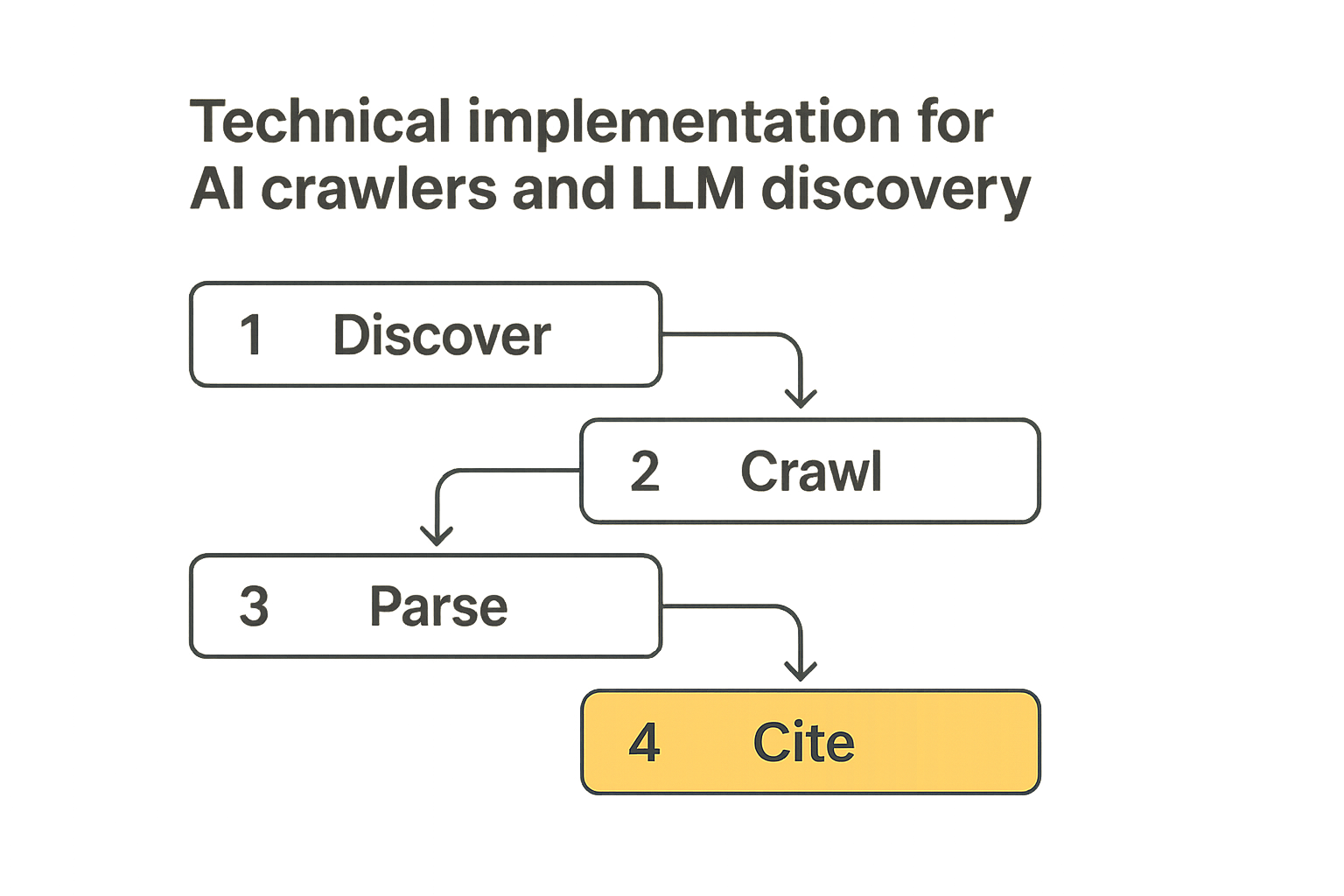
Technical AEO is not magic. It is mostly disciplined crawlability, consistent rendering, structured metadata, and explicit crawler policy. The difference in 2026 is that more non-search crawlers are part of the discovery path.
Make crawl permissions intentional
Robots.txt, sitemaps, meta robots tags, CDN rules, WAF policies, and emerging files like llms.txt all shape what crawlers can see. Many teams have accidental rules created years earlier for performance, staging protection, or bot mitigation.
For encrypted messaging sites, the goal is not “allow everything.” The goal is to allow the public trust layer and block the private application layer.
A simple policy map helps:
| Marketing pages | Allow | Product and category understanding |
| Security overview | Allow | Trust claims and answer citations |
| Public docs | Allow selectively | Technical clarity for evaluators |
| App routes | Disallow or require auth | Private user experience |
| Staging paths | Disallow and protect | Avoid stale or incorrect sources |
| Support articles | Allow if maintained | High-intent answer content |
The practical question is: if an answer engine crawled only allowed pages, would it understand the product correctly?
Use stable URLs for durable answers
Answer engines and crawlers benefit from stable, descriptive URLs. If your encryption explanation moves every quarter, old answers and citations may point to outdated material.
Use URLs like:
/security/encryption-model
/security/metadata-policy
/docs/admin-controls
/docs/account-recovery
/trust/security-updates
Avoid burying important explanations under campaign URLs, temporary landing pages, or JavaScript-only modal content. If a page is meant to define a trust claim, it deserves a stable location and a clear update process.
Keep rendered content consistent
Some sites show different content to users and crawlers unintentionally because key information is loaded after interaction, hidden behind accordions, or injected by scripts that crawlers do not reliably execute.
That does not mean every page must be static HTML. It does mean core answer content should be available in the initial rendered document or reliably accessible to major crawlers.
Common implementation checks:
- Fetch the page without JavaScript and inspect what remains.
- Render the page as a crawler and compare visible text.
- Confirm schema matches the visible content.
- Check canonical tags on documentation and support articles.
- Verify that important pages appear in XML sitemaps.
- Review whether llms.txt points crawlers toward the right public sources.
Schema markup that makes private communication legible
Schema markup will not compensate for weak content. It can, however, reduce ambiguity when content is already clear. For encrypted messaging AEO, schema should reinforce entity identity, product function, and specific question-answer relationships.
Start with organization and software entities
At minimum, secure messaging companies should model the organization and software product consistently. That usually means Organization, WebSite, SoftwareApplication, Product where appropriate, and BreadcrumbList on deeper pages.
The goal is not to mark up every sentence. The goal is to help answer engines understand that the same entity owns the product, documentation, security pages, and support content.
Key properties to keep consistent:
- Brand name.
- Product name.
- Description.
- Application category.
- Operating systems or platforms.
- Documentation links.
- Support links.
- Security or privacy policy references when appropriate.
Use FAQ and HowTo markup carefully
FAQ markup can help when pages answer discrete questions, but it becomes a liability if used to wrap promotional copy. For encrypted messaging, FAQ entries should be factual and narrow.
Good FAQ questions:
- “Can the service provider read message content?”
- “What happens when a user adds a new device?”
- “Can workspace administrators export messages?”
- “Are message attachments encrypted?”
- “What metadata is collected to operate the service?”
HowTo markup may fit setup flows, such as enabling device verification or configuring retention settings. It should not be forced onto conceptual security pages.
Mark claims, not vibes
Schema should describe content that exists visibly on the page. If a page says “private by design” and schema says “end-to-end encrypted enterprise messaging with zero provider access,” that mismatch is a problem.
Practical rule: Treat schema as a contract with the visible page. If the markup is more specific than the content, fix the content first.
This matters because answer engines may use structured data as one signal among many. Inconsistent markup can make the page look less reliable, not more.
A publishing workflow for cite-ready encrypted messaging pages
AEO fails when content is published as a one-off campaign. Secure messaging pages need a workflow because product behavior, legal language, and crawler expectations change over time.
Build the page from questions, not slogans
Start with the questions answer engines are likely to encounter:
- “Is this messaging app end-to-end encrypted?”
- “Can the company read my messages?”
- “Is this suitable for business communication?”
- “How does account recovery work?”
- “What metadata does the service collect?”
- “Can administrators monitor employee messages?”
Then map each question to a page, section, answer block, evidence link, and schema opportunity.
Run a security review before SEO review
The review order matters. SEO can improve structure, headings, internal links, and snippets. But the security team or product owner must approve the substance first.
A practical implementation sequence looks like this:
- Collect high-intent buyer and user questions.
- Map each question to the current public source of truth.
- Identify missing, stale, or ambiguous explanations.
- Draft answer blocks and supporting sections.
- Run product and security review for accuracy.
- Add schema, canonical tags, sitemap inclusion, and crawler policy updates.
- Test rendered content and structured data.
- Monitor crawler activity and answer quality over time.
This workflow prevents the common failure where SEO publishes an optimized page that product later has to walk back.
Assign ownership after publishing
Encrypted messaging pages decay. Product behavior changes. Compliance positioning changes. New AI crawlers appear. Old docs remain indexed.
Assign each trust page an owner and a review cadence. The owner does not have to write every update, but they should be accountable for accuracy.
A simple page register can track:
| Encryption model | Security architecture | Security lead | Protocol or recovery change |
| Metadata policy | Privacy operations | Legal/privacy | Data collection change |
| Admin controls | Product behavior | Product manager | Permission model change |
| Compliance use case | Market positioning | GTM/legal | Certification or policy change |
| AI crawler policy | Technical SEO | Web/SEO | New crawler or standard |
What breaks when teams implement encrypted messaging answer engine optimization badly
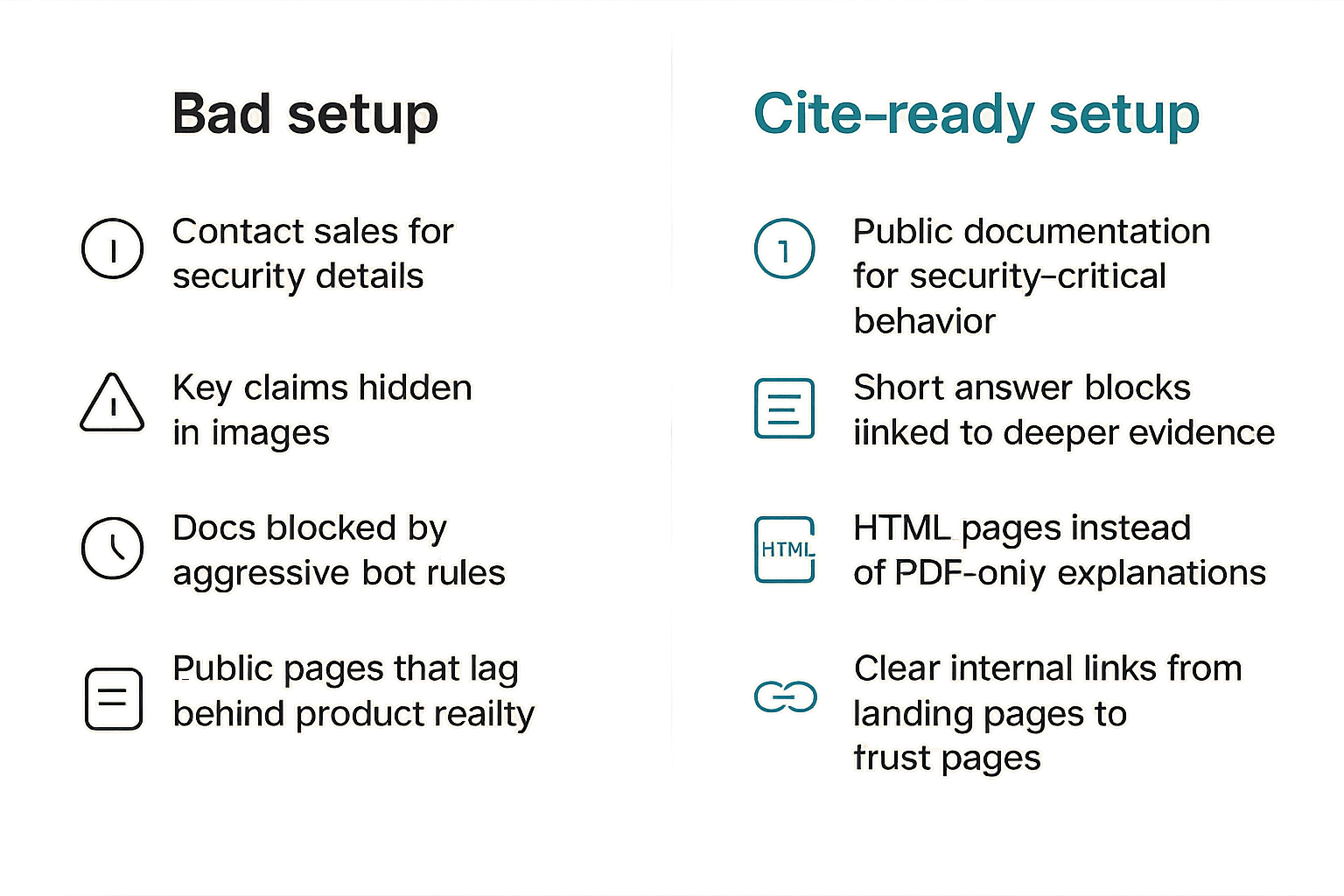
Bad AEO is not harmless. It can create support tickets, sales friction, legal review cycles, and public confusion. The failure mode is usually not a single broken tag. It is a mismatch between what the product does, what the website says, and what answer engines can understand.
Important content is hidden from crawlers
The most common failure is hiding the good material. Security details live in sales PDFs. Admin behavior is explained only in onboarding. Metadata handling is buried in a legal policy written for compliance, not comprehension.
Answer engines then rely on whatever is visible: homepage copy, app store listings, old reviews, or third-party comparisons. That is how precise products get summarized imprecisely.
What works:
- Public documentation for security-critical behavior.
- Short answer blocks linked to deeper evidence.
- HTML pages instead of PDF-only explanations.
- Clear internal links from landing pages to trust pages.
What fails:
- “Contact sales for security details.”
- Key claims hidden in images.
- Docs blocked by aggressive bot rules.
- Public pages that lag behind product reality.
Generic claims replace technical clarity
Another failure is over-optimization around broad privacy keywords. Teams write pages that repeat “secure messaging,” “private chat,” and “encrypted communication” without defining the trust model.
This may look like SEO work, but it does not help answer engines produce accurate answers. It also makes your product harder to differentiate.
A better pattern is to pair the keyword with the operational detail:
- “Encrypted messaging for teams where provider access to message content is not part of the operating model.”
- “Private group chat with administrator controls that manage users without exposing conversation content.”
- “Secure messaging with documented account recovery tradeoffs.”
The keyword gets context. The answer gets safer.
Old pages become accidental sources of truth
Stale pages are especially dangerous in security categories. An answer engine may not know that an old support article was superseded by a new architecture page unless the site makes that relationship clear.
Use redirects, canonical tags, update notes, and internal links to prevent outdated pages from competing with current sources of truth. If a security behavior changed, say when and how the documentation changed.
Do not leave old comparison posts, launch announcements, or deprecated docs as orphaned content. In AEO, orphaned content can become training or retrieval material long after the team forgot it existed.
Measurement for answer engine visibility
Traditional SEO measurement is not enough for encrypted messaging answer engine optimization. Rankings still matter, but the bigger question is whether answer engines understand and cite the right version of your trust model.
Track questions, not just rankings
Build a question set around buyer, user, and evaluator intent. Then test how answer engines respond over time.
Useful categories:
- Brand questions: “Does [product] use end-to-end encryption?”
- Category questions: “Best encrypted messaging for small teams.”
- Comparison questions: “[product] vs [competitor] privacy.”
- Risk questions: “Can admins read messages in [product]?”
- Workflow questions: “How does account recovery work in [product]?”
For each answer, record whether the response is accurate, whether your site is cited, which page is cited, and what claim is repeated.
Do not overfit to one answer engine. Outputs vary. The purpose is to detect patterns, not declare a single score.
Watch crawler behavior in logs
Crawler logs show whether AI-related bots are reaching your public trust layer. They can also reveal crawl traps, blocked docs, or over-crawled low-value pages.
Look for:
- Which AI crawlers visit security and documentation pages.
- Whether crawlers hit outdated URLs.
- Whether important pages are skipped.
- Whether bot mitigation blocks desired crawlers.
- Whether sitemap changes affect discovery.
Log data does not prove citation. It proves access and behavior. That is still useful because answer engines cannot cite what their crawlers never see.
Accept that attribution is incomplete
AEO attribution is messy. Answer engines may use multiple sources, cached content, licensed data, retrieval indexes, and live crawls. You will not always know why a specific answer changed.
That does not make the work pointless. It means measurement should combine:
- Crawl visibility.
- Content coverage.
- Structured data validation.
- Manual answer testing.
- Support and sales feedback.
- Brand mention monitoring where available.
The practical question is whether the public web contains a clear, current, crawlable version of your product truth. If it does not, measurement tooling will only show the symptoms.
Where CrawlProof fits in the workflow
For website owners and marketers, the hard part is not understanding that AI crawlers matter. The hard part is operationalizing that knowledge across content, schema, crawler policy, and publishing workflows.
That is where CrawlProof fits: not as a replacement for security review or content strategy, but as the visibility and validation layer for answer engine optimization.
See how AI crawlers interact with your site
Encrypted messaging teams need to know whether AI crawlers can reach the pages that explain encryption, privacy, metadata, admin permissions, and recovery. If crawlers mostly hit the homepage and skip the trust layer, the answer engine has a weak input set.
CrawlProof helps teams inspect crawler behavior and understand how AI discovery differs from traditional search crawling. That makes it easier to find mismatches between what you think is public and what crawlers actually reach.
Validate AEO changes before they decay
AEO changes are easy to ship and easy to forget. A new schema block, llms.txt update, sitemap entry, or trust page can drift out of sync with the rest of the site.
The operating model should be continuous validation:
- Did the new page become crawlable?
- Is it linked from the right public surfaces?
- Are AI crawlers seeing it?
- Does schema match visible content?
- Are deprecated pages still accessible?
That changes the conversation from “We optimized for AI once” to “We maintain an answer-ready public knowledge layer.”
Connect content, technical SEO, and crawler policy
Encrypted messaging AEO sits between teams. Content owns clarity. Product owns behavior. Security owns accuracy. Developers own rendering and crawl controls. Marketing owns positioning.
CrawlProof is useful because it gives those teams a shared view of the website as an answer engine input. That is the workflow operators need: fewer assumptions, more observable behavior.
Closing rule for encrypted messaging answer engine optimization
Encrypted messaging answer engine optimization is not about making private systems less private. It is about making public explanations more precise.
Teams think the problem is that AI answer engines do not know enough about them. The real problem is that many websites do not provide a stable, crawlable, evidence-backed explanation of what the product does and does not protect.
Make the safe answer the easiest answer
If you want answer engines to describe your secure messaging product accurately, make the safe answer the easiest answer to find, extract, and cite.
That means clear public pages, stable URLs, structured data, intentional crawler policy, maintained evidence, and a workflow that updates content when the product changes. Do that, and encrypted messaging answer engine optimization becomes less about chasing AI hype and more about publishing a trustworthy source of truth.
Try crawlproof.com
CrawlProof helps website owners understand AI crawler behavior, improve answer engine optimization, and validate how their content is discovered by LLM-driven systems. Try crawlproof.com.