Freelancing LLM crawlers sounds like a niche technical problem until a prospect says they found three competitors through an AI answer engine and never saw your site.
That is the pain point. A freelancer can have a clean portfolio, strong testimonials, and useful articles, but still be invisible when ChatGPT, Perplexity, Gemini, Claude, or AI-enhanced search systems generate recommendations.
Teams think the problem is ranking for more keywords. The real problem is whether LLM crawlers can discover, interpret, trust, and reuse the right parts of your expertise.
That changes the conversation. For freelancers, consultants, solo agencies, and the teams that build sites for them, this is not just SEO copywriting. It is a discovery architecture problem: crawl access, structured context, proof, freshness, attribution, and conversion paths all have to work together.
This guest contribution is written for crawlproof.com readers by the team at ugig.net, where we spend a lot of time looking at how independent professionals use AI systems to find work, package expertise, and compete with larger firms.
Table of contents
Freelancing LLM crawlers are an architecture problem

Most freelancer websites were designed for humans who already had some intent. Someone clicks a LinkedIn profile, lands on a homepage, scans a service page, and books a call.
LLM crawlers do not behave like that prospect. They fetch pages, extract text, infer entities, compare sources, and may use your content later inside an answer where your site is only one supporting source. Sometimes the user never visits your site at all unless the answer engine decides you are worth citing.
The mistake teams make is treating freelancing LLM crawlers as another traffic channel to optimize after the site is finished. In practice, AI discovery touches information architecture, content formatting, technical access, schema, and proof.
Why the old portfolio model is weaker now
The traditional freelancer portfolio has three big weaknesses in an AI search environment:
- It hides expertise behind vague service labels like growth strategy, brand support, or technical consulting.
- It puts proof in visual-heavy case studies that are hard to extract.
- It assumes the prospect will navigate the site before forming an opinion.
Answer engines often form the opinion first. They may answer a query like best freelance Webflow migration expert for SaaS teams, then decide which sources support that answer. If your site only says I build beautiful websites, the model has very little to work with.
A useful way to think about it is this: your site needs to serve both the human buyer and the machine evaluator. The human wants confidence. The crawler needs clean context.
What LLM crawlers need from a freelancer site
LLM crawlers and AI indexing systems need pages that make expertise explicit. They need to understand:
- Who you are.
- What you do.
- Who you do it for.
- Which problems you solve.
- What evidence supports the claim.
- How current the information is.
- Whether the page can be trusted as a source.
That does not mean writing robotic content. It means removing ambiguity.
A freelance cybersecurity analyst should not bury incident response, cloud misconfiguration review, and SOC workflow design inside one generic consulting paragraph. A freelance content strategist should not make AI systems infer whether they write SaaS landing pages, technical docs, or thought leadership.
Practical rule: If a buyer would use a phrase to shortlist you, that phrase should exist in a clear, crawlable, context-rich page on your site.
Where answer engines differ from search engines
Classic SEO rewards relevance, authority, links, technical crawlability, and user satisfaction signals. Answer engines still care about many of those inputs, but the output is different.
A search engine gives a list. An answer engine gives a synthesized recommendation, explanation, or comparison. That means your content has to survive summarization.
A page title alone is not enough. The crawler needs enough surrounding evidence to understand why you are relevant. The answer system needs enough confidence to mention you without hallucinating details.
For freelancers, this matters because the buyer journey is compressed. A prospect may ask for a shortlist of experts and skip ten blue links entirely.
Map your freelance expertise into answerable assets
Before touching robots.txt or schema, map your expertise into assets that answer engines can retrieve. This is where many freelancer sites are weakest.
Teams think the problem is publishing more blog posts. The real problem is that their expertise is not organized into answerable units.
Turn services into clear entities
An entity is something a system can identify and relate to other things. Your name, business, services, industries, tools, certifications, case studies, and locations can all function as entities.
For example, a weak service page says:
- I help startups grow with better content.
A stronger answer-ready version says:
- I provide B2B SaaS content strategy for seed to Series B software companies, with a focus on product-led growth pages, technical blog programs, and sales enablement content.
The second version gives an LLM crawler more hooks: B2B SaaS, content strategy, company stage, product-led growth, technical blog, sales enablement.
The practical question is not whether the sentence sounds more elegant. The practical question is whether it can be retrieved for the right query.
Separate proof from persuasion
Freelancer websites often mix proof and persuasion into the same glossy narrative. That works for a human who has time. It works less well for machines that need extractable facts.
Create proof blocks that are easy to parse:
- Client type.
- Problem.
- Scope.
- Constraints.
- Deliverables.
- Outcome.
- Date or timeframe.
- Permission level for naming the client.
Do not invent numbers. If you cannot disclose metrics, say what changed operationally. For example: reduced manual QA steps, rebuilt onboarding documentation, migrated 120 pages, launched a three-email lifecycle sequence, or replaced a spreadsheet workflow with a lightweight dashboard.
Practical rule: Proof should be structured enough that a crawler can quote it and a prospect can verify it.
Build pages for retrieval not decoration
Design still matters. But AI systems mostly do not care about parallax sections, animated counters, or clever hero copy.
What works:
- Service pages with specific problem statements.
- Case studies with consistent sections.
- FAQ blocks that answer buyer questions directly.
- Author pages that clarify expertise and credentials.
- Internal links between related services and examples.
- Plain text summaries near complex visuals.
What fails:
- One-page portfolios with all services compressed into cards.
- Testimonials embedded as images.
- Case studies hidden behind modals.
- Empty category pages.
- Vague headlines that require human interpretation.
If your most valuable proof only exists inside a PNG, PDF, carousel, or JavaScript-only component, assume some crawlers will miss it or misunderstand it.
Control crawler access without hiding your best content
A lot of freelancers and agencies hear about AI crawlers and immediately ask whether they should block them. That is the wrong first question.
The better question is: what should be discoverable, under what conditions, and for what commercial purpose?
Understand what robots rules actually do
Robots.txt is an access instruction, not a business strategy. It can tell compliant crawlers which paths they should not fetch. It does not explain which pages are important, which services you want cited, or what facts are safe to reuse.
For a freelancer site, common crawl control mistakes include:
- Blocking the entire site because of vague AI scraping fear.
- Blocking the blog while hoping answer engines discover expertise.
- Allowing thin tag archives while hiding strong service pages.
- Forgetting that staging or duplicate subdomains may be accessible.
A basic robots policy might look like this:
User-agent: *
Disallow: /wp-admin/
Disallow: /private/
Allow: /

Sitemap: https://example.com/sitemap.xml
That is not an endorsement to expose everything. It is a reminder that access should match intent. If the page helps establish your public expertise, blocking it can work against you.
Use llms.txt as a routing layer
The emerging llms.txt pattern gives site owners a way to summarize important resources for language models and AI agents. It is not a magic ranking file. It is better understood as a routing layer.
For a freelancer, an llms.txt file can point systems toward:
- Primary service pages.
- Best case studies.
- Author profile.
- Contact or booking page.
- Public policies about content use.
- High-signal guides or explainers.
A simple version might look like this:
# Example Freelance Consultant

## About
Independent technical content strategist for B2B SaaS companies.

## Key pages
- Services: https://example.com/services/
- SaaS case studies: https://example.com/case-studies/
- Author profile: https://example.com/about/
- Contact: https://example.com/contact/

## Content use
Public pages may be summarized with attribution. Private client materials are not public content.
What breaks in practice is expectation. Teams add llms.txt and assume they are done. The file can help with routing, but it cannot fix vague pages, missing proof, broken schema, or stale content.
Avoid blanket blocking decisions
There are valid reasons to block certain AI crawlers or restrict certain paths. Client work, gated research, private pricing, proprietary frameworks, and unpublished materials may need protection.
But freelancers should be careful with blanket decisions. If your business depends on being discovered as an expert, hiding all crawlable expertise from AI systems may reduce future visibility.
Use a tiered approach:
| Public service pages | Usually allow | Core commercial discovery asset |
| Public case studies | Usually allow | Evidence for expertise and fit |
| Blog guides | Usually allow | Supports answer engine retrieval |
| Client portals | Block | Private operational material |
| Draft pages | Block | Low quality or confidential |
| Gated templates | Case by case | Depends on acquisition model |
Practical rule: Do not block content because AI exists. Block content because you have a clear reason that outweighs discovery value.
Build a crawler friendly freelance content workflow
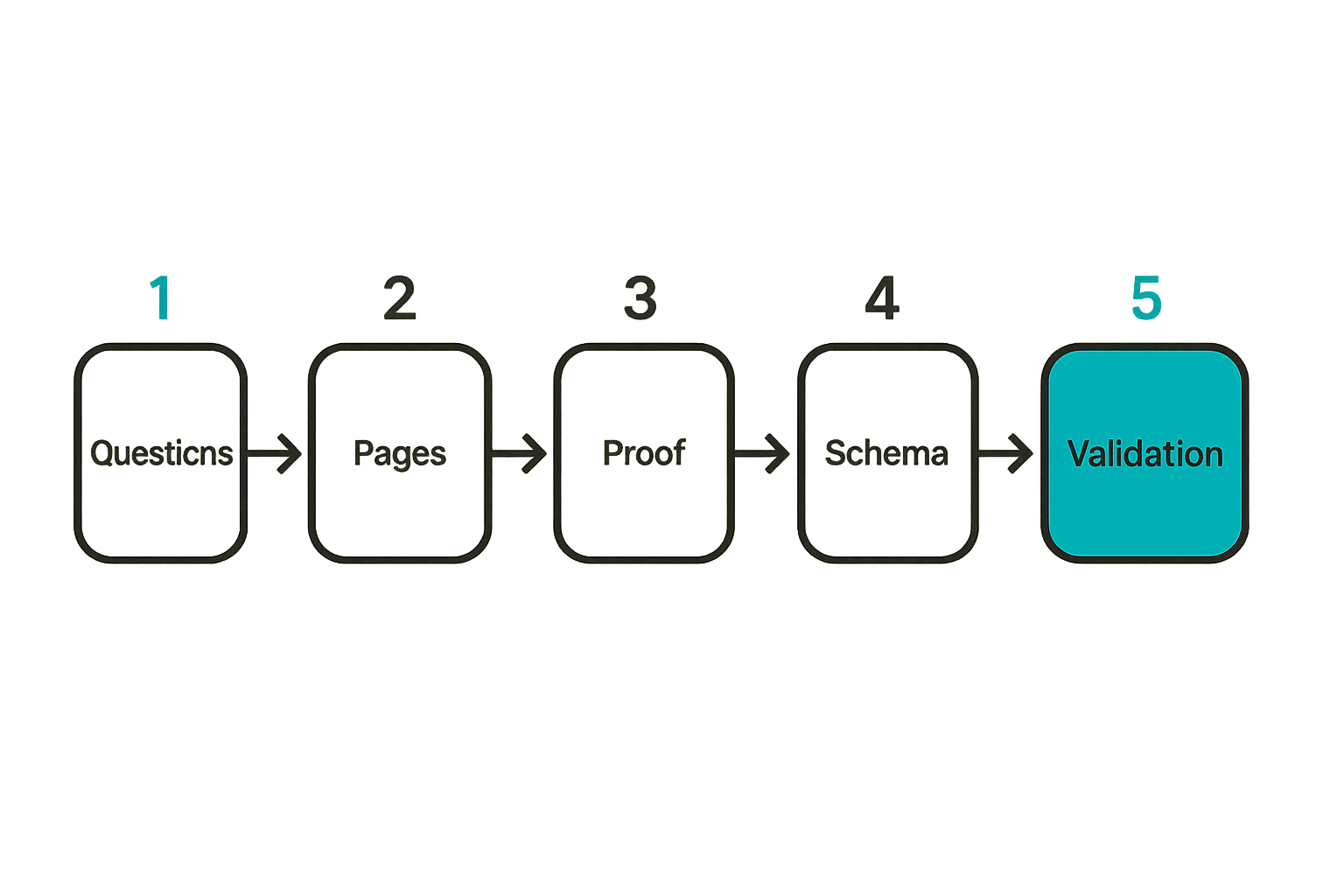
Freelancing LLM crawlers become manageable when you turn the problem into a workflow. The goal is not to chase every bot. The goal is to publish content that answer engines can identify, revisit, and cite accurately.
Start with the question inventory
Start by listing the questions prospects ask before hiring you. Not generic keywords. Actual buying questions.
Examples:
- Who can migrate a WordPress content library to Webflow without losing SEO?
- Which freelance analyst can build Looker dashboards for marketplace operations?
- How do I find a technical writer who understands developer docs and API onboarding?
- What should a small ecommerce brand pay for Klaviyo lifecycle email setup?
- Can a freelance security consultant review cloud permissions before an audit?
Then map each question to a page or page section. If there is no answer on your site, the crawler has nothing to retrieve.
This is where AEO differs from old content calendars. You are not publishing because Tuesday needs a blog post. You are building a retrieval surface for commercial questions.
Publish pages with stable intent
A common failure mode is constantly changing a page's purpose. Today the page is a service page. Next month it becomes a thought leadership essay. Later it becomes a landing page for a promotion.
That instability makes it harder for crawlers and answer systems to understand what the URL represents.
For freelancers, use stable page types:
- Home page for positioning.
- Service pages for specific commercial offers.
- Case studies for proof.
- Guides for educational visibility.
- Author page for identity and trust.
- Contact page for conversion.
You can improve the content over time, but do not make every URL do every job.
Refresh evidence on a schedule
AI discovery is not a one-time setup. Stale evidence weakens trust.
Refresh these assets on a schedule:
- Service pages after offer changes.
- Case studies after new outcomes are approved.
- Tool lists when your stack changes.
- Availability statements when capacity changes.
- FAQ answers when buyer objections shift.
- llms.txt when important URLs change.
For many independent professionals, quarterly is enough. For high-volume agencies or freelancers in fast-moving niches, monthly may be safer.
The mistake teams make is refreshing blog posts while leaving the money pages untouched. Answer engines need current commercial context, not just fresh editorial content.
Schema and structured data for independent experts
Schema is not a shortcut to citations. It is a clarity layer. Used well, it reduces ambiguity about who you are, what you offer, and how pages relate.
Used badly, it becomes markup theater: technically present, commercially useless.
Use schema to reduce ambiguity
Freelancers often sit between personal brand and business entity. Schema can help clarify that relationship.
Useful types may include:
- Person for the individual expert.
- Organization or LocalBusiness where a formal business exists.
- ProfessionalService for service-oriented pages.
- Article or BlogPosting for guides.
- FAQPage for genuine FAQ sections.
- Review only when compliant and accurate.
- BreadcrumbList for site structure.
The goal is not to mark up everything possible. The goal is to make important relationships explicit.
For example, if Jane Doe offers freelance Shopify development, the site should make it clear that Jane Doe is the author, the service is Shopify development, the audience is ecommerce merchants, and the contact path is the booking page.
Mark up services case studies and authorship
A practical schema model for a freelancer site might connect:
- The author profile to articles.
- Service pages to the provider.
- Case studies to the relevant service.
- FAQs to the page topic.
- Breadcrumbs to the site hierarchy.
You can implement this manually, through a CMS plugin, or inside your site framework. The implementation matters less than consistency.
A simplified JSON-LD pattern for a service page could include fields like name, description, provider, areaServed, serviceType, and url. Keep the text aligned with visible page content. Do not use schema to make claims the page itself does not support.
What works is schema that mirrors the page. What fails is schema that tries to compensate for thin content.
Keep structured data consistent
Inconsistent structured data creates avoidable confusion. If your page says you are a freelance RevOps consultant, your schema says marketing agency, and your LinkedIn says automation specialist, systems may struggle to classify you.
Consistency should cover:
- Name formatting.
- Business name.
- Service names.
- Location or remote availability.
- Author identity.
- SameAs references where appropriate.
- Dates on articles and case studies.
Practical rule: Schema should confirm the page's meaning, not introduce a second version of reality.
What breaks when freelancer sites implement this badly
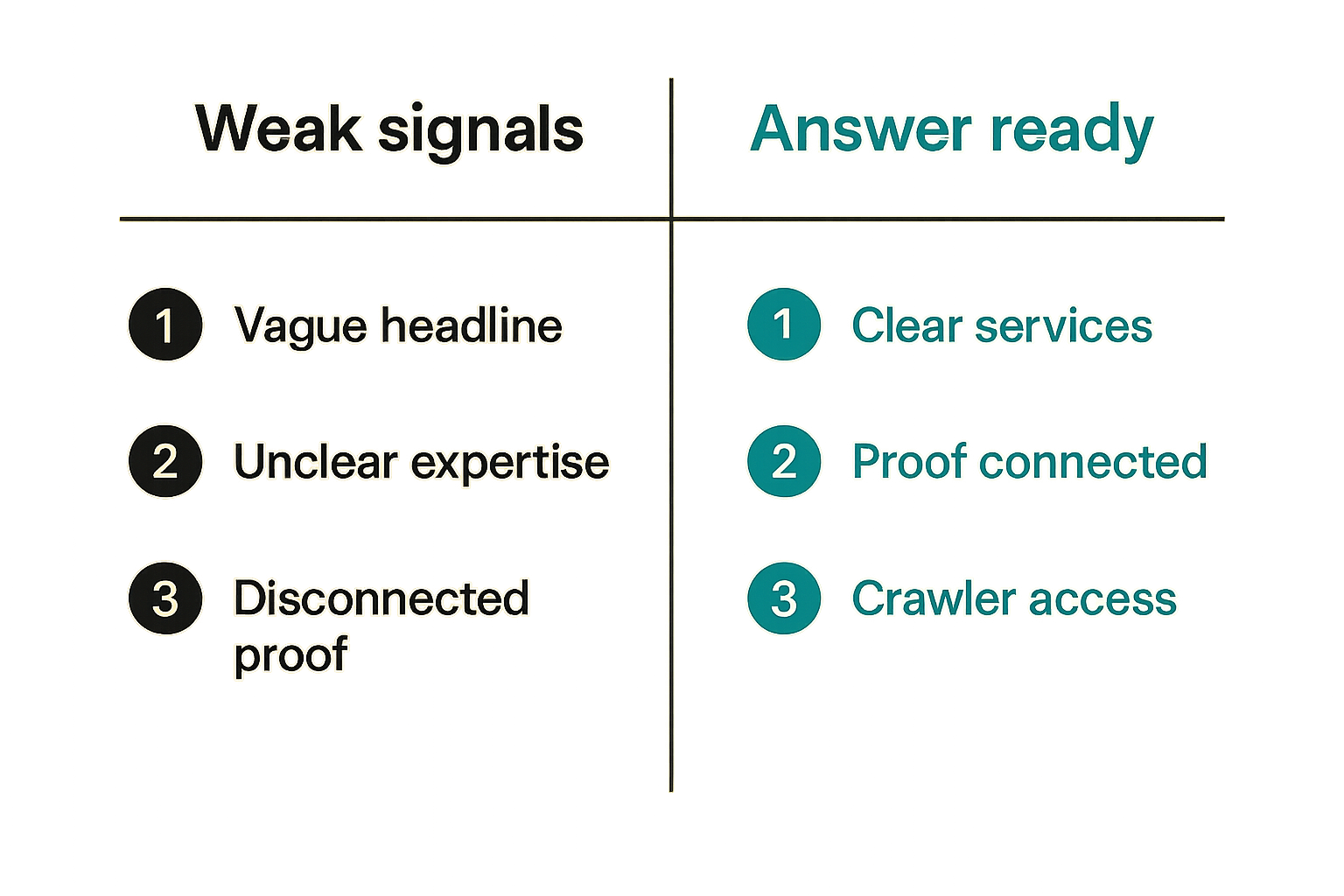
The failure modes are predictable. Most sites do not fail because one tag is missing. They fail because the system sends mixed signals.
The site is crawlable but not understandable
This is the most common problem. Crawlers can access the site, but the content is too vague to classify.
Symptoms include:
- Headlines based on slogans rather than services.
- About pages that tell a story but do not state expertise.
- Blog posts that never link to relevant offers.
- Case studies that omit industry, scope, and deliverables.
- Thin service pages that repeat the same copy.
The site is technically open, but semantically weak. In AI discovery, that is not enough.
A better pattern is to use plain-language summaries near the top of important pages:
- I am a freelance analytics engineer helping B2B marketplaces build dbt models, warehouse reporting, and executive dashboards.
- This case study covers a six-week migration from spreadsheet-based reporting to a governed Looker dashboard system.
- This guide explains how SaaS teams can brief freelance technical writers for API documentation projects.
Clear beats clever when a machine is deciding whether you belong in an answer.
The proof exists but is not connected
Another failure mode is disconnected evidence. The freelancer has good proof, but it lives in scattered places: a testimonial on the homepage, a case study buried in a blog category, a client quote in an image, and a service claim with no supporting links.
Answer engines need relationship paths. Humans do too.
Connect proof like this:
- Service page links to relevant case studies.
- Case study links back to the service.
- Author page links to strongest guides.
- Guides link to service pages when commercially relevant.
- FAQ answers link to proof where useful.
Internal linking is not just an SEO tactic. It is context wiring.
The AI summary is correct but commercially useless
Sometimes the AI system understands you, but the resulting summary does not drive work.
For example, an answer engine might summarize a freelancer as a writer who publishes useful articles about startups. That may be accurate, but it does not tell the buyer that the freelancer offers conversion-focused landing page copy for seed-stage SaaS companies.
This happens when educational content overwhelms commercial positioning. Many freelancers publish useful essays but underbuild their service pages.
The fix is not to make every article salesy. The fix is to ensure your commercial pages are strong enough to be retrieved and cited alongside your educational content.
Measure AI crawler visibility like an operator
You cannot improve what you never inspect. Freelancers do not need enterprise observability, but they do need a basic operating rhythm for AI crawler visibility.
The practical question is: can you see whether crawlers are reaching your important pages, and can you see whether answer engines describe you accurately?
Track crawler behavior separately
Separate AI crawler activity from normal traffic where possible. Depending on your stack, this may involve server logs, analytics filters, CDN logs, or specialized AEO tooling.
Look for:
- Which crawler user agents request your site.
- Which pages they request most often.
- Whether they hit service pages or only blog posts.
- Whether important pages return errors.
- Whether blocked paths match your policy.
- Whether crawl activity changes after publishing or updating pages.
Do not obsess over every bot name. The useful pattern is whether your best public assets are accessible and discoverable.
Test answer engine outputs manually
Manual testing is imperfect but useful. Run prompts that resemble buyer questions and inspect the answers.
Test variations like:
- Find freelance technical SEO consultants for B2B SaaS migrations.
- Who writes developer documentation for API startups?
- Compare independent Shopify conversion specialists for small brands.
- What should I look for in a freelance analytics engineer?
Then ask:
- Are you mentioned?
- Are competitors mentioned?
- Are your services described accurately?
- Are citations present?
- Which pages are cited?
- Is the answer using stale information?
Do not treat one prompt as truth. Treat repeated patterns as signals.
Tie visibility back to pipeline quality
Visibility without fit is noise. A freelancer does not need every AI answer to mention them. They need the right buyers to find the right offer.
Track practical outcomes:
| AI crawler hits service pages | Discovery surface is reachable | Crawlers only hit low-value pages |
| Answer engines cite case studies | Proof is retrievable | Citations point to outdated posts |
| Prospects mention AI search | Channel is influencing pipeline | Leads are broad and unqualified |
| Branded searches increase | More people verify you | People cannot understand offer quickly |
| Contact form quality improves | Positioning matches demand | Visibility creates support noise |
That changes the conversation from bot watching to pipeline design.
A practical implementation sequence for freelancers
Most independent professionals do not have time for a six-month technical SEO project. The work has to be sequenced.
Here is a practical three-week implementation path.
Week one audit discovery and access
Start with access and inventory.
- Crawl your own site with a basic SEO crawler or site audit tool.
- List every public service, case study, guide, author, and contact URL.
- Check robots.txt for accidental blocking.
- Confirm your XML sitemap includes important pages.
- Review whether key content is visible without relying on images or modals.
- Identify pages with vague titles or duplicate intent.
- Write down your top ten buyer questions.
At the end of week one, you should know whether the site can be discovered and where the biggest content gaps are.
Week two publish answer ready pages
Next, strengthen the pages that matter commercially.
Prioritize:
- One clear homepage positioning section.
- Two to four specific service pages.
- Three proof-rich case studies or project summaries.
- One detailed author or about page.
- A concise FAQ section on each service page.
- Internal links between offers, proof, and contact.
You do not need a huge content library. A small site with specific, structured, well-linked pages is often more useful than a large site full of vague posts.
Use this page checklist:
- The page states who it is for.
- The page states the problem solved.
- The page names the service clearly.
- The page includes proof or links to proof.
- The page includes a next step.
- The page can be understood without design effects.
Week three validate and iterate
In week three, add clarity layers and test outputs.
- Add or clean up schema for key page types.
- Create or update llms.txt.
- Re-submit or refresh sitemaps where appropriate.
- Check server logs or tooling for crawler access.
- Test answer engines with buyer-style prompts.
- Fix inaccurate descriptions by improving source pages.
- Set a monthly or quarterly review cadence.
This is not about gaming a model. It is about making sure public facts about your work are easy to retrieve and hard to misread.
Where CrawlProof fits in a freelancer AEO stack
Freelancing LLM crawlers are not something most freelancers want to monitor manually forever. The workflow is too fragmented: robots rules, crawl logs, llms.txt, schema, answer testing, and page updates all live in different places.
The practical role for AEO tooling is to shorten that loop.
CrawlProof is built for site owners and marketers who need to understand how AI answer engines and LLM crawlers interact with their content. For freelancers, agencies, and consultants, that matters because your website is not just a brochure. It is the source material AI systems may use to describe your expertise.
A useful AEO stack should help you answer:
- Are important pages accessible to relevant crawlers?
- Are technical files like robots.txt and llms.txt aligned with your strategy?
- Are schema and page signals coherent?
- Are answer engines likely to understand your services?
- Which pages need cleanup before more content is published?
This is where tooling earns its keep: not by promising guaranteed citations, but by making the invisible parts of AI discovery easier to inspect.
Make AEO part of normal site operations
For freelancers, the winning pattern is boring in the best way. Every time you add a service, publish a case study, change your niche, or update your availability, you also update the discovery layer.
That means:
- Update the visible page.
- Update internal links.
- Update structured data if needed.
- Update llms.txt when a key URL changes.
- Check crawl access.
- Test one or two answer-engine prompts.
The mistake teams make is treating AEO as a campaign. It is closer to site hygiene. Small inconsistencies compound. So do small improvements.
If freelancing LLM crawlers become part of your normal publishing workflow, you are less dependent on guessing how AI systems see you. You create a web presence that is easier to discover, easier to verify, and easier to cite.
Try crawlproof.com
CrawlProof helps site owners understand AEO, AI crawler behavior, schema markup, and emerging standards like llms.txt. Try crawlproof.com to see how your content is positioned for AI answer engines.