A site can rank, get crawled by Google, pass Core Web Vitals, and still disappear when someone asks an AI answer engine for a recommendation. That is the uncomfortable part of geo generative engine optimization in 2026.
Teams think the problem is better prompts, more blog posts, or stuffing pages with question-and-answer blocks. The real problem is that AI answer engines need a reliable citation supply chain: crawl access, extractable facts, clear entity signals, structured evidence, and content that survives summarization.
That changes the conversation. GEO is not a replacement for SEO. It is a workflow layer on top of search, content operations, technical architecture, and brand trust. If your site is hard for LLM crawlers to fetch, parse, verify, or attribute, the engine has an easier option: cite someone else.
The practical question is not whether generative engine optimization matters. The practical question is whether your website is built so AI systems can confidently use it.
Table of contents
GEO generative engine optimization is a citation system
GEO generative engine optimization is often discussed like it is a new bag of content tactics. Add FAQs. Mention entities. Write in a clear format. Those things can help, but they are not the system.
A useful way to think about it is this: SEO historically optimized for discovery and ranking in a list of links. GEO optimizes for inclusion, attribution, and reuse inside generated answers. The engine is not only deciding whether a page is relevant. It is deciding whether the page is safe and useful enough to synthesize.
Why GEO is not just AI SEO
The mistake teams make is treating GEO as SEO with a new name. In classic SEO, a user can scan ten blue links, compare snippets, and choose a source. In AI answers, the engine compresses the answer path. It may cite three sources, one source, or none. That means your page has to win earlier in the pipeline.
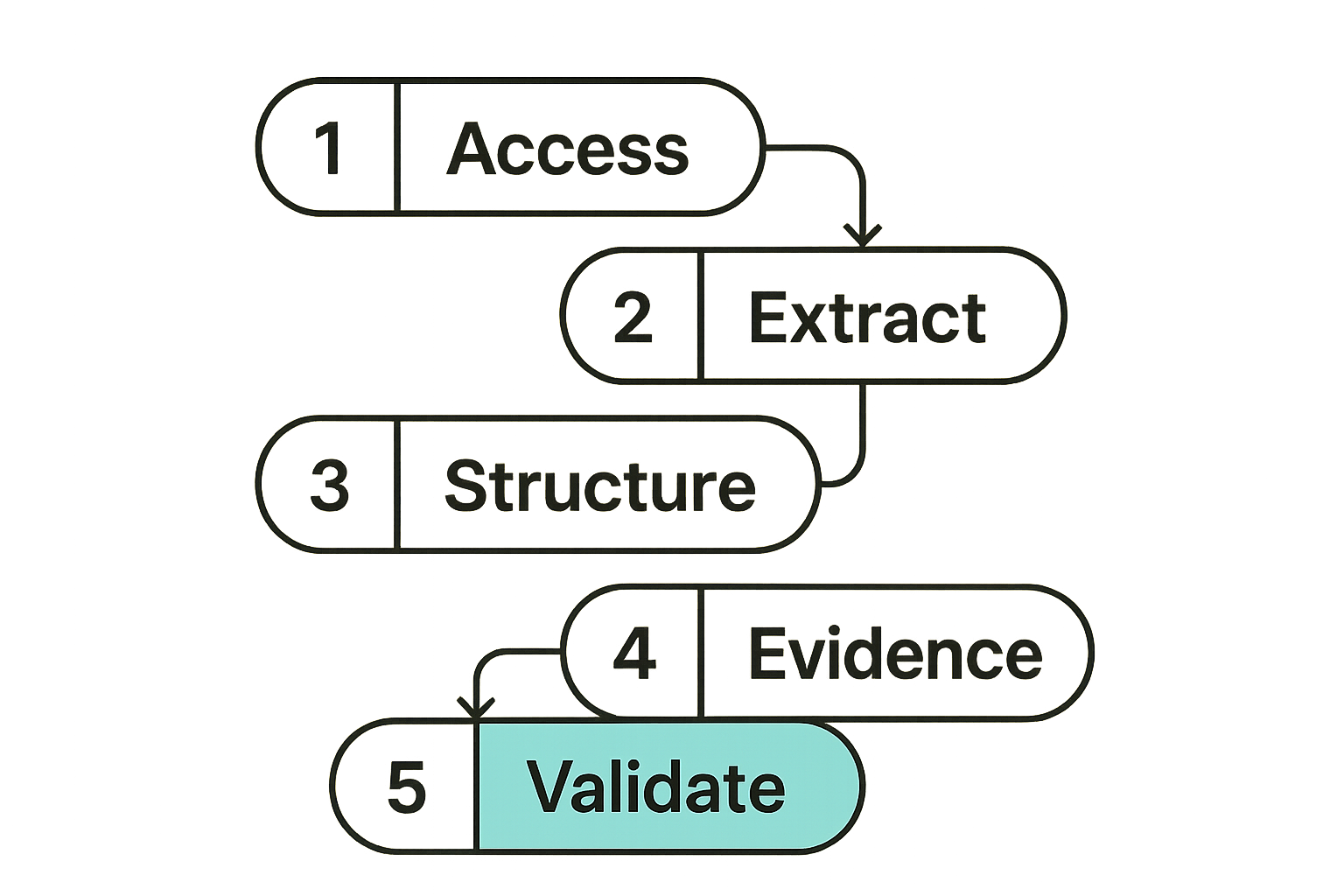
The pipeline looks roughly like this:
- Can the crawler access the page?
- Can the system extract the main answer without running fragile UI code?
- Can it identify the publisher, topic, entities, dates, and claims?
- Can it compare your content with other sources?
- Can it cite you without creating user risk?
If any step fails, the page may not be considered, even if it ranks well elsewhere. If you are new to the broader category, our earlier primer on what AEO is and why it is not SEO is a useful companion because GEO sits inside that answer-engine shift.
What answer engines need before they cite you
Answer engines need more than words. They need confidence. Confidence comes from consistency across signals: page title, headings, body copy, schema, internal links, author or organization identity, freshness, and access permissions.
Practical rule: If a human editor cannot quickly identify the claim, source, date, and business context on a page, an answer engine probably cannot use it reliably either.
This is why generic content underperforms in GEO. A 2,000-word article that says little clearly gives the model nothing durable to quote. A shorter page with precise claims, clean structure, and supporting evidence may be more useful.
The GEO generative engine optimization architecture
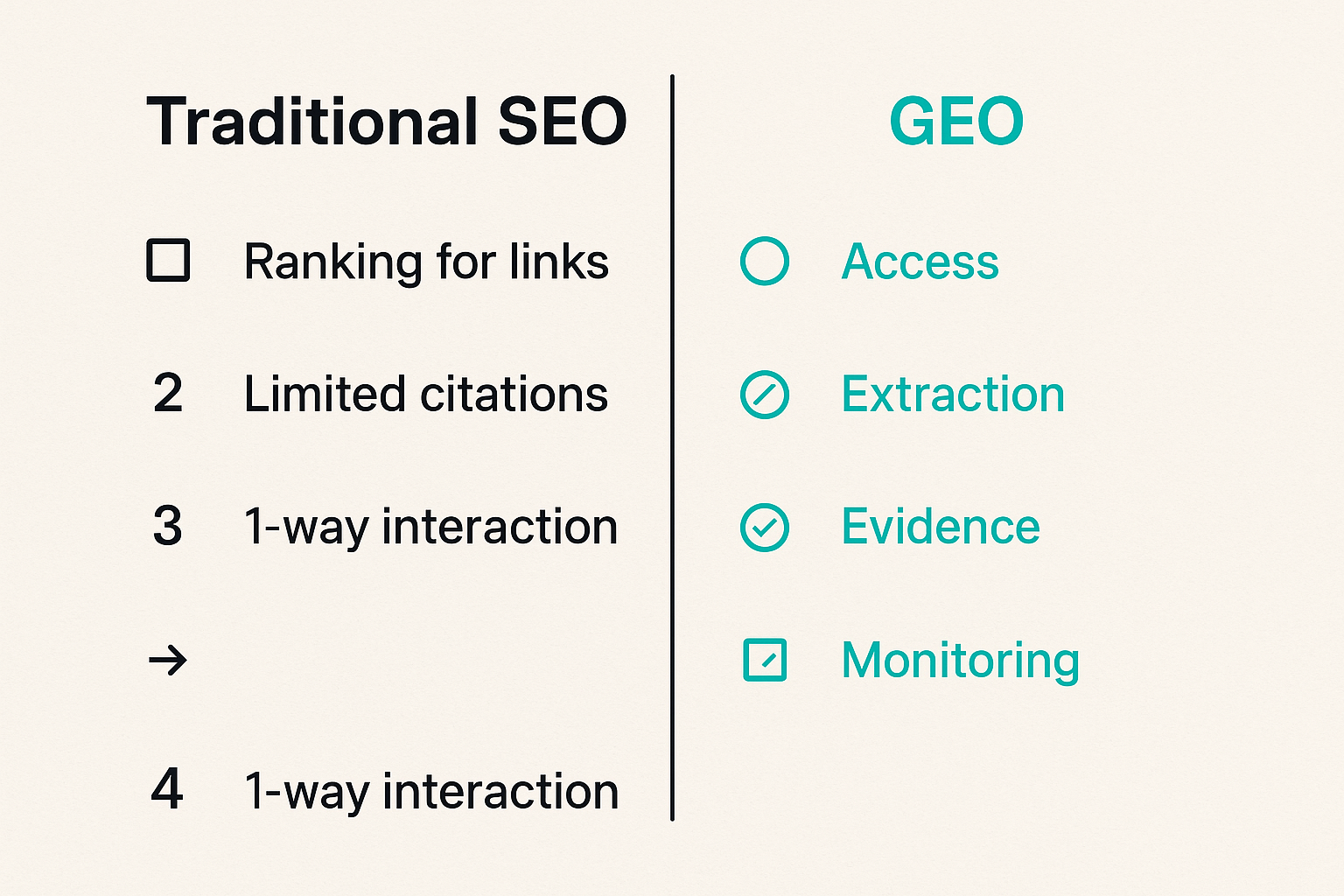
GEO generative engine optimization works best when treated as architecture. Not heavy enterprise architecture. Just the basic operating model for how your website presents knowledge to machines that summarize.
The architecture has to connect content, crawl access, semantic structure, and measurement. If those teams work separately, the output is usually inconsistent. Content says one thing. Schema says another. Robots policy blocks a crawler. The answer engine moves on.
The four layers that matter
Most GEO work falls into four layers:
| Access | Let relevant AI crawlers fetch useful pages | Developer or SEO | Pages are invisible or partially visible |
| Extraction | Make the answer easy to parse | Content and UX | The engine misreads or skips key facts |
| Evidence | Support claims with schema, dates, sources, and context | SEO and editorial | The engine lacks confidence to cite |
| Monitoring | Check what bots and answer systems actually see | SEO operations | Teams optimize based on assumptions |
This table is simple, but it is where most production problems show up. The UI is not the whole system. Your page may look polished to a visitor and still be a poor source for an AI crawler.
Where traditional SEO leaves gaps
Traditional SEO still matters. Fast pages, strong internal linking, useful content, canonical URLs, and clean metadata all help. But GEO introduces gaps that older workflows do not always cover.
For example, a team may allow Googlebot but block other AI crawlers. A JavaScript-heavy product page may render for users but expose thin HTML to bots. A pricing page may use images or dynamic components for key information. A blog post may bury the answer under brand narrative.
Related reading from our network: teams building secure communication products face a similar architecture problem where the visible interface is not the system; the workflow underneath matters more, as covered in End-to-End Encrypted Messaging in 2026.
Map the answer journey before you write
Before creating GEO content, map the questions where you actually deserve to be cited. This is where many teams drift into content theater. They publish broad explainers for every adjacent keyword and hope answer engines pick them up.
The practical question is: what decisions should your brand help the user make?
Start with decisions, not keywords
Keywords still provide demand signals, but answer engines respond to tasks. A buyer may ask:
- Which tool should I use for a specific workflow?
- What are the risks of a technical approach?
- How do I compare two categories?
- What steps should I follow before implementation?
- What standard, file, or policy should I adopt?
Those are decision points. GEO content should map to them. A page targeting a broad keyword can rank, but a page targeting a decision can be cited.
A useful worksheet looks like this:
| Understand a category | Explainer | Definitions, contrasts, examples | Concise summary block |
| Choose an approach | Comparison | Tradeoffs, use cases, limits | Table plus recommendation |
| Implement a workflow | Guide | Steps, configs, edge cases | Numbered sequence |
| Validate a site | Audit page | Findings, checks, priorities | Checklist and score |
An extractable claim is a sentence or block that can stand alone without losing meaning. For GEO, this matters more than clever prose.
Weak claim: Many modern businesses are thinking about AI visibility.
Better claim: GEO improves the chance that an answer engine can crawl, understand, and cite a website by making content access, structure, and evidence explicit.
The second sentence gives the system something usable. It defines the subject, the outcome, and the method. You still need depth around it, but the core claim is stable.
Practical rule: Every important page should contain three to five extractable claims that are accurate, specific, and supported by the surrounding content.
Make your site crawlable for LLM bots
Crawlability is the boring part until it breaks. Then it becomes the whole project.
Many site owners assume that if Google can crawl a page, AI answer engines can also see it. That is not always true. Different bots have different user agents, policies, rendering capabilities, and crawl patterns. Some fetch raw HTML. Some respect robots directives differently. Some rely on indexed snapshots or third-party search systems.
Robots rules are now business rules
Robots.txt used to be mostly an SEO and crawl-budget tool. In GEO, it also expresses your AI access policy. Blocking every AI-related bot may be a valid business decision. Allowing every bot may also be valid. The mistake is doing either accidentally.
A simple policy review should ask:
- Which AI crawlers do we allow?
- Which sections of the site should they access?
- Are paid, private, or user-generated areas protected?
- Are important public resources accidentally blocked?
- Does our policy match legal, content, and commercial goals?
Example robots pattern:
User-agent: GPTBot
Allow: /blog/
Allow: /guides/
Disallow: /account/

User-agent: ClaudeBot
Allow: /blog/
Allow: /guides/
Disallow: /account/

User-agent: *
Disallow: /admin/
Disallow: /checkout/
This is not a universal recommendation. It is a pattern: be explicit. In the same way local networks need intake and routing rules instead of vague goodwill, AI crawl access needs an operating model; related reading from our network: Community First in 2026.
Render paths and blocked assets
What breaks in practice is not always robots.txt. It is rendering. The crawler fetches the page and sees a shell, a cookie wall, a blocked script, or a navigation component with no meaningful links.
Check these conditions:
- Is the main answer present in the initial HTML?
- Are headings and body text available without client-side interaction?
- Are canonical tags stable?
- Are internal links crawlable as real links?
- Are key facts not trapped in images, accordions, or scripts?
- Do bot requests get a different experience because of WAF rules?
If the important content only appears after a chain of JavaScript calls, you are betting that every answer system can execute your frontend the way a browser does. That is a bad bet.
Use schema and content structure as evidence
Schema markup is not a magic citation switch. It is a way to make your page less ambiguous. In GEO, ambiguity is expensive because the answer engine has many alternatives.
The job of schema is to reinforce what the page already says. If the visible page is thin and the schema is rich, that is not optimization. That is a mismatch.
Schema is not decoration
Use schema to clarify entities and relationships:
- Organization details for publisher identity
- Article or BlogPosting markup for editorial content
- FAQPage only when questions and answers are genuinely visible
- Product or SoftwareApplication markup where appropriate
- BreadcrumbList for hierarchy
- Person markup for authors when author identity matters
The practical issue is consistency. If your article says it was updated in July 2026 but schema says 2024, trust drops. If the author page is missing or the organization has no consistent identity across the site, the signal gets weaker.
For teams working specifically with emerging crawler guidance files, our guide to llms.txt and skill.md explains how these files can complement schema by giving AI systems a clearer map of your content.
Content blocks that survive summarization
Answer engines compress. That means your content needs durable structures:
- Definition blocks that state the concept plainly
- Comparison tables with honest tradeoffs
- Step-by-step workflows
- Short examples after abstract claims
- Clear limitations and exceptions
- Last-updated context when freshness matters
Practical rule: Write important sections so they still make sense when lifted out of the page and shown beside two competing sources.
This does not mean writing robotic content. It means reducing dependency on surrounding fluff. If a paragraph needs five previous paragraphs to make sense, it is fragile for GEO.
Create a GEO workflow your team can operate
GEO fails when it becomes a one-time content sprint. A few optimized articles might help, but the advantage comes from repeatable operations.
The mistake teams make is assigning GEO to one person without authority over crawl rules, templates, schema, editorial standards, and measurement. That person can write recommendations. They cannot fix the system.
A practical implementation sequence
Start with a workflow that can run every month:
- Inventory pages that should be cited: category pages, comparison pages, product pages, docs, high-intent articles, and trust pages.
- Test access for major AI crawlers and standard bots. Confirm what HTML they receive.
- Identify missing or inconsistent schema on priority templates.
- Rewrite key sections into extractable claims, tables, and workflows.
- Add or update llms.txt-style guidance if your team uses it.
- Review robots policy with SEO, engineering, legal, and leadership.
- Run sample answer prompts and record whether your brand appears, how it is described, and which competitors are cited.
- Create tickets for template fixes, content edits, and internal linking gaps.
- Re-test after deployment and document changes.
This sequence is intentionally operational. GEO is not a hack you apply after publishing. It is a review loop.
Ownership across SEO content and engineering
A simple ownership model helps:
| Query and prompt mapping | SEO strategist | Sales or support | Decision map |
| Page structure | Content lead | SEO | Updated briefs |
| Schema templates | Developer | SEO | Valid markup |
| Crawl policy | Developer or ops | Legal and SEO | Robots and access rules |
| Measurement | SEO operations | Leadership | Visibility log |
Related reading from our network: focused software teams face the same discipline problem when turning positioning into repeatable launch workflows, as discussed in Specialty Products in 2026.
Measure visibility without pretending it is classic rankings
GEO measurement is messy. Anyone selling perfect rank tracking across every generated answer is probably oversimplifying. Answer engines vary by user, location, session context, model version, retrieval source, and prompt wording.
That does not mean measurement is impossible. It means you need operational indicators instead of pretending there is one universal position number.
Metrics that are useful enough
Track signals that help teams make decisions:
| Crawl access status | Whether bots can fetch priority pages | Fix robots, WAF, rendering, status codes |
| Extractability | Whether core facts appear in HTML | Improve templates and copy blocks |
| Schema coverage | Whether entities are machine-readable | Fix template-level markup |
| Citation presence | Whether engines mention or cite you | Compare by prompt cluster |
| Description accuracy | Whether AI summaries describe you correctly | Update positioning and evidence |
| Competitor citations | Who engines trust instead | Study source structure and coverage |
Do not overfit one prompt. Build prompt clusters around real decisions. For example, a B2B SaaS site might track best tools for a workflow, how-to implementation prompts, comparison prompts, and risk prompts.
What fails in measurement
What fails is screenshot reporting. A team asks ChatGPT or Perplexity five questions, captures the answers, celebrates a mention, and moves on. There is no baseline, no prompt set, no page mapping, and no technical audit.
A better report says:
- These 40 prompts map to these 12 decision pages.
- These 7 pages are blocked or weakly extractable.
- These 5 prompts cite competitors because they have clearer comparison pages.
- These 3 pages need schema fixes.
- These 4 answers describe us inaccurately.
That changes the conversation from hype to tickets.
Common GEO failure modes
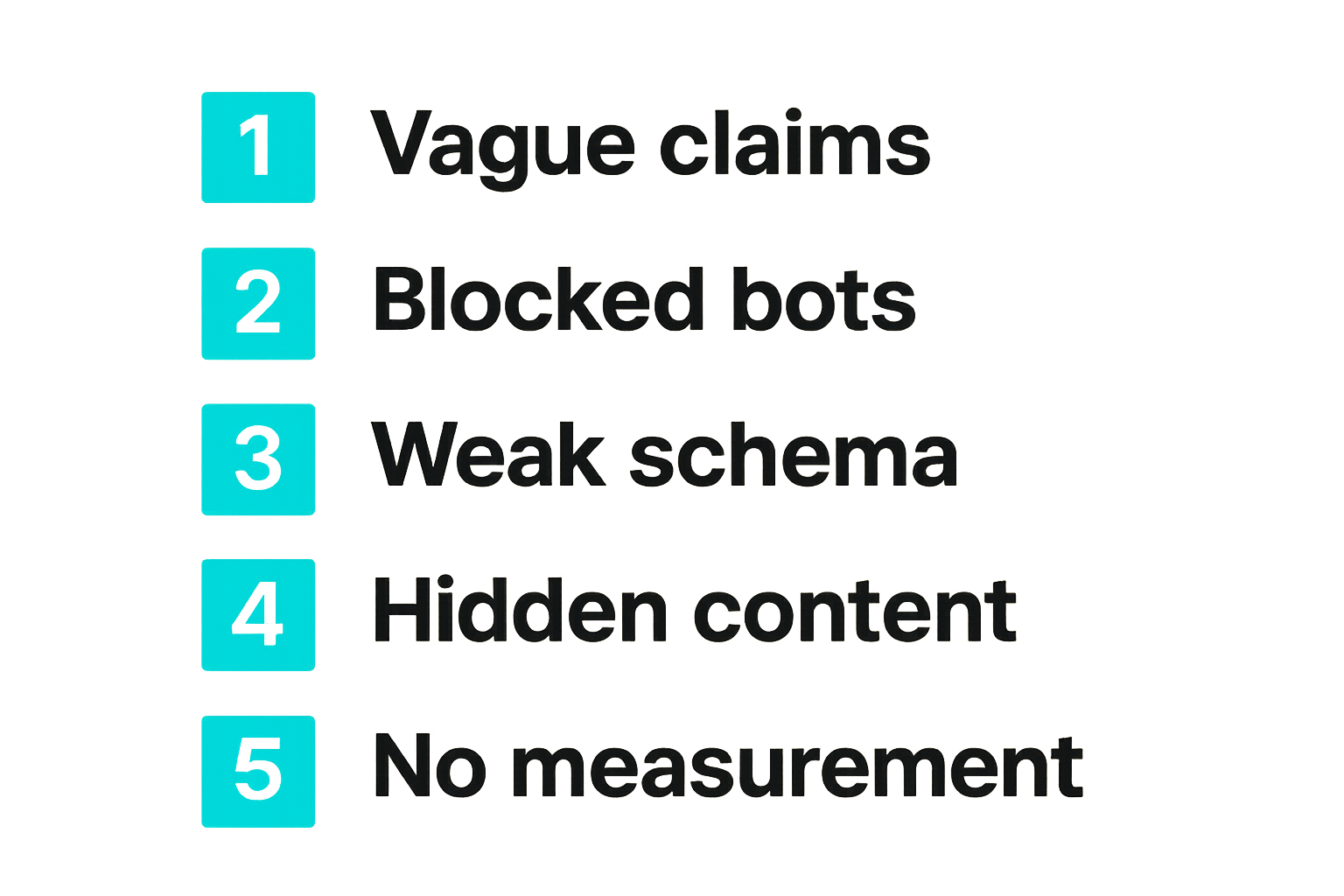
Most GEO problems are not mysterious. They are usually the same failures repeated across content, templates, and access controls.
The difficult part is that the symptoms appear outside your analytics. You may not see a clean referrer. You may not see a normal search impression. You simply stop showing up where buyers ask questions.
What breaks when pages are vague
Vague pages create weak citations. If your homepage says your product helps teams streamline modern workflows, the answer engine has to infer too much. If ten competitors say the same thing, none of you are especially useful.
Common vague-page problems:
- The page never states who the product is for.
- The category is unclear or overloaded with buzzwords.
- Benefits are not tied to concrete workflows.
- Claims lack examples, limits, or evidence.
- Comparison pages avoid real tradeoffs.
- Important details are hidden behind sales calls.
What works is specificity. Name the audience. Name the use case. Name the inputs and outputs. Name what you do not do. Answer engines are better at citing clear, bounded claims than broad positioning language.
What breaks when access is inconsistent
Access failures are more painful because teams often do not notice them. A CDN rule blocks uncommon user agents. A bot receives a 403. A consent manager hides the body. A page returns different canonicals. A staging noindex pattern leaks into production.
Run checks from outside your logged-in browser. Fetch like a bot. Inspect raw HTML. Review status codes. Compare mobile, desktop, and crawler paths. Make sure your public knowledge base is actually public to the systems you want to reach.
Practical rule: Never approve a GEO change based only on how the page looks in a browser. Validate what crawlers receive.
What works for GEO in 2026
The best GEO programs are not flashy. They are consistent. They make the site easier to understand, easier to verify, and easier to cite.
This is where GEO aligns with good content strategy. The difference is that you are designing for two readers at once: the human buyer and the machine mediator that may summarize the page before the buyer ever visits.
The practical content pattern
A strong GEO page usually includes:
- A direct answer near the top
- A clear definition or position statement
- The audience and use case
- A comparison table where tradeoffs matter
- A workflow or implementation sequence
- Specific examples
- A limitations section
- Updated dates when freshness matters
- Internal links to related authoritative pages
- Schema that matches the visible content
The internal link structure matters because answer engines need context. If one page says you are an AEO auditor, another explains crawler behavior, and another shows audit outputs, the cluster is stronger than a single isolated article. The CrawlProof blog is where we publish those adjacent notes on AEO, LLM crawlers, schema, and emerging standards.
The technical pattern
The technical pattern is equally practical:
- Serve meaningful HTML, not just an app shell.
- Keep canonical URLs clean and stable.
- Use descriptive title tags and headings.
- Maintain accurate schema across templates.
- Review robots.txt intentionally.
- Avoid hiding core content behind interaction.
- Keep public docs and guides linkable.
- Monitor bot access and unexpected blocks.
- Maintain llms.txt or similar guidance if it fits your policy.
What fails is trying to compensate for weak architecture with more content. If the template hides the answer, publishing 50 more pages just creates 50 more weak sources.
Product fit and next steps
GEO generative engine optimization is still early enough that teams should be skeptical of certainty. Nobody outside the platforms controls exactly how answer engines select sources. But you can control whether your site is accessible, structured, specific, and easy to verify.
That is the work. Not chasing every rumor about model behavior. Not rewriting your entire site for bots. Build a citation-ready web presence that also helps humans make better decisions.
Where CrawlProof fits
CrawlProof is built around a simple question: what can AI crawlers and answer engines actually find on your pages?
For site owners, marketers, SEO teams, content strategists, and developers, that question is more useful than abstract GEO advice. You need to know whether your pages expose the right content, schema, robots policy, AI-bot access, and positioning signals. The homepage audit flow at CrawlProof is designed to surface those issues quickly so teams can turn GEO findings into fixes.
Use it when you need an outside view of a URL, when a page is not being cited the way you expect, or when engineering and marketing need a shared checklist instead of another theory document.
Try crawlproof.com
crawlproof.com helps site owners and marketers understand how AI answer engines and LLM crawlers discover, parse, and cite their content.
Try crawlproof.com and start treating geo generative engine optimization as an operating workflow, not a guessing game.