Most sites were built for search results pages. That made sense when the goal was a blue link, a snippet, and a click. In 2026, more discovery happens inside answer engines, AI assistants, and LLM-powered search surfaces where the user may never see a traditional results page.
That is where geo optimization becomes an operational problem. Not geographic SEO. Not another keyword hack. Generative Engine Optimization is the work of making your content discoverable, understandable, trustworthy, and easy to cite when AI systems assemble answers.
Teams think the problem is content freshness. The real problem is crawlability, structure, extraction, and evidence. If an AI crawler can reach your page but cannot identify the answer, the author, the entity, the date, the product, or the supporting facts, your content is functionally invisible.
The practical question is not whether AI search will replace SEO. The practical question is whether your site gives answer engines enough clean signals to use your content when they already are forming responses.
Table of contents
Geo optimization is an architecture problem, not a prompt trick
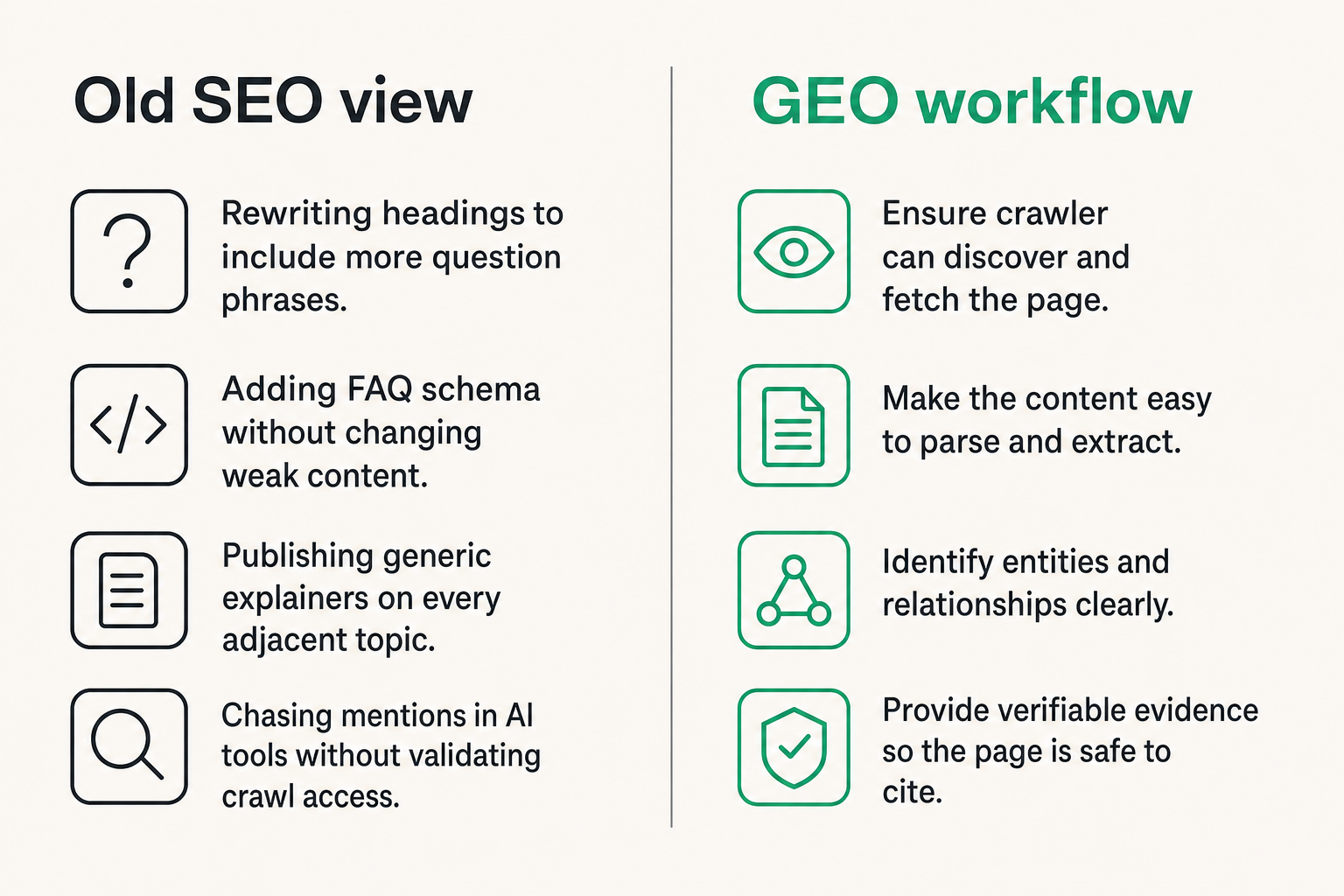
What teams usually optimize first
The mistake teams make is treating geo optimization like a writing style. They ask for more concise introductions, more FAQ blocks, or more AI-friendly summaries. Those can help, but they are not the system.
A useful way to think about it is pipeline design. An answer engine has to discover a URL, fetch it, parse it, classify the entity, extract claims, compare those claims against other sources, and decide whether the page is safe and useful enough to cite.
If any part of that pipeline fails, better prose does not rescue the page.
Common first moves include:
- Rewriting headings to include more question phrases.
- Adding FAQ schema without changing weak content.
- Publishing generic explainers on every adjacent topic.
- Chasing mentions in AI tools without validating crawl access.
Those moves are not automatically wrong. They are just downstream. If the crawler cannot see your content, if your templates hide key answers behind client-side rendering, or if your schema contradicts the visible page, your rewrite is cosmetic.
What answer engines actually need
Answer engines need retrievable, attributable information. They prefer pages where the main topic is obvious, the entity relationships are clean, and the answer can be lifted without guessing.
That changes the conversation. You are no longer optimizing only for a search result impression. You are optimizing for machine extraction and downstream citation.
Important signals include:
- Stable URLs with clear topical purpose.
- Crawlable HTML that contains the core answer.
- Schema markup that matches visible content.
- Author, company, date, and update signals where relevant.
- Clear evidence for comparisons, claims, pricing, features, and definitions.
- Internal links that explain topical hierarchy.
Practical rule: if the best answer on the page only appears after a user clicks, filters, waits for JavaScript, or reads between marketing claims, assume many AI crawlers will miss it.
Where traditional SEO still matters
Geo optimization does not replace SEO. It sits on top of it. Technical SEO, page speed, indexability, internal links, canonicalization, and content quality still matter because answer engines often build from the same web substrate.
The difference is the output format. SEO asks whether a page can rank. Geo optimization asks whether a system can extract and trust the page enough to cite it inside an answer.
That is why a page can rank well and still be absent from AI responses. Ranking is not the same as citation readiness.
How AI answer engines discover and evaluate pages
Discovery is not the same as citation
Discovery means a crawler or retrieval system found your URL. Citation means your content was selected as a source for an answer. There are many steps between those two events.
A page might be discovered through a sitemap, internal link, backlink, browser telemetry, search index, or direct crawl. But citation usually requires stronger conditions: the answer must be clear, current, specific, and aligned with the user query.
The practical question is: which pages on your site deserve to be answer sources?
Not every page should. A cart page, thin tag archive, or login-only dashboard is not a candidate. A product comparison, pricing explanation, technical guide, glossary entry, integration page, or original dataset may be.
Crawler access creates the first gate
AI crawlers vary. Some identify themselves clearly. Some rely on search indexes. Some fetch pages directly. Some respect robots rules in specific ways. Some products use separate training, browsing, and answer retrieval systems.
You do not need to memorize every bot name to start. You do need to know whether your site unintentionally blocks the crawlers and answer engines you care about.
What breaks in practice is messy access policy:
- Robots.txt blocks broad user-agent classes by accident.
- CDN bot protection challenges non-browser clients.
- WAF rules block unfamiliar crawlers.
- Rate limits treat legitimate fetches as abuse.
- Staging directives leak into production.
- Canonical tags point answer-worthy pages elsewhere.
For adjacent reading from our network, teams building AI-agent products face similar trust and access-control tradeoffs in distribution workflows: Related reading from our network: Apple Developer Program for AI Agent Products.
Evidence beats vague authority
Many teams still write like broad authority is enough. It is not. Answer engines need evidence they can use.
A vague claim like Our platform improves productivity is weak. A useful claim says what changed, for whom, under which conditions, and how the reader can verify it. Even when you cannot publish proprietary numbers, you can define scope and avoid overclaiming.
Good evidence can include:
- Clearly dated product documentation.
- Transparent comparison criteria.
- First-party process explanations.
- Specific examples and edge cases.
- Public changelogs or release notes.
- Structured author and organization data.
Practical rule: write claims as if a machine will separate them from your brand voice and compare them against five other sources.
The geo optimization stack: access, structure, evidence, monitoring
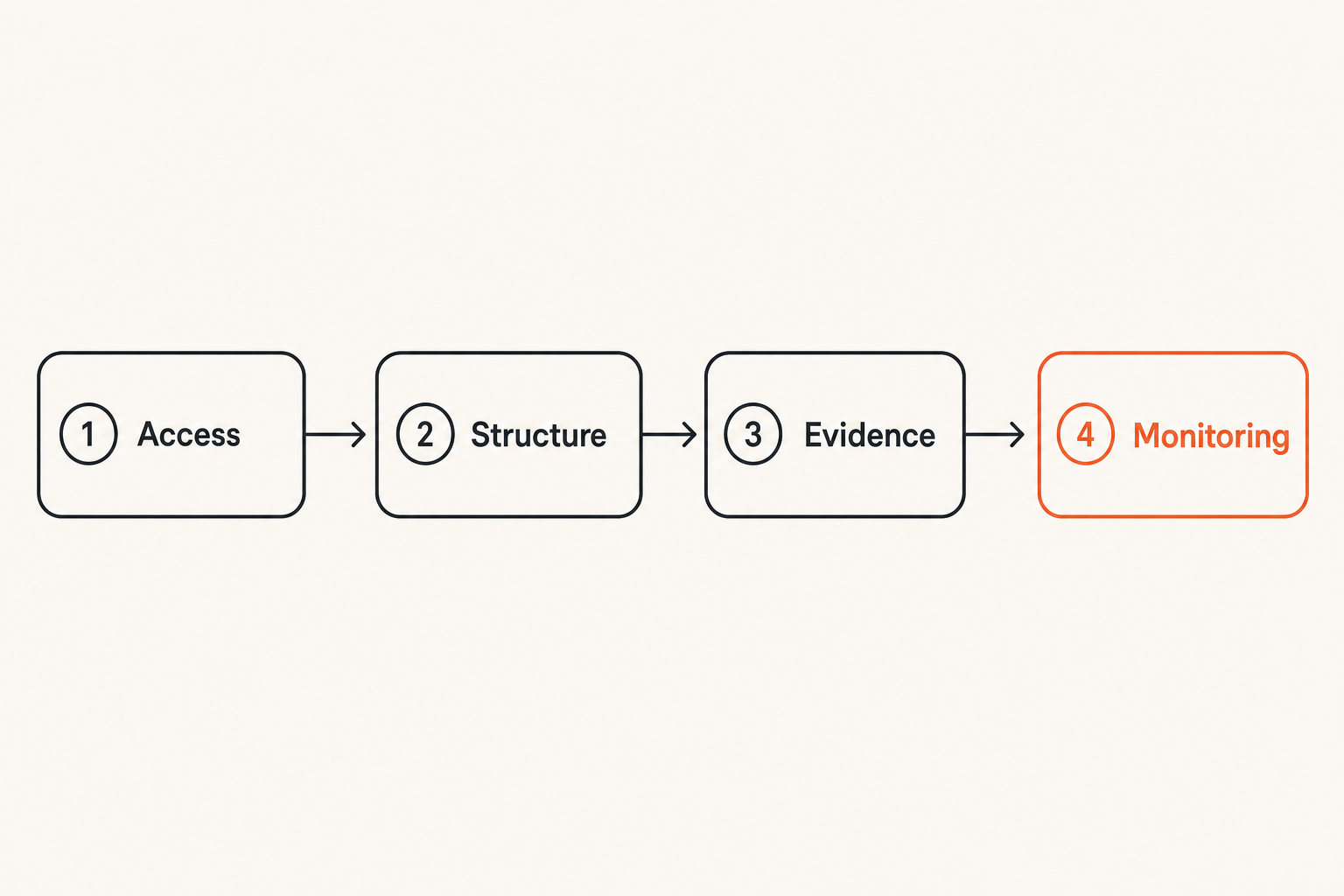
Access layer
The access layer answers a simple question: can AI systems reach the page and retrieve the useful content?
This includes robots.txt, meta robots, canonical tags, redirects, status codes, CDN behavior, authentication boundaries, and server-rendered content. It also includes whether pages are discoverable through sitemaps and internal links.
A basic access check should answer:
- Does the URL return a 200 status for normal crawlers?
- Is the canonical self-referential or intentionally consolidated?
- Are AI crawlers blocked by robots.txt or bot protection?
- Is the main answer present in initial HTML?
- Are important assets blocked in a way that prevents interpretation?
The mistake teams make is assuming Googlebot success equals AI crawler success. It often correlates, but it is not identical.
Structure layer
The structure layer tells machines what the page is about. It includes headings, schema markup, breadcrumbs, internal links, entity names, table structure, and consistent labels.
For geo optimization, structure is not decoration. It is the extraction map.
Useful structural choices include:
- One clear page purpose.
- Descriptive H2 and H3 sections.
- Short answer blocks near the top of sections.
- Tables for comparisons and requirements.
- Schema that matches the visible page.
- Consistent naming for products, people, and organizations.
If your article is about answer engine optimization, say so plainly. If your product is an AEO auditor, describe the category instead of hiding behind a slogan. Readers appreciate clarity. Machines need it.
Evidence and monitoring layer
The evidence layer proves the page deserves to be cited. The monitoring layer checks whether later site changes broke that readiness.
This is where geo optimization becomes an ongoing workflow rather than a launch checklist. Content teams publish updates. Developers change templates. Security teams adjust bot rules. Marketing adds personalization. Any of those changes can alter what AI crawlers see.
A healthy monitoring layer watches for:
- Pages that become blocked.
- Schema errors after CMS changes.
- Missing titles or meta descriptions.
- Content rendered only after scripts execute.
- Important pages omitted from sitemaps.
- Thin pages competing with stronger canonical pages.
Build pages that answer engines can quote
Lead with the answer, then prove it
An answer-ready page does not bury its point. It gives the answer early, then supports it with examples, constraints, and context.
This does not mean every page should become a bland FAQ. It means each section should have a quotable unit. A good unit is specific enough to stand alone and connected enough to support a larger answer.
Example pattern:
- State the answer in one or two sentences.
- Define the scope.
- Explain the tradeoff.
- Provide an example.
- Link to a deeper page when needed.
This is especially important for product and category pages. If the page says only The future of customer intelligence is here, an answer engine has little to use. If it says The product audits how AI crawlers see a page, including schema, robots rules, and answer-ready content gaps, the extraction path is clearer.
Use entity clarity instead of keyword stuffing
Geo optimization rewards clarity around entities: companies, products, people, standards, tools, categories, and concepts.
Keyword stuffing tries to repeat a phrase. Entity clarity explains relationships.
For example, a weak paragraph says: Geo optimization helps geo optimization strategy and geo optimization content for AI search.
A stronger paragraph says: Geo optimization, often called Generative Engine Optimization, is the operational layer that helps AI answer engines discover, parse, and cite web content. It overlaps with AEO, technical SEO, schema markup, and AI crawler access.
The second version gives the system more context. It connects terms without sounding like a spam page.
If your team is still separating AEO from SEO conceptually, this explainer on what AEO is and why it is not just SEO is a useful reference point before you design page templates.
Separate claims from opinions
Marketing copy often blends facts, claims, and positioning. Humans can interpret that. Machines may not.
For answer engines, separate the layers:
- Fact: what the product, service, or page does.
- Claim: what outcome it can produce.
- Evidence: why the claim is credible.
- Opinion: the company view or editorial stance.
This matters because citations often attach to factual claims. If the claim is buried inside superlatives, the page becomes harder to trust.
Practical rule: every important page should contain at least one plain-language paragraph that a skeptical third party could quote without rewriting your marketing copy.
Technical controls for geo optimization
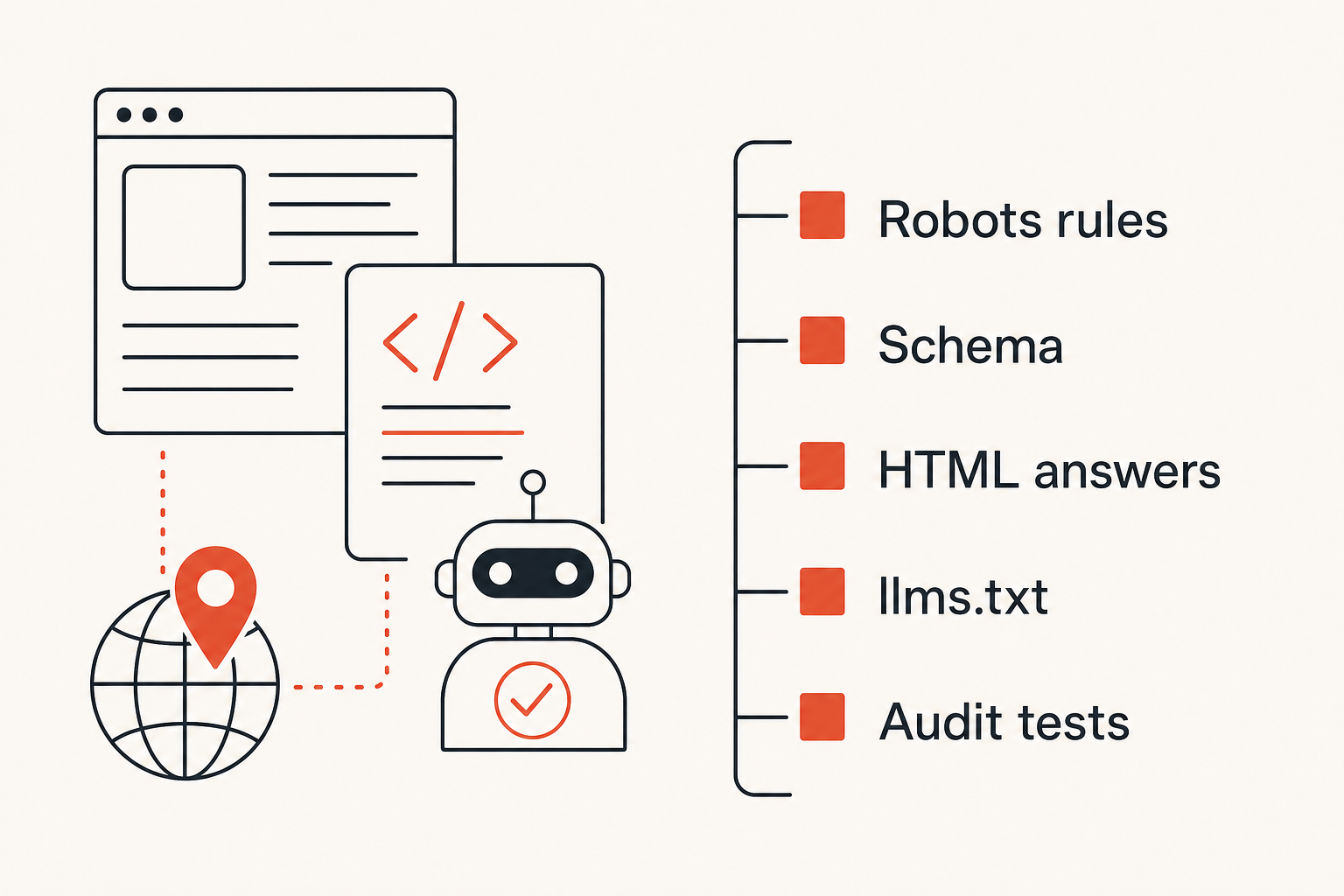
Robots rules and AI bot access
Robots rules are now business policy, not just SEO plumbing. Blocking all AI crawlers may be appropriate for some content businesses. Allowing selected crawlers may be better for sites that depend on discovery. The point is to make the decision deliberately.
At minimum, document:
- Which AI crawlers are allowed.
- Which directories are blocked.
- Whether training bots and answer-retrieval bots are treated differently.
- Who owns changes to robots.txt.
- How changes are tested before release.
A simple example:
User-agent: GPTBot
Allow: /blog/
Allow: /docs/
Disallow: /account/

User-agent: ClaudeBot
Allow: /blog/
Allow: /docs/
Disallow: /account/

User-agent: *
Disallow: /checkout/
Disallow: /admin/
Sitemap: https://example.com/sitemap.xml
This is not a universal recommendation. It is a pattern: expose public answer-worthy content, protect private or transactional areas, and avoid accidental blanket blocks.
Schema markup and page semantics
Schema does not magically make a weak page authoritative. But it helps machines understand page type, entity relationships, authorship, organization details, products, breadcrumbs, FAQs, reviews, and articles.
For geo optimization, schema should be treated like a contract with the page. If the visible page says one thing and the schema says another, you create ambiguity.
Useful schema types often include:
- Organization
- WebSite
- Article or BlogPosting
- Product
- SoftwareApplication
- FAQPage when there are real visible FAQs
- BreadcrumbList
- Person for authors or experts
A minimal article schema can work better than a bloated graph full of stale properties. Keep it accurate, maintainable, and generated from reliable CMS fields.
llms.txt as a routing layer
The emerging llms.txt pattern gives site owners a way to point AI systems toward useful resources. It is not a replacement for sitemaps, robots.txt, or schema. It is closer to a curated routing layer for LLM-facing discovery.
A useful llms.txt file should not dump every URL. It should highlight pages that explain the site, its products, its documentation, its policies, and its best answer sources.
Example shape:
# Example Site

## Core pages
- About: https://example.com/about
- Product overview: https://example.com/product
- Documentation: https://example.com/docs

## Best explainers
- How pricing works: https://example.com/pricing-guide
- Integration guide: https://example.com/docs/integrations
If you are evaluating this layer, our earlier guide to llms.txt and skill.md explains what belongs in those files and how to keep them useful instead of noisy.
A practical geo optimization workflow
Step 1: inventory answer-worthy pages
Start with a page inventory. Do not begin by rewriting everything.
Create a list of pages that should be cited by answer engines:
- Category explainers.
- Product pages.
- Comparison pages.
- Documentation pages.
- Pricing or policy explainers.
- Original research or data pages.
- High-intent blog posts.
- About and organization pages.
Then tag each page by purpose. Is it meant to define a concept, explain a workflow, compare options, support a product decision, or document a technical process?
This prevents a common failure: treating every page as if it should answer every query. Focus beats coverage sprawl.
Once you have the inventory, inspect what a crawler can actually see.
A practical test includes:
- Fetch the page without a logged-in session.
- Review the raw or server-rendered HTML.
- Check whether the main answer appears before scripts run.
- Validate schema against visible content.
- Review robots and canonical directives.
- Confirm internal links point to the page from relevant hubs.
- Compare the extracted text with the page you intended to publish.
This is where many teams get surprised. The CMS preview looks perfect. The browser looks perfect. The crawler view is missing the comparison table, the FAQ, the product details, or the author information.
Step 3: fix, validate, and monitor
Treat fixes like engineering work, not editorial vibes.
A useful implementation sequence:
- Pick 10 to 25 high-value pages.
- Audit access, schema, rendered content, and answer clarity.
- Create tickets by owner: content, SEO, developer, security, or CMS.
- Fix blocking issues first.
- Rewrite sections only after extraction issues are solved.
- Re-test crawler visibility.
- Add the page to monitoring.
- Repeat with the next page group.
For adjacent reading from our network, the same operational discipline shows up in real-time dashboards, where the UI is less important than state, retries, and reliable event delivery: Related reading from our network: SSE Streaming for Home Media, IPTV, and Torrent Dashboards.
What breaks when geo optimization is implemented badly
Blocked crawlers and invisible content
The simplest failure is also the most damaging: the content is blocked.
Sometimes this is intentional. Often it is not. A security plugin blocks unfamiliar user agents. A CDN challenge page replaces the article. A robots rule copied from staging disallows the whole site. A migration changes canonical tags.
The site owner sees a working page. The crawler sees a wall.
What to check:
- Robots.txt for broad disallow rules.
- X-Robots-Tag headers.
- Meta robots directives.
- CDN bot challenge logs.
- Server status codes by user agent.
- Redirect chains.
JavaScript-only answers
Modern sites often render important content client-side. That can work for users and still fail for crawlers.
Answer engines vary in rendering capability, timing, and cost constraints. If a page requires several scripts, API calls, hydration steps, and user interactions before the answer appears, extraction becomes fragile.
This is common on:
- Product configurators.
- Comparison tables.
- Pricing calculators.
- Documentation search pages.
- Infinite-scroll blogs.
- Review widgets.
The fix is not always a full rebuild. Often you can server-render core content, include static fallbacks, expose summary tables in HTML, and make interactive layers progressive rather than mandatory.
Unverifiable claims
Another failure mode is content that is visible but not credible. It makes claims without proof, uses generic language, or lacks dates and ownership.
Examples that fail:
- Best platform for every business.
- Trusted by leading teams with no supporting context.
- Complete guide that omits key tradeoffs.
- Updated recently with no visible update date.
- Comparison pages that never explain criteria.
Answer engines are not perfect judges of truth, but they do compare signals. Pages with clear scope, evidence, and attribution have a better chance than pages full of unsupported superlatives.
What works and what fails
What works
Strong geo optimization is boring in the best way. It makes the site easier to crawl, easier to parse, and easier to cite.
| Access | Deliberate robots and bot policy | Reduces accidental invisibility |
| Rendering | Core answers in HTML | Improves extraction reliability |
| Structure | Clear headings and schema | Helps classify the page |
| Content | Specific claims with evidence | Supports citation decisions |
| Internal links | Topic hubs and contextual links | Shows relationships between pages |
| Monitoring | Regular crawler-view audits | Catches regressions after releases |
What works is not glamorous. It is consistent. The teams that win are usually the teams that turn AEO into a repeatable publishing and technical QA process.
What fails
The failure pattern is predictable: teams bolt AI optimization onto the end of a workflow that was never designed for machine citation.
| Content | Generic AI-written summaries | No original evidence or authority |
| Schema | Markup that does not match the page | Ambiguous or untrusted signals |
| Access | Blanket bot blocking | Pages cannot be retrieved |
| UX | Answers hidden behind interactions | Crawlers miss the useful content |
| Measurement | Only checking rankings | Citations and extraction issues are missed |
| Ownership | No technical owner | Fixes die between SEO and engineering |
For adjacent reading from our network, ecommerce teams see a similar workflow problem when checkout savings depend on testing codes, exclusions, and final totals rather than trusting the first visible offer: Related reading from our network: Wayfair Coupon Workflow.
Operator checklist
Use this checklist when reviewing a page for geo optimization:
- Can a crawler fetch the URL without being blocked?
- Is the main answer visible in server-rendered HTML?
- Does the page have one clear purpose?
- Are headings descriptive without being spammy?
- Does schema match visible content?
- Are authorship, organization, and update signals clear?
- Are claims specific and supported?
- Does the page link to related authoritative pages on your site?
- Is the page included in a sitemap or curated LLM-facing file when appropriate?
- Is there a monitoring process after template or CMS changes?
Practical rule: do not scale geo optimization until your first batch of pages passes access, extraction, structure, and evidence checks.
Measurement: how to know whether geo optimization is working
AI citation visibility is still inconsistent across tools, queries, locations, sessions, and retrieval modes. If you only measure final citations, you will miss the operational causes.
Track inputs first:
- Crawl access status.
- Rendered text completeness.
- Schema validity.
- Page inclusion in sitemaps and llms.txt.
- Internal link depth.
- Answer block clarity.
- Content update recency.
- Known bot access errors.
These are controllable. They tell you whether your site is eligible for citation before you worry about whether a specific assistant cited you yesterday.
Watch citations, not just rankings
Rank tracking is useful, but it is not enough. Answer engines may cite pages that rank below you. They may also summarize without citing, cite competitors, or rely on sources with cleaner structure.
Citation monitoring should look at:
- Which queries trigger your brand or site.
- Which pages are cited.
- Which competitors are cited instead.
- Whether citations point to old or weak pages.
- Whether answer engines misunderstand your product category.
- Whether your own pages contradict each other.
The key is to separate visibility, correctness, and quality. Being mentioned incorrectly is not success. Being cited for an outdated page may create support problems.
Use audits as regression tests
Geo optimization should become part of release QA. When a template changes, when a CMS plugin updates, when security rules change, or when a redesign launches, crawler visibility can regress.
Create regression checks for high-value pages:
- Fetch as a normal crawler.
- Fetch as selected AI user agents where possible.
- Compare extracted text against expected answer blocks.
- Validate structured data.
- Check robots, canonical, and status codes.
- Record changes over time.
This does not need to be complex at first. It does need to be owned.
Where CrawlProof fits into the geo optimization workflow
See what AI crawlers see
CrawlProof is built around a simple operating assumption: you cannot improve what you have not seen from the crawler side.
For site owners and marketers concerned with AI answer engines, the browser view is not enough. You need to know whether LLM crawlers and answer engines can actually find the content, schema, robots rules, AI-bot access, and positioning that matter.
That is the job of an audit layer. CrawlProof helps teams inspect pages from an AEO perspective, so geo optimization work starts with evidence instead of guesses. You can run an audit from CrawlProof when you want to see your site the way AI crawlers do.
Turn findings into implementation work
A useful geo optimization audit should not end with a vague score. It should produce work that different owners can act on.
Examples:
- Content owner: rewrite the answer block and add evidence.
- Developer: server-render the comparison table.
- SEO lead: fix canonical and sitemap inclusion.
- Security owner: adjust bot protection rules.
- CMS owner: map schema fields to reliable content.
- Founder or operator: decide which crawlers to allow.
This is why the topic belongs in workflow planning. AEO is not only a marketing initiative. It touches publishing, engineering, security, and product positioning.
Keep ownership clear
The fastest way to stall geo optimization is unclear ownership. Content teams can write better pages, but they usually cannot fix CDN rules. Developers can fix rendering, but they may not know which pages matter commercially. SEO teams can diagnose indexability, but AI crawler policy may require leadership decisions.
Assign owners by layer:
- Access: engineering, infrastructure, or security.
- Structure: SEO, CMS, and development.
- Evidence: content, product marketing, subject-matter experts.
- Monitoring: SEO operations or growth engineering.
- Policy: leadership and legal where needed.
That changes the conversation from Is AI search hurting us? to Which part of our citation pipeline is weak?
Closing: geo optimization is now a site operations discipline
The short version
Geo optimization is not a one-time content rewrite. It is the operational practice of making your website accessible, structured, evidence-rich, and monitorable for AI answer engines and LLM crawlers.
The sites that adapt fastest will not be the ones that publish the most generic AI content. They will be the ones that make their best content easy to discover, easy to parse, and safe to cite.
Start small. Pick the pages that should represent your company in AI answers. Check whether crawlers can reach them. Confirm the answer appears in HTML. Add accurate schema. Curate llms.txt where appropriate. Support claims with evidence. Monitor for regressions.
That is geo optimization as a workflow. Not hype. Not magic. Just better site operations for the way discovery is changing.
Try crawlproof.com
CrawlProof helps site owners and marketers see how AI answer engines and LLM crawlers discover, parse, and cite their content. Try crawlproof.com