Machine learning engineer jobs are expensive pages to get wrong. A hiring team publishes a role, the SEO team writes a thin guide around salary and skills, the developer adds basic JobPosting schema, and everyone assumes the page can now be found.
Then the answers start appearing somewhere else. AI search results summarize the market, cite a competitor, recommend a different job board, or answer the candidate's question without exposing your page at all.
Teams think the problem is ranking for machine learning engineer jobs. The real problem is whether an answer engine can understand, trust, and reuse your page when it builds an answer about those jobs.
That changes the conversation. This is not only a keyword strategy. It is a content architecture, schema, crawl access, freshness, and evidence problem. If your site publishes hiring pages, compensation guides, career explainers, bootcamp content, or recruiting marketplace pages, you need to design for how AI systems extract facts and choose citations in 2026.
Table of contents
Why machine learning engineer jobs are an AEO architecture problem
The phrase machine learning engineer jobs looks like a normal SEO keyword. It is not. It sits at the intersection of recruiting, career advice, compensation research, skills taxonomy, location intent, employer trust, and labor market comparison.
A traditional page can rank for a while by matching the phrase, adding a few related terms, and earning links. An answer engine has a different job. It needs to decide what facts to extract, whether those facts are current, whether your page is a source or just a wrapper, and whether citing you improves the answer.
The mistake teams make is treating an AI answer as a search result with a different interface. It is closer to a generated brief assembled from accessible evidence.
The query is not one intent
A candidate searching for machine learning engineer jobs may want open roles, salary ranges, required skills, remote options, visa sponsorship, interview expectations, or a comparison between machine learning engineer and data scientist roles.
A hiring manager may use the same phrase while researching job descriptions, compensation bands, talent availability, or how competitors describe the role.
A content team that builds one generic page for every intent creates weak evidence. The page may be readable to humans but hard for an answer engine to cite because it does not clearly answer a specific question.
Answer engines compress the market
AI answer engines do not show ten similar pages because ten pages contain the phrase. They compress the topic into a small set of claims: what the job is, what skills matter, who is hiring, what salary signals exist, where jobs are remote, and how to apply.
If your page does not provide clean claims, it becomes background noise. Worse, if your facts are mixed with sales copy, outdated listings, or vague summaries, another source may become the citation even when your site has the better offer.
Practical rule: Build pages so a crawler can lift one accurate paragraph, one structured fact set, and one clear next action without guessing.
The ranking mindset misses the citation layer
SEO still matters. Crawlers need access, internal links still shape discovery, and authority is not dead. But AEO adds another layer: citation readiness.
A useful way to think about it is this: SEO asks whether the page can be discovered and ranked. AEO asks whether the page can be trusted, summarized, and cited inside an answer. If your team is new to that distinction, our primer on what AEO is and why it is not just SEO is the cleanest place to start.
Map the real journey behind machine learning engineer jobs
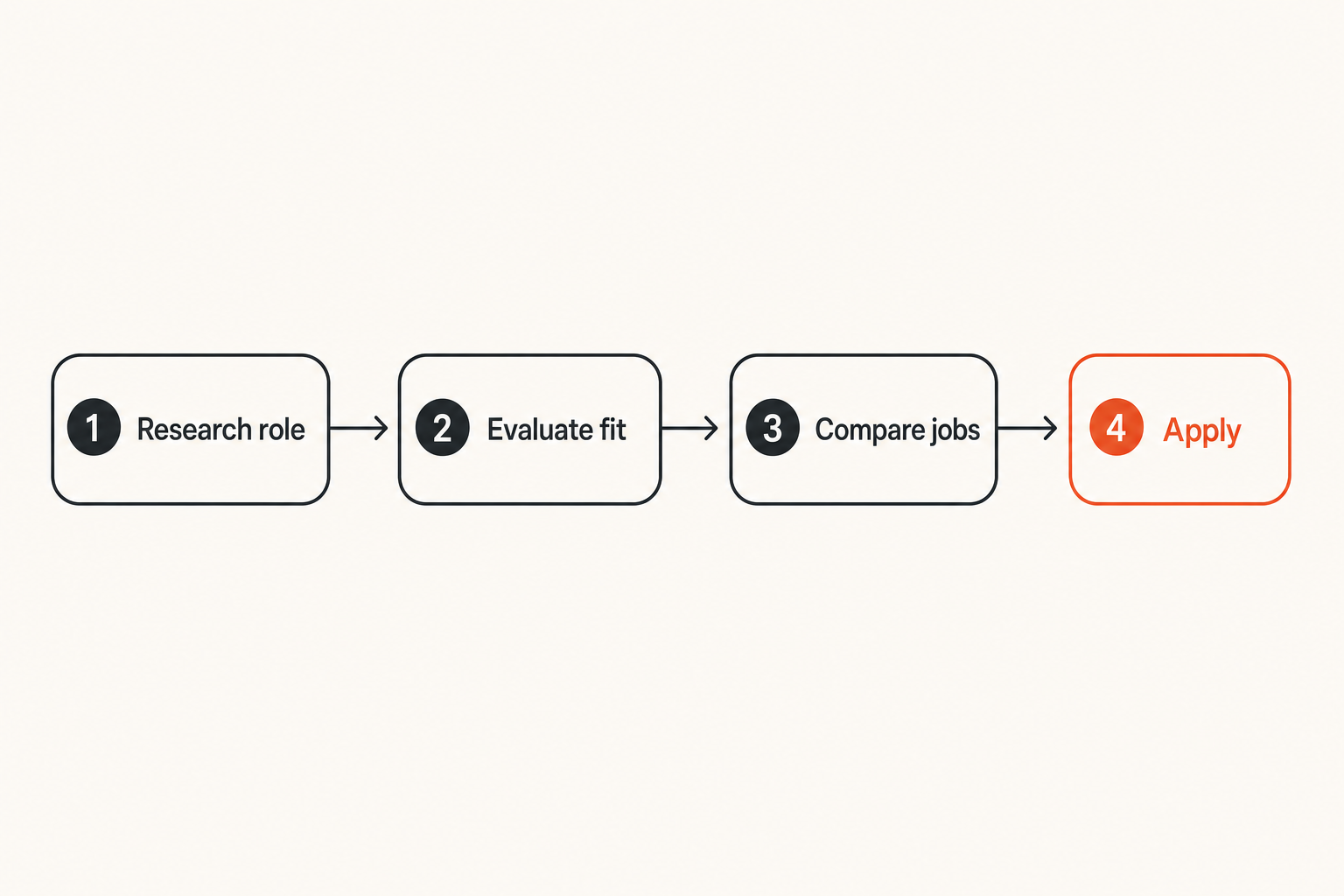
Before touching schema or llms.txt, map the workflow. The practical question is not how many pages you can publish. It is which decision each page helps a human or AI system resolve.
For machine learning engineer jobs, the journey usually has four clusters: understand the role, evaluate fit, compare opportunities, and take action. Your architecture should serve those clusters without forcing every page to do everything.
Separate candidates from buyers
Candidates and employers read the same words differently. A candidate wants to know whether the role is real, whether they qualify, what the interview will test, and whether the opportunity is worth applying to. An employer wants to know how to title the role, what skills to require, and how to position the job.
Do not collapse those into one generic article. Use separate pages or clearly separated sections:
- Candidate guide: skills, responsibilities, salary context, portfolio expectations, application steps.
- Job listing page: open roles, filters, freshness, location, compensation, employer details.
- Hiring guide: job description template, seniority bands, evaluation criteria, market positioning.
- Company page: why this employer hires ML engineers, team structure, tech stack, benefits, trust signals.
That changes the conversation from keyword coverage to evidence coverage.
Build pages around decisions
Answer engines favor pages that resolve a specific question. A page titled Machine Learning Engineer Jobs in Berlin should not drift into a general AI career essay. It should answer the location-specific decision: what roles exist, which employers hire there, what skills appear repeatedly, whether remote or hybrid work is normal, and what a candidate can do next.
The same rule applies to editorial content. A guide on entry-level machine learning engineer jobs should explain the gap between entry-level titles and actual production expectations. A salary page should explain assumptions, locations, seniority, and update cadence.
Keep commercial and editorial evidence connected
Many sites split their content badly. Blog posts explain the market, while job listings contain the current opportunities. AI crawlers may see each page in isolation. If the editorial page never links to the live role page, and the role page never links back to the supporting guide, the answer engine has to infer the relationship.
Make the connection explicit with internal links, breadcrumbs, related entities, and schema. If a guide mentions applied machine learning roles, link to the relevant listing category. If a job listing requires MLOps experience, link to a skills explainer or hiring rubric.
Related reading from our network: teams doing job discovery in other markets face similar filtering and trust problems, and this workflow guide for Craigslist jobs with AI-assisted screening shows how messy listings become operational systems when users rely on automation.
Design pages as extractable evidence, not articles
AEO does not reward walls of optimized prose. It rewards clarity. The best pages make their claims easy to identify, verify, and reuse.
What breaks in practice is that content teams optimize for a human scroll path while the machine path is neglected. Critical details sit in accordions, salary assumptions are buried in prose, publication dates are missing, and job facts are duplicated inconsistently across modules.
Use stable facts before persuasive copy
For pages targeting machine learning engineer jobs, put stable facts near the top:
- Role title and common title variants.
- Location or remote policy.
- Seniority level.
- Core skills and tools.
- Salary or compensation assumptions, if available.
- Application or hiring process.
- Last updated date.
- Source of the information.
Persuasive copy can follow. The crawler should not have to parse three paragraphs of brand language before it finds the facts.
Make entities explicit
Answer engines reason through entities. A machine learning engineer is a role. Python, PyTorch, TensorFlow, Kubernetes, feature stores, vector databases, and cloud platforms are tools or technologies. A company is an organization. A location is a place. A salary range is an offer attribute with assumptions.
Write like you want those entities resolved correctly. Avoid vague phrases like modern AI stack without naming the stack. Avoid saying competitive salary without a range or explanation. Avoid calling every role AI engineer if the job is actually data engineering with model integration.
Practical rule: If a human recruiter needs clarification, an answer engine probably needs clarification too.
Avoid answer-hostile layouts
Some design patterns look fine to users but weaken extraction:
- Infinite scroll job listings with no paginated fallback.
- Job cards where the role details only load after interaction.
- Salary content rendered as an image.
- Key facts hidden behind tabs with no server-rendered content.
- Duplicate job URLs with different filters and no canonical logic.
- Expired jobs returning 200 OK with no clear expired status.
The UI is not the whole system. State, freshness, and machine-readable structure are the real work.
Use schema to remove ambiguity
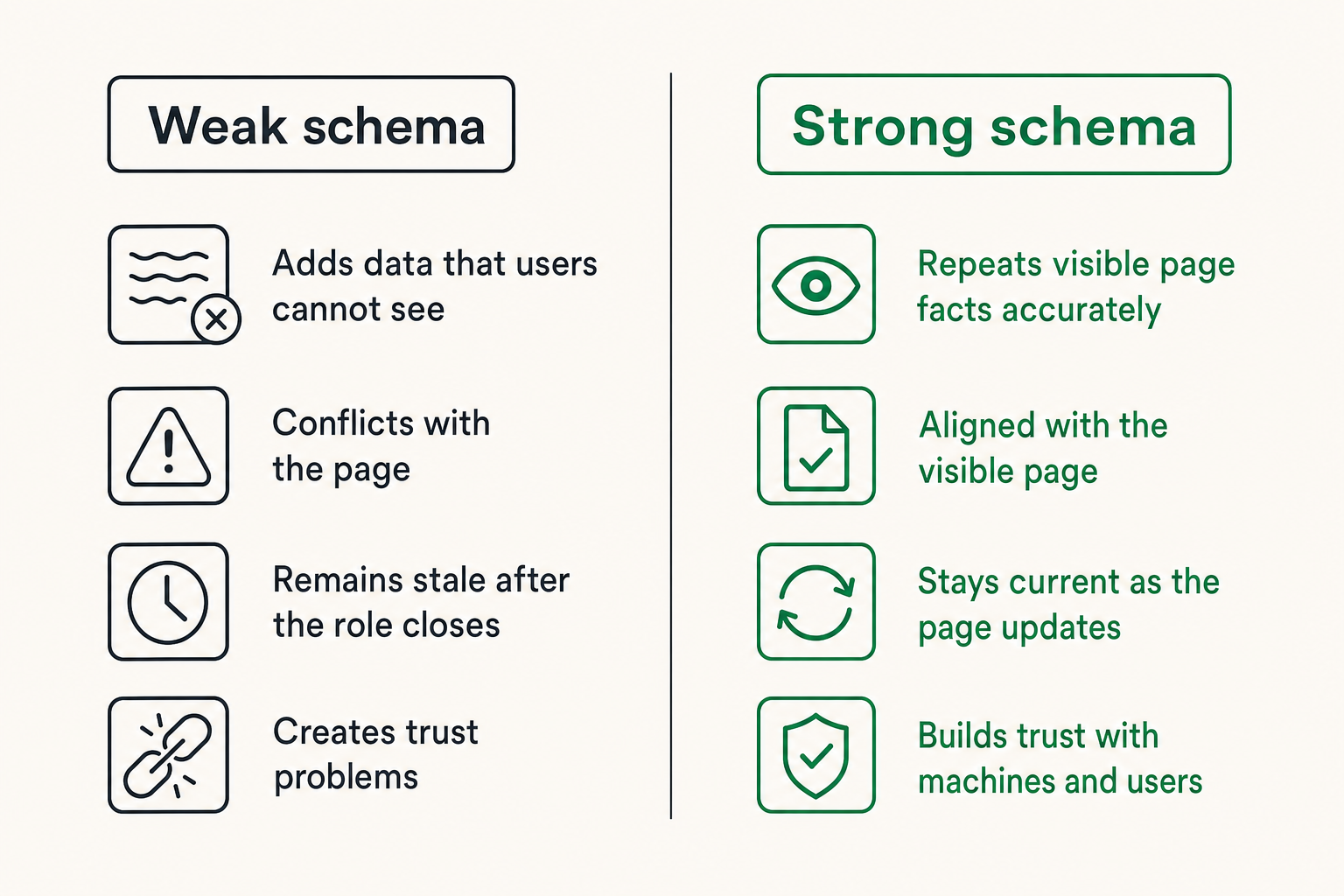
Schema is not decoration. It is a contract between your page and systems that need to understand it quickly. For machine learning engineer jobs, the most obvious schema type is JobPosting, but stopping there is usually too shallow.
The practical question is what ambiguity your schema removes. If your markup repeats visible page facts accurately, it helps. If it adds data that users cannot see, conflicts with the page, or remains stale after the role closes, it creates trust problems.
JobPosting is necessary but not enough
JobPosting schema should cover the basics: title, hiring organization, job location, employment type, date posted, valid through, description, compensation if available, and application URL.
For ML roles, the description should not be a generic blob. Include responsibilities, required skills, preferred skills, team context, and seniority. Keep the marked-up description aligned with the visible page.
Example pattern:
{
  @context: https://schema.org,
  @type: JobPosting,
  title: Machine Learning Engineer,
  employmentType: FULL_TIME,
  datePosted: 2026-08-01,
  validThrough: 2026-09-01,
  hiringOrganization: {
    @type: Organization,
    name: Example AI Systems
  },
  jobLocationType: TELECOMMUTE,
  applicantLocationRequirements: {
    @type: Country,
    name: United States
  }
}
This is only a sketch. The point is not to copy a snippet blindly. The point is to make the job state legible.
Depending on the page, combine JobPosting with other structured context:
- Organization for employer identity.
- BreadcrumbList for hierarchy.
- FAQPage for candidate questions, when the answers are visible and maintained.
- Article or BlogPosting for career guides.
- ItemList for curated collections of open roles.
- Person for author or reviewer expertise on editorial pages.
Do not over-markup everything. Over-marking vague content does not make it more trustworthy. It just creates more surface area for inconsistency.
Treat schema as a contract
Schema should be generated from the same source of truth as the page. If the job closes, the visible status, schema validThrough, sitemap state, and internal links should all reflect that change.
Practical rule: Never let structured data say something the visible page does not support.
Control crawler access without blocking discovery
AEO visibility depends on access. If AI crawlers cannot fetch the useful content, they cannot cite it. If they can fetch only partial content, they may summarize the wrong thing.
This is where the SEO, legal, product, and engineering conversation gets uncomfortable. Some teams want maximum exposure. Others worry about content use. Both are legitimate concerns. The mistake teams make is leaving the decision to accidental robots rules, CDN defaults, or old bot-blocking playbooks.
Robots rules are now product decisions
Robots.txt, meta robots, X-Robots-Tag headers, paywalls, login walls, and bot protection all shape what answer engines can access. For job content, you need a deliberate policy:
- Which pages should AI crawlers access?
- Which pages should be excluded?
- Are listings indexable after expiration?
- Are salary guides allowed for AI retrieval?
- Do bot protections challenge legitimate crawlers?
- Does the HTML response contain the useful content without interaction?
Do not assume your browser experience is the crawler experience. Test it.
llms.txt helps with intent, not magic
Files like llms.txt can help declare which resources are useful for language models and answer engines. They are not a replacement for crawlable HTML, structured data, and clean internal architecture.
If you are deciding what to include, start with stable resources: canonical guides, category pages, documentation, policies, and high-value explainers. For more detail on the emerging file patterns, see our breakdown of llms.txt and skill.md.
What breaks when access is inconsistent
Inconsistent access creates strange outcomes. The crawler sees the teaser but not the job detail. The schema says the role is open but the page shows expired. The sitemap lists thousands of filter URLs. The CDN serves a bot challenge to some crawlers and normal HTML to others.
In production, these failures are hard to spot because human QA passes. Someone opens the page, sees the role, and assumes everything is fine. The answer engine sees a different page.
Build a publishing workflow for AI visibility
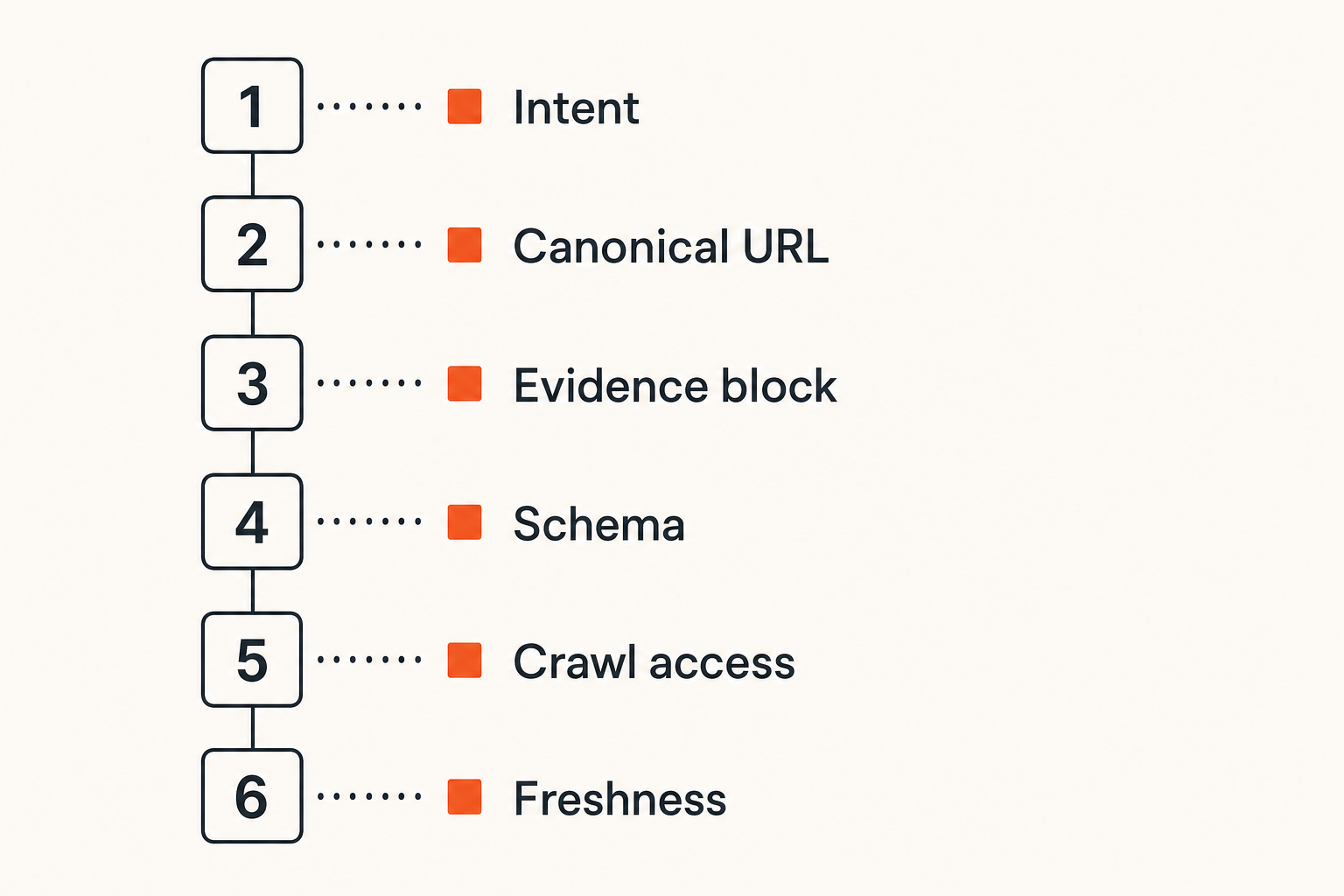
AEO for machine learning engineer jobs is not a one-time optimization pass. It is a workflow. Every new role, guide, and category page should move through the same checks before it becomes part of your public evidence layer.
Related reading from our network: SOC teams face a similar ownership issue when response actions span tools and teams; this article on fleet response architecture and SOC workflows is a useful parallel for thinking about triggers, handoffs, and operational failure modes.
The implementation sequence
Use a sequence like this:
- Define the page intent. Candidate listing, employer guide, salary guide, skills explainer, company hiring page, or category hub.
- Choose the canonical URL. Avoid creating uncontrolled duplicates for filters, locations, and campaign parameters.
- Write the evidence block. Summarize the role, audience, location, skills, compensation assumptions, and last updated date.
- Add visible support. Include FAQs, role comparisons, source notes, hiring process details, and related pages.
- Generate schema from the source of truth. Do not hand-edit structured data separately from the page state.
- Validate crawl access. Check robots rules, rendered HTML, canonical tags, sitemap inclusion, and bot protection behavior.
- Test answerability. Ask the questions users would ask and verify that the page contains the facts needed to answer them.
- Publish and monitor. Watch crawl logs, indexing state, job expiration, internal link flow, and whether AI answers cite competitors for facts you own.
This is not heavy process. It is the minimum viable operating model for pages you expect answer engines to trust.
Ownership across SEO, recruiting, and engineering
AEO breaks when no one owns the full chain. Recruiting owns the job facts. SEO owns discoverability. Engineering owns rendering, schema, and crawl behavior. Content owns the narrative and supporting guides.
The operator move is to assign one page owner and several system owners. The page owner is accountable for whether the page answers its intended question. System owners maintain the templates, feeds, schema, and crawl rules.
Release criteria before indexing
Before allowing a page to index or appear in llms.txt, check:
- The page has one primary intent.
- The title and H1 reflect that intent.
- The useful content is visible in HTML.
- Schema matches visible content.
- The page has a last updated date where freshness matters.
- Canonical and sitemap signals agree.
- Expiration behavior is defined.
- Internal links connect the page to related evidence.
Practical rule: Do not publish pages into the AI-visible corpus until you know what claim each page is supposed to support.
Measure citation readiness for machine learning engineer jobs
You cannot manage AEO by looking only at impressions. For machine learning engineer jobs, you need to measure whether your pages are understandable, current, and likely to be used as sources.
A practical measurement model includes technical access, structured clarity, content completeness, freshness, and prompt-level answer quality. None of these alone proves citation. Together they show whether the page is eligible to be cited.
Track what answer engines can verify
Create a checklist of verifiable facts for each page type.
For a job listing:
- Is the role title clear?
- Is the employer clear?
- Is the location or remote policy clear?
- Is the compensation clear or explicitly unavailable?
- Is the application path clear?
- Is the posting date and expiration state clear?
- Are required skills separated from preferred skills?
For a guide:
- Is the author or publisher clear?
- Is the update date visible?
- Are claims scoped by region, seniority, or industry?
- Are definitions consistent across the site?
- Are related pages linked?
Use prompts as QA, not vanity monitoring
Many teams ask an AI system whether it mentions their brand and stop there. That is too shallow.
Use prompts to find extraction gaps:
- What skills are required for this specific role?
- Is this job remote?
- Does this page explain salary assumptions?
- Which source would you cite for current machine learning engineer openings?
- What is unclear or missing from this page?
The goal is not to game a prompt. The goal is to discover whether your content can support the answer you expect.
Job content decays fast. A stale listing damages more than one URL. It weakens trust in the surrounding category, company page, and career guide.
Use explicit freshness controls:
- validThrough in JobPosting schema.
- Automated expired state.
- Clear closed role messaging.
- Updated timestamps on category pages.
- Removal or noindex policy for expired thin pages.
- Redirect rules when a role has a strong replacement.
Related reading from our network: trust and verification problems also show up in regulated communication workflows, and this guide to IRS secure messaging workflow is an adjacent example of why identity, state, and records matter when automation is involved.
What works and what fails in practice
Most AEO failures are not caused by one missing tag. They are caused by disconnected systems. The listing database says one thing. The template says another. The content guide says a third. The crawler gets a fourth.
The useful way to think about it is supply chain integrity. Your page is the output of many systems: ATS, CMS, schema generator, front-end renderer, CDN, sitemap builder, robots policy, and internal linking logic. If any step corrupts the signal, answer engines may ignore the page.
What works
What works is boring and durable:
- Server-rendered or reliably rendered job facts.
- Canonical category pages for high-value role clusters.
- Schema generated from the same database as visible content.
- Clear expired and closed states.
- Editorial guides that support commercial pages.
- Internal links that explain entity relationships.
- Crawl logs reviewed for AI crawler access.
- Prompt QA tied to page release and refresh cycles.
This is not hype. It is operational hygiene for a new discovery surface.
What fails
What fails is also predictable:
- Publishing thousands of low-context job pages.
- Using AI-written role summaries with no source of truth.
- Blocking AI crawlers while expecting AI citations.
- Treating llms.txt as a substitute for page quality.
- Letting expired listings remain indistinguishable from open roles.
- Hiding salary, location, or required skills behind scripts.
- Creating separate SEO copy that contradicts the actual job post.
A comparison table for operators
| Page intent | One page tries to rank for every variation | Each page supports a specific candidate or employer decision |
| Job facts | Mixed into promotional copy | Presented as visible, structured, current facts |
| Schema | Hand-edited, stale, inconsistent | Generated from the same source as the page |
| Crawl access | Accidental bot blocks and partial rendering | Tested HTML, robots, sitemap, and bot behavior |
| Freshness | Expired jobs remain live without context | Expiration state is visible and reflected in schema |
| Internal links | Blog and jobs sections are disconnected | Guides, listings, categories, and company pages reinforce each other |
| Measurement | Tracks rank and traffic only | Tracks crawlability, completeness, freshness, and answerability |
Common failure modes on job and career sites
The problems below show up often because they sit between teams. SEO sees the content. Engineering sees the template. Recruiting sees the ATS. Nobody sees the full answer-engine path.
Thin listings with no context
A thin listing may technically describe a machine learning engineer role, but it does not explain the team, stack, seniority, hiring process, or compensation assumptions. It is hard to cite because it does not add much beyond the title.
Thin pages can work for users who already trust the site and only need to apply. They work poorly for answer engines trying to recommend sources.
Fix this by adding structured context blocks to templates. Do not depend on every recruiter to write a perfect post. Give them fields that create useful evidence by default.
JavaScript hides the useful parts
Modern front ends often render listings, filters, and role details client-side. Some crawlers can handle JavaScript. Some cannot. Some can render but may not wait long enough or execute the same path as a human.
The safe pattern is to ensure critical facts exist in the initial HTML or a reliably accessible rendered state. If the only place your compensation band appears is inside a client-only component after a filter interaction, you are making citation harder than it needs to be.
Expired jobs poison the corpus
Expired jobs are normal. Ambiguous expired jobs are the problem. If an answer engine sees an old machine learning engineer job as open, it may repeat bad information. If users land on dead pages with no alternatives, trust drops.
Use a defined policy:
- Open jobs return indexable pages with accurate validThrough data.
- Recently closed jobs show a closed state and related open roles.
- Old thin jobs are noindexed, removed, or redirected where appropriate.
- Category pages stay current and do not depend on dead listings for substance.
CrawlProof is built for the gap between how teams think their pages look and what AI crawlers can actually find. That gap is where AEO problems hide.
For machine learning engineer jobs, you do not need another dashboard full of generic scores. You need to know whether the page exposes the right content, schema, crawl permissions, and positioning for answer engines to understand it.
Audit the page like an AI crawler
A normal page review asks whether the design looks right. An AEO audit asks different questions:
- What content is visible to an AI crawler?
- What schema is present and is it consistent?
- Are robots and AI-bot access rules helping or blocking discovery?
- Does the page make its entities and claims clear?
- Are important facts missing from the crawler-visible version?
CrawlProof runs that kind of check so teams can see the page from the crawler side, not just the browser side.
Use findings to assign fixes
Good AEO work produces tickets, not vibes. A CrawlProof-style audit should turn into concrete work:
- SEO updates the page intent and internal links.
- Content adds missing evidence blocks.
- Engineering fixes rendering, schema, or bot access.
- Recruiting improves structured job fields.
- Product defines expiration and archive behavior.
The output should be operational enough that someone can fix it.
Make AEO operational
The teams that win will not be the ones that publish the most pages about machine learning engineer jobs. They will be the ones that make every important page easier for answer engines to parse, verify, and cite.
That means repeatable audits, template-level fixes, and a shared language across marketing, engineering, and content. If you want more notes on how AI crawlers, schema, and answer engines interact, the CrawlProof blog covers those implementation details from the same operator angle.
Closing: compete for answers, not only blue links
Machine learning engineer jobs will remain a competitive topic because it carries commercial value from both sides of the market. Candidates want opportunity. Employers want talent. Platforms want demand. AI answer engines sit between all of them.
The practical takeaway is simple: stop treating this as a single keyword page. Treat it as an evidence system. Your content, schema, crawl access, freshness policy, and internal links all decide whether an answer engine can use your site.
The practical takeaway
If you operate a job board, employer career site, recruiting agency site, or career content hub, audit your machine learning engineer jobs pages against four questions:
- Can an AI crawler access the useful content?
- Can it identify the entities and facts without guessing?
- Can it verify that the facts are current?
- Can it connect the page to related evidence on your site?
If the answer is no, the fix is not more keyword density. The fix is better architecture.
Try crawlproof.com
crawlproof.com helps site owners and marketers understand how AI answer engines and LLM crawlers discover and cite their content.
Try crawlproof.com