Most site teams are now optimizing for two discovery systems at once. Classic search still matters. AI answer engines now matter too. The awkward part is that the same change can help one channel and hurt another.
Multi-objective optimization is the practical way to handle that conflict. Not as a math buzzword. As an operating model for deciding what to publish, what to expose to crawlers, what to mark up, what to gate, and what to measure.
Teams think the problem is getting more AI visibility. The real problem is balancing visibility, citation quality, conversion intent, crawler access, technical risk, and brand control without turning the site into a pile of contradictory optimizations.
That changes the conversation. The practical question is not whether AEO replaces SEO. It is how your website makes tradeoffs when Google, ChatGPT, Perplexity, Claude, Bing, and human buyers all consume the same pages differently.
Table of contents
Why multi-objective optimization belongs in AEO
AEO is not just SEO with a new label. If you need the short version of the distinction, our post on what AEO is and why it is not SEO is the right baseline. The important point here is operational: AI answer engines do not only rank pages. They extract, summarize, compare, cite, and sometimes answer without sending the click.
That means a page has to satisfy multiple consumers. A human buyer wants context and proof. A search engine wants crawlable content and relevance. An answer engine wants concise, attributable facts. A legal or brand team wants claims to stay controlled. A developer wants the site to remain fast, maintainable, and secure.
The old single-objective SEO habit
The mistake teams make is treating every page like it has one primary job: rank higher for a keyword. That habit shaped years of content operations. Pick a term, build the page, improve internal links, tune titles, add schema, monitor rankings.
That still matters. But it is incomplete in 2026 because visibility is no longer only a ranked list. An AI system may read your page, extract one paragraph, ignore your CTA, blend your facts with competitors, and cite a different source. If your optimization model only rewards rankings, you will miss the place where the answer engine made its decision.
The new AEO constraint stack
A useful way to think about it is a constraint stack. Your page has to be discoverable, accessible, extractable, credible, attributable, and commercially useful. These objectives are connected but not identical.
A short FAQ can be highly extractable but commercially thin. A detailed product page can convert well but hide the answer behind tabs or scripts. A gated report can generate leads but may be invisible to AI crawlers. Aggressive bot blocking can reduce scraping risk but also remove you from emerging answer surfaces.
Practical rule: If one optimization makes the page better for a crawler but worse for a buyer, do not ship it blindly. Name the tradeoff first.
The operator view
Operators need a decision system, not another checklist. Multi-objective optimization gives you that system. It says every page has several goals, every goal has a weight, and every change should be judged by its effect across the set.
This is not theoretical. It affects whether you put definitions above the fold, whether you expose pricing, whether you add schema, whether you allow GPTBot or PerplexityBot, whether you publish llms.txt, and whether you rewrite comparison pages for answer inclusion or buyer education.
The objectives you are actually optimizing
Before you optimize, define the objectives. Many AEO projects fail because teams use vague goals like better AI visibility. That is not a workflow. It is a wish.
Search demand and answer inclusion
The first objective is still demand capture. You want to be discoverable when people ask about your category, product, alternatives, pricing, implementation, risks, or comparisons. In classic SEO, this often maps to keyword rankings. In AEO, it also maps to whether your facts are eligible for inclusion in generated answers.
The practical question is: can an answer engine find a clean, quotable answer on your page? If the answer is buried in brand language, split across accordions, or contradicted by another page, you are making extraction harder.
Crawler accessibility and content extraction
Accessibility is not only about whether Googlebot can fetch the page. LLM crawlers and answer engines may interact with your site differently. They may not execute your JavaScript as expected. They may be blocked by robots rules. They may see a stripped-down version of the page. They may miss content loaded from third-party widgets.
This is where developers become part of the AEO workflow. The page content, rendered DOM, robots policy, structured data, canonical tags, and server behavior are all part of the optimization surface.
Trust, attribution, and conversion
AEO is not valuable if it produces untrusted mentions or low-intent traffic. You need attribution and commercial fit. That means clear authorship, updated dates where appropriate, consistent entity naming, product facts, sourceable claims, and landing paths that help buyers act.
The mistake teams make is optimizing for answer inclusion while stripping away the signals that make a buyer trust the answer. A page can be easy to summarize and still weak as a business asset.
The tradeoff map for multi-objective optimization
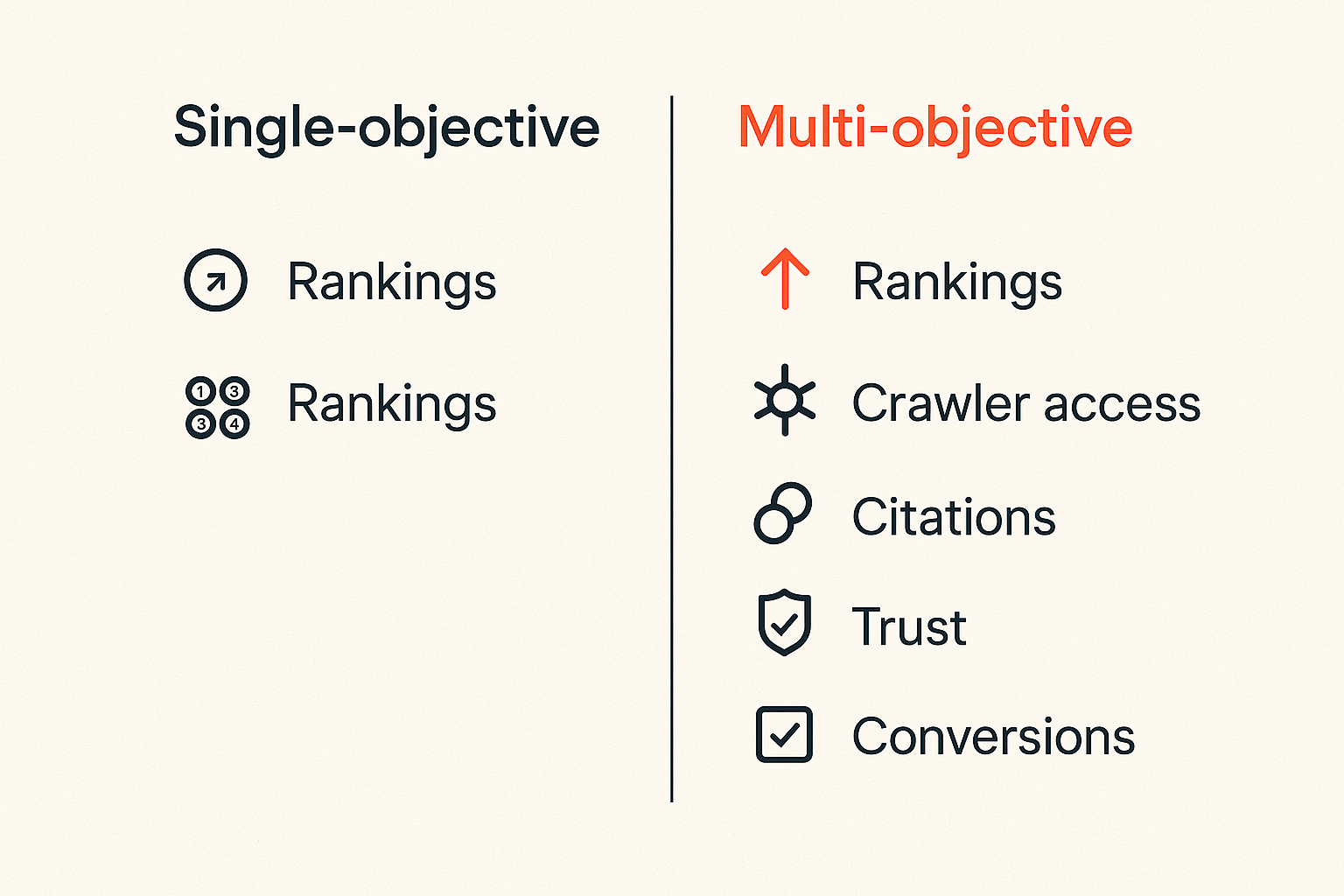
Multi-objective optimization becomes useful when you stop pretending that all improvements point in the same direction. They do not.
What improves one objective but damages another
Consider a few common conflicts:
- Publishing full pricing improves answer usefulness, but may create sales, competitive, or regional complexity.
- Blocking AI crawlers may reduce unwanted training access, but can reduce visibility in answer engines that respect robots directives.
- Adding long explanatory sections may improve topical coverage, but can dilute the direct answer if the page is poorly structured.
- Using heavy interactive components may improve human engagement, but can make extraction brittle.
- Creating many narrow FAQ pages may increase answer coverage, but can create duplicate or thin content.
What breaks in practice is not that teams choose the wrong objective. It is that they choose implicitly. Marketing pushes for visibility. Legal pushes for caution. Engineering pushes for simplicity. Sales wants higher-intent leads. Nobody writes down the decision rule.
How to decide which tradeoffs are acceptable
Start by assigning the page a primary business role. A category education page, a product page, a pricing page, a documentation page, and a comparison page should not have the same weights.
For example:
- A glossary article may weight extractability and citation above conversion.
- A product page may weight conversion and trust above broad answer inclusion.
- A documentation page may weight precision and crawlability above persuasive copy.
- A comparison page may weight attribution, freshness, and entity clarity.
Practical rule: Do not apply the same AEO template to every page type. Optimize the objective mix, not the surface pattern.
A simple comparison table
| Page goal | Rank for target keyword | Balance ranking, extraction, citation, and conversion |
| Content layout | Long-form coverage first | Direct answer, evidence, context, next action |
| Technical review | Check indexability | Check rendered content, schema, bots, canonicals, snippets |
| Measurement | Ranking and traffic | Scorecard across access, extraction, citations, leads |
| Ownership | SEO team | SEO, content, dev, product, legal where needed |
| Risk model | Avoid losing rankings | Avoid invisible content, wrong citations, weak attribution |
Related reading from our network: teams working on decentralized infrastructure face a similar routing and validation problem in IaaS in cloud computing, where one system has to satisfy cost, reliability, validation, and operational control at the same time.
A multi-objective optimization workflow for AEO teams
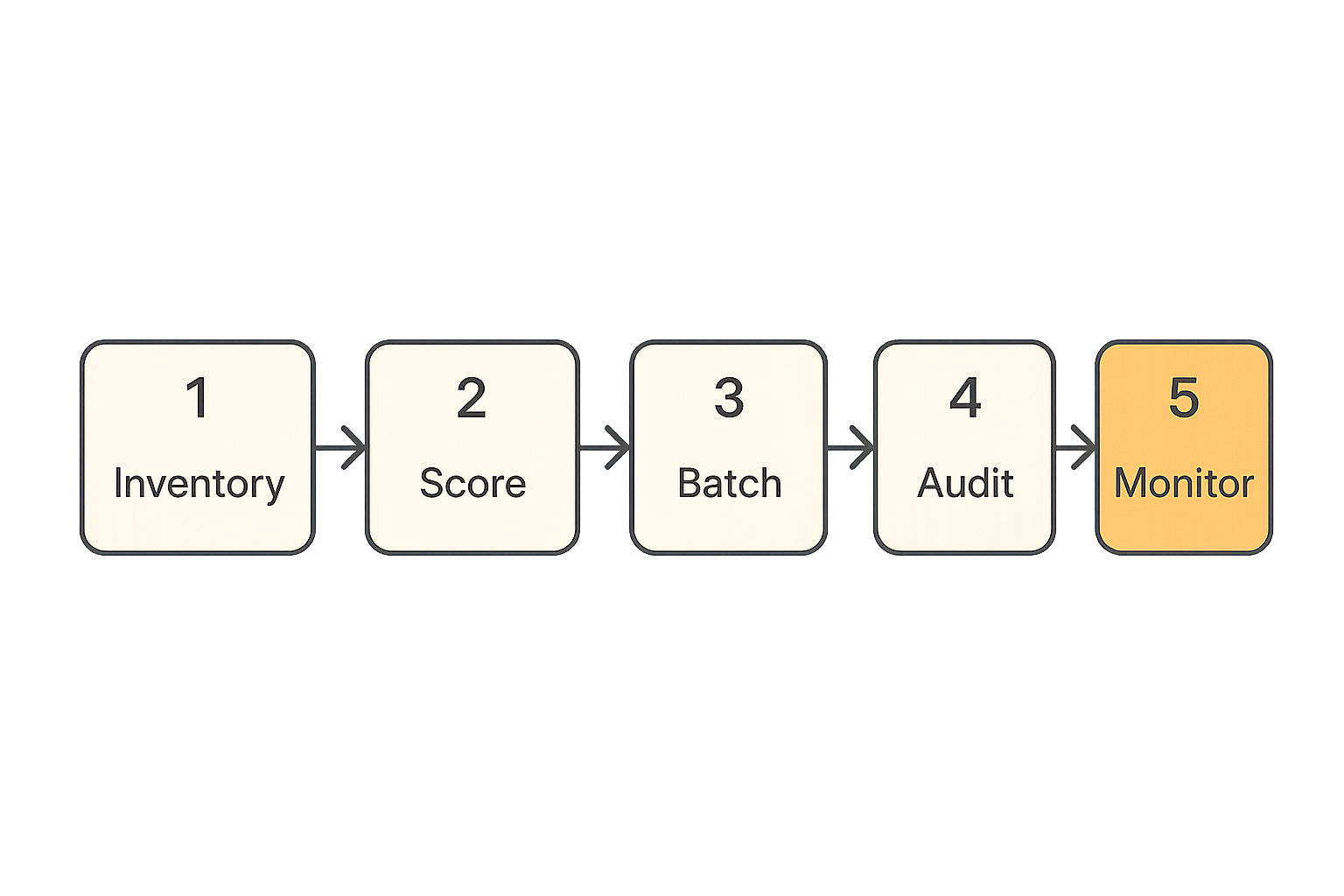
The workflow matters more than the theory. If multi-objective optimization only lives in a strategy deck, it will not change what ships.
Step 1 inventory the pages that matter
Do not start with the whole site. Start with pages that influence discovery, trust, and revenue:
- Category landing pages.
- Comparison and alternatives pages.
- Pricing and packaging pages.
- Documentation and implementation pages.
- High-traffic blog posts.
- Product or service pages.
- About, author, and trust pages.
For each page, record the intended audience, target queries, business role, canonical URL, schema types, robots status, and whether the key content appears in the initial rendered HTML.
Step 2 score each page across objectives
Use a simple 1 to 5 score. Avoid false precision. The goal is to expose tradeoffs, not produce a perfect formula.
Score each page on:
- Crawl access: Can important bots fetch it?
- Render reliability: Is the main content visible without fragile client-side behavior?
- Answer clarity: Is there a concise answer to the likely question?
- Entity clarity: Are brand, product, author, and topic signals consistent?
- Evidence: Are claims supported with specifics?
- Attribution: Would an answer engine know who to cite?
- Conversion path: Is there a clear next step for a human?
- Maintenance risk: Can the team keep it accurate?
A page with high answer clarity and low attribution is dangerous. A page with strong conversion and weak crawler access is under-leveraged. A page with high topical coverage and low maintenance discipline becomes stale quickly.
Step 3 ship changes in controlled batches
A practical implementation sequence looks like this:
- Pick one page type, such as comparison pages.
- Define the objective weights for that page type.
- Audit five representative URLs.
- Identify repeated failure modes.
- Update the template or content brief.
- Ship changes to a small batch.
- Re-audit rendered output and crawler access.
- Watch rankings, impressions, AI referrals where available, conversions, and qualitative answer mentions.
- Expand only after the pattern works.
The point is not to freeze the site. The point is to reduce random changes. Multi-objective optimization works best when it becomes a repeatable publishing and QA loop.
Content architecture rules that survive AI answer engines
Content architecture is where AEO either becomes durable or turns into formatting theater. You cannot fix a confused page with a few schema fields.
Answer engines need clean chunks. Buyers need context. You can satisfy both by using layered structure:
- Start sections with direct answers.
- Follow with explanation, constraints, examples, and caveats.
- Use tables when comparing options.
- Keep entity names consistent.
- Avoid burying definitions inside storytelling.
- Use headings that match real user questions.
This does not mean every article should sound robotic. It means important facts should be easy to locate and quote.
Separate canonical facts from persuasive copy
A common failure mode is mixing facts, claims, and positioning in the same paragraph. For humans, this may read smoothly. For machines, it can blur what is factual and what is marketing.
Better architecture separates:
- What the product or service is.
- Who it is for.
- What it does not do.
- How it compares with alternatives.
- What proof supports the claim.
- What the reader should do next.
This helps answer engines extract accurate summaries and helps internal teams keep claims updated.
Use schema as a contract
Schema should describe what is already true on the page. It should not be used to smuggle claims into markup that the visible page does not support.
Useful schema patterns for AEO often include Organization, WebSite, Article, FAQPage where appropriate, Product or Service where accurate, BreadcrumbList, Person for authors, and sameAs links for entity disambiguation. The exact mix depends on the page.
Practical rule: If your schema says something the visible page does not clearly support, fix the page before you celebrate the markup.
Related reading from our network: local coordination systems deal with similar trust and routing issues; the post on building a supreme community as an operating system is a useful adjacent lens for thinking about asks, offers, follow-up, and reliability.
Crawler access is an optimization variable
Crawler access used to be treated as a technical SEO hygiene task. In AEO, it is a business decision. You are deciding which automated systems can read which parts of your site under which rules.
Robots files are policy, not decoration
Robots.txt, meta robots, X-Robots-Tag headers, canonicals, and firewall rules create your crawler policy. If these are inconsistent, your AEO strategy is mostly guesswork.
Common issues include:
- Blocking AI crawlers accidentally through broad bot rules.
- Allowing crawlers but blocking CSS or JS required for rendering.
- Setting noindex on pages that content teams expect answer engines to use.
- Using canonical tags that point away from the best answer source.
- Serving different content to bots and users in ways that create risk.
The practical question is not whether all bots should be allowed. The question is whether your policy matches your business intent.
llms.txt and crawler guidance
Emerging files like llms.txt are attempts to give AI systems clearer guidance about important content. They are not magic. They do not guarantee citation. But they are useful as part of an explicit machine-readable content strategy.
If you are new to the format, our guide to llms.txt and skill.md explains what these files are and what teams commonly put in them. In a multi-objective optimization model, llms.txt is one input. It should point machines toward canonical, maintained, high-signal resources, not every URL you hope will get attention.
Rendering, rate limits, and blocked assets
What breaks in practice is often boring infrastructure. The crawler can fetch the page, but the main content is injected after an API call. The documentation loads through a client-side app. The firewall challenges unfamiliar user agents. The rate limit treats legitimate crawlers like abuse. The page returns a different experience by geography.
Developers should test the actual rendered output and server behavior, not just the browser view. If an answer engine cannot reliably see the answer, the content strategy does not matter.
Measurement when there is no single winning metric
Measurement is harder in AEO because answer inclusion is less transparent than traditional rankings. You may not get a clean referrer. You may see brand searches move before direct AI traffic. You may be cited in one surface and ignored in another.
Use a scorecard instead of a scoreboard
A scoreboard asks: did traffic go up? A scorecard asks: did the system improve across the objectives we control?
A useful AEO scorecard might include:
- Pages with clean crawler access.
- Pages with valid structured data.
- Pages with direct answer blocks.
- Pages with consistent entity naming.
- Pages with visible authorship or ownership.
- Pages included in llms.txt where appropriate.
- Pages with a clear conversion path.
- Pages with stale claims or weak evidence.
This keeps the team focused before lagging indicators show up.
Track leading indicators before citations arrive
Leading indicators are not proof of business impact, but they tell you whether the foundation is improving. Track whether answer-critical pages are crawlable, renderable, well structured, internally linked, and semantically clear.
You can also manually test answer engines for key prompts, but treat that as qualitative evidence. AI answers vary by user, location, model, time, and retrieval layer. Do not build your whole reporting system around screenshots.
Watch for objective drift
Objective drift happens when a team starts with balanced goals and slowly over-optimizes one metric. The content becomes too extractive and loses persuasion. The dev team tightens bot controls and visibility drops. The SEO team expands pages until the direct answer disappears. The conversion team gates the asset that answer engines needed.
Practical rule: Review the objective weights when a page changes role. A page built for education should not keep the same optimization model after it becomes a sales landing page.
Related reading from our network: media and streaming operators face their own version of objective drift when balancing access, safety, reliability, and user experience in world wide technology workflows.
What breaks when teams implement this badly
Bad implementation usually looks sophisticated from a distance. There are dashboards, briefs, schema validators, and bot policies. But the workflow does not connect decisions to outcomes.
The content team optimizes against the dev team
Content publishes answer-friendly pages. Engineering blocks unfamiliar bots. SEO requests schema. Product changes the page template. Legal edits claims. Nobody owns the combined result.
This is why AEO needs a shared artifact. A page brief should include not only keywords and headings, but crawler policy, schema requirements, canonical facts, conversion intent, and maintenance owner.
The site becomes readable but not trustworthy
Some teams overreact to AI answer engines by making every page a list of short answers. That can improve extraction, but it can also remove evidence, nuance, and brand credibility.
Trust still matters. Answer engines look for signals, and humans do too. Dates, authors, original examples, clear product boundaries, transparent methodology, and consistent entity references all help. Thin content that is easy to summarize is still thin content.
The audit never reaches the backlog
Another failure mode is audit theater. The team runs a scan, finds problems, exports a report, and then nothing changes. The issues are too vague for developers, too technical for content, or too disconnected from revenue for leadership.
A useful audit produces prioritized work:
- Fix blocked important pages.
- Add missing schema where the page supports it.
- Rewrite unclear answer sections.
- Consolidate duplicate pages.
- Update stale claims.
- Add llms.txt references to canonical resources.
- Improve internal links to high-signal pages.
If the output cannot become tickets, briefs, or template changes, it is not an operating workflow.
Where CrawlProof fits in the workflow
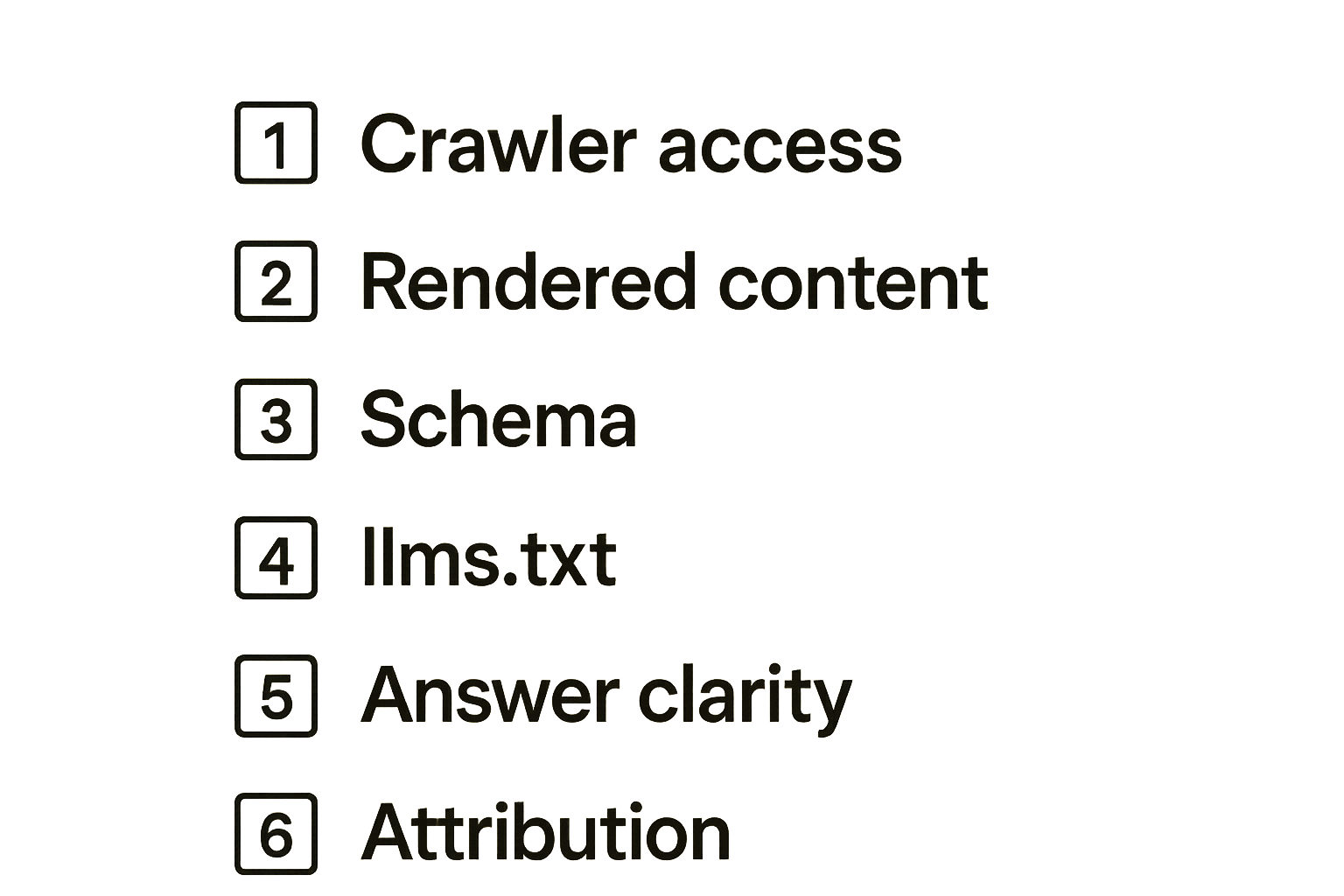
CrawlProof is built for the part of multi-objective optimization that is easy to hand-wave and hard to verify: what AI crawlers and answer engines can actually find on your site.
See the site like AI crawlers do
Most teams inspect pages as humans. They open the browser, scroll, and assume the important content is available. That is not enough. You need to know whether the crawl path, rendered content, robots policy, schema, and positioning signals line up.
CrawlProof helps site owners and marketers run AEO audits so they can see which content is visible, which signals are missing, and which technical rules may be preventing discovery. The goal is not to replace SEO tools. It is to expose the machine-consumption layer that standard workflows often miss.
Turn findings into priorities
AEO work competes with every other backlog item. That means findings need priority, not just severity. A blocked pricing page is different from a missing schema field on an old announcement. A weak answer block on a high-intent comparison page is different from a minor metadata issue on a low-value post.
The right product fit is architectural: use CrawlProof to identify where crawler access, schema, llms.txt guidance, content extraction, and page positioning do not match your business intent.
Use audits as a shared operating layer
The best use of an audit is not a one-time report. It is a shared layer between SEO, content, development, and leadership. Content teams see what needs rewriting. Developers see what needs fixing. Marketers see where AI discovery may be blocked. Leadership sees the tradeoffs clearly.
That is how multi-objective optimization becomes a workflow instead of another acronym.
Closing the loop on multi-objective optimization
Multi-objective optimization is useful because it matches how websites actually operate in 2026. Your site has to rank, be cited, convert, stay accurate, remain maintainable, and respect crawler policy. Those goals do not always agree.
What works
What works is explicit tradeoff management:
- Define page roles before optimizing.
- Score pages across several objectives.
- Fix crawler and rendering problems before rewriting everything.
- Make answer sections clear without deleting context.
- Use schema to reinforce visible facts.
- Treat llms.txt as guidance, not a guarantee.
- Connect audits to tickets, briefs, and templates.
- Revisit weights when the business role of a page changes.
What fails
What fails is pretending one metric can govern the whole system:
- Chasing AI citations while blocking crawlers.
- Adding schema without fixing page content.
- Publishing extractable pages that do not build trust.
- Gating the assets that answer engines need to understand you.
- Letting every team optimize its own slice without a shared decision model.
- Measuring only traffic and ignoring visibility foundations.
The next practical step
Pick ten pages that matter. Score them against crawl access, render reliability, answer clarity, entity consistency, evidence, attribution, conversion path, and maintenance risk. Then fix the highest-impact mismatch first.
That is multi-objective optimization in practice: not maximizing everything, not chasing every crawler, and not rewriting the site for hype. It is making better tradeoffs in the system that now decides whether AI answer engines can discover, understand, and cite your content.
Try crawlproof.com
CrawlProof helps site owners and marketers see how AI answer engines and LLM crawlers discover, interpret, and cite their content. Try crawlproof.com.