Your content may rank in classic search and still disappear inside an AI answer. That is the practical neural engine problem most site owners are running into in 2026.
The page exists. The keyword research was done. The article has headings, internal links, and decent backlinks. Then someone asks an AI assistant a buying, troubleshooting, or comparison question, and your site is missing from the answer.
Teams think the problem is ranking. The real problem is whether a neural engine can crawl, extract, understand, trust, and reuse your content as a source.
That changes the conversation. This is not just SEO with a new label. It is an architecture and workflow problem: content structure, machine-readable context, bot access, schema, entity clarity, refresh cycles, and measurement all have to work together.
Table of contents
The neural engine is not a magic ranking layer
What teams think they are optimizing
The mistake teams make is treating the neural engine as another SERP with a different skin. They ask: how do we rank in ChatGPT, Perplexity, Gemini, or the next assistant interface?
That question is too narrow. A neural engine may retrieve from a live web index, cached documents, structured data, internal knowledge graphs, user context, partner feeds, or a blend of all of them. The answer surface is the last step, not the whole system.
A more useful question is: can the system understand what our page is evidence for?
Classic SEO trained teams to think in terms of pages and keywords. Answer engines operate closer to claims, entities, relationships, and tasks. A page may contain 2,000 words, but only three sentences may be useful to an answer engine. If those sentences are vague, buried, blocked, stale, or inconsistent with the rest of the site, the model may ignore them.
The architecture view
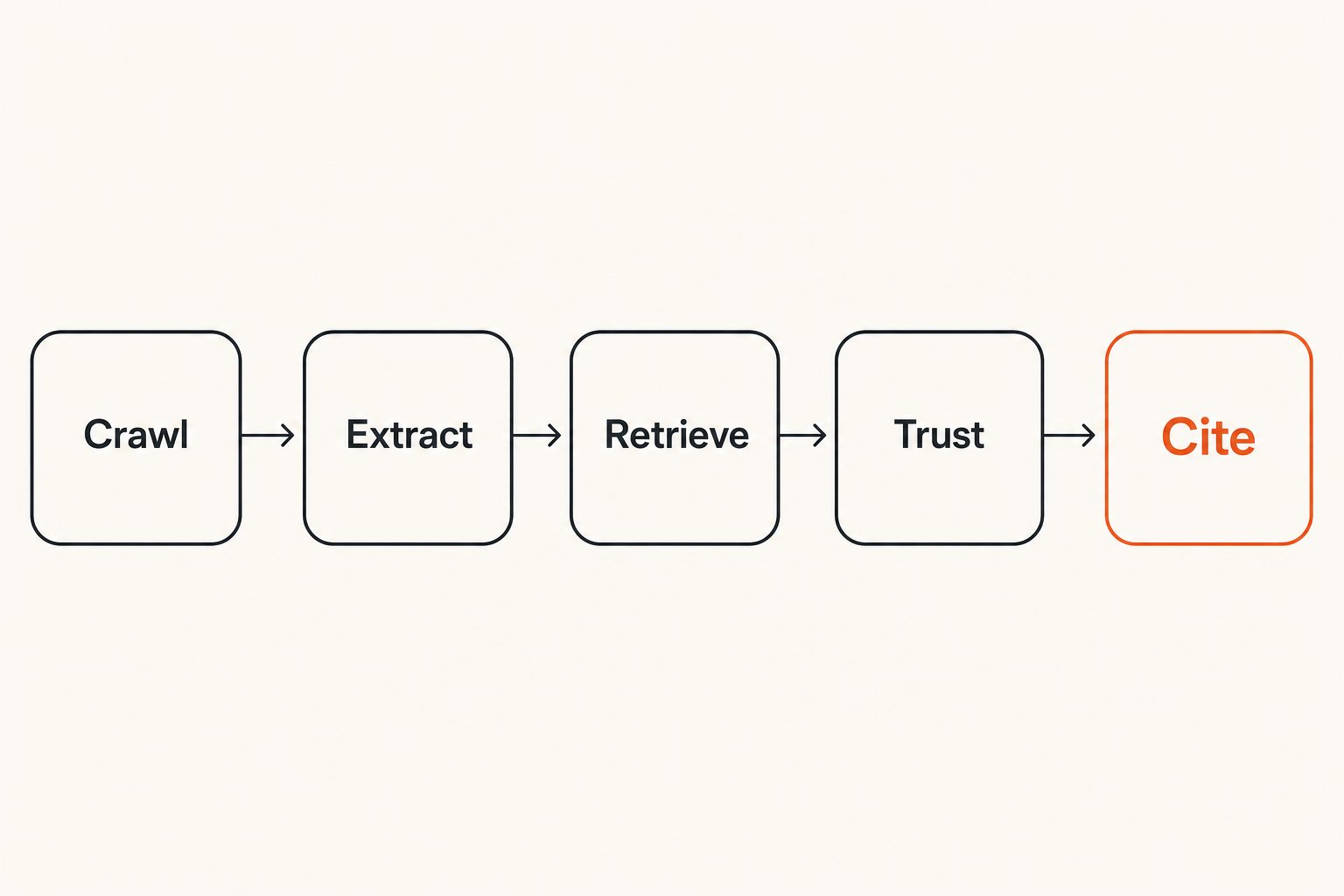
A useful way to think about it is a pipeline:
- Discovery: can the crawler find the URL?
- Access: is the crawler allowed to fetch it?
- Rendering: can the important content be seen without fragile client-side behavior?
- Extraction: can the system identify the main answer, entities, dates, author, and supporting evidence?
- Retrieval: can the content match a real user question?
- Trust: does the source look authoritative, specific, consistent, and current?
- Citation: is the page worth naming as a source?
If any layer fails, the visible outcome looks the same: no mention, no citation, no referral, no influence.
Practical rule: Do not optimize for the answer box first. Optimize the upstream evidence pipeline that makes your page eligible to be used in the answer.
Where AEO fits
Answer Engine Optimization is the operating discipline around that pipeline. If you need the baseline distinction, the CrawlProof guide to what AEO is and why it is not SEO frames the shift from ranking pages to becoming usable source material for answers.
AEO does not replace SEO. Search visibility still matters. Links still matter. Technical hygiene still matters. But the workflow changes because the consumer of your content is no longer only a human scanning ten blue links. It is also a machine system deciding whether your content is usable as evidence.
The practical question is not whether neural engines will replace search. The practical question is whether your site is legible to them today.
How a neural engine reads your website
Crawl access comes before intelligence
Many teams jump straight to prompts, content formats, or AI summaries. What breaks in practice is simpler: the crawler cannot access the right page, cannot see the important content, or gets a different experience than a normal browser.
AI crawlers and answer engines vary in how they fetch and process pages. Some behave like traditional crawlers. Some are stricter about robots rules. Some may use a search index rather than crawling your page directly at answer time. You do not control all of that. You do control whether your site is internally coherent and machine-readable.
Check the basics:
- Important URLs are linked in normal HTML, not only generated after interaction.
- Canonicals point to the correct preferred page.
- Robots rules do not accidentally block AI-related user agents you want to allow.
- Server responses are stable and fast enough for crawlers.
- Content is not hidden behind consent walls, region gates, or broken bot detection.
A neural engine does not experience your page like a marketer reviewing a landing page mockup. It extracts text, headings, structured data, links, and sometimes visual context. It then compresses that material into representations useful for retrieval and generation.
This is where page design and machine readability can diverge. A beautiful page with key facts inside image text, tabs, modals, or late-loaded components may be weak source material. A plain page with a clear definition, direct answer, schema markup, update date, and supporting examples may be much easier to use.
The mistake teams make is assuming that if a human can eventually find an answer, the machine can too. That is often false.
Citations depend on source confidence
Citation is not guaranteed even when your content informs an answer. An assistant might use your page as background context without exposing it. It might cite a competitor with clearer source signals. It might cite a publisher because the publisher states the same fact more directly.
Source confidence comes from multiple signals:
- Clear entity identity: who is the company, author, product, or organization?
- Specificity: does the page make concrete claims or generic statements?
- Consistency: do facts match across the site?
- Provenance: are dates, authorship, and source context visible?
- Accessibility: can crawlers retrieve the content reliably?
Practical rule: If a paragraph would not make sense when lifted out of the page, it is probably weak retrieval material.
Build the content layer for retrieval
Pages need answerable units
For AEO, content architecture should make answers easy to extract. That does not mean turning every page into an FAQ dump. It means each major section should answer a specific question in a self-contained way.
Bad unit:
- We help modern teams unlock growth with innovative workflows.
Better unit:
- CrawlProof audits whether AI crawlers can access a page, extract its main content, read its schema markup, and understand its answer-engine positioning.
The second sentence names the product, action, crawler context, and outcome. It gives a neural engine something usable.
For informational content, each page should include:
- A direct answer near the top.
- Clear headings that map to real questions.
- Definitions only when needed, not as filler.
- Examples that show the concept in production.
- A summary of what changed, what to do, or how to decide.
Freshness and provenance matter
AI answer engines often deal with time-sensitive uncertainty. Pricing, policies, standards, crawler behavior, and platform names change. If your page has no visible updated date, no author context, and no stable claim structure, it may lose to a page that is easier to trust.
Freshness does not mean changing the publish date every week. It means keeping the evidence current:
- Update pages when platform behavior changes.
- Add notes when standards are emerging or experimental.
- Keep product descriptions consistent across homepage, docs, blog, and schema.
- Remove obsolete claims instead of letting old pages conflict with new ones.
Content teams in publishing face a similar workflow problem: the tool is less important than the editorial state machine behind it. Related reading from our network: content management system workflow for digital publishers.
What fails in content architecture
What fails is not usually one bad article. It is a content estate that sends mixed signals.
Common problems include:
- Ten pages answering the same question with slightly different facts.
- Glossary pages that define terms without showing operational use.
- Comparison pages that never state who the product is actually for.
- Case studies that hide the measurable outcome behind brand storytelling.
- Blog posts with no connection to product entities or category pages.
A neural engine needs evidence it can align. If your site cannot agree with itself, do not expect an answer engine to clean it up for you.
Technical signals that feed a neural engine
Schema markup reduces ambiguity
Schema markup is not a magic inclusion ticket. It is a disambiguation layer. It tells machines what a page is about, who published it, what entity is being described, and how pieces of information relate.
For most sites, start with practical schema:
- Organization or LocalBusiness for identity.
- WebSite and WebPage for site structure.
- Article or BlogPosting for editorial content.
- Product, SoftwareApplication, Service, or FAQPage when appropriate.
- BreadcrumbList for hierarchy.
- Person for authors or experts when relevant.
The point is not to mark up everything. The point is to mark up the facts you want systems to understand consistently.
Practical rule: Schema should confirm the visible page, not compensate for a page that is vague to humans.
llms.txt and AI crawler instructions
Emerging files like llms.txt give teams a way to provide AI-oriented guidance, important URLs, summaries, and usage notes. The standard is still evolving, and different crawlers may treat it differently. That is why it should be part of your AEO stack, not the whole stack.
Use it to point toward canonical explanations, documentation, product pages, and high-quality source pages. Do not use it as a dumping ground for every URL on the site.
If you are new to this layer, CrawlProof has a practical explainer on llms.txt and skill.md that covers what these files are for and what to put in them.
Rendering and robots rules still break things
Technical SEO problems become AEO problems when they prevent extraction. The neural engine cannot cite what it cannot see.
Check for:
- Important copy rendered only after user interaction.
- Product details stored inside images or canvas elements.
- Blocked CSS or scripts that change the extracted text order.
- Incorrect noindex tags inherited from templates.
- Bot protection that blocks legitimate crawlers.
- Canonical tags pointing to weaker duplicate pages.
In production, the failures are often boring. A staging robots rule ships. A redesign moves core copy into a component that does not render server-side. A cookie banner covers the body. A CDN rule challenges unknown bots. The content team sees a page. The crawler sees friction.
A workflow for neural engine readiness
Step 1 audit access
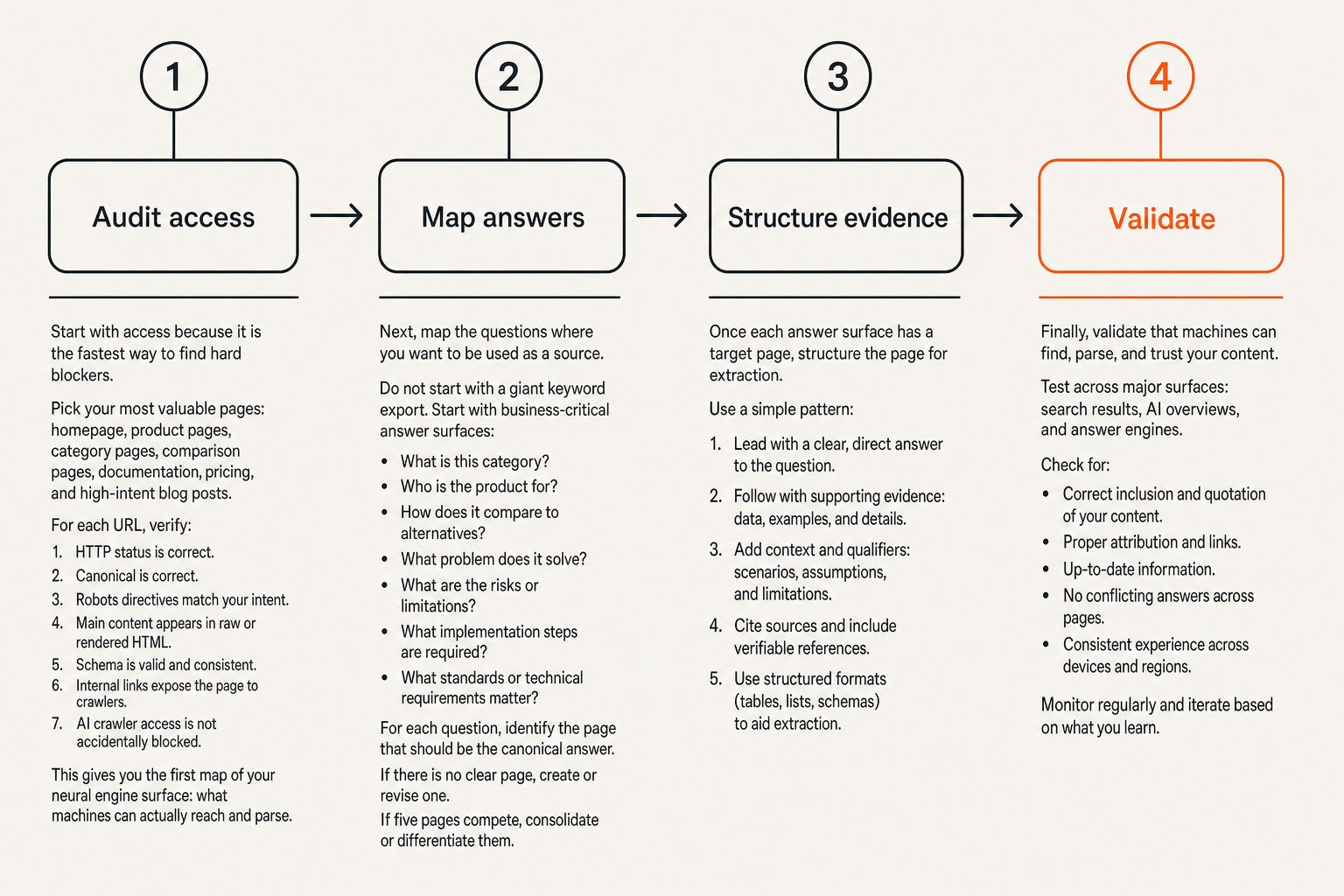
Start with access because it is the fastest way to find hard blockers. Pick your most valuable pages: homepage, product pages, category pages, comparison pages, documentation, pricing, and high-intent blog posts.
For each URL, verify:
- HTTP status is correct.
- Canonical is correct.
- Robots directives match your intent.
- Main content appears in raw or rendered HTML.
- Schema is valid and consistent.
- Internal links expose the page to crawlers.
- AI crawler access is not accidentally blocked.
This gives you the first map of your neural engine surface: what machines can actually reach and parse.
Step 2 map answer surfaces
Next, map the questions where you want to be used as a source. Do not start with a giant keyword export. Start with business-critical answer surfaces:
- What is this category?
- Who is the product for?
- How does it compare to alternatives?
- What problem does it solve?
- What are the risks or limitations?
- What implementation steps are required?
- What standards or technical requirements matter?
For each question, identify the page that should be the canonical answer. If there is no clear page, create or revise one. If five pages compete, consolidate or differentiate them.
Step 3 structure the evidence
Once each answer surface has a target page, structure the page for extraction.
Use a simple pattern:
- Direct answer in the opening section.
- Short explanation of why the topic matters now.
- Operational framework or decision model.
- Concrete examples.
- Technical implementation notes.
- Limitations and edge cases.
- Clear next step.
This is not about writing for robots. It is about making the page useful when a human or machine needs a precise answer quickly.
Step 4 validate and repeat
Validation is where many teams stop too early. Publishing is not validation.
Check whether crawlers can see the changed page. Test how assistants answer related questions. Look for citations, mentions, and omissions. Compare your page against sources that do get cited. Update the content and technical signals based on what you find.
The loop matters more than the first pass. AEO is not a one-time migration project. It is an operating cadence.
Measurement is the operating layer
Track crawlability and extractability
If you cannot measure whether a neural engine can access and extract your content, you are guessing.
Track page-level signals such as:
- Indexable status.
- Robots and meta directives.
- Main content extracted successfully.
- Schema detected and parsed.
- Important entities found.
- Last updated date visible.
- Internal links pointing to the page.
These are not vanity metrics. They are eligibility metrics. Before asking why an answer engine did not cite you, confirm that your page was technically eligible to be understood.
Track citation and mention patterns
Citation measurement is messy because answer engines vary by interface, user context, location, freshness, and retrieval mode. Still, you can build a useful directional view.
Track a small set of prompts around your highest-value intents. Record:
- Whether your brand is mentioned.
- Whether your page is cited.
- Which competitors are cited.
- Which source types dominate.
- Whether the answer repeats your positioning accurately.
- Whether outdated facts appear.
Do not overreact to one prompt. Look for patterns. If competitors are cited because their pages are more specific, that is a content issue. If old facts appear, that is a freshness issue. If nobody cites you despite strong content, that may be an access, authority, or entity issue.
Track query coverage by intent
Classic SEO reporting often groups by keyword. For neural engine visibility, group by intent and answer type.
Useful buckets include:
- Definition: what is the concept?
- Evaluation: which tools or vendors should I consider?
- Implementation: how do I do this?
- Troubleshooting: why is this failing?
- Comparison: how does X differ from Y?
- Policy or standard: what rules apply?
This helps teams avoid optimizing random prompts. The goal is to cover the answer surfaces that matter to the business.
Freelancers and marketplace sellers face a similar dependency problem when one platform controls discovery. Related reading from our network: Fiverr alternatives for sellers building an AI-assisted channel stack.
Common failure modes in neural engine optimization
JavaScript hides the answer
Modern sites often ship content through client-side components, personalization layers, analytics gates, and interactive UI. That can be fine for users and still bad for extraction.
What breaks in practice is the main answer not appearing in a stable, crawlable form. The crawler may see the shell, navigation, footer, and some generic text, but miss the actual product detail or explanation.
Fixes are usually straightforward:
- Server-render critical content.
- Keep core facts in HTML text.
- Avoid putting important terms only in images.
- Test rendered and non-rendered extraction.
- Make accordions and tabs accessible in source.
Thin programmatic pages create weak evidence
Programmatic SEO can create useful coverage, but it also creates weak pages at scale when teams swap variables into generic templates. Neural engines are not impressed by volume alone.
A weak programmatic page might include the target phrase, a few generic paragraphs, and a call to action. It may rank for a low-competition query, but it gives an answer engine little reason to trust or cite it.
Stronger pages include unique evidence:
- Specific examples.
- Local or category-specific constraints.
- Real comparison criteria.
- Clear source data.
- Human review.
- Internal links to canonical explanations.
The practical question is whether the page adds evidence or just another URL.
Conflicting brand facts confuse the model
AEO exposes brand inconsistency. If your homepage says one thing, your about page says another, your schema says a third, and old blog posts use outdated positioning, machines may struggle to identify the current truth.
Common conflicts:
- Company name variations.
- Product category changes.
- Old pricing or packaging.
- Deprecated features.
- Multiple descriptions of the same audience.
- Inconsistent founder, location, or contact facts.
Fixing this is not glamorous. It is operational cleanup. But it matters because answer engines often synthesize from multiple pages. Consistency makes synthesis safer.
What works vs what fails in practice
Comparison table
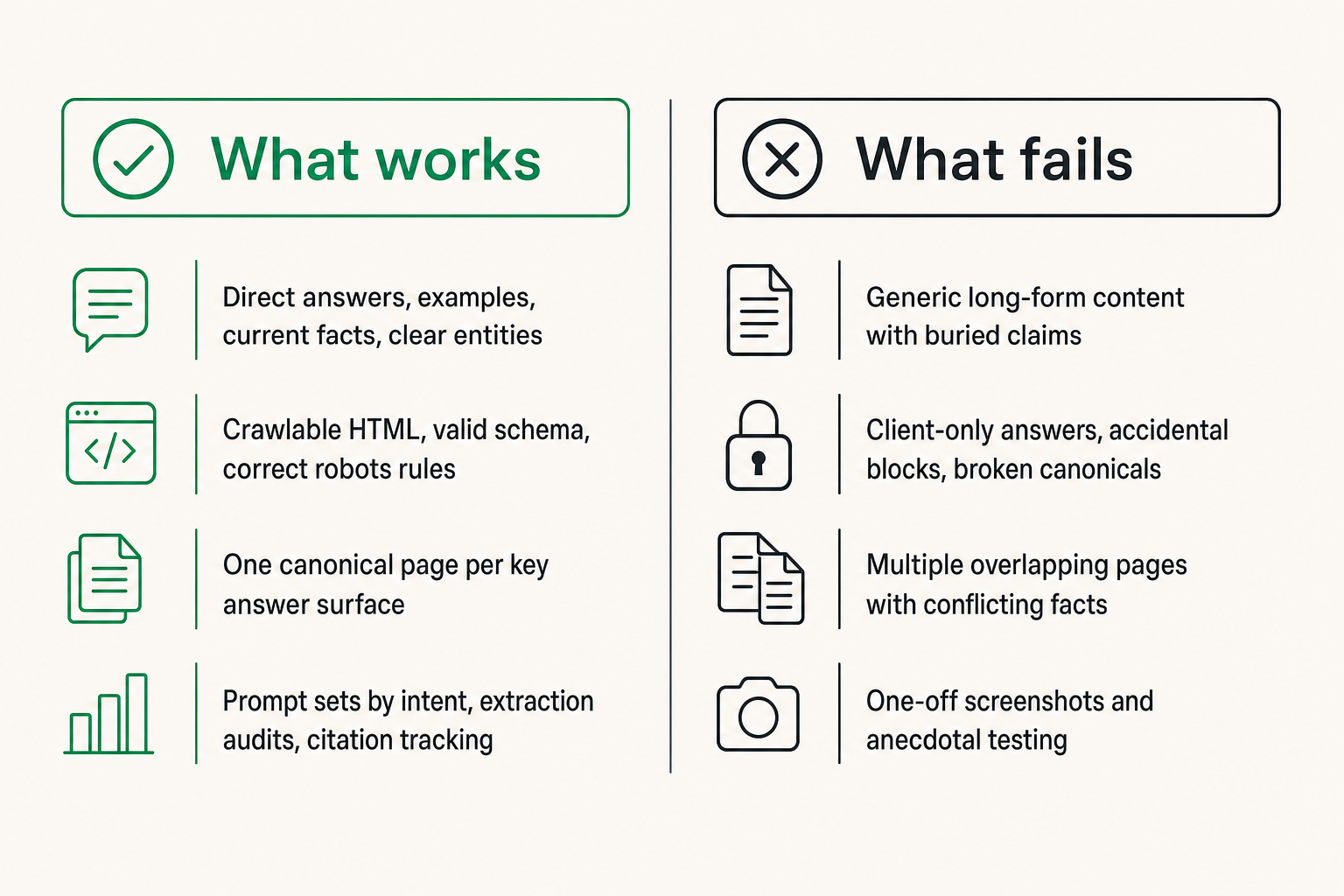
A practical neural engine strategy separates durable work from theater.
| Content | Direct answers, examples, current facts, clear entities | Generic long-form content with buried claims |
| Technical setup | Crawlable HTML, valid schema, correct robots rules | Client-only answers, accidental blocks, broken canonicals |
| Site architecture | One canonical page per key answer surface | Multiple overlapping pages with conflicting facts |
| Measurement | Prompt sets by intent, extraction audits, citation tracking | One-off screenshots and anecdotal testing |
| Governance | Named owners and refresh cadence | Everyone assumes SEO owns everything |
| AI files | Curated llms.txt guidance linked to canonical sources | Treating llms.txt as a magic ranking file |
The table is not complicated because the work is not conceptually complicated. It is operationally difficult because it crosses content, SEO, engineering, product, and brand.
Decision rules for operators
Use these rules when prioritizing work:
- If a page cannot be crawled, fix access before rewriting copy.
- If a page can be crawled but not understood, fix structure and schema.
- If a page is understandable but not trusted, improve specificity, provenance, and consistency.
- If a page is trusted but not cited, compare it against cited sources and strengthen the answer surface.
- If a page is cited with the wrong facts, clean up stale or conflicting site content.
Practical rule: Treat every missing citation as a debugging problem, not a branding insult.
This is the mindset shift. You are not trying to trick a neural engine. You are reducing uncertainty for systems that decide what information is safe to reuse.
Implementation checklist for website teams
Assign real owners
AEO fails when everyone assumes someone else owns it. SEO owns rankings. Content owns articles. Engineering owns templates. Brand owns positioning. Legal owns claims. No one owns whether an answer engine can extract and cite the site correctly.
Assign ownership by layer:
- SEO or growth: intent map, query coverage, competitor citation review.
- Content: answer quality, freshness, examples, editorial updates.
- Engineering: rendering, robots, schema implementation, performance.
- Product marketing: positioning, category language, comparison claims.
- Leadership or founder: final source-of-truth decisions on brand facts.
This does not require a new department. It requires explicit responsibility.
Create a weekly AEO cadence
A useful weekly workflow looks like this:
- Review crawl and extraction issues for priority URLs.
- Test a fixed prompt set across important answer engines.
- Log mentions, citations, missing sources, and wrong facts.
- Pick three pages to improve based on business impact.
- Update content, schema, internal links, or access rules.
- Re-test after changes are live.
- Document what changed and what improved.
Keep the loop small enough to run. AEO programs fail when teams create a huge spreadsheet and never ship fixes.
Give developers concrete tasks
Developers do not need vague requests like make us visible in AI. They need tickets that are testable.
Good engineering tickets:
- Add Article schema to blog templates with headline, datePublished, dateModified, author, publisher, and mainEntityOfPage.
- Ensure product description renders in server-side HTML.
- Add Organization schema with sameAs links and consistent company name.
- Expose important guide pages in footer or hub navigation.
- Fix canonical tags on comparison pages.
- Add llms.txt with curated canonical URLs.
- Remove accidental noindex from resource pages.
This turns AEO from a strategy deck into shipped work.
Product fit: auditing your neural engine surface
When an audit helps
A neural engine audit helps when you need to know what machines can actually see, not what your CMS preview shows.
It is especially useful when:
- You redesigned the site and AI referrals dropped.
- Your brand is missing from answer engines despite strong SEO.
- Competitors are cited for topics where you have better expertise.
- Your schema exists but does not match visible content.
- Your robots rules were edited without AEO review.
- You have many old pages with stale positioning.
The goal is not to generate a generic score. The goal is to identify which layer of the pipeline is failing.
How CrawlProof fits
CrawlProof is built for site owners and marketers who need to see their pages the way AI crawlers and answer engines may see them. It audits access, content extraction, schema markup, robots behavior, AI-bot readiness, and answer-engine positioning.
That matters because the hidden failure is often not content quality. It is mismatch: the page humans discuss internally is not the page machines can extract externally.
A practical audit gives teams a shared object to work from. Content can see what text is extracted. Developers can see what directives or rendering choices block access. Marketers can see whether the page clearly supports the answer surface they care about.
The same architectural lesson appears in other technical workflows: the visible UI is rarely the whole system. In payments, for example, checkout screens matter, but state, reconciliation, settlement, and failure handling are where operations succeed or break. Related reading from our network: crypto checkout architecture for high-risk merchants.
AEO has the same shape. The answer result is visible. The operating system behind it is crawl access, extraction, structured data, content evidence, and measurement.
Operating the neural engine loop in 2026
What to do this week
If you want a practical starting point, do this in order:
- Pick ten URLs that matter commercially.
- Confirm each one is crawlable, indexable, canonical, and accessible to the bots you care about.
- Extract the visible text and compare it with what a human sees.
- Validate schema against the actual page content.
- Write one direct answer near the top of each page.
- Add or update date, author, publisher, and entity signals where appropriate.
- Test five prompts per intent bucket and log citations.
- Fix the highest-impact blocker before creating new content.
This is not hype work. It is maintenance for a web where machines increasingly mediate discovery.
The neural engine does not need your site to be clever. It needs your site to be accessible, specific, consistent, and useful as evidence. Build that loop and you give answer engines fewer reasons to ignore you.
Try crawlproof.com
CrawlProof helps site owners and marketers understand how AI answer engines and LLM crawlers discover, extract, and cite their content. Try crawlproof.com