Most website teams still debug AI visibility like old SEO. They change a title tag, add a schema block, publish three FAQ answers, then wait for an answer engine to cite them.
That is too linear. Nonlinear optimization is a better operating model for AEO because AI answer engines do not reward one isolated input. They combine crawl access, content clarity, entity confidence, structured data, freshness, authority, and retrieval context. One weak part can suppress the whole system.
Teams think the problem is ranking for a keyword. The real problem is becoming a reliable source inside a machine-mediated answer workflow.
That changes the conversation. The practical question is not “What is the one AEO tactic?” It is “Which constraints are preventing AI crawlers and answer engines from discovering, understanding, trusting, and citing this page?”
Table of contents
Why nonlinear optimization fits AEO in 2026

AEO is not just SEO with a new acronym. Search engines traditionally returned links. Answer engines synthesize responses. That means your page is not only competing for position; it is competing to be extracted, compressed, compared, and cited.
In that environment, nonlinear optimization means improving an interconnected system where small changes can have outsized effects, and big changes can do nothing if they target the wrong constraint.
AI visibility is not one variable
A page can be technically crawlable but semantically vague. It can have strong expertise but weak schema. It can be well written for humans but difficult for a model to extract because the answer is buried after a long intro.
A useful way to think about it is this: answer engines need enough confidence to use your content inside an answer. Confidence is assembled from signals, not granted by one tag.
Common signal categories include:
- Crawl permissions and bot access
- Rendered HTML availability
- Page speed and server reliability
- Clear entity naming
- Direct answers to answerable questions
- Consistent schema markup
- Internal links that establish topical relationships
- External references and citations
- Freshness where freshness matters
- Brand and author credibility
If any one layer is badly broken, improving another layer may not move the outcome.
The constraint usually moves
The mistake teams make is assuming last quarter's bottleneck is still the bottleneck.
Early on, the problem may be that AI crawlers cannot access important pages. After that is fixed, the problem may shift to weak extraction. Once extraction improves, the problem may become lack of authority or unclear differentiation.
Practical rule: optimize the current constraint, not the most fashionable tactic.
This is why nonlinear optimization matters. You are not climbing a straight ladder. You are operating a system where the limiting factor changes as the system improves.
Related reading from our network: teams building independent service businesses face a similar stack problem in best freelance websites for beginners in 2026, where visibility depends on proof, platform workflow, proposals, and repeat-client mechanics rather than one profile field.
The AEO system has multiple dependent layers
AI answer engines make decisions through a pipeline. The exact pipeline varies by platform, but the practical layers are familiar: discover, crawl, parse, understand, retrieve, synthesize, cite.
If you only optimize the visible page copy, you are entering halfway through the pipeline and hoping the upstream steps worked.
Crawl access is the first gate
Before an answer engine can cite you, a crawler or retrieval system has to reach useful content. This sounds basic, but in production many sites accidentally hide their best material from non-Google crawlers.
Things that break access include:
- Robots rules that block AI-related user agents without intention
- JavaScript-only content with poor server-rendered fallback
- Paywalls or modals that obscure the answer
- CDN rules that challenge unfamiliar bots
- Canonicals pointing away from the actual source page
- Broken sitemap coverage
- Slow or unreliable responses under bot traffic
AEO starts with availability. If the model cannot fetch the page cleanly, the rest is theory.
Access is necessary but not sufficient. The answer engine must also extract the right claims.
Extraction improves when pages have:
- Clear headings that match real questions
- Short answer blocks near the relevant heading
- Definitions where definitions are useful
- Tables for comparisons
- Lists for steps, requirements, and tradeoffs
- Named entities used consistently
- Schema that reinforces the visible content
Poor extraction often looks like “we published the answer, but AI tools cite a competitor.” In many cases, the competitor simply made the answer easier to retrieve and quote.
For background on the shift from classic search intent to answer inclusion, see our guide to what AEO is and why it is not just SEO.
Nonlinear optimization starts with constraints
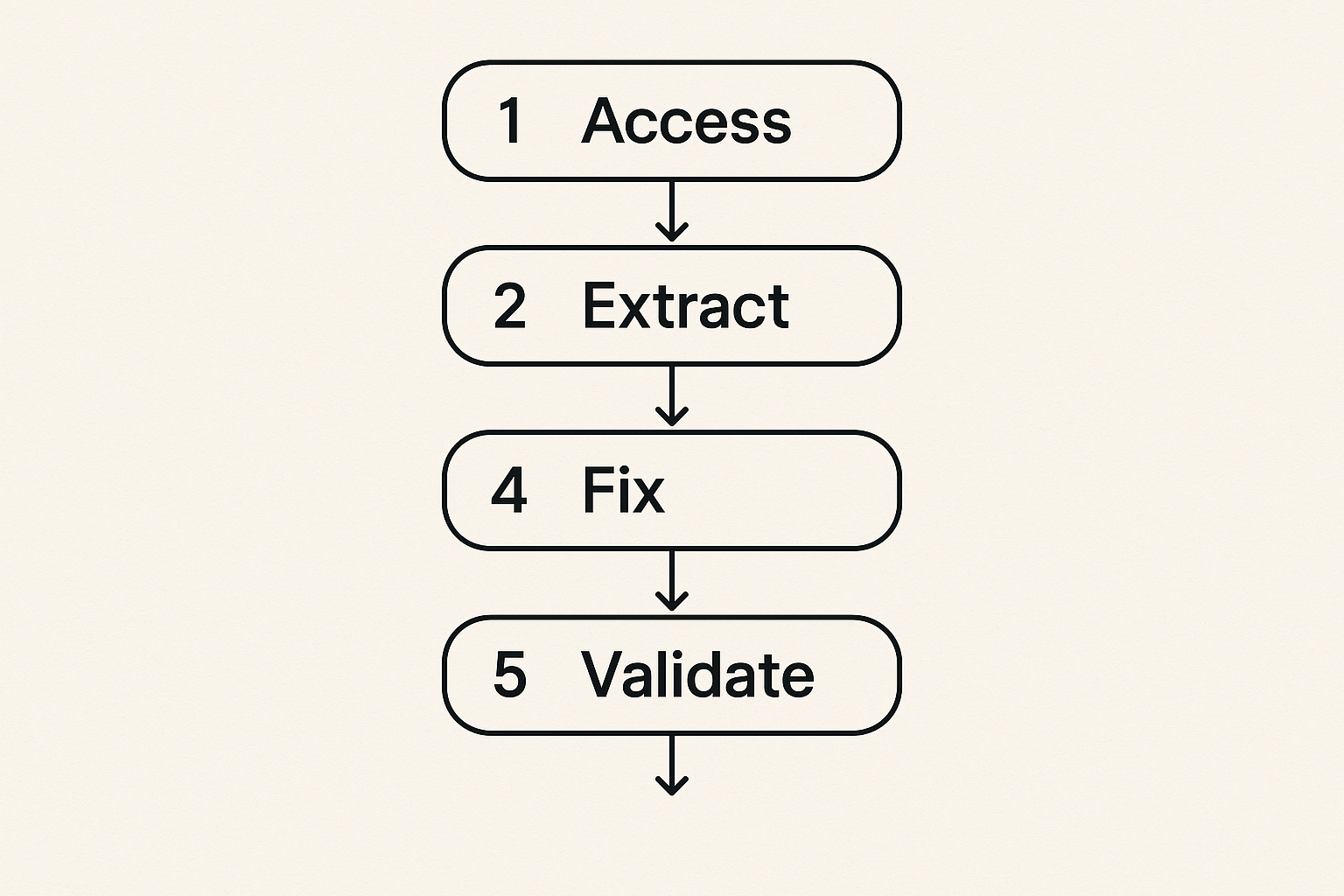
Nonlinear optimization is not permission to change everything at once. It is the opposite. It forces you to identify which constraint is currently limiting the system.
In AEO, the constraint is usually one of four things: discoverability, extractability, credibility, or usefulness.
Find the bottleneck before changing content
Before rewriting a page, ask four questions:
- Can AI crawlers access the page without special handling?
- Can a machine extract the main answer in seconds?
- Does the page provide enough evidence to be trusted?
- Is the page clearly better than generic summaries already available?
If the answer to the first question is no, do not start with copywriting. If the answer to the second is no, do not start with backlinks. If the answer to the third is no, do not start with more FAQs.
Practical rule: do not optimize a downstream signal while an upstream gate is failing.
That single rule saves teams from a lot of busywork.
Treat pages as systems, not documents
A page is not just text. It is a bundle of signals delivered through infrastructure.
A high-performing AEO page usually includes:
- A stable URL
- A crawlable HTML response
- A clear title and meta description
- A direct answer section
- Supporting explanation
- Structured data
- Internal links to related source pages
- External references where useful
- Author or organization context
- Last updated information if relevant
The page's job is not to “sound optimized.” Its job is to reduce ambiguity for a crawler, retriever, model, and human evaluator.
Build an AEO signal map before you optimize
Most teams do not need more random changes. They need a signal map.
A signal map is a simple inventory of what an answer engine can see, infer, and trust about a page. It gives SEO, content, and engineering teams one shared operating view.
Map the signals answer engines can inspect
Start with a table like this:
| Access | robots.txt, CDN, status codes | AI bots blocked unintentionally | Developer |
| Rendering | HTML source, rendered DOM | Core answer only appears after JS | Developer |
| Structure | headings, tables, lists | Answer buried in prose | Content strategist |
| Semantics | entities, definitions, schema | Inconsistent terminology | SEO or content |
| Trust | author, evidence, citations | Unsupported claims | Editorial |
| Routing | sitemap, llms.txt, internal links | Key pages not surfaced | SEO or developer |
| Measurement | logs, prompts, answer checks | No feedback loop | Operator |
This makes the work concrete. You can assign ownership instead of debating abstract “AI optimization.”
Separate source signals from presentation signals
Source signals are the things answer engines can use to understand and validate content. Presentation signals are the things humans see in the browser.
Both matter, but they are not the same.
For example:
- A beautiful interactive pricing calculator may be useful for humans but invisible to a crawler.
- A well-structured comparison table may look plain but be easy for a model to parse.
- A long brand story may improve trust for readers but weaken extraction if it delays the answer.
What breaks in practice is that teams optimize the presentation layer and assume the source layer came along for free. It often does not.
Related reading from our network: local community platforms have the same source-versus-interface problem; Mighty Networks alternatives for local communities looks at how trust, routing, and follow-up matter more than the surface UI.
What works in nonlinear optimization for AEO
Nonlinear optimization works when teams change the part of the system that is actually limiting answer inclusion.
That usually means boring, high-leverage improvements before flashy ones.
Improve the weakest useful layer
A weak layer is not always the layer with the lowest score. It is the layer that, if improved, would unlock the next step in the pipeline.
Use this comparison:
| Add more content to target more queries | Improve extractability of pages already close to being cited |
| Optimize every page the same way | Identify the current constraint per page type |
| Treat schema as a checklist | Use schema to reinforce visible claims |
| Measure only rankings | Measure crawl access, answer inclusion, and citation quality |
| Publish first, debug later | Validate crawler visibility before and after publishing |
Practical rule: the highest-leverage fix is the smallest change that removes the current bottleneck.
Sometimes that is a rewrite. Sometimes it is a robots rule. Sometimes it is adding a table. Sometimes it is changing one vague heading into a question a buyer actually asks.
Use small controlled changes
AEO is still an emerging field. Pretending every causal relationship is perfectly measurable is not honest. The better approach is controlled iteration.
Change one or two meaningful things at a time:
- Move the direct answer closer to the heading
- Add an explicit definition
- Add
FAQPage or Article schema where appropriate - Add an llms.txt entry for important resources
- Clarify author or organization context
- Improve internal links from related pages
Then observe logs, crawl behavior, AI answer outputs, and referral patterns. You will not get perfect attribution, but you will get directional evidence.
What fails when teams optimize linearly
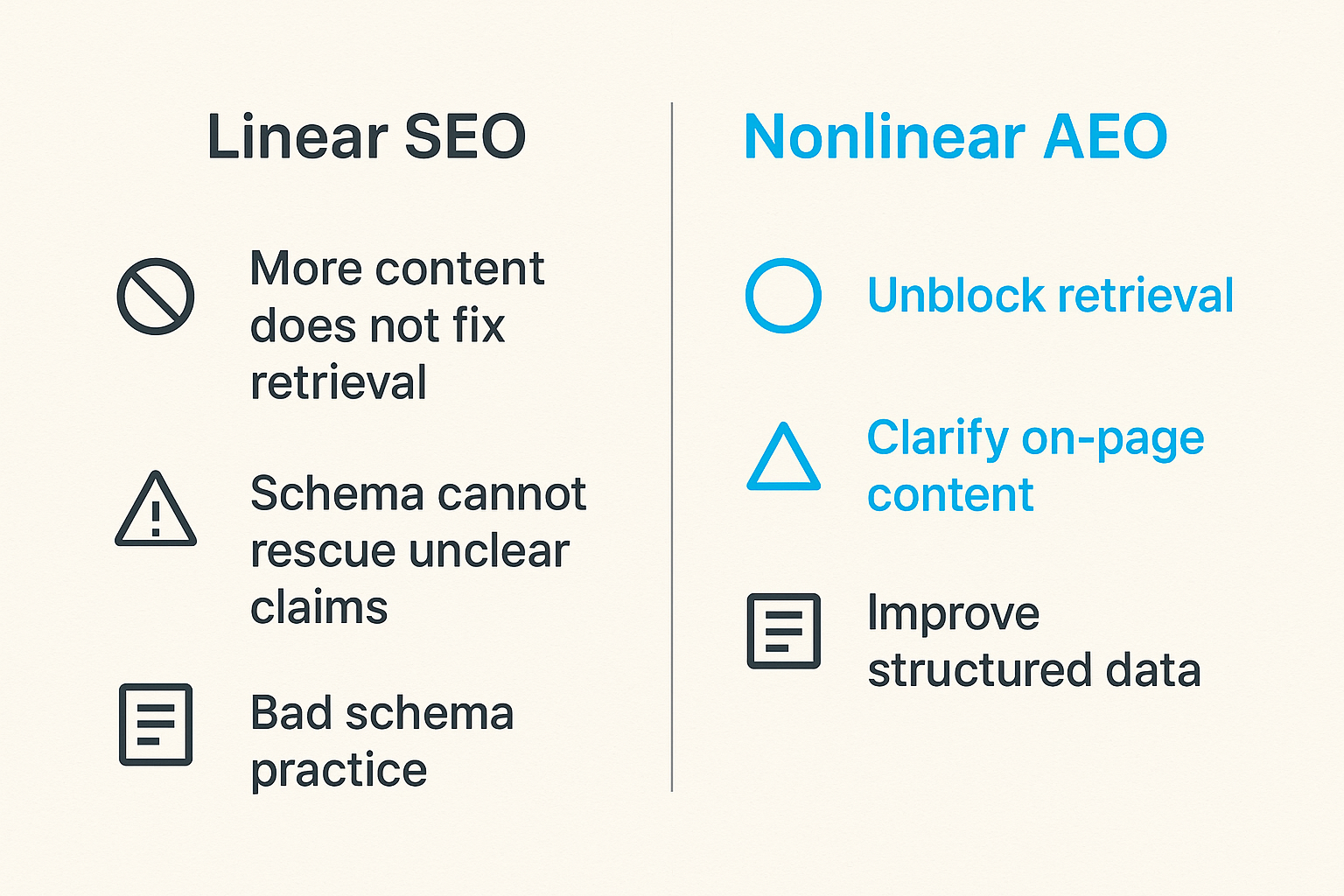
Linear optimization feels productive because it creates visible work. The team can say it published pages, added schema, or produced a prompt-testing spreadsheet.
But the system may not improve.
More content does not fix blocked retrieval
If AI crawlers cannot reliably access your content, publishing more pages just creates more inaccessible inventory.
This failure mode shows up often on sites with:
- Aggressive bot protection
- JavaScript-heavy content shells
- Inconsistent canonical tags
- Poor sitemap hygiene
- Staging rules accidentally deployed to production
The content team sees output. The answer engine sees little or nothing.
The mistake teams make is treating publishing velocity as a substitute for retrieval quality.
Schema cannot rescue unclear claims
Schema is not magic. It helps machines interpret what is already present. It should not be used to claim things the page does not clearly support.
Bad schema practice includes:
- Marking thin content as expert guidance
- Adding FAQ schema for questions not visible on the page
- Using inconsistent organization names
- Repeating generic descriptions across many pages
- Treating schema validation as the same thing as semantic clarity
If a page does not make a clear, useful claim, structured data will not turn it into a reliable source.
For the routing side of this problem, our explainer on llms.txt and skill.md covers how emerging files can point AI systems toward the resources you actually want them to inspect.
A practical nonlinear optimization workflow
Nonlinear optimization becomes useful when it becomes an operating workflow. Otherwise it is just a clever phrase.
The goal is to turn AEO work into a repeatable loop: inspect, diagnose, change, validate, and repeat.
Run the workflow page by page
Use this sequence for any commercially important page:
- Select the page and target answer use case. Define the question or task where you want the page cited.
- Check crawler access. Inspect robots rules, status codes, canonical tags, rendered HTML, and bot protection behavior.
- Extract the main answer manually. If a human cannot find the answer quickly, a model may struggle too.
- Inspect structure. Review headings, tables, lists, summaries, and schema alignment.
- Identify the constraint. Decide whether the bottleneck is access, extraction, trust, or usefulness.
- Make one focused fix. Do not rewrite the whole page unless the constraint is page quality itself.
- Validate after deployment. Recheck source, rendered page, schema, logs, and answer outputs.
- Record the result. Keep a changelog so future teams know what changed and why.
This is not glamorous, but it is how you avoid random optimization.
Prioritize fixes by dependency order
Dependency order matters. Fixing trust before access is like polishing a locked storefront.
A practical priority order is:
- Access
- Renderability
- Extractability
- Semantic clarity
- Trust support
- Routing and internal discovery
- Measurement and iteration
There are exceptions, but this order prevents the most common waste.
Here is a simple config-style checklist teams can adapt:
AEO_PAGE_REVIEW
url: /example-page
answer_use_case: "best option for X"
access_status: pass | fail
rendered_answer_visible: pass | fail
schema_matches_content: pass | fail
entity_names_consistent: pass | fail
trust_evidence_present: pass | fail
llms_txt_routed: pass | fail
current_constraint: access | extraction | trust | usefulness
next_fix_owner: seo | content | dev | editorial
Related reading from our network: remote teams face comparable handoff problems when control is shared across roles; Vizio remote control lessons for remote team workflows is a useful adjacent lens on permissions, ownership, and support paths.
Measurement without pretending attribution is perfect
AEO measurement is messy. Answer engines vary by user, prompt, geography, freshness, and model version. If someone promises clean last-click attribution for every AI citation, be skeptical.
The practical question is not whether measurement is perfect. It is whether your feedback loop is good enough to improve decisions.
Track leading indicators
Leading indicators tell you whether the system is becoming easier to discover and cite.
Useful indicators include:
- Important URLs accessible to known AI-related crawlers
- Clean server responses for crawler requests
- Pages included in sitemap and llms.txt where appropriate
- Schema validity and schema-content alignment
- Presence of direct answer blocks
- Consistent entity naming across pages
- Internal links from related topical pages
- Brand mentions in AI answers, even without links
- Citations to your domain in answer outputs
Do not treat any single metric as the truth. Look for convergence across signals.
Watch answer inclusion patterns
Prompt testing has value, but only if you treat it as sampling, not absolute truth.
Track patterns such as:
- Which competitors are cited repeatedly
- Whether your page is mentioned but not linked
- Whether answer engines summarize your claims correctly
- Whether stale pages appear instead of updated pages
- Whether your brand is used for informational answers but not commercial recommendations
That changes the conversation from “Did we rank?” to “Where in the answer workflow are we losing confidence?”
Technical implementation details that matter
Technical AEO is not about adding every new file or markup type because someone posted about it. It is about making your source layer legible to systems that retrieve and synthesize information.
Use llms.txt as a routing layer
An llms.txt file is not a guaranteed ranking lever. Treat it as routing documentation for AI systems that choose to inspect it.
A simple version might look like this:
# Example Company

## Key resources
- https://example.com/guides/main-topic
- https://example.com/docs/product-overview
- https://example.com/pricing
- https://example.com/about

## Preferred summaries
- https://example.com/ai-summary.md

## Contact
- https://example.com/contact
The value is not the file alone. The value is the discipline of deciding which pages best represent your expertise.
Make schema match visible content
Schema should reduce ambiguity. It should not introduce claims that are absent from the page.
Good implementation practices:
- Use
Organization, Article, FAQPage, Product, or SoftwareApplication only where appropriate - Keep names, URLs, and descriptions consistent
- Include dates when freshness matters
- Mark up authors when authorship is meaningful
- Avoid boilerplate schema copied across unrelated pages
- Validate output after deployment, not just before merge
Practical rule: structured data should confirm the visible page, not compensate for it.
When schema, visible copy, internal links, and llms.txt point in the same direction, answer engines have less ambiguity to resolve.
Nonlinear optimization is easier when the team can see the page the way an AI crawler sees it. Otherwise, AEO discussions turn into opinions.
CrawlProof is built for site owners, marketers, content teams, and developers who need to understand what AI answer engines and LLM crawlers can actually find, and what they miss.
Audit what AI crawlers can actually see
The useful audit questions are operational:
- Can AI-related crawlers access the page?
- What content is visible in the source and rendered output?
- Is schema present and aligned?
- Are robots rules helping or blocking the intended workflow?
- Are important pages discoverable through routing signals?
- Does the page make a clear answer-worthy claim?
This is where nonlinear optimization becomes practical. Instead of arguing whether to add more content or more markup, you inspect the system and identify the active constraint.
Turn findings into an operating loop
AEO should not be a one-time cleanup. It should become part of publishing and maintenance.
A simple operating loop looks like this:
- Audit priority URLs before major content changes.
- Fix access and rendering issues first.
- Improve extraction with clearer structure.
- Align schema and routing files.
- Re-audit after deployment.
- Monitor answer inclusion and crawler behavior over time.
That is nonlinear optimization applied to real website operations: remove the current bottleneck, validate, then move to the next constraint.
The closing point is simple. Nonlinear optimization is not a buzzword for AEO. It is the only honest way to work on a system where crawl access, semantic clarity, trust, and answer inclusion depend on each other.
Try crawlproof.com
CrawlProof helps site owners and marketers see how AI answer engines and LLM crawlers discover, interpret, and cite their content. Try crawlproof.com.