A developer searches for open dynamics engine examples because they need something that works now: a collision demo, a rigid body setup, a joint configuration, a compileable starting point. A website owner sees the keyword and thinks the job is to publish a few snippets and hope Google, ChatGPT, Perplexity, or another answer engine sends traffic.
Teams think the problem is content coverage. The real problem is example architecture.
If your examples are buried in a JavaScript app, split across tabs, missing version context, blocked by robots rules, or written as vague tutorial prose, answer engines may understand that you have a page about the topic but still avoid citing it. That changes the conversation. The practical question is not simply whether you rank for open dynamics engine examples. It is whether an AI system can discover, parse, trust, summarize, and cite the example without inventing the missing parts.
A useful way to think about it is this: technical examples are supply chain assets for answer engines. The UI is only one surface. The real system is the URL structure, the text surrounding the code, the metadata, the crawl policy, the maintenance workflow, and the validation loop.
Table of contents
Why open dynamics engine examples are an AEO architecture problem
The keyword is a system test
Open Dynamics Engine, usually shortened to ODE, is a physics engine used for rigid body dynamics, collision detection, joints, contacts, and simulations. Searches for open dynamics engine examples are usually not casual. They come from someone implementing or debugging a system.
That makes the keyword a useful test case for Answer Engine Optimization. If an answer engine is going to cite your content, it needs more than a paragraph that says ODE supports rigid body simulation. It needs a page that answers a concrete implementation question.
This is where many SEO habits break. Traditional content production tends to create broad guides. Example-seeking users want narrower units: one task, one environment, one working result.
If you are new to the difference, Answer Engine Optimization is best understood as optimizing for systems that synthesize answers and choose citations, not just systems that list blue links.
Answer engines do not experience your site like a loyal reader. They crawl, segment, extract, summarize, and decide whether a passage is safe to use. With technical examples, they are implicitly asking:
- Is there a complete answer on the page?
- Is the example tied to a version or environment?
- Is the code visible in the HTML?
- Is the surrounding explanation specific enough to reduce hallucination risk?
- Is the page authoritative relative to competing sources?
The mistake teams make is treating crawlability as binary. Either the page is indexable or it is not. In practice, crawlability has layers. A crawler can fetch a page and still miss the core code example. An answer engine can understand the topic and still choose not to cite it because the example is incomplete.
Practical rule: For technical example pages, being indexed is not the same as being usable by an answer engine.
The business risk is losing the citation
For a software documentation site, developer tool, agency, consultant, or niche publisher, citations are the new qualified referral surface. If an AI answer says, use this ODE hinge joint pattern and cites someone else, that competitor becomes the trusted source for the next click.
This is not only about traffic. It is about being the source the market sees when the answer is formed. If your examples are good but hard to extract, you may have done the expensive part and lost the distribution layer.
Related reading from our network: teams building developer workflows face similar operational tradeoffs around schemas, permissions, events, and audits in editor-native agent workflows.
What the phrase open dynamics engine examples really implies
It carries multiple intents
The phrase open dynamics engine examples is broad, but the underlying needs are not. A good content architecture should split the keyword into operational intents:
- Installing or compiling ODE on a specific platform
- Creating a world, body, geom, and simulation loop
- Adding collision handling and contact joints
- Modeling hinge, slider, ball, and universal joints
- Debugging unstable simulations
- Comparing ODE to Bullet, MuJoCo, PhysX, or custom solvers
- Finding a minimal C or C++ starting point
A single page can target the broad phrase, but it should route users and crawlers to the right detail pages. If everything is on one giant article, answer engines may extract a shallow summary. If everything is split without an index, crawlers may not understand the library.
It expects runnable proof
A page that says here is how to create a box in ODE is weaker than a page that shows the minimum working loop. The user wants proof that the code can run. The answer engine wants the same thing for different reasons: complete examples reduce the chance of giving a broken answer.
A minimal example should state:
- Language and binding used
- ODE version or package assumption
- Build command or dependency expectation
- What the example demonstrates
- What the example intentionally omits
- Expected output or observable behavior
For example, the prose around a code block might say:
This example creates an ODE world, adds one dynamic body, attaches a box geometry, steps the simulation, and prints the Y position for 120 frames. It omits rendering and collision callbacks so the simulation loop stays visible.
That sentence is not filler. It tells an answer engine what the code is for and what not to infer.
It needs context around the code
Code without context is risky. Context without code is weak. The useful page has both.
For open dynamics engine examples, context usually means explaining why a pattern exists. For example, contact joints are created during collision handling and destroyed after stepping the world. If the page only shows the callback, an answer engine may miss the lifecycle. If it only explains the lifecycle, the user still has to reconstruct the implementation.
Practical rule: The more procedural the topic, the more each code block needs a plain-language contract before and after it.
Build the page like a crawlable example library
Separate overview, index, and example detail pages
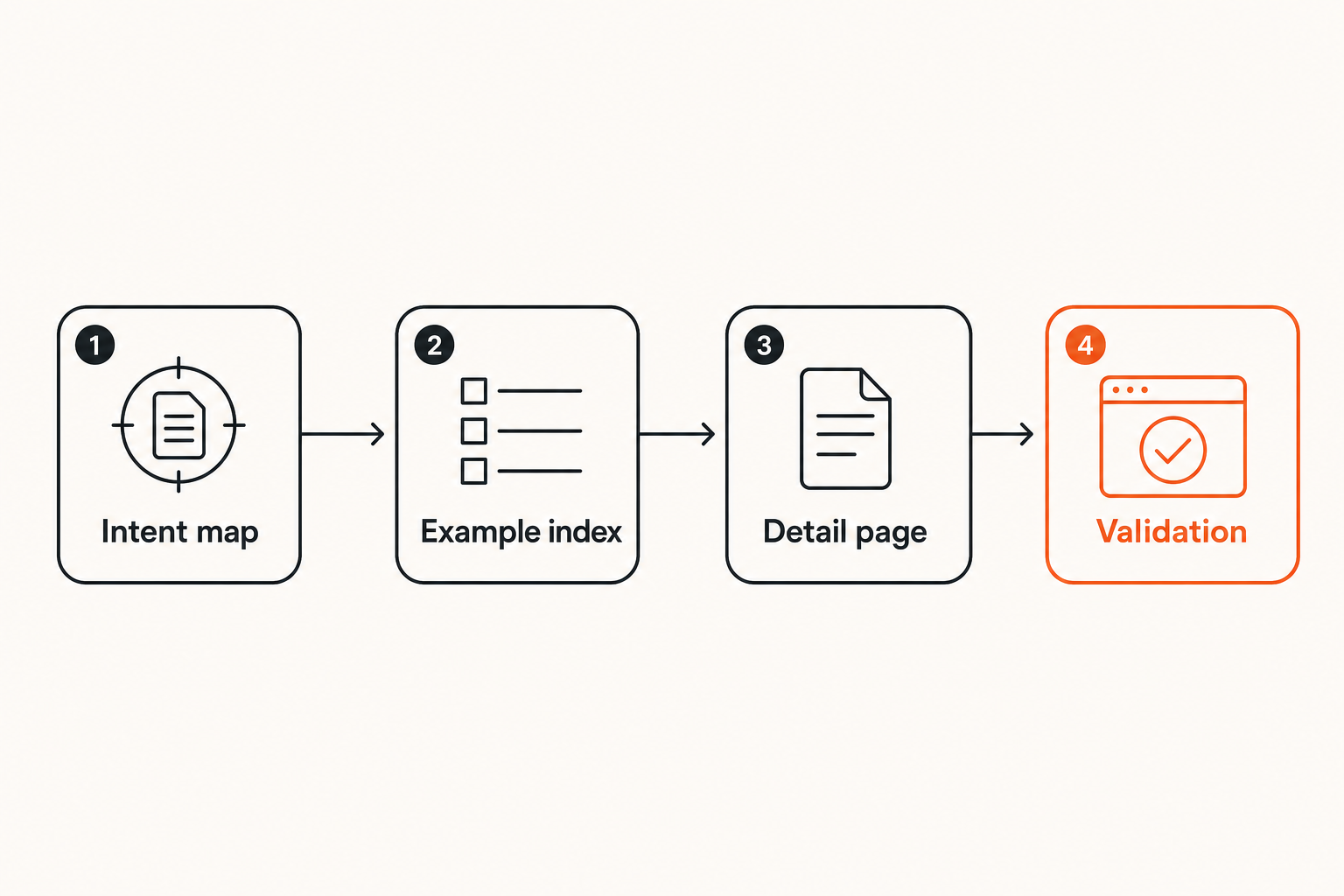
The best structure is usually not one massive guide. It is a small library:
- An overview page that explains what the library covers.
- An index page that lists examples by task.
- Detail pages where each example solves one problem.
- Optional comparison pages for alternatives and tradeoffs.
For example:
/examples/open-dynamics-engine/
/examples/open-dynamics-engine/basic-world/
/examples/open-dynamics-engine/box-body/
/examples/open-dynamics-engine/collision-callback/
/examples/open-dynamics-engine/hinge-joint/
/examples/open-dynamics-engine/unstable-simulation-debugging/
This is not just tidy information architecture. It creates clean citation targets. An answer engine can cite the hinge joint page for a hinge question instead of citing a generic ODE guide that mentions hinges once.
Use stable URLs and descriptive titles
Stable URLs matter because examples age. If you change slugs every time you reorganize docs, citations rot and answer engines have less reason to trust the page.
Use titles that state the job:
- Open Dynamics Engine basic world example in C
- Open Dynamics Engine collision callback example
- Open Dynamics Engine hinge joint example with anchor and axis
- Debugging unstable Open Dynamics Engine simulations
Avoid titles that only make sense inside your site, such as Part 3: Contacts or Tutorial 7. Those may work for humans in sequence, but they are weak standalone answers.
Make each example independently answerable
Each detail page should work as a self-contained answer. That does not mean duplicating your entire documentation set. It means including enough local context so the page can be quoted without sending the user on a scavenger hunt.
A strong example page includes:
- A short summary answer at the top
- Prerequisites
- Complete code or a clearly marked excerpt
- Build or run instructions
- Explanation of important lines
- Common mistakes
- Links to adjacent examples
- Last updated date
Related reading from our network: this is similar to why streaming products cannot be reduced to a play button; the real system is ingest, delivery, permissions, and reconciliation, as explained in streaming SaaS architecture.
Write examples that answer engines can quote safely
Put the answer before the explanation
Many technical writers bury the useful answer under history, disclaimers, and conceptual framing. That is risky in answer engines. The top of the page should give the direct answer first.
A good opening for an ODE example page might be:
To create a basic Open Dynamics Engine simulation, initialize ODE, create a world, add a body, assign a mass, attach a geometry, then call dWorldStep or dWorldQuickStep inside a loop. The example below uses C and omits rendering so the simulation lifecycle is clear.
This gives the answer engine a clean extractable passage. Then the page can go deeper.
The same rule applies outside physics engines. If you publish API examples, schema examples, analytics examples, or crawler configuration examples, the first section should make the implementation path obvious.
Keep code blocks complete and small
Answer engines are better at using code when the example is complete enough to stand alone and small enough to summarize. Huge files create noise. Tiny fragments create ambiguity.
Aim for a middle ground:
#include <ode/ode.h>
#include <stdio.h>

int main(void) {
    dInitODE();

    dWorldID world = dWorldCreate();
    dWorldSetGravity(world, 0, -9.81, 0);

    dBodyID body = dBodyCreate(world);
    dMass mass;
    dMassSetBox(&mass, 1.0, 1.0, 1.0, 1.0);
    dBodySetMass(body, &mass);
    dBodySetPosition(body, 0, 10, 0);

    for (int i = 0; i < 120; i++) {
        dWorldStep(world, 0.016);
        const dReal *pos = dBodyGetPosition(body);
        printf("%d %f\n", i, pos[1]);
    }

    dWorldDestroy(world);
    dCloseODE();
    return 0;
}
That block is not a full application. It is a clear example. The page should then explain the lifecycle: initialize ODE, create world, configure gravity, create body, set mass, step simulation, destroy resources.
Add constraints, versions, and failure notes
What breaks in practice is not usually the basic happy path. It is the missing constraints.
For ODE examples, note whether the code assumes:
- ODE installed from system packages or source
- C or C++ compilation
- Single precision or double precision build
- No rendering loop
- No collision space
- Fixed timestep
- Specific compiler flags
Failure notes are especially valuable because answer engines can use them to avoid unsafe generalizations. Add a section such as:
Common failure: If the body does not move, confirm that the simulation loop calls dWorldStep and that gravity is set on the world. Creating a body and mass is not enough; the world must be stepped.
Practical rule: Every technical example should say what it demonstrates, what it omits, and what commonly breaks.
Mark up the page without overclaiming
Schema will not rescue a weak page, but it can help machines understand the page type and relationships. For example pages, consider structured data that reflects the actual asset:
- Article or TechArticle for the explanatory page
- SoftwareSourceCode where a page contains a code example
- BreadcrumbList for library hierarchy
- FAQPage only if the visible page really has questions and answers
A simplified JSON-LD pattern might look like this:
{
  "@context": "https://schema.org",
  "@type": "TechArticle",
  "headline": "Open Dynamics Engine collision callback example",
  "about": "Open Dynamics Engine",
  "programmingLanguage": "C",
  "dateModified": "2026-08-05"
}
Do not stuff schema with claims the page does not support. If the page is a thin overview, marking it like a complete source code example only creates mismatch.
Use llms.txt as a routing layer
Emerging files such as llms.txt can help point AI crawlers toward the content you want them to evaluate. They are not magic ranking files. They are routing and summarization aids.
For an example library, a simple llms.txt entry might describe the library and link to the index:
# Example library
- Open Dynamics Engine examples: /examples/open-dynamics-engine/ - C examples for ODE worlds, bodies, collision callbacks, and joints.
If you are deciding what belongs in those files, our explainer on llms.txt and skill.md covers the practical difference between publishing crawler-facing summaries and publishing executable or agent-facing instructions.
Keep robots policy aligned with your goal
Many teams accidentally ask for citations while blocking the crawlers that might generate them. Others allow everything without thinking through licensing, privacy, or support implications.
Your policy should match the business goal:
- If examples are public acquisition assets, make them fetchable.
- If examples require authentication, do not expect broad citation.
- If code has licensing restrictions, state them clearly.
- If generated pages are low quality, do not expose them just because you can.
The practical question is not allow or block in the abstract. It is which assets should answer engines be allowed to inspect, summarize, and cite.
Operational workflow for publishing example content
Start with intent mapping
AEO content operations should begin before writing. For open dynamics engine examples, map the intents into page types:
- Broad overview: what the example library covers.
- Task page: one implementation job.
- Troubleshooting page: one recurring failure mode.
- Comparison page: when to choose one pattern over another.
- Reference page: short definitions and API concepts.
This prevents the common mess where one article tries to be tutorial, reference, comparison, and support thread at the same time.
Related reading from our network: freelancers and consultants face a comparable distribution problem when they stop relying on one platform and build a channel stack, discussed in freelance websites in 2026.
Build the example asset
A practical implementation sequence looks like this:
- Pick one exact user task, such as create a hinge joint.
- Write the answer sentence before the article.
- Build or test the code in the target environment.
- Add setup assumptions and run instructions.
- Explain the important lines, not every line.
- Add failure notes and expected output.
- Add schema and internal links.
- Validate crawler-visible text and code.
- Publish with a last-updated date.
- Re-audit after dependency or API changes.
This sequence is boring in the right way. It reduces rework and makes the page easier for both humans and machines to trust.
Validate what crawlers can see
Validation is where teams often get surprised. The browser view looks fine. The crawler-visible version is missing the code. The page title is generic. The canonical points somewhere else. The code is loaded after interaction. The robots file blocks a bot that the team assumed was allowed.
Do not validate only with a visual review. Validate the fetched HTML, rendered text, structured data, canonical tags, robots policy, and crawler-specific access.
A simple internal review checklist:
- Can the raw HTML expose the summary answer?
- Can rendered output expose the code block?
- Does the canonical point to the page itself?
- Does the title include the task and technology?
- Is the example linked from an index page?
- Is the page allowed by robots policy?
- Does schema match visible content?
Common failure modes with open dynamics engine examples
The demo is invisible to crawlers
Interactive demos are useful for humans, but many are weak citation assets. If the example lives inside a canvas, a GitHub embed, a client-rendered playground, or a collapsed tab, an answer engine may not see the actual implementation.
This does not mean you should avoid interactive demos. It means the demo should be paired with crawlable text and code.
A better pattern:
- Put the complete example code in a standard code block.
- Add the interactive demo below it.
- Include a plain text explanation of what happens.
- Link to source files only as a supplement, not the primary content.
The mistake teams make is assuming the best human interface is also the best machine interface. Often it is not.
The code is too fragmented to cite
Documentation teams often split examples into tiny pieces because it feels educational. First create the world. Then later create the body. Then later add collision. That is fine inside a long tutorial, but answer engines may struggle to extract a complete answer.
If the page uses fragments, add a complete final version. Label it clearly:
Complete example
The following file combines the world setup, body creation, simulation loop, and cleanup shown above.
This gives the model a safe citation target.
The page satisfies humans but not answer engines
Humans can infer missing steps. Answer engines are more cautious when citation quality matters. A human might understand that a snippet belongs in main.c and needs ODE linked at compile time. A model may avoid citing the page because that context is absent.
What breaks in practice is the support burden. Users copy incomplete code, get errors, ask for help, and blame your docs. The same incompleteness makes the page less useful for answer engines.
Fix the page once. Make it explicit.
Measuring whether answer engines can use your examples
Track inclusion signals, not vanity rank
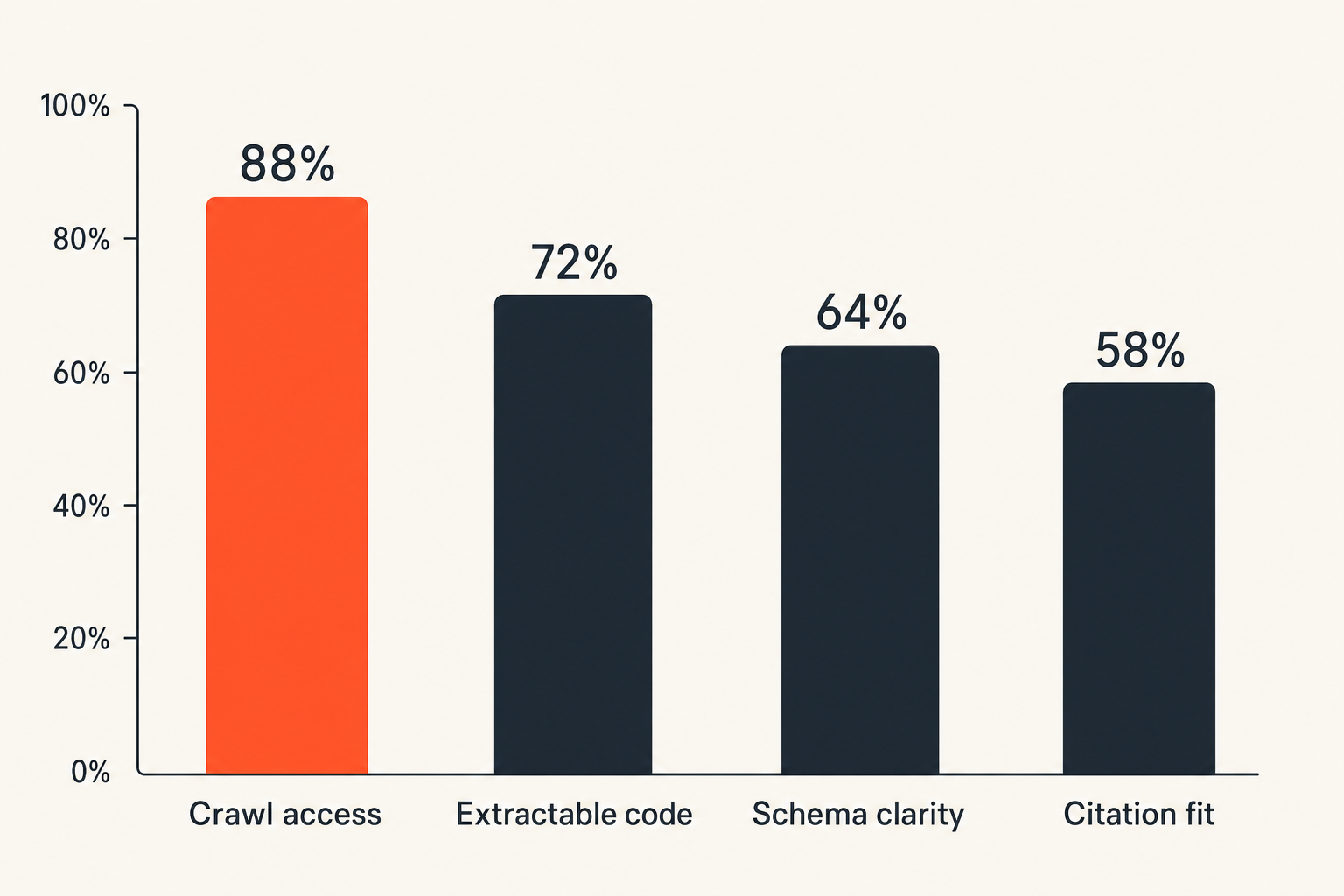
Traditional rank tracking only tells part of the story. For answer engines, measure whether your content appears in answers, summaries, citations, and generated recommendations.
Useful signals include:
- Your page appears as a cited source for task-specific prompts.
- The answer engine quotes or paraphrases your summary accurately.
- The cited URL is the detail page, not only the homepage.
- The answer includes correct version or environment context.
- The model does not confuse your example with a competitor example.
Do not overfit to one tool on one day. Answer outputs vary. Look for directional evidence across prompts and engines.
Compare crawlable content to rendered content
The most practical audit is side-by-side comparison:
- What a user sees in the browser
- What a crawler can fetch in HTML
- What a rendered crawler can extract
- What structured data claims
- What robots policy permits
If those five layers disagree, answer engines may behave unpredictably.
For example, a page title might say Open Dynamics Engine collision example while the visible H1 says Physics demo. Schema might call it a TechArticle, but the code is in an iframe. Robots might allow Googlebot and block GPTBot. None of those issues alone is mysterious. Together, they create ambiguity.
Review citations and answer snippets manually
Manual review still matters. Ask task-oriented prompts such as:
Show me a minimal Open Dynamics Engine C example that creates a world and steps a body.
How do I add a hinge joint in ODE? Cite sources.
Then inspect whether the answer uses your page correctly. If the model cites you but explains the wrong thing, your page may be too broad. If it explains your page accurately but cites another source, your authority or crawl visibility may be weaker than your content quality.
Practical rule: Treat AI citations like production logs. They are imperfect, but they reveal how the system is actually behaving.
What works and what fails
What works in practice
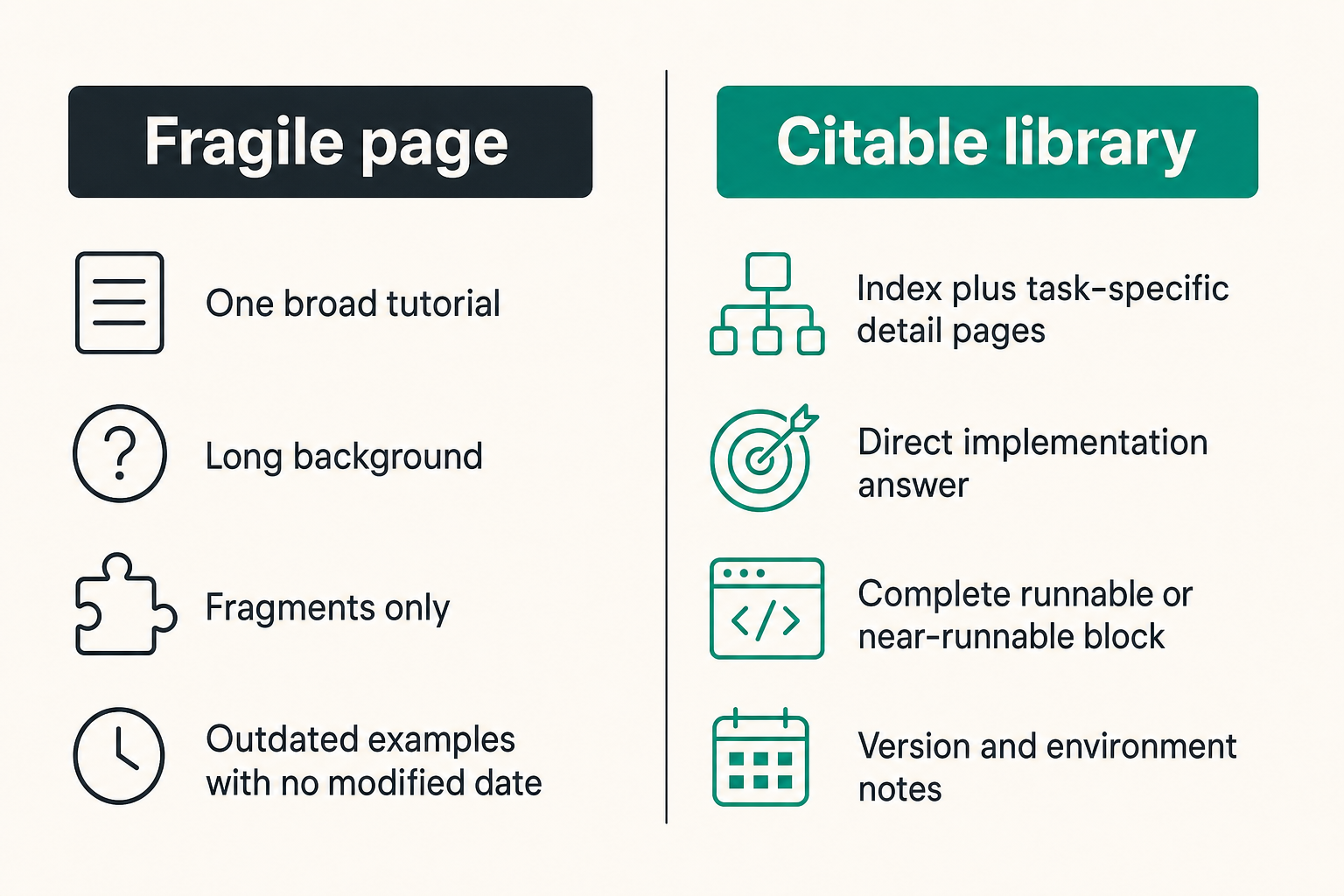
What works is not glamorous. It is disciplined documentation architecture:
- One intent per detail page
- A direct answer near the top
- Complete code examples
- Version and environment notes
- Plain HTML fallback for important content
- Accurate schema
- Clear robots and AI crawler policy
- Internal links from index to detail pages
- Maintenance when APIs or dependencies change
This gives answer engines multiple reasons to trust and cite the page. It also improves the human experience, which is the part many AEO conversations forget.
What fails in practice
What fails is usually the opposite:
- A giant guide with no extractable sections
- Snippets that depend on missing files
- Code hidden behind interactive UI
- Titles that omit the task
- Schema that does not match the visible page
- Outdated examples with no modified date
- Conflicting robots rules
- No validation after launch
Many teams publish technically correct content that is operationally invisible. The content exists. The answer engine cannot use it confidently.
A comparison table for operators
| URL structure | One broad tutorial | Index plus task-specific detail pages |
| Opening | Long background | Direct implementation answer |
| Code | Fragments only | Complete runnable or near-runnable block |
| Context | Assumed by author | Versions, constraints, expected behavior |
| Machine access | Client-only demo | Crawlable text plus optional demo |
| Schema | Missing or inflated | Accurate TechArticle or code markup |
| Maintenance | Updated when someone complains | Reviewed when dependencies change |
| Measurement | Keyword rank only | Citation, extractability, and crawl checks |
The key point is not that every page needs to be long. It is that every page needs to be operationally complete for the task it claims to answer.
Product fit: auditing example pages with crawlproof.com
Where CrawlProof fits in the workflow
CrawlProof is built for site owners and marketers who need to see what AI crawlers and answer engines can actually find on a page. For example libraries, that means checking whether the useful parts are exposed: content, schema, robots rules, AI-bot access, and positioning.
This matters because AEO problems are often invisible in the browser. Your page can look polished and still fail as a citation source. The audit lens is different: less design review, more crawler evidence.
Use CrawlProof after you have a real page to inspect, not as a substitute for writing useful examples. The tool helps surface what machines can see and what they may miss.
How to turn findings into fixes
A practical fix loop looks like this:
- Audit the example page.
- Identify missing or blocked content.
- Compare schema to visible page content.
- Check whether AI crawlers are allowed or blocked intentionally.
- Update the page structure, metadata, or robots policy.
- Re-test after deployment.
- Monitor whether answer snippets improve over time.
If the audit shows that your ODE code block is not visible, the fix is not more backlinks. It is making the code extractable. If schema is missing, the fix is accurate markup. If the title is vague, the fix is a task-specific title.
That changes the conversation from content vibes to operational evidence.
Do not use any AEO audit tool as a way to avoid editorial judgment. Tools can tell you that a page is crawlable. They cannot decide whether your example is the best explanation of a hinge joint, collision callback, or simulation loop.
You still need technical review. You still need to run the code. You still need to remove ambiguity. The tool belongs in the workflow, not above it.
Closing checklist for open dynamics engine examples
The publish checklist
Before publishing an example page, confirm:
- The title includes the task and Open Dynamics Engine or ODE.
- The first paragraph directly answers the implementation question.
- The code is visible as text, not only inside an embed.
- The example states language, version assumptions, and omissions.
- Build or run instructions are present where relevant.
- The page links back to the example index.
- Schema matches the visible content.
- Robots rules allow the crawlers you want to reach.
- The page has a stable canonical URL.
The maintenance checklist
After publishing, review periodically:
- Dependency or package changes
- Broken build commands
- Deprecated ODE APIs or bindings
- Incorrect generated snippets in answer engines
- Pages cited for the wrong intent
- Internal links to adjacent examples
- Last-modified dates and changelog notes
Technical examples decay. AEO maintenance is mostly about preventing quiet decay from becoming citation loss.
Final decision rule
If someone asks for open dynamics engine examples, your page should be able to answer without hidden assumptions. If an answer engine crawls the same page, it should be able to extract the answer, understand the constraints, and cite the correct URL.
That is the bar. Not hype. Not keyword stuffing. A crawlable, citable example system.
Try crawlproof.com
CrawlProof helps site owners and marketers understand how AI answer engines and LLM crawlers discover, interpret, and cite their content. Try crawlproof.com