Most teams notice optimization problems only after traffic gets weird. Search impressions soften, AI referrals are inconsistent, and competitors start showing up in answers for topics you covered months ago.
The first instinct is to rewrite pages. Add more FAQs. Publish more posts. Chase another checklist.
Teams think the problem is content quality. The real problem is that answer engines are operating against an architecture your team does not measure: crawler access, extracted facts, structured data, source confidence, entity clarity, freshness signals, and citation suitability.
That changes the conversation. In 2026, optimization problems are not just SEO issues. They are workflow issues between content, development, analytics, and governance. The practical question is not whether a page is good. It is whether an AI crawler can discover it, parse it, trust it, summarize it, and cite it without guessing.
Table of contents
Optimization problems are now visibility architecture problems

Why the old checklist is incomplete
Classic SEO checklists still matter. Titles, links, page speed, canonical tags, internal linking, and useful content did not become irrelevant because AI answer engines arrived. The mistake teams make is assuming those controls are enough.
A useful way to think about it is this: search engines rank pages, while answer engines assemble answers from sources. That means your page is competing not only as a destination, but as an input. The system may never send the user to your page if it can extract enough information to answer directly. Or it may cite another source because that source is easier to parse, more clearly attributed, or more current.
That does not mean you should panic and rewrite everything for bots. It means the optimization surface expanded. Your site now has to support humans, search crawlers, AI crawlers, summarizers, citation systems, and internal brand governance.
If your team is new to this shift, the cleanest starting point is understanding how answer engine optimization differs from search optimization. We cover that distinction in more detail in What is AEO, and why it is not SEO, but the operator version is simple: AEO is about making your best information discoverable, extractable, and citeable by systems that generate answers.
What AI answer engines need from a page
AI answer engines need more than good prose. They need signals that reduce uncertainty.
A page that performs well in AEO usually provides:
- Clear crawl permission for relevant AI bots
- Stable HTML that exposes core content without brittle rendering
- A direct answer to the page's primary question
- Named entities that are consistent across the site
- Structured data that matches visible content
- Freshness signals for claims that change over time
- Evidence, examples, and definitions that can be quoted safely
- Author, organization, and source context
- Internal links that connect related concepts
Practical rule: Treat every important page as both a human-facing asset and a machine-readable evidence packet.
This is where many optimization problems start. Teams publish content, but they do not package the page as a reliable source. The article may read well, but the extracted version is incomplete, ambiguous, or outdated.
Optimization problems start with crawl access
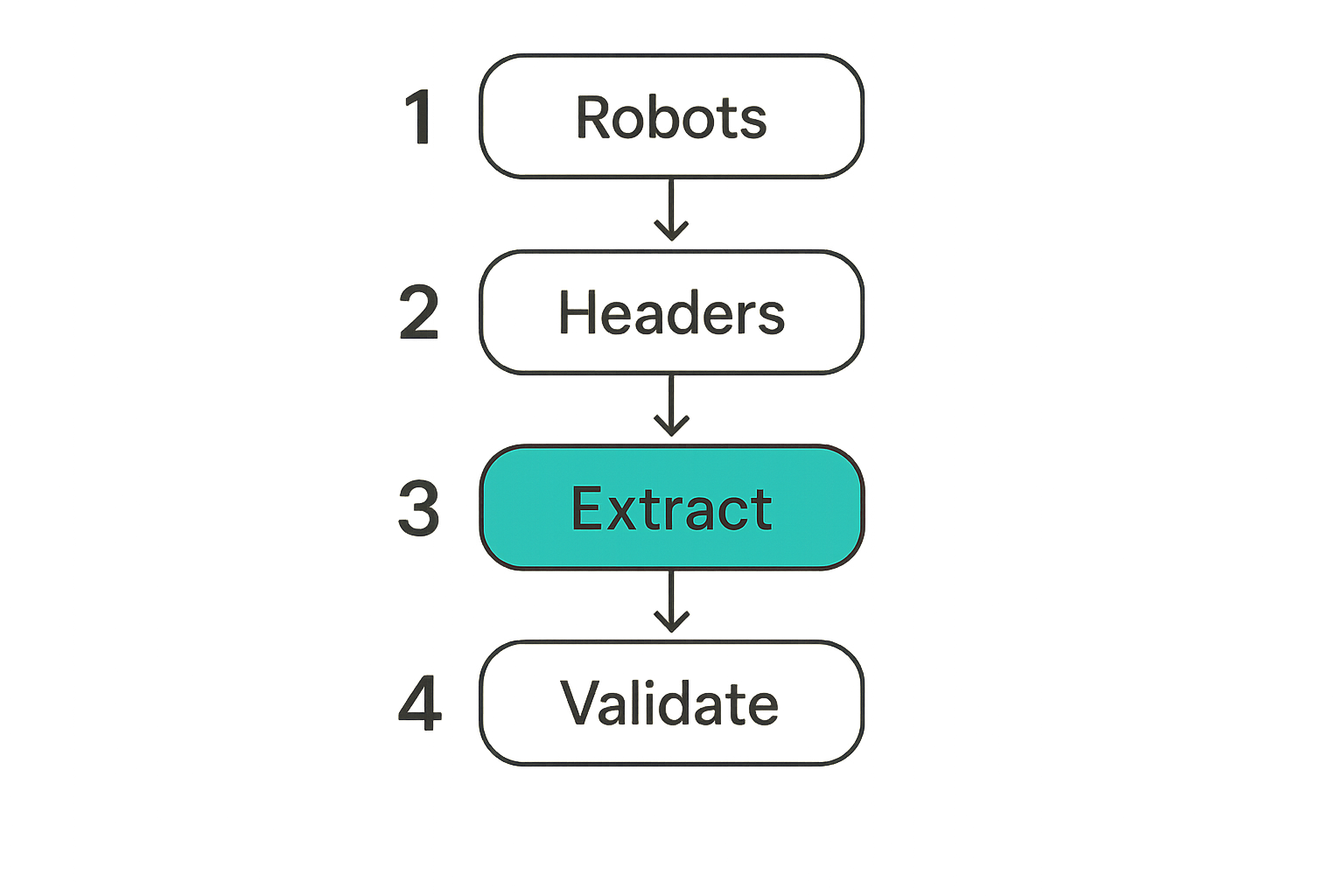
Robots rules are business rules
Crawl access is often treated as a technical footnote. In practice, it is a business policy. If GPTBot, ClaudeBot, PerplexityBot, Google-Extended, or other AI crawlers cannot access the pages you want cited, your AEO strategy has already hit a wall.
The hard part is that access decisions are not one-size-fits-all. Some publishers want broad AI discovery. Some brands want selected access. Some companies want to block model training while still allowing search-like discovery where available. The important thing is not which policy you choose. The important thing is that the policy is intentional, documented, and tested.
A basic access review should check:
robots.txt directives by user agent- Meta robots tags on important templates
- X-Robots-Tag headers from the server or CDN
- Firewall and bot protection behavior
- Login walls, cookie gates, and geo rules
- Whether staging rules leaked into production
What breaks in practice is ownership. Marketing assumes developers handled it. Developers assume SEO requested what they needed. Legal has concerns about AI crawling, but no one translates those concerns into route-level rules.
Practical rule: Do not let default bot settings become your AI visibility strategy.
Many modern sites ship content through client-side rendering, personalization layers, A/B testing tools, or component systems. Humans see the page. Some crawlers see enough. Others may see a partial shell, delayed content, duplicated content, or navigation without the main answer.
This is not a theoretical edge case. In production, extraction breaks when:
- The main answer loads after a script event
- Content requires user interaction to reveal
- Tabbed sections hide important details
- Product facts live inside scripts rather than visible HTML
- Infinite scroll buries supporting content
- Consent banners obscure or delay extraction
For AEO, the safe default is simple: important facts should exist in server-rendered or reliably crawlable HTML. Enhancement is fine. Hiding the source of truth behind runtime behavior is where optimization problems become expensive.
Related reading from our network: teams building AI-heavy workflows face similar architecture decisions around local runtimes, events, and tool boundaries in Mac Tools for AI Agent Builders.
Answer blocks beat vague introductions
AEO does not reward rambling. It rewards clarity that can be extracted without losing meaning. The first meaningful section of a page should answer the primary question directly, then expand.
A weak opening says:
- This topic is changing fast
- Many businesses are paying attention
- There are several things to consider
A stronger opening says:
- The specific problem
- The practical answer
- The conditions where the answer changes
- The next step a reader should take
This matters because answer engines often work with chunks. If your key point is distributed across five paragraphs of context, the system may extract the wrong sentence or skip the page entirely. The goal is not to write robotic content. The goal is to make the page resilient when read out of order.
Entity consistency reduces ambiguity
Entity ambiguity is one of the quieter optimization problems. Your site may refer to the same thing in multiple ways: AEO, answer optimization, AI SEO, AI visibility, answer engine strategy. Semantic variation is fine, but the core entity should be consistent.
For example, if a product page calls your service an AEO auditor, the blog calls it an AI SEO checker, and your schema says software application, answer engines may still understand you. But you are making them do more work than necessary.
Create a small entity map for your site:
| Category | Answer Engine Optimization | AEO, AI answer optimization | Random acronyms with no definition |
| Product | CrawlProof | CrawlProof AEO auditor | Generic crawler tool only |
| Audience | Site owners and marketers | SEO teams, content strategists | Everyone with a website |
| File standard | llms.txt | AI crawler guidance file | Sitemap replacement |
The point is not to remove natural language. It is to reduce avoidable ambiguity around the concepts you need to own.
Schema markup turns pages into machine-readable evidence
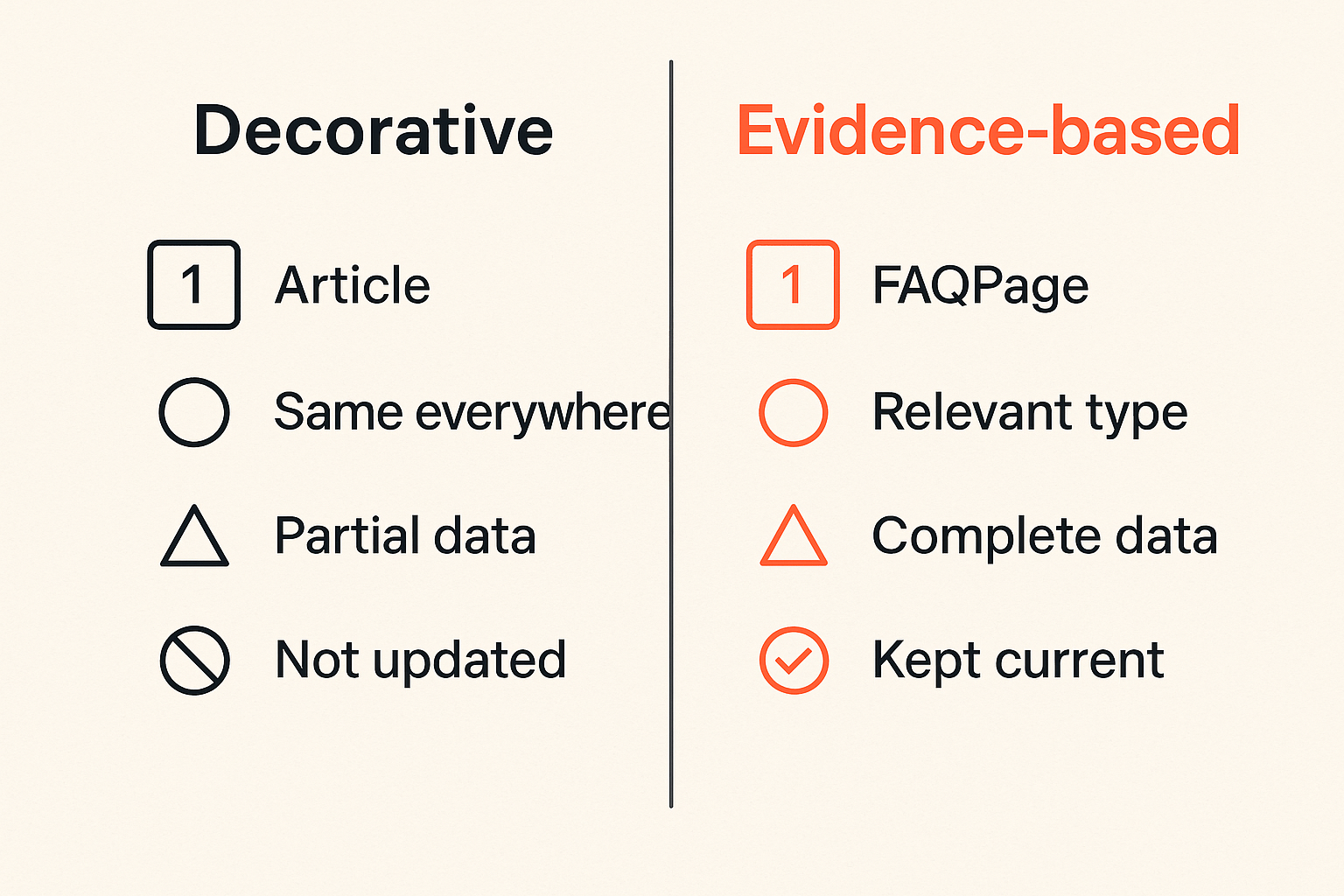
Use schema to confirm, not decorate
Schema markup is not magic. It does not turn weak content into a trusted source. It helps machines confirm what the page is, who published it, what entities it discusses, and how those entities connect.
The mistake teams make is adding schema as decoration. They install a plugin, output generic Article schema everywhere, and assume the problem is solved. That changes very little if the structured data is thin, mismatched, or not maintained.
Useful schema answers operational questions:
- What type of page is this?
- Who is the publisher?
- Who is the author or responsible organization?
- What topic does the page cover?
- When was it published and modified?
- What products, services, or concepts are mentioned?
- Does the schema match visible page content?
For many AEO pages, Article, FAQPage, HowTo, Organization, Product, SoftwareApplication, and BreadcrumbList can be relevant. The right choice depends on the page. The wrong move is applying everything everywhere.
Practical rule: Schema should clarify visible truth, not invent a second version of the page.
Common schema failures in production
Schema breaks less dramatically than JavaScript. It usually decays. A template changes. A plugin updates. A page type is reused. Suddenly your structured data says one thing and the content says another.
Common failures include:
dateModified never updates after edits- FAQ schema marks up content not visible on the page
- Organization details differ across templates
- Author fields point to empty profile pages
- Product schema appears on educational content
- Breadcrumb schema conflicts with actual navigation
- Multiple schema systems output duplicate graphs
Here is a simple comparison operators can use:
| Decorative schema | Plugin defaults, same markup everywhere | Low confidence and frequent mismatch |
| Page-type schema | Templates mapped to content types | Better consistency and easier QA |
| Evidence schema | Markup tied to visible claims, entities, and dates | Stronger extraction and citation support |
The practical question is not whether you have schema. It is whether your schema is specific, accurate, and maintained.
llms.txt and AI crawler guidance need ownership
What belongs in crawler guidance files
Emerging files like llms.txt and related guidance formats are not replacements for sitemaps, robots rules, or schema. They are a way to make your important AI-facing resources easier to find and understand.
A useful guidance file might include:
- A short description of the site
- Key pages or sections intended for AI discovery
- Canonical documentation or evergreen resources
- Preferred product and category language
- Update expectations
- Contact or policy references where appropriate
If you are evaluating these files, the practical issue is not hype. It is maintainability. A stale guidance file is worse than no guidance because it points crawlers toward outdated priorities. For a deeper operator view, see our prior guide on llms.txt and skill.md.
What fails when nobody owns them
What breaks in practice is that crawler guidance files sit between teams. Content wants visibility. Developers control deployment. Legal cares about AI usage. SEO wants measurement. No one owns the lifecycle.
That creates predictable failure modes:
- The file references old URLs
- Priority pages are missing
- Product descriptions drift from current positioning
- Links point to redirected or canonicalized pages
- The file conflicts with robots directives
- Nobody reviews it after a site migration
Assign ownership the same way you would for a sitemap or analytics configuration. Someone should be responsible for updates, validation, and change review. The file does not need daily attention, but it cannot be a one-time experiment.
Related reading from our network: security and technical freelancers face a similar ownership problem when AI-assisted work becomes a delivery workflow rather than a novelty, as discussed in Security Jobs in 2026.
Measurement is where most AEO optimization problems hide
Track discoverability before attribution
Many teams want to measure AEO by referral traffic. That is understandable, but incomplete. Answer engines may cite without sending much traffic. They may summarize without a visible click. They may influence branded search, sales calls, or direct visits later.
So the first measurement layer should be discoverability, not attribution.
Track whether:
- Important pages are crawlable by relevant AI user agents
- Core content appears in extracted text
- Schema validates and matches visible content
- Key questions have direct answer blocks
- Important entities are consistently named
- Freshness dates are accurate
- AI crawler access differs by route or template
- Pages are cited or mentioned in monitored answer surfaces where you can test manually
This gives teams a control plane. You cannot force an answer engine to cite you. You can make the site easier to discover, parse, and trust.
Build a citation readiness scorecard
A citation readiness scorecard is more useful than a vague AEO score. It should break down the reasons a page is or is not ready to be used as a source.
A simple scorecard might use these categories:
| Access | Can relevant crawlers reach the page? | Dev / SEO |
| Extraction | Is the main content visible in HTML? | Dev |
| Structure | Is the answer easy to identify? | Content |
| Evidence | Are claims supported and current? | Content / SME |
| Schema | Does structured data match the page? | SEO / Dev |
| Entity clarity | Are names and relationships consistent? | Content / Brand |
| Maintenance | Is there a review date or owner? | Content Ops |
The score is less important than the discussion it creates. When a page underperforms, you want to know whether the issue is access, extraction, clarity, evidence, or freshness. Otherwise every problem becomes a rewrite request.
Freshness and change control matter more than publishing volume
Old facts create answer risk
Publishing more content is the easiest lever to pull and the easiest way to create debt. In AEO, outdated pages are not just low performers. They can become risky sources because answer engines may reuse old facts in new contexts.
This is especially true for topics that change: pricing, product capabilities, standards, legal policies, supported integrations, technical procedures, and market definitions. If an answer engine extracts an old statement from your site, the user may blame your brand even if the page was technically archived.
The mistake teams make is treating freshness as a date field. Freshness is a workflow. Someone must decide which claims age quickly, which pages need scheduled review, and which updates require schema or guidance file changes.
Version your important pages
For critical pages, use lightweight version control in the content process. You do not need a heavy documentation system for every blog post, but you do need traceability for pages that define your category, product, or policies.
A practical versioning model includes:
- Owner name or team
- Last substantive review date
- Next review date
- Change summary
- Source of truth for volatile claims
- Links to related pages that may need updates
This also helps developers. If a template changes and extraction breaks, the content owner knows which pages require retesting. If a product positioning statement changes, the guidance file and schema can be updated in the same workflow.
Related reading from our network: private communication products face the same need for explicit ownership and lifecycle control around sensitive architecture decisions, as shown in this guide to end to end encryption messaging.
What breaks when teams implement AEO badly
The content team ships faster than the system can verify
Content velocity feels productive until it outruns QA. A team publishes twenty pages, but no one checks whether AI crawlers can access them, whether the schema is correct, whether the internal links make sense, or whether the answer blocks are extractable.
Then leadership asks why AI tools mention competitors. The content team points to the publishing calendar. SEO points to rankings. Developers point to uptime. Nobody has a shared view of the actual AEO pipeline.
This is the pattern to avoid:
- Publish content based on keyword gaps
- Add generic schema automatically
- Assume crawl access is fine
- Wait for rankings or referrals
- Rewrite pages when results are unclear
What fails is the lack of validation between publishing and performance analysis. If you do not test discoverability, extraction, and citation readiness, you cannot diagnose optimization problems. You can only guess.
Developers optimize performance and accidentally remove context
Developers are often blamed unfairly for SEO problems. Most are doing exactly what they were asked to do: reduce payload, improve Core Web Vitals, simplify templates, or ship a redesign.
The issue is that performance optimization can remove machine-readable context if no one defines what must remain visible. Examples include:
- Removing breadcrumbs from rendered HTML
- Replacing text sections with image-based layouts
- Hiding FAQs behind interactive components
- Deferring article body content too aggressively
- Consolidating templates and losing page-type schema
- Moving author or modified-date fields out of the DOM
The fix is not to slow developers down. The fix is to create acceptance criteria. If a page template is important for AI discovery, the pull request should preserve crawlable content, structured data, canonical signals, and key entity language.
Practical rule: Every redesign should include an extraction test, not just a visual QA pass.
A practical workflow for fixing optimization problems
The six-step implementation sequence
AEO becomes manageable when you turn it into an operating workflow. Do not start by changing every page. Start with the pages that matter most: category pages, product pages, high-intent explainers, comparison pages, documentation, and evergreen authority content.
Use this sequence:
- Inventory priority URLs. Select the pages you actually want answer engines to discover and cite. Do not include everything by default.
- Audit crawl access. Check robots directives, headers, bot protection, and route-level differences for AI crawlers and standard crawlers.
- Test extraction. Compare what humans see with what a crawler can read from HTML and rendered output. Identify missing main content, hidden answers, and broken sections.
- Normalize entities. Create preferred labels for your product, category, authors, organization, and important concepts. Update pages that drift.
- Validate schema and guidance. Confirm structured data matches visible content. Review
llms.txt, sitemap references, and canonical URLs together. - Create a review cadence. Assign owners, set freshness expectations, and retest after template changes, migrations, or major content updates.
This sequence works because it separates causes. Access problems are not content problems. Extraction problems are not brand problems. Schema problems are not editorial problems alone. Each issue needs the right owner.
What works and what fails
Here is the operator-level comparison:
| Auditing priority pages before rewriting them | Rewriting content without checking crawlability |
| Making key facts visible in crawlable HTML | Putting important facts inside scripts or images |
| Maintaining schema by template and page type | Installing a plugin and never reviewing output |
| Defining preferred entity names | Letting every team invent new terminology |
| Reviewing crawler guidance after major changes | Treating llms.txt as a one-time file |
| Measuring discoverability and extraction | Waiting only for referral traffic |
A useful way to think about it is an AEO release pipeline. Content is not done when it is published. It is done when the page is accessible, extractable, structured, internally connected, and assigned to an owner for review.
Where CrawlProof fits in the workflow
Use audits to make invisible issues visible
The frustrating part of AEO is that many failures are invisible from the browser. A page can look fine and still be weak as an answer-engine source. Site owners need a way to see what AI crawlers and answer engines can actually find, not just what the marketing page looks like.
That is where CrawlProof fits. The product is built for site owners and marketers who need to diagnose AEO issues without turning every question into a custom engineering project. You can run an audit from CrawlProof to inspect crawl access, content visibility, schema, robots rules, AI-bot access, and positioning signals from an answer-engine perspective.
This is not a replacement for strategy. It is a diagnostic layer. The value is that it makes the conversation concrete. Instead of saying a page needs better AEO, you can say the page blocks a crawler, hides the core answer, has mismatched schema, or lacks clear entity positioning.
Turn findings into operating rules
Audits are only useful if they change behavior. The best teams turn findings into rules that affect publishing, development, and content maintenance.
Examples:
- New evergreen pages must include a direct answer block near the top
- Product and category names must follow the entity map
- Schema changes require validation before release
- Important content must remain visible without interaction
- AI crawler access must be checked after CDN or firewall changes
llms.txt must be reviewed during major content updates
You can also learn from patterns across other audits. The CrawlProof blog publishes practical notes on AEO, schema markup, LLM crawlers, and emerging standards so teams can update their workflow as the ecosystem changes.
The point is not to chase every new AI crawler announcement. The point is to build a site that exposes the right facts clearly and consistently.
Closing the loop on optimization problems
The operating model to keep
The optimization problems that matter in 2026 are not solved by one plugin, one prompt, or one content sprint. They are solved by a workflow that connects visibility architecture to daily publishing.
Keep this model:
- Crawl access is a policy decision
- Extraction is a technical acceptance criterion
- Content structure is a citation-readiness issue
- Schema is evidence, not decoration
- Entity consistency is brand infrastructure
- Freshness is a maintenance workflow
- Measurement starts before attribution
If you manage those layers, AEO becomes less mysterious. You still cannot control whether an answer engine cites you on a given day. But you can remove the avoidable reasons it ignores, misreads, or distrusts your site.
That is the practical answer to optimization problems in AEO: stop treating them as isolated page defects. Treat them as a system that needs owners, tests, and release discipline.
Try crawlproof.com
CrawlProof helps site owners and marketers see how AI answer engines and LLM crawlers discover, parse, and cite their content. Try crawlproof.com.