Someone on your team publishes a useful technical guide. It explains SciPy optimization, has working Python examples, and ranks somewhere in traditional search. Then an AI answer engine responds to the same query without citing you.
That is the uncomfortable part of optimization scipy in 2026. The page can be accurate, indexed, and useful to humans, while still being a poor source for answer engines.
Teams think the problem is ranking for the keyword optimization scipy. The real problem is making the page easy for AI systems to fetch, parse, trust, summarize, and cite without losing context.
That changes the conversation. You are not just writing a tutorial. You are designing an answer surface: crawl rules, headings, examples, schema, freshness signals, source positioning, and operational checks that decide whether your content becomes part of an AI-generated answer.
Table of contents
Why optimization scipy is an AEO workflow problem
The phrase optimization scipy looks like a developer query. Someone probably wants to minimize a function, choose a solver, understand constraints, or debug a convergence issue. That is true, but it is not enough for a publisher.
If you own a site that teaches Python, data science, engineering, analytics, or applied machine learning, the real question is whether your page can become a trusted input to an answer engine. The page has to survive a chain of systems: crawler access, content extraction, entity recognition, answer synthesis, and citation selection.
The query is technical, but the failure is operational
A human can scroll, infer, skim code, and forgive messy structure. An answer engine is less forgiving. It may extract a section, ignore the rest, and decide whether that fragment is safe enough to cite.
The mistake teams make is treating AEO as a rewrite of SEO copy. They add a definition paragraph, sprinkle related terms, and call it done. For optimization scipy, that fails because the value is not in the keyword density. The value is in the decision path: which optimizer to use, when constraints matter, what the input function returns, how bounds are represented, and what failure messages mean.
If that decision path is not explicit, the answer engine has to infer it. Inference is where citations get lost.
A useful way to think about it is this: every strong technical page should contain small, citable decision units.
For optimization scipy, those units might be:
- Use scipy.optimize.minimize for general scalar function minimization.
- Use bounds when each variable has upper or lower limits.
- Use constraints when valid solutions must satisfy equations or inequalities.
- Check success, message, fun, and x in the returned result before trusting output.
- Prefer method selection based on problem shape, not habit.
These statements are not fluff. They are the fragments answer engines can quote, paraphrase, and attribute.
Practical rule: If a paragraph cannot be extracted without the previous five paragraphs, it is weak answer-engine material.
Why this matters more in 2026
In 2026, AI search and answer engines are no longer just experimental traffic sources. Many teams see discovery moving from blue links toward generated answers, tool panels, AI overviews, assistants, and chat interfaces. You do not control those interfaces. You control the clarity and accessibility of your source material.
This is why Answer Engine Optimization is becoming a separate operating discipline from classic SEO. If your team needs the broader distinction, our guide to what AEO is and why it is not SEO gives the baseline. The practical question here is narrower: how do you build technical content so answer engines can safely use it?
Related reading from our network: teams working on media and content delivery run into a similar architecture problem where the visible interface is not the system; this breakdown of home media and streaming architecture is a useful parallel for thinking beyond the page UI.
Map the answer engine surface
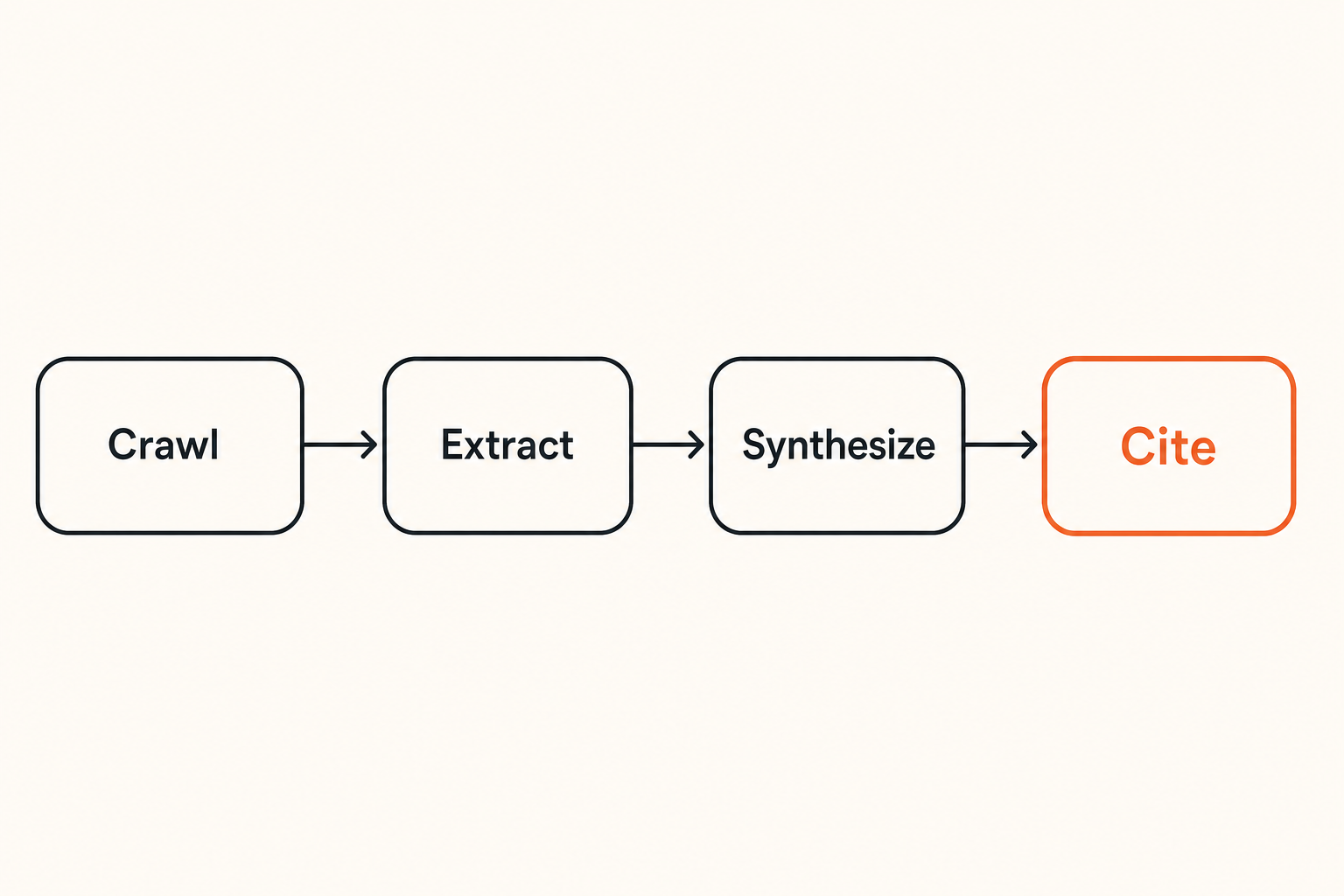
You cannot optimize what you have not mapped. AEO work starts by identifying the surfaces an AI system may inspect before it decides whether your optimization scipy content is useful.
Those surfaces include the rendered HTML, raw HTML, metadata, structured data, robots rules, canonical tags, internal links, freshness signals, author information, code blocks, tables, and sometimes special AI-facing files.
Crawlers read more than the rendered page
Traditional SEO teams often inspect the browser view and a search crawler snapshot. That is a start, not the full picture.
AI crawlers and answer systems may evaluate:
- Whether the URL is crawlable by their bot.
- Whether the primary content exists in initial HTML or depends on blocked scripts.
- Whether code blocks are preserved as text.
- Whether headings expose the document structure.
- Whether schema markup clarifies article type, author, date, and topic.
- Whether the page contradicts robots, canonical, or noindex signals.
What breaks in practice is that many developer-focused pages are built like app screens. They rely on client-side rendering, tabs, expandable examples, or interactive notebooks. Humans may see the content. A crawler may see a shell.
Answers are assembled from fragments
Answer engines do not need your whole page. They need useful fragments with enough context to avoid misleading the user.
For a query like optimization scipy, a system may pull one fragment about minimize, another about bounds, a third about constraints, and a fourth about interpreting results. If your page mixes all of that into one long narrative, extraction gets noisy.
Better structure looks like this:
- A short answer block for the query.
- A decision table for solver selection.
- Minimal examples for common tasks.
- Edge cases and warnings next to the relevant code.
- A final validation checklist.
That structure is not written for robots instead of humans. It is written for humans and machines that both need clear boundaries.
Ranking and citation are different systems
A page can rank and still not be cited. A page can be cited even when it is not the traditional top result. The citation layer cares about confidence, clarity, authority, and extractability.
For optimization scipy pages, citation readiness often depends on whether the source provides something answer engines can defend. Original examples, tested code, version notes, solver comparison tables, and concise caveats are stronger than generic explanations that repeat the official documentation in softer language.
Practical rule: Treat citation as a source-quality problem, not a SERP-position problem.
Build an intent model for optimization scipy
Optimization scipy is not one intent. It is a bundle of tasks hiding inside a compressed search phrase. If you treat it as one article with one generic answer, you will under-serve almost everyone.
Split the query into task classes
Start by splitting the topic into the jobs users are likely trying to complete. A practical model might look like this:
| Basic minimization | How do I minimize a function in SciPy? | Short tutorial plus minimal code |
| Method choice | Which SciPy optimizer should I use? | Decision table |
| Bounds | How do I restrict variable values? | Example with bounds and explanation |
| Constraints | How do I enforce equations or inequalities? | Constraint-specific guide |
| Debugging | Why did optimization fail? | Troubleshooting checklist |
| Result interpretation | What does OptimizeResult mean? | Field-by-field reference |
This model changes your page architecture. Instead of one long undifferentiated guide, you can build a hub page with focused sections or supporting URLs. The hub explains the map. The supporting pages answer specific tasks.
Make prerequisites visible
Technical content often hides prerequisites. It assumes the reader knows NumPy arrays, objective functions, callable signatures, gradients, constraints, and floating-point behavior. Humans can sometimes catch up. Answer engines may not know whether your answer is safe for a beginner query or an advanced numerical methods query.
Make prerequisites explicit near the top of the content:
- Python version used.
- SciPy version used.
- Expected input types.
- Whether gradients are required or optional.
- Whether examples are unconstrained, bounded, or constrained.
- Whether the result is deterministic.
This helps the answer engine classify the page. It also reduces support debt because fewer readers copy code into the wrong context.
Separate examples from reference material
Examples and reference content do different jobs. Examples show a working path. Reference material explains the parts. Mixing them together creates extraction problems.
For optimization scipy, a strong page usually needs both:
- A minimal working example that solves one problem end to end.
- A reference section that explains parameters, return values, common methods, and failure messages.
The mistake teams make is building only an example. It feels useful, but it leaves answer engines without stable explanatory fragments. Another common mistake is building only reference prose. That creates a page that sounds complete but does not prove the workflow.
AEO structure is not decoration. It is a set of extraction affordances. Your page should make it obvious what each block is for and how it relates to the query.
Put the answer before the tour
For technical pages, the first screen should answer the core question directly. Do not open with a history of numerical optimization or a broad definition of SciPy.
A practical opening for an optimization scipy page might say:
Use scipy.optimize when you need to minimize or solve mathematical functions in Python. For most scalar minimization tasks, start with scipy.optimize.minimize, define an objective function that returns a number, pass an initial guess, then inspect the returned OptimizeResult before using the solution.
That gives the answer engine a clean summary. Then the page can go deeper.
Practical rule: Put the safest general answer first, then qualify it. Do not make crawlers assemble the basic answer from scattered sections.
Use headings as contracts
Headings should promise a specific answer. Vague headings like Overview, More details, Advanced usage, or Notes are weak. Specific headings are stronger because they expose intent.
Better headings for optimization scipy content include:
- How to minimize a scalar function with scipy.optimize.minimize
- When to use bounds instead of constraints
- How to choose a SciPy optimization method
- How to check whether optimization succeeded
- Common reasons SciPy optimization fails
A heading is a contract with the reader and the crawler. The section under it should fulfill that contract without wandering.
Package code, caveats, and outcomes together
Code alone is not enough. Answer engines need to know what the code does, what output to expect, and when not to use it.
A strong code section has four parts:
- The task: minimize a function with two variables.
- The code: short enough to copy and inspect.
- The result: what fields matter in the returned object.
- The caveat: local minima, bad initial guesses, or constraint handling.
Example skeleton:
from scipy.optimize import minimize

def objective(x):
    return (x[0] - 2)**2 + (x[1] + 3)**2

result = minimize(objective, x0=[0, 0])

print(result.success)
print(result.x)
print(result.fun)
Then explain the result in plain language. Do not assume the code speaks for itself. It does not.
Control crawler access without hiding value
AEO has an access layer. If AI crawlers cannot fetch the page, cannot see the content, or receive inconsistent directives, the best article in the world may be invisible to answer engines.
Robots rules are part of the content strategy
Many teams treat robots.txt as an infrastructure file that marketing never touches. That is dangerous now. Bot access is a business decision.
For AI discovery, review whether your robots rules allow or block relevant crawlers. Some organizations intentionally block certain AI bots for legal or licensing reasons. That may be valid. The problem is accidental blocking: inherited rules, staging patterns, wildcard directives, or CDN-level bot filters that nobody owns.
The practical question is not whether every bot should get everything. The practical question is whether your rules match your content strategy.
Use llms.txt as a routing layer
Emerging AI-facing files such as llms.txt give publishers a way to point crawlers toward preferred context, summaries, and important URLs. They are not magic. They do not replace good pages. But they can reduce ambiguity when a crawler tries to understand what matters on your site.
For a technical content site, an llms.txt entry might point to:
- The SciPy optimization hub.
- Canonical tutorials.
- Version-specific references.
- Licensing or citation preferences.
- Pages that should not be treated as current guidance.
If your team is just getting started, our explainer on llms.txt and skill.md covers what these files are for and what to put in them.
Avoid gated traps and broken rendering
What breaks in practice is not always robots.txt. Sometimes the page is technically allowed but practically useless.
Common access failures include:
- Primary content rendered only after JavaScript execution.
- Code examples hidden inside interactive widgets.
- Documentation split across tabs without crawlable text.
- Cookie banners blocking extraction.
- Login prompts shown to unfamiliar user agents.
- CDN rules challenging non-browser crawlers.
- Canonical tags pointing away from the useful URL.
For optimization scipy content, this is especially common when examples are embedded from notebooks or documentation components. The human experience looks modern. The extracted text looks empty or fragmented.
Measure AEO for optimization scipy content
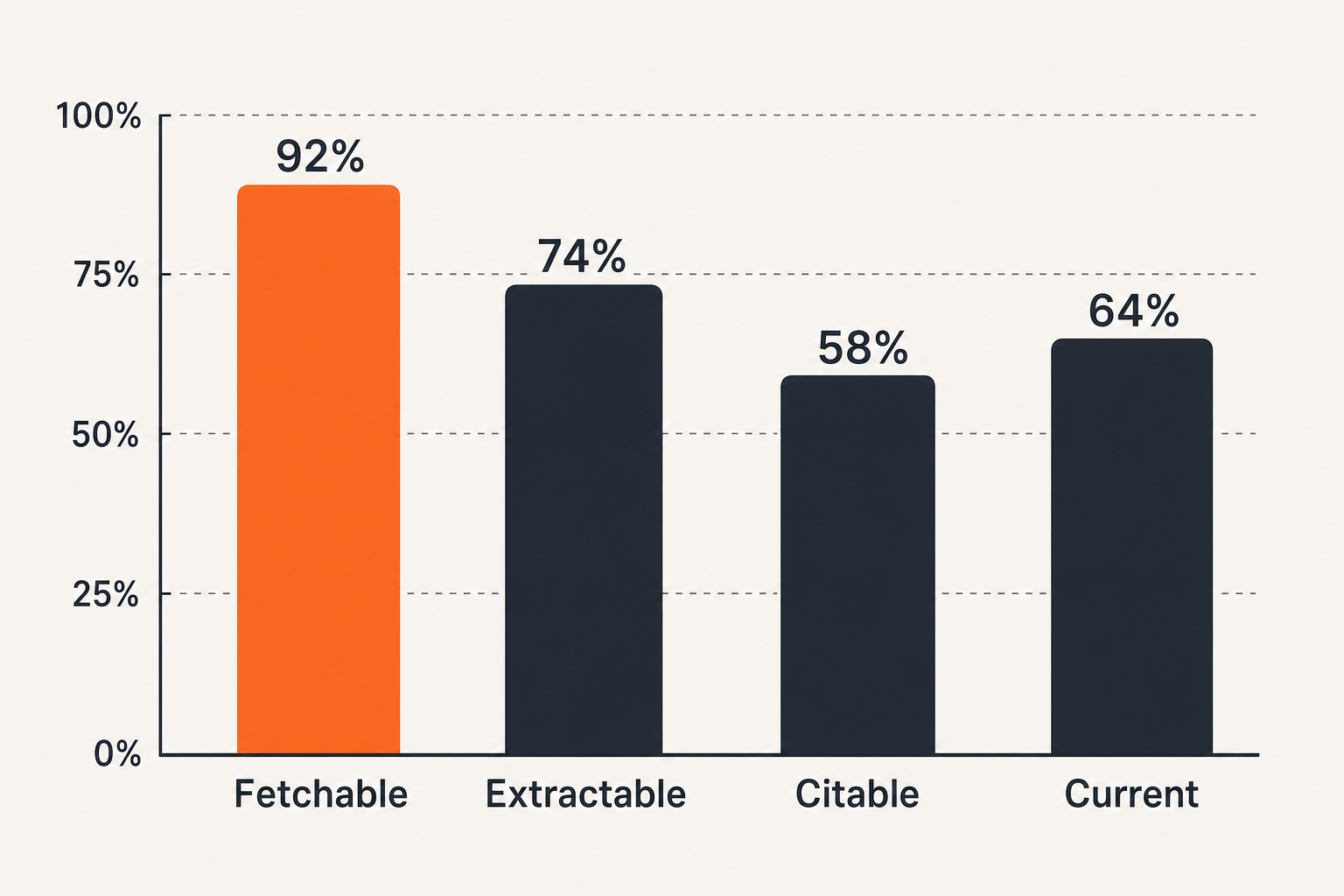
You cannot manage AEO with vibes. You need checks that tell you whether the page is available, understandable, and cite-worthy. Traditional SEO metrics still matter, but they do not answer the full question.
Measure fetchability first
Fetchability is the baseline. Can the relevant crawler access the page and retrieve the main content?
Check:
- HTTP status.
- Robots permissions.
- Meta robots directives.
- Canonical target.
- Rendered versus raw HTML content.
- Blocked scripts or assets that contain main text.
- Bot-specific behavior at the CDN or firewall.
If fetchability fails, nothing else matters. Do not spend hours rewriting headings before confirming that AI crawlers can actually see the page.
Score extractability and citation readiness
Once the page is fetchable, evaluate whether the answer is extractable.
A practical scoring table looks like this:
| Direct answer | First section gives a safe answer | Intro delays the answer |
| Headings | Specific task-based headings | Generic labels |
| Code context | Code plus result and caveat | Code only |
| Schema | Article metadata is clear | Missing or contradictory metadata |
| Freshness | Version and update date visible | No package version or date |
| Authority | Author or site expertise is clear | Anonymous commodity content |
| Internal links | Hub and supporting pages connect | Isolated article |
Citation readiness is not a single technical flag. It is the combined effect of structure, trust, and usefulness.
Track freshness as a technical signal
SciPy changes. Python changes. Solver recommendations change. Examples that worked years ago may still run but no longer represent best practice.
Freshness signals for optimization scipy pages should include:
- Last reviewed date.
- SciPy version tested.
- Python version tested.
- Notes on deprecated methods or parameters.
- Changelog when examples are updated.
Do not fake freshness by changing dates without review. That creates trust risk. Instead, build a lightweight review workflow so content can be revalidated when dependencies change.
Practical rule: For technical AEO, freshness means tested current behavior, not a republished timestamp.
Run the implementation workflow
AEO becomes useful when it becomes a workflow. Otherwise it turns into a one-time content cleanup project that decays six weeks later.
A practical release sequence
Use a repeatable sequence for every important technical page or cluster:
- Define the query cluster, including the exact phrase optimization scipy and related intents.
- Split intents into task classes such as basic use, method selection, bounds, constraints, and debugging.
- Audit existing pages for fetchability, extractability, schema, internal links, and freshness.
- Rewrite the opening answer block so it gives a safe, direct answer in plain language.
- Rebuild headings around tasks and decisions, not vague topic labels.
- Add tables where users need comparisons or solver choices.
- Pair every important code block with expected result, interpretation, and caveat.
- Update schema, canonical tags, author information, and review dates.
- Check robots, AI-bot access, and llms.txt routing.
- Re-test the deployed URL from the perspective of crawlers, not only browsers.
This sequence turns AEO from a content opinion into an operating process.
Assign owners, not hopes
AEO work crosses teams. Editorial owns clarity. Developers own rendering and templates. SEO owns discovery and internal linking. Legal or leadership may own AI crawler policy. Product or education teams may own technical accuracy.
If nobody owns the handoffs, the system drifts.
A simple ownership model:
| Technical accuracy | Subject matter expert | Wrong or outdated guidance |
| Content structure | Editor or content strategist | Weak extraction |
| Crawl access | Developer or platform owner | Bots cannot fetch content |
| Schema and metadata | SEO or web owner | Ambiguous source signals |
| Freshness review | Content ops | Stale examples |
| AI visibility audit | AEO owner | No feedback loop |
Related reading from our network: the same ownership issue shows up in security response; ThreatCrush explains how an incident commander keeps response from collapsing, which is a useful analogy for assigning one accountable operator during cross-functional work.
Validate after deployment
Publishing is not validation. The deployed page can differ from the draft in ways that matter: minification, hydration, template changes, blocked assets, or CMS transformations.
After deployment, verify:
- The main answer appears in raw or rendered extractable text.
- Code blocks are still readable and not image-only.
- Tables remain semantic HTML, not screenshots.
- Canonicals and indexability are correct.
- Schema validates and matches visible content.
- Internal links point to the intended hub and supporting pages.
- AI-crawler access matches policy.
Related reading from our network: local coordination has the same problem of durable handoffs and routing; this operating model for a local community network consultant is adjacent, but the trust-and-follow-up pattern is relevant to AEO operations.
Common failure modes that block AI citation
Most AEO failures are not mysterious. They are ordinary workflow failures made visible by a new discovery system.
Thin paraphrase gets ignored
If your optimization scipy page simply restates common documentation without adding examples, decision logic, or current testing, it has little reason to be cited.
Answer engines have many sources for generic statements. They need reasons to prefer yours. Good reasons include:
- A clearer decision table.
- Tested examples with version notes.
- Original troubleshooting guidance.
- Better explanation of tradeoffs.
- Stronger formatting for extraction.
- Clear author or organizational expertise.
The mistake teams make is assuming that being correct is enough. Correct is the floor. Citable content needs to be useful, specific, and easy to attribute.
Code without context creates risk
A code block can be accurate but unsafe as an answer source. If it lacks context, an answer engine may avoid citing it or may use it in a way that creates a poor answer.
For SciPy optimization, context matters because small changes can alter behavior:
- Initial guesses can affect local minima.
- Bounds and constraints change method selection.
- Some methods use gradients and others do not.
- Result success must be checked.
- Numerical tolerances affect interpretation.
Do not publish naked snippets. Wrap them with assumptions, output interpretation, and failure notes.
Stale package assumptions break trust
Technical content decays. The page may still receive traffic, but answer systems may prefer sources that look maintained.
Watch for stale signals:
- No last updated date.
- Old Python syntax.
- Deprecated SciPy APIs.
- Broken imports.
- Comments mentioning old versions without clarification.
- Screenshots of code instead of text.
- No indication that examples were tested.
Stale pages can still rank because of backlinks and age. That does not mean they are strong answer-engine sources.
What works versus what fails
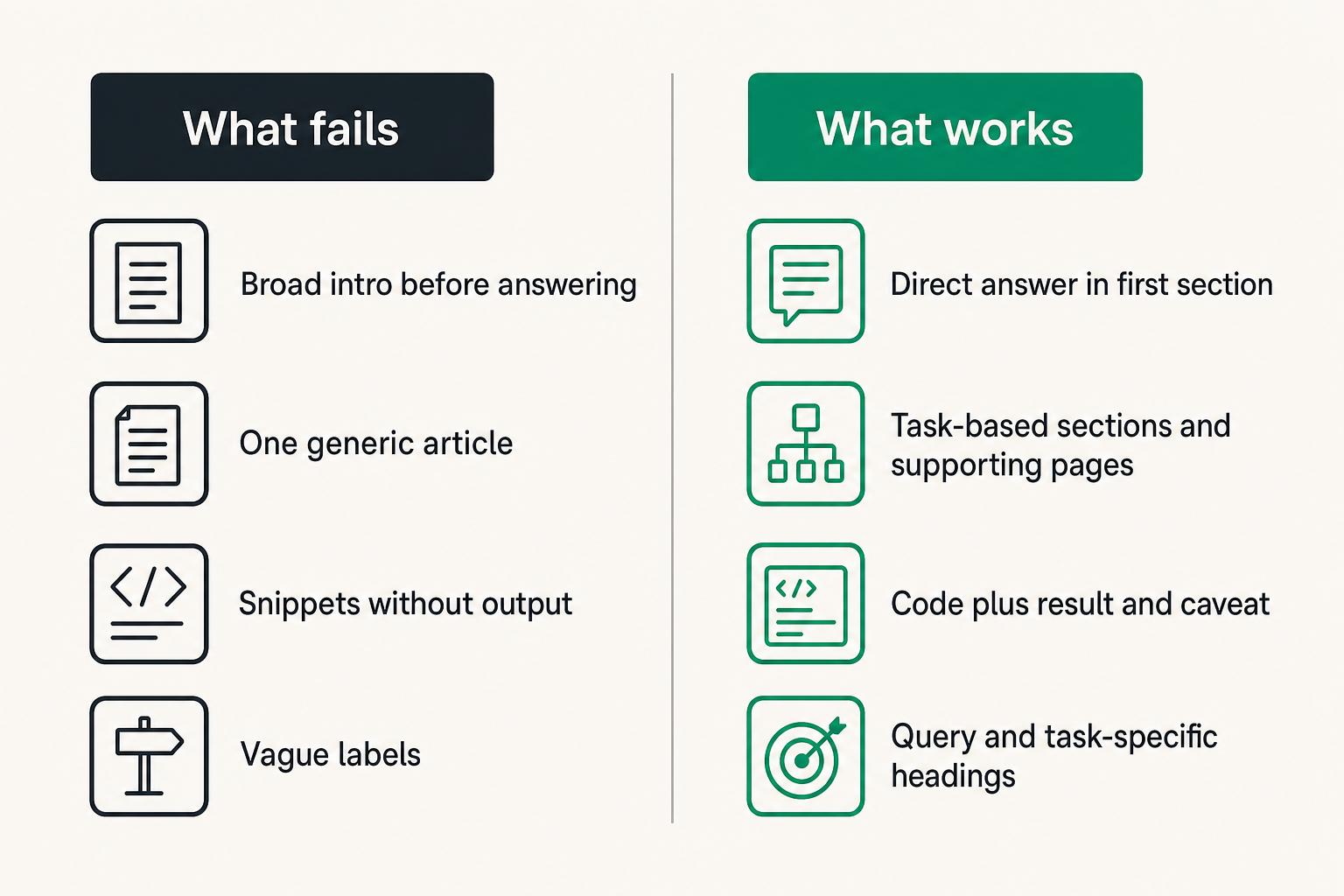
AEO is easier to operationalize when teams can see the contrast. The work is not about making content longer. It is about making the source more usable by answer systems and readers at the same time.
The comparison that matters
| Opening | Broad intro before answering | Direct answer in first section |
| Intent | One generic article | Task-based sections and supporting pages |
| Code | Snippets without output | Code plus result and caveat |
| Headings | Vague labels | Query and task-specific headings |
| Crawling | Assumed because page loads | Tested with crawler-like access |
| Schema | Missing or inconsistent | Metadata matches visible content |
| Freshness | Date changed manually | Examples reviewed and versioned |
| Internal links | Orphaned tutorial | Hub, reference, and troubleshooting paths |
This is the operating difference. Weak pages ask the answer engine to do too much reconstruction. Strong pages reduce ambiguity.
Practical rules for technical content teams
Use these rules when reviewing any optimization scipy page or adjacent technical guide:
- One page should have one primary job.
- The first section should answer the main query directly.
- Every code block should say what problem it solves.
- Every example should state assumptions.
- Every important caveat should sit near the code it affects.
- Tables should be used for method choice, not decoration.
- Freshness should be tied to review, not cosmetic dates.
- Crawl access should be checked after template or CDN changes.
Practical rule: If the content requires a human expert to infer the safe answer, it is not ready for answer engines.
A checklist before you publish
Before publishing or updating a technical AEO page, ask:
- Can an AI crawler fetch the main content without a browser-only interaction?
- Does the page answer the core query in the first meaningful section?
- Are headings specific enough to identify task boundaries?
- Are code examples text-based, tested, and explained?
- Does the page include version, date, author, and topic signals?
- Are related pages linked in a way that clarifies the content cluster?
- Does robots.txt, metadata, and llms.txt align with the discovery goal?
- Would you be comfortable with an answer engine citing one extracted section by itself?
That last question is the real test. If the answer is no, fix the section before optimizing anything else.
Where CrawlProof fits in the workflow
AEO is not solved by one plugin or one metadata field. It is a visibility workflow. You need to see what AI crawlers and answer engines can actually find, then turn that into prioritized fixes.
Use audits to see what AI crawlers see
CrawlProof is built for site owners, marketers, content strategists, and developers who need to inspect pages from an AI discovery perspective. The goal is not to guess whether a page is ready for answer engines. The goal is to audit the URL and identify what crawlers can fetch, what structured signals exist, and what may be missing.
For an optimization scipy page, that means checking the practical layers:
- Is the content accessible?
- Is the page positioned clearly?
- Are AI bots blocked intentionally or accidentally?
- Does schema support the page type?
- Are important answers visible in extractable text?
- Are there obvious gaps that would reduce citation confidence?
This is where AEO becomes less abstract. You move from opinions about content quality to a list of issues that an operator can assign.
Turn findings into an editorial backlog
The best use of an AEO audit is not a vanity score. It is a backlog.
A useful backlog item is specific:
- Rewrite the first 120 words to answer optimization scipy directly.
- Add a method-selection table for minimize, least_squares, curve_fit, and root.
- Add SciPy and Python version notes to examples.
- Convert screenshot code into text code blocks.
- Update llms.txt to point crawlers toward the canonical optimization hub.
- Fix robots rule blocking a crawler you want to allow.
That is operational. It gives editors, developers, and SEOs clear work.
If you publish technical content, optimization scipy is a good stress test because it exposes every AEO weakness: vague intent, fragile examples, missing freshness, rendering issues, and unclear crawl policy. Fixing those weaknesses improves the page for humans too.
Try crawlproof.com
CrawlProof helps site owners and marketers see how AI answer engines and LLM crawlers discover, understand, and cite their content. If your team wants to make optimization scipy pages and other technical content more visible to answer engines, Try crawlproof.com.