Peptide AEO has become a real problem because AI answer engines do not browse peptide websites the way a buyer, researcher, or SEO crawler does. They fetch, compress, compare, and summarize. If your peptide content is vague, blocked, duplicated, or buried behind scripts, the answer engine may cite someone else even when your page is more accurate.
Teams think the problem is rankings. The real problem is whether an AI system can discover the right page, understand the entity, trust the claim, and quote it without creating regulatory or scientific risk.
That changes the conversation. Peptide AEO is not a content refresh. It is a workflow that connects technical SEO, schema markup, crawl policy, evidence management, compliance review, and measurement.
The practical question is simple: when an answer engine is asked about your peptide category, product line, research focus, or safety language, have you built a site that can be safely cited?
Table of contents
Peptide AEO is not peptide SEO with a new label
Why peptide pages are hard for answer engines
Peptide websites sit in a difficult zone. The content is scientific enough to require precision, commercial enough to invite aggressive copy, and sensitive enough that sloppy claims can create legal or trust problems. A generic answer engine does not always know whether a page is written for researchers, clinicians, procurement teams, patients, hobbyists, or internal documentation.
What breaks in practice is context. A page may mention a peptide name, concentration, purity, storage condition, and research disclaimer, but the important parts are scattered across tabs, PDFs, product cards, accordions, and footers. A human can infer intent. A model may compress the page into one unsafe sentence.
The mistake teams make is treating peptide AEO as a prompt problem. They ask how to get ChatGPT, Perplexity, Gemini, or another answer surface to mention them. That is too late in the workflow. The upstream problem is whether the source material is crawlable, structured, and unambiguous.
Practical rule: if a sentence would be risky when quoted without the surrounding page, rewrite it before you ask an answer engine to cite it.
The answer engine changes the unit of competition
Traditional SEO usually optimizes pages against queries. Answer engine optimization optimizes evidence against tasks. The model is not only choosing a blue link. It is trying to synthesize an answer, decide which sources are reliable, and avoid overclaiming.
For peptide sites, that means your competitor may not be another product page. It may be a review article, a regulatory page, a database, a forum thread, or a distributor with cleaner structured data. The answer engine is looking for extractable facts, not your preferred funnel.
A useful way to think about it is this: SEO asks whether a page can rank. Peptide AEO asks whether a fact can survive retrieval, summarization, and citation.
What success looks like in 2026
Success is not just seeing your brand name in an AI answer. That can happen for the wrong reason. A better target is controlled visibility: answer engines can find your approved pages, understand what each peptide page is about, cite the correct source, and avoid mixing educational content with commercial claims.
A practical peptide AEO system should help you answer four questions:
- Which pages are available to AI crawlers?
- Which facts are structured enough to be extracted?
- Which claims have evidence and review status?
- Which answer engines cite you for the right query classes?
That is an architecture question, not a slogan.
Peptide AEO starts with crawl access and content state
Audit what AI crawlers can actually fetch
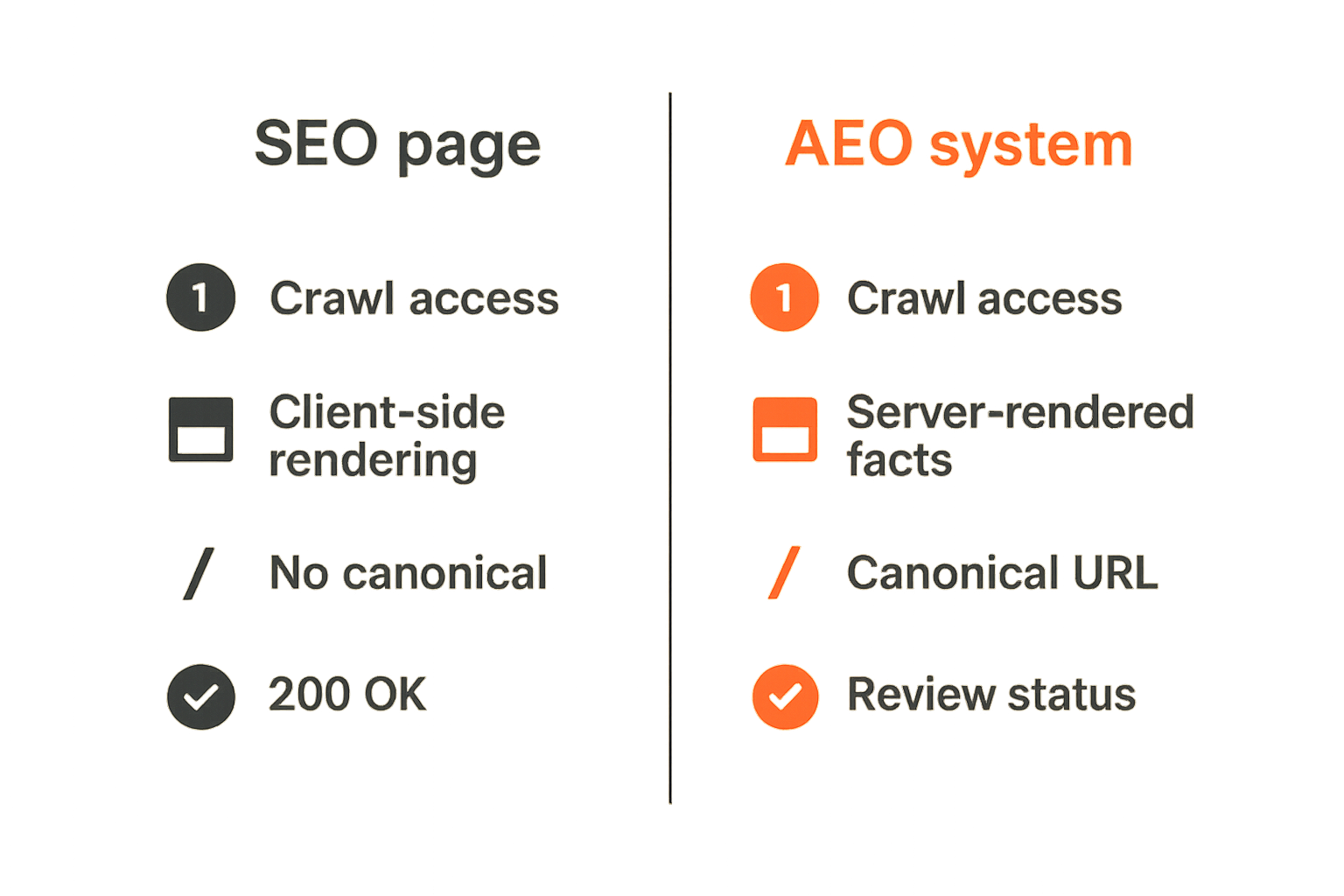
Before rewriting content, inspect access. Many peptide teams publish pages that appear fine in a browser but are poor source material for AI systems. Common issues include blocked user agents, client-side rendering, regional consent overlays, aggressive bot protection, and product data loaded after the initial HTML response.
Start with a simple crawl matrix:
| robots.txt |
Allowed and blocked paths |
AI crawlers may never reach key pages |
| HTML response |
Server-rendered facts |
Models may not execute scripts reliably |
| Canonicals |
Preferred source URL |
Prevents duplicate peptide facts competing |
| Status codes |
200, 301, 404, 410 |
Stale pages can remain in memory or indexes |
| Metadata |
Title, description, headings |
Helps classify page intent quickly |
| Logs |
AI crawler hits |
Confirms whether policy matches reality |
Do not assume standard SEO crawling is enough. AI answer engines and data partners may use different user agents, fetch intervals, and rendering behavior. Some will respect controls. Some may discover content through syndicated copies. You need visibility before you can make policy decisions.
Make the canonical answer obvious
Peptide sites often have multiple versions of the same information: product page, category page, blog post, certificate PDF, FAQ, and technical note. That is normal operationally. It is dangerous for answer extraction when the values differ.
Pick a canonical source for each important fact class. For example:
- Product identity belongs on the product page.
- Storage and handling belong on a technical data section.
- Safety disclaimers belong on every relevant commercial page.
- Educational explanations belong on evergreen guide pages.
- Evidence summaries belong on reviewed scientific content.
The canonical page should not merely exist. It should be obvious in the HTML, internal links, schema, and sitemap. When multiple pages compete, answer engines can choose the shortest, newest, most linked, or most confident text. That is not always the page you want cited.
Practical rule: for every peptide entity, assign one canonical page for identity, one for educational context, and one for transactional detail. Do not let blog posts become accidental product records.
Control gated and sensitive content
Some peptide businesses gate certificates, batch documents, wholesale catalogs, or compliance documents. That may be commercially or legally necessary. But if the only precise information is gated, answer engines may rely on weaker public pages.
The fix is not to expose everything. The fix is to publish a public, approved summary layer. This layer tells crawlers what the page is, what can be cited, and where the boundary is.
For sensitive pages, include:
- A public summary that identifies the document type.
- Clear non-promotional disclaimers.
- Links to request access when appropriate.
- No hidden claims that only appear after login.
- Consistent metadata that does not overstate the page.
Peptide AEO is partly about deciding what answer engines should not use. Crawl access is a business policy, not just a technical switch.
Build a citation-ready peptide content model
Map entities before writing pages
The peptide category has many entity collisions: abbreviations, analogs, modified sequences, research names, brand names, and category terms. A model may confuse them if your site does not disambiguate them.
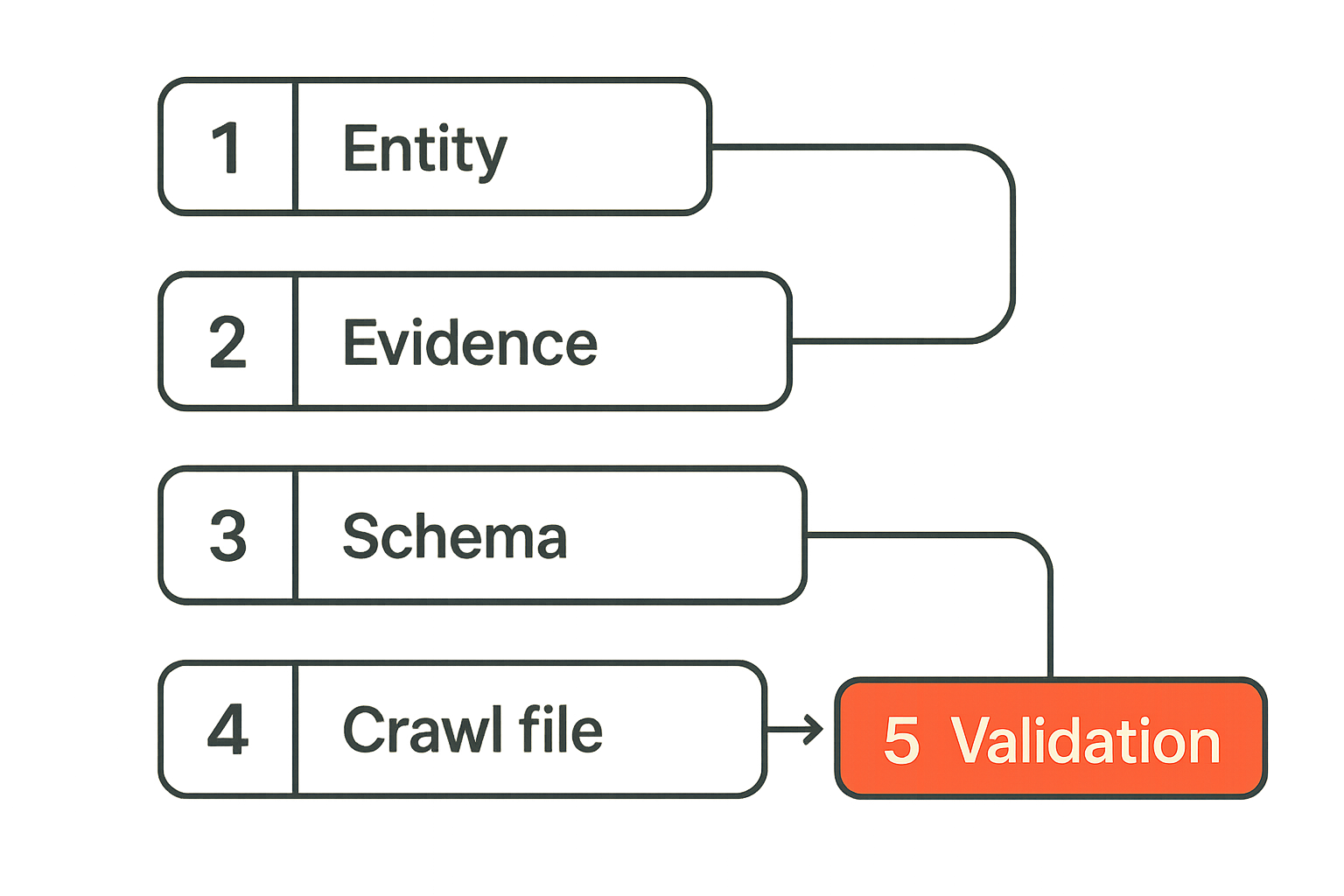
Build an entity map before you scale content. At minimum, track:
- Preferred peptide name.
- Synonyms and abbreviations.
- Category or class.
- Intended page type.
- Research-only or commercial status.
- Related products or educational articles.
- Claim boundaries.
- Review owner and update date.
This sounds like content operations, but it is also technical infrastructure. Your entity map informs URLs, titles, schema, internal links, breadcrumbs, and answer summaries. Without it, every writer invents their own structure and every crawler sees a different taxonomy.
As guest contributors, the team at coinpayportal.com works on systems where state, trust, and reconciliation matter; peptide AEO has the same pattern, because a cited answer is only as reliable as the source state behind it.
Separate claims, evidence, and disclaimers
A peptide page usually contains three very different content types:
- Entity facts: what the peptide is, how it is named, and how it is categorized.
- Evidence context: what research, documentation, or source material supports the discussion.
- Compliance boundaries: what the page is not claiming, who it is for, and how it should not be used.
Do not blend these into one persuasive paragraph. Answer engines tend to extract clean statements. If a claim, caveat, and marketing hook are in the same sentence, the model may keep the hook and drop the caveat.
A better structure looks like this:
- Short definition or identity statement.
- Research context in a separate section.
- Approved use language in a separate section.
- Handling, storage, or specification facts in a table.
- Disclaimers near the relevant claim, not only in the footer.
Practical rule: if a caveat changes the meaning of a peptide claim, keep the caveat in the same answer block or table row as the claim.
Use schema as a contract
Schema markup will not force an answer engine to cite you. It can, however, reduce ambiguity. Treat schema as a machine-readable contract between your content model and crawlers.
For peptide sites, useful structured data often includes Organization, WebSite, WebPage, BreadcrumbList, Article, FAQPage where appropriate, Product where compliant, and Dataset or ScholarlyArticle only when the page genuinely fits. Do not mark up a sales page as a scientific article because it sounds authoritative. That creates a trust problem.
A lightweight implementation plan can look like this:
page_type: peptide_guide
primary_entity: peptide name
entity_synonyms: approved list
review_status: reviewed
review_owner: scientific or compliance lead
last_updated: visible date
schema_types:
  - WebPage
  - Article
  - BreadcrumbList
answer_blocks:
  - identity
  - research_context
  - handling_notes
  - compliance_boundary
The point is not to impress validators. The point is to make your intended interpretation explicit.
Put answer blocks near the top
Answer engines have limited patience for pages that hide the answer under brand copy. If the first screen says almost nothing concrete, the model may classify the page poorly or pull from a later section without enough context.
For important peptide pages, place a concise answer block near the top. It should state what the page covers, who it is for, and what boundary applies. This block is not a sales pitch. It is the source of truth you would tolerate being quoted.
Example structure:
- One sentence identifying the peptide or topic.
- One sentence giving the research or educational context.
- One sentence stating the relevant limitation or disclaimer.
- One link to a deeper approved section.
This is not dumbing down the page. It is giving retrieval systems a stable summary.
Use tables for facts that must not be paraphrased
Peptide content often contains values that should remain exact: sequence, purity, molecular weight, form, storage range, batch availability, or document type. Put those facts in tables when appropriate. Tables give both humans and machines a cleaner extraction target.
| Storage condition |
Labeled table row |
Mentioned in body copy only |
| Research disclaimer |
Repeated near relevant claims |
Footer-only legal text |
| Synonyms |
Controlled list |
Randomly scattered abbreviations |
| Specification |
Product data table |
Image or PDF only |
| Update status |
Visible reviewed date |
No date or hidden CMS timestamp |
The mistake teams make is assuming an answer engine will preserve nuance from long prose. Sometimes it will. In production, you should not bet your risk profile on sometimes.
Avoid claim inflation
Peptide AEO rewards clarity, not hype. Inflated claims may get attention, but they also increase the chance that answer engines summarize your page in a way you do not want. This is especially risky when content touches health, performance, therapeutic, or outcome-oriented language.
Use conservative phrasing. Attribute claims. Avoid implying human use if the page is research-only. Keep commercial availability separate from educational explanation.
A useful internal test: ask whether the sentence would still be acceptable if it appeared in an AI answer beside your brand name with no other context. If not, revise it.
llms.txt, robots, and crawler policy for peptide sites
What llms.txt can and cannot do
llms.txt is emerging as a way to give AI systems a plain-text guide to important content, preferred pages, and usage boundaries. For peptide AEO, it can be useful because it lets you point crawlers toward approved summaries, technical references, and policy pages.
But llms.txt is not a magic enforcement layer. It is closer to a routing and preference file. Some systems may use it. Some may ignore it. Some may discover your content through other sources. Treat it as one piece of crawler communication, not as a replacement for robots.txt, canonical tags, schema, and server logs.
A practical llms.txt for a peptide site might include:
- Approved educational guides.
- Canonical product or category pages.
- Scientific glossary pages.
- Compliance and usage policy pages.
- Pages that should not be summarized as medical advice.
- Contact or licensing instructions for data use.
The goal is to reduce guesswork.
Align robots.txt with business intent
Robots.txt still matters because it communicates crawl permissions. The problem is that many teams inherit robots rules from old SEO setups, staging environments, or ecommerce templates. Those rules may block folders that now contain important AEO material.
Review robots.txt with business intent in mind:
- Should AI crawlers access educational content?
- Should they access product pages?
- Should they access PDFs?
- Should faceted search be blocked?
- Should internal search pages be blocked?
- Should gated or account paths be blocked?
There is no universal answer. A research supplier, clinic-adjacent publisher, academic project, and ecommerce brand may choose different policies. What matters is that the policy is deliberate and tested.
Log crawler behavior
Policies without logs are guesses. You need to know which AI-related crawlers are hitting your site, which paths they request, what status codes they receive, and whether important pages are being revisited after updates.
At minimum, review:
- User agent.
- IP and reverse DNS when feasible.
- Requested URL.
- Response code.
- Response size.
- Timestamp.
- Cache behavior.
- Redirect chain.
This is where AEO becomes operational. If an important peptide guide was updated last month and no major AI crawler has fetched it since, your answer visibility may lag even if the page is perfect.
Technical implementation workflow for peptide AEO
Step one: inventory pages and entities
Start with an inventory rather than a rewrite. Pull every relevant URL into a spreadsheet or content database. Classify each page by entity, page type, risk level, canonical status, and crawl status.
A simple workflow works well:
- Export URLs from your CMS, sitemap, analytics, and crawl tool.
- Group URLs by peptide entity, category, and intent.
- Mark canonical pages and duplicates.
- Identify pages with sensitive claims or outdated language.
- Check whether each page is indexable and accessible to key crawlers.
- Assign an owner for review and updates.
- Prioritize pages that answer high-value AI search questions.
Do not start with the highest traffic page automatically. Start with the page most likely to be quoted incorrectly.
Step two: add structured data and summaries
Once the inventory is clean, add structure. For each priority page, create a consistent page pattern:
- H1 that clearly names the entity or topic.
- Intro answer block.
- Entity facts table.
- Research or educational context.
- Compliance boundary.
- Related canonical links.
- Visible reviewed or updated date.
- Structured data matching the actual page type.
This is not a design-only exercise. Developers, content strategists, and compliance reviewers need the same source of truth. If the CMS allows freeform editing everywhere, build reusable blocks for answer summaries, disclaimers, data tables, and review metadata.
Step three: validate with prompts and logs
Validation has two sides: retrieval and interpretation. First, verify that crawlers can fetch the page. Then test whether a model can summarize it correctly.
Use controlled prompts during QA, such as:
- What is this page about?
- What entity does this page describe?
- Does the page make any human-use claims?
- What caveats are attached to the main claim?
- Which page would you cite for the storage information?
The answers do not need to be perfect across every model. You are looking for failure patterns. If multiple tools miss the disclaimer, the page structure is probably weak. If they confuse two peptides, your entity model is weak. If they cite an old PDF, your canonical signals are weak.
What breaks when peptide AEO is implemented badly
Thin science pages become liability
Thin content is not just an SEO problem. In peptide AEO, thin content can become a liability because answer engines may fill gaps with external assumptions. If your page names a peptide but provides no precise context, the model may combine your page with broader web knowledge and produce an answer you did not write.
This is especially risky for pages that look scientific but are mostly commercial. A product page with strong calls to action and weak boundaries can be summarized as an endorsement rather than a listing.
What works is a minimum viable evidence layer: identity, context, limitations, source links where appropriate, and review date. What fails is publishing dozens of near-empty pages to capture long-tail names.
JavaScript hides the answer
Modern websites often load product data, FAQs, and tabs through JavaScript. That may work for users. It may not work consistently for all crawlers and answer systems. If the peptide name appears in the initial HTML but the critical disclaimer loads later, extraction can break.
Server-render important facts. If that is not possible, test rendered and non-rendered views. Use static HTML for core answer blocks, canonical links, schema markup, and disclaimers. Avoid placing key facts only in images, modals, or downloadable PDFs.
The practical question is not whether Google can render your page. The practical question is whether the systems building AI answers can retrieve the same state you approved.
Inconsistent product naming confuses models
Inconsistent naming is common: one page uses the full peptide name, another uses an abbreviation, another uses a SKU, and a blog post uses a casual category label. Humans inside the company know these refer to the same or related things. Models may not.
Fix naming at the system level:
- Maintain synonym lists.
- Use consistent title patterns.
- Add breadcrumbs.
- Link related names intentionally.
- Avoid using near-synonyms interchangeably.
- Document retired names and redirects.
This is boring work. It is also the difference between being cited accurately and being blended into a generic answer.
Measure peptide AEO like an operations loop
Track answer visibility by query class
Do not measure peptide AEO with one vanity prompt. Segment queries by intent and risk. For example:
- Entity definition queries.
- Comparison queries.
- Storage or handling queries.
- Research context queries.
- Supplier or availability queries.
- Safety and disclaimer queries.
- Brand-specific queries.
For each query class, track whether your site appears, whether it is cited, whether the cited page is correct, and whether the answer preserves your boundaries. This gives you a practical backlog. If you are visible for brand queries but absent from educational queries, you have an authority gap. If you are cited but misquoted, you have a structure or claim-boundary gap.
Watch crawler access and freshness
AEO performance can decay because the wrong page remains the freshest known source. Watch whether important AI crawlers revisit updated content. If you make a compliance update and the page is not refetched for weeks, old language can continue appearing in AI outputs.
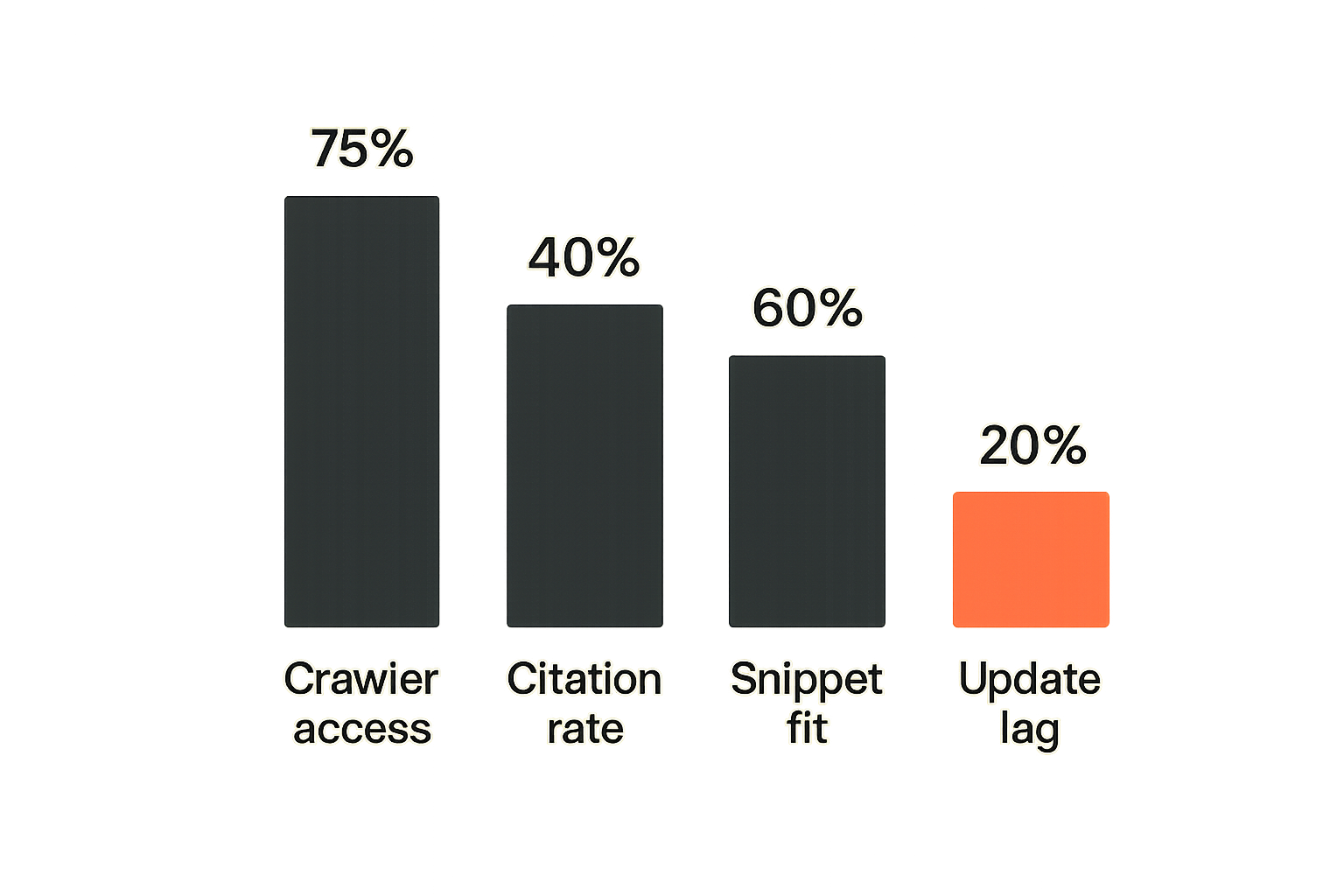
Useful operational metrics include:
| AI crawler hits |
Whether systems are fetching pages |
Review crawl policy and discovery |
| Freshness lag |
Time between update and crawler revisit |
Improve sitemaps and internal links |
| Citation accuracy |
Whether cited answers match source |
Rewrite answer blocks and tables |
| Canonical match |
Whether correct URL is cited |
Fix duplicates and canonical signals |
| Boundary preservation |
Whether caveats survive summaries |
Move disclaimers closer to claims |
This is not perfect attribution. AI answer surfaces are opaque. But operational measurement beats guessing.
Review citations, not just mentions
A brand mention without a citation may be useful, but it is hard to debug. A citation gives you a source URL and lets you inspect what the answer engine used. For peptide AEO, citations matter because they let you verify whether the system relied on approved pages.
Review citations regularly:
- Is the cited page current?
- Is it the canonical source?
- Does the answer preserve scientific nuance?
- Does it mix educational and commercial language?
- Does it cite a distributor, scraper, or outdated PDF instead of your page?
When the wrong page is cited, resist the urge to simply add more copy. Fix the information architecture.
What works and what fails for peptide AEO teams
What works
The teams that make progress usually treat peptide AEO as a shared operating model. They do not hand it to one SEO manager and hope for the best.
What works:
- Entity maps that writers and developers both use.
- Server-rendered answer blocks on priority pages.
- Schema that reflects the real page type.
- Visible review dates and accountable owners.
- Crawl policies aligned with business risk.
- Tables for exact facts.
- Prompt testing during QA.
- Log review after important updates.
The pattern is consistent: reduce ambiguity before asking answer engines to trust you.
What fails
What fails is usually faster and more tempting:
- Publishing AI-generated peptide pages without review.
- Copying scientific language into sales pages without boundaries.
- Blocking crawlers accidentally through old robots rules.
- Hiding critical facts in PDFs, images, or tabs.
- Treating llms.txt as a replacement for structured content.
- Measuring only whether a chatbot mentions the brand.
- Letting each product manager invent naming conventions.
These shortcuts create content volume, not answer reliability.
Practical rule: if peptide AEO work does not produce cleaner source pages, cleaner crawler policy, or cleaner measurement, it is probably theater.
Ownership model
Peptide AEO needs an owner, but it should not live in one department. A practical ownership model looks like this:
| SEO or AEO lead |
Query classes, visibility, content priorities |
Work becomes unfocused |
| Developer |
Rendering, schema, logs, crawl controls |
Pages are not machine-readable |
| Content strategist |
Page structure and internal linking |
Facts remain scattered |
| Scientific reviewer |
Accuracy and terminology |
Claims drift or become vague |
| Compliance reviewer |
Boundaries and risk language |
AI answers overstate intent |
| Commercial owner |
Product and market priorities |
Effort ignores business value |
This does not require a large team. It requires clear handoffs. The smaller the team, the more important the checklist becomes.
Where CrawlProof fits in a peptide AEO stack
Use it to connect crawlers, schema, and content changes
CrawlProof fits where many peptide AEO programs get messy: the gap between content intent and crawler reality. You can write careful pages, add schema, publish llms.txt, and still not know whether AI crawlers are reaching the right content or whether your site is sending mixed signals.
For peptide sites, that visibility matters. You want to know which pages are discoverable, how crawler behavior changes after updates, and where structured data or policy files need attention. The product fit is architectural rather than cosmetic: connect the technical signals to the content workflow so teams can make decisions with evidence.
A sensible stack looks like this:
- CMS patterns for answer blocks and review metadata.
- Structured data templates for major page types.
- robots.txt and llms.txt aligned with business policy.
- Crawler monitoring and AEO diagnostics.
- Prompt and citation review for priority query classes.
- Human approval for claims and sensitive pages.
That is the operating system for peptide AEO.
Keep humans in the compliance loop
Automation can surface crawler behavior, schema issues, missing summaries, and stale pages. It should not decide whether a peptide claim is acceptable. Keep scientific and compliance review in the loop for high-risk content.
The right workflow is not publish first, clean up later. The right workflow is structured drafting, machine-readable implementation, crawler validation, and human approval before the page becomes an authoritative source.
This is the part many teams underestimate. Answer engines amplify source material. If your source material is loose, the output can be looser.
Try crawlproof.com
Peptide AEO is an architecture and operations problem: crawl access, structured facts, compliant content, and measurable AI citations. CrawlProof helps site owners understand how AI crawlers discover, parse, and cite their content. Try crawlproof.com.