If you manage a website in 2026, scipy optimization minimize may sound like the wrong conversation. You have crawler logs, schema problems, content briefs, AI search volatility, and executives asking why competitors appear in answer engines while your better pages do not.
Teams think the problem is more content. The real problem is allocation under constraints.
You have limited developer time, limited editorial capacity, and limited evidence about what AI answer engines can actually read, trust, and cite. That changes the conversation. The practical question is not whether optimization is useful. The practical question is how to turn AEO work into a repeatable prioritization workflow instead of another spreadsheet argument.
This is where scipy optimization minimize becomes useful. Not because every SEO team needs to become a numerical computing team, but because the model forces better thinking: define the outcome, map the signals, assign costs, add constraints, and choose the next set of fixes with less hand waving.
Table of contents
Why scipy optimization minimize belongs in an AEO workflow
Not a math flex
The mistake teams make is treating scipy optimization minimize as a technical trick detached from marketing reality. In an AEO workflow, it is better understood as a decision engine. You are asking a practical question: given a fixed amount of time, which fixes create the most citation-ready surface area for AI answer engines?
That matters because AEO work spans multiple owners. Content wants better explainers. Developers want clean tickets. SEO wants crawlability and schema. Leadership wants visibility in ChatGPT-like answers, Perplexity-style summaries, AI Overviews, and vertical assistants. Everyone is partly right, but nobody has unlimited capacity.
A useful way to think about it is this: the solver does not decide your strategy. It exposes the tradeoffs inside your strategy. If your assumptions are weak, the output will be weak. If your inputs reflect real crawler access, entity clarity, schema completeness, and content usefulness, the model becomes a disciplined way to prioritize.
From rankings to objective functions
Classic SEO prioritization often starts with keywords, volume, difficulty, and current rank. AEO prioritization needs a broader model. Answer engines do not only need a page that targets a term. They need pages that can be crawled, parsed, trusted, summarized, and cited.
So instead of asking which keyword has the highest volume, you define an objective function. For example, maximize expected answer-engine usefulness while minimizing engineering effort, editorial effort, and implementation risk. That sounds abstract, but it maps cleanly to the work teams already do.
A product page with blocked AI bot access may score high on business value but low on retrievability. A strong explainer may be readable but lack structured evidence. A support page may answer an important question but hide the answer below tabs, scripts, or thin boilerplate.
Practical rule: If a page cannot be fetched, parsed, and understood, its keyword opportunity is theoretical.
Where the SEO team fits
The SEO team should not own every variable. It should own the model design and the operating cadence. Developers provide crawl and rendering constraints. Content teams estimate editorial lift. Product marketing identifies business value. Analytics teams help define observed outcomes.
If your team is new to answer engine optimization, it helps to separate AEO from classic SEO before building the model. The distinction is covered well in what AEO is and why it is not just SEO, especially the shift from ranking pages to becoming the cited source inside generated answers.
The solver is just the coordination layer. It turns cross-functional opinions into comparable numbers, then forces the team to inspect why one fix outranks another.
Build the objective before you touch the solver
Choose the business outcome
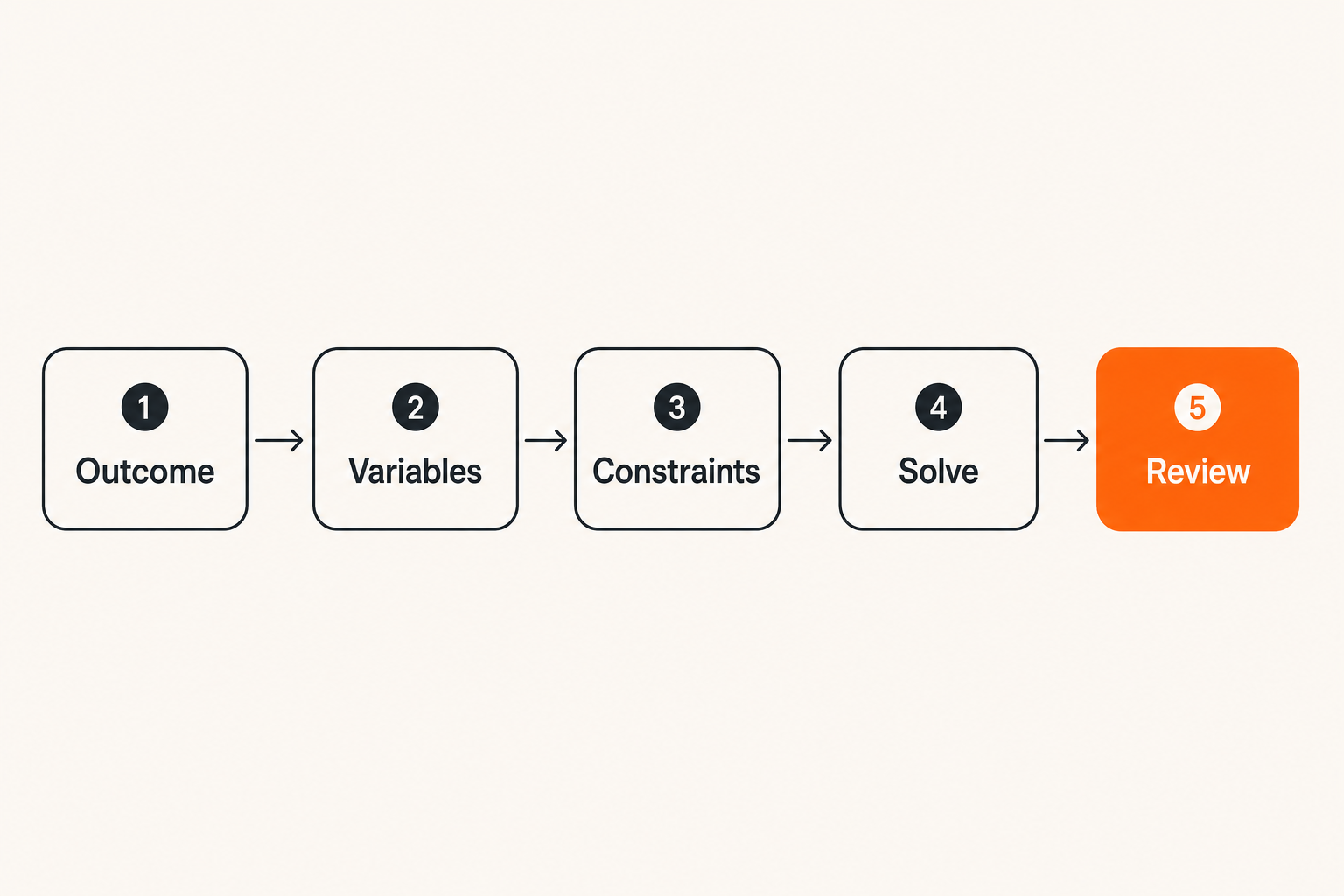
Before writing Python, choose the outcome. Many teams skip this and end up optimizing a proxy because it is easy to measure. That is how you get dashboards that improve while pipeline does not.
Good AEO outcomes are tied to business context. Examples include increasing citation readiness for commercial comparison pages, improving retrievability for technical documentation, making local service pages easier for assistants to summarize, or reducing ambiguity around product entities.
The objective should be narrow enough to guide action. Improve AI visibility is too broad. Prioritize 30 fixes that improve crawl access, schema clarity, and answer usefulness for high-intent solution pages is usable.
Practical rule: A solver needs a measurable objective, but your business needs a meaningful one. Do not confuse the two.
Translate content work into variables
In scipy optimization minimize, the solver changes variables to reduce an objective function. In your AEO model, variables can represent decisions such as whether to update a page, add FAQ schema, create an llms.txt entry, unblock an AI crawler, rewrite an answer section, or add author and organization evidence.
For a simple model, each potential fix can be binary: do it or do not do it. For a more nuanced model, each fix can be continuous from 0 to 1, representing partial allocation. In practice, binary planning is often easier for teams because tickets are discrete.
You might track variables like:
- x1: improve schema on product pages
- x2: rewrite top answer blocks on comparison pages
- x3: add citations and source context to research pages
- x4: fix robots rules for AI crawler access
- x5: create or update llms.txt
- x6: consolidate duplicate thin pages
Each variable needs an expected benefit and a cost. The benefit does not have to be perfect. It has to be explicit enough to debate.
Add constraints that reflect reality
Constraints are where the model becomes useful. Without constraints, every team simply chooses everything that looks valuable. That is not planning. That is a wishlist.
Common constraints include developer hours, editorial hours, page owner availability, release windows, legal review, brand review, CMS limitations, and technical debt. Some fixes also depend on other fixes. For example, adding schema may not help much if AI crawlers cannot access the page. Improving answer copy may not help if the answer is rendered only after client-side interaction.
Related reading from our network: teams building payment flows face the same mistake when they treat checkout UI as the whole system instead of modeling state and settlement, as shown in this crypto checkout architecture breakdown on peptide payments.
Map AEO signals into features
Crawl access and rendering
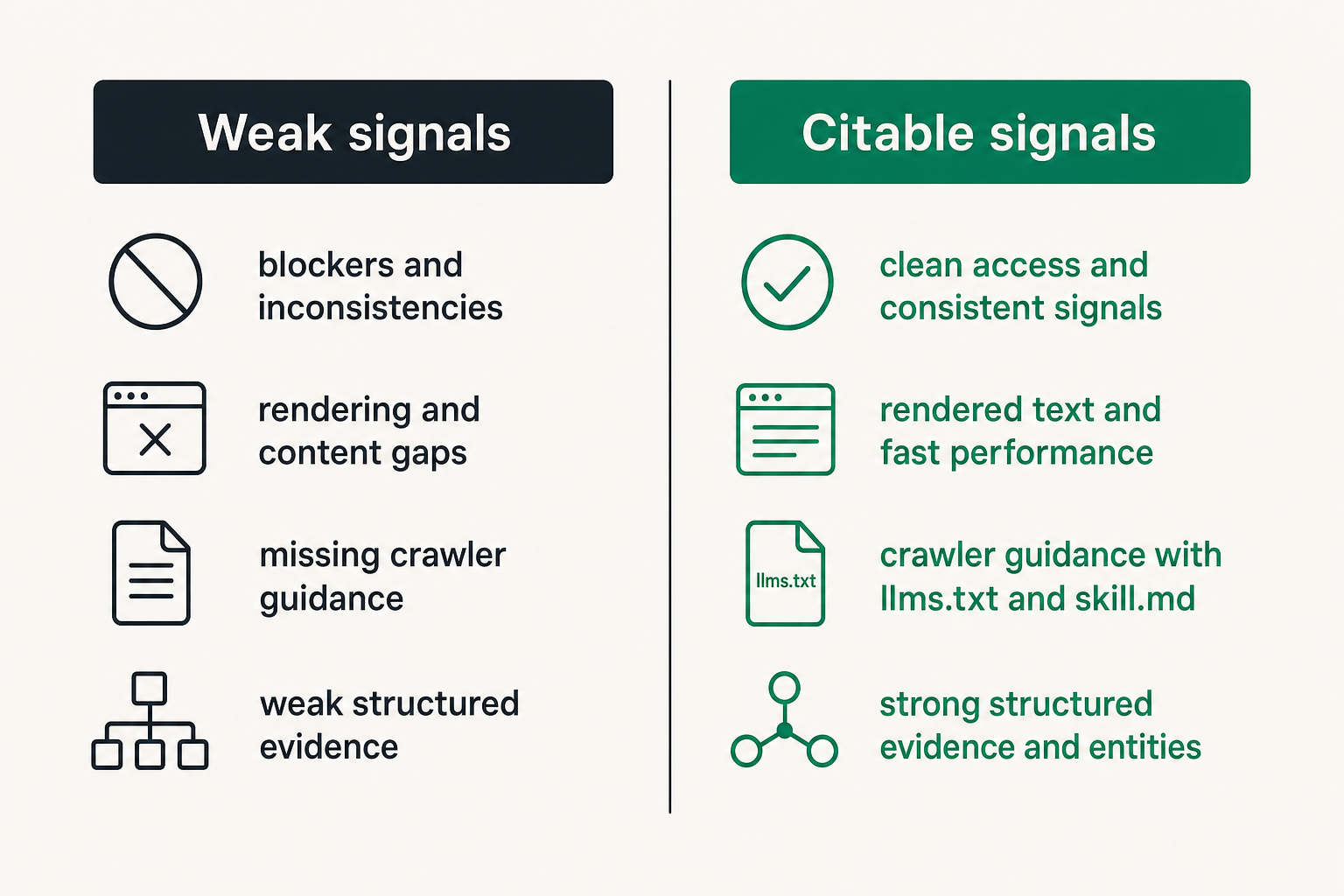
AEO starts with retrievability. If AI crawlers and answer engines cannot fetch a URL, your content is not a candidate. If they fetch it but miss the main content due to rendering, blocked assets, excessive JavaScript, or confusing templates, your page may be present but not usable.
The practical signals include robots rules, AI bot access, status codes, canonical consistency, server response reliability, page speed under crawler-like conditions, rendered text availability, and whether important answers appear in the initial HTML.
This is also where emerging files matter. Teams experimenting with crawler guidance should understand llms.txt and skill.md as part of the access and context layer, not as magic ranking files.
What breaks in practice is not usually one dramatic blocker. It is a stack of small issues: a noindex on a template, a canonical to the wrong page, a script-heavy answer section, and a robots rule nobody reviewed after a migration.
Structured evidence and entities
Answer engines need confidence. Schema markup is not a guarantee of citation, but it helps machines connect entities, authorship, products, FAQs, reviews, organizations, and topical relationships.
In your optimization model, structured evidence can become a feature. A page with missing Organization schema, weak author signals, and no clear entity relationships may receive a lower readiness score. A page with clean Article, Product, FAQPage, HowTo, or BreadcrumbList markup may receive a higher score, assuming the markup reflects visible content.
Do not reward schema spam. Reward consistency between markup and page content. AEO is not about hiding extra claims in JSON-LD. It is about making the visible evidence easier to parse.
Citation usefulness
Citation usefulness is the part many technical models miss. A page can be crawlable and well marked up while still being a poor answer source. If the content rambles, buries the conclusion, lacks definitions, avoids specifics, or does not answer follow-up questions, an answer engine has little reason to cite it.
Useful citation features include concise answer blocks, clear headings, original comparisons, named entities, dates, examples, limitations, and source context. Pages that explain tradeoffs tend to be more useful than pages that only sell.
Practical rule: AEO-ready content should answer the user, identify the entity, expose the evidence, and make citation easy without forcing a crawler to infer everything.
Scipy optimization minimize example for content prioritization
A minimal scoring model
The point of a scipy optimization minimize model is not mathematical purity. The point is turning AEO priorities into an inspectable function. Here is a simplified pattern.
import numpy as np
from scipy.optimize import minimize

# each row is a fix: value, dev_hours, editor_hours, risk
fixes = np.array([
    [90, 8, 2, 3],
    [70, 2, 6, 2],
    [50, 1, 3, 1],
    [85, 5, 1, 4],
    [60, 3, 2, 2],
])

def objective(x):
    value = fixes[:, 0]
    return -np.dot(value, x)

constraints = [
    {'type': 'ineq', 'fun': lambda x: 16 - np.dot(fixes[:, 1], x)},
    {'type': 'ineq', 'fun': lambda x: 10 - np.dot(fixes[:, 2], x)},
    {'type': 'ineq', 'fun': lambda x: 8 - np.dot(fixes[:, 3], x)},
]

bounds = [(0, 1) for _ in fixes]
start = np.zeros(len(fixes))
result = minimize(objective, start, bounds=bounds, constraints=constraints, method='SLSQP')
print(result.x)
This example uses continuous values between 0 and 1. In a real implementation, you may round, convert to tickets, or use a mixed-integer solver if you need strict binary choices. For many planning sessions, continuous output is still useful because it shows which fixes the model wants to fund first.
How to read the output
If the solver returns high allocation for robots fixes, schema cleanup, and answer rewrites, that does not mean the model discovered truth. It means those fixes scored well under your stated assumptions and constraints.
The team should inspect the output like an operating review:
- Did the model prioritize pages with real business value?
- Did it over-reward cheap tasks with low strategic impact?
- Did it ignore dependency order?
- Did it overweight subjective content scores?
- Did it choose work that can ship this sprint?
This is where the conversation becomes productive. Instead of debating opinions, you debate assumptions. That changes the conversation because weak assumptions become visible.
What the model does not know
The model does not know whether an answer engine will cite you next week. It does not know whether a competitor will publish better research. It does not know whether a crawler changed behavior. It does not know whether your brand is trusted in a niche.
That is fine. The model is not a prophecy engine. It is a prioritization system. Its job is to help you choose the next best set of actions under constraints.
The mistake teams make is treating the output as an answer instead of a decision aid. Use it to focus implementation, then validate against actual crawler behavior, answer inclusion, and downstream business outcomes.
Constraints matter more than clever scores
Budget and engineering capacity
Most AEO programs fail at the constraint layer. Teams create a long audit, assign everything a severity, and then wonder why nothing ships. Severity is not the same as feasibility.
Engineering capacity is often the binding constraint. Robots rules, rendering changes, canonical fixes, schema templates, CMS components, and log instrumentation all require technical ownership. If your model ignores developer hours, it will recommend a fantasy roadmap.
Editorial capacity matters too. Rewriting answer blocks, adding examples, consolidating pages, and improving topical coverage take time. If every fix requires a senior subject matter expert, the model needs to know that.
Related reading from our network: independent operators face a similar allocation problem when choosing platforms, outreach channels, and proof assets, which is why this guide to freelance websites for remote work is relevant as an adjacent planning example.
Risk and dependency limits
Not every high-value fix should ship first. Some changes are risky. Updating robots rules can expose or block the wrong paths. Changing templates can affect thousands of pages. Consolidating content can break internal links or remove long-tail coverage.
Dependencies matter. If a page is blocked, improving copy may be premature. If schema is generated from bad CMS fields, manual patches may create maintenance debt. If entity names are inconsistent across the site, adding more markup may amplify confusion.
A practical model should include dependency flags or penalties. At minimum, tag each fix as independent, dependent, or risky. Then review the solver output through that lens before creating tickets.
When to rerun the model
Rerun the model when the system changes, not every time someone has an opinion. Good triggers include a site migration, major template change, crawler access change, new product launch, content consolidation, schema deployment, or observed change in AI answer citations.
Monthly or quarterly works for many teams. Fast-moving publishers may run it weekly. The cadence matters less than the habit: update inputs, rerun, review assumptions, ship selected fixes, then measure.
Practical rule: Optimization is a loop. If you do not feed results back into the model, you are just decorating a spreadsheet with math.
What works in production
Start with decisions not dashboards
Dashboards are useful after you know what decisions they support. Starting with dashboards usually creates metric sprawl: crawl counts, schema counts, impressions, mentions, answer snapshots, content scores, log lines, and subjective quality ratings with no operating logic.
Start with decisions instead. Which pages should we fix this sprint? Which template deserves engineering time? Which content cluster needs entity cleanup? Which crawler access problem blocks the most business value?
Then build the smallest dataset that supports those decisions. A compact model with 40 candidate fixes and 8 meaningful features is usually more useful than a giant dashboard nobody trusts.
Keep humans in the loop
AEO has judgment baked into it. You are estimating whether a page is likely to be useful in generated answers. You are judging authority, clarity, originality, and whether the content has a reason to be cited.
Use human review where judgment is high and automation where repetition is high. Automation can detect blocked crawlers, missing schema, thin pages, inconsistent titles, and rendering gaps. Humans should evaluate whether the page actually answers the question well.
A good operating model combines both. The solver ranks candidates. The team reviews the top recommendations. Owners convert them into tickets. Results update the next run.
Validate against crawler behavior
Validation is where AEO becomes operational. You need to inspect what crawlers can access, not just what your browser shows. You also need to test structured data, rendered content, robots behavior, and whether your pages present clear answer-ready sections.
Related reading from our network: legal streaming workflows have similar operational friction because access, devices, rights, and tracking all affect the real user path, as this practical guide to AP Bio streaming shows in a different niche.
For AEO, validation means comparing your intended page state with the crawler-visible state. If those diverge, fix the system before chasing more content.
What fails when teams implement it badly
Optimizing stale assumptions
The fastest way to make scipy optimization minimize useless is to feed it stale inputs. A page that was blocked last month may be fixed now. A once-important page may no longer matter. A schema template may have changed. An answer engine may now cite a different type of source.
Stale assumptions are worse than no model because they create false confidence. The team thinks it is being rigorous while optimizing yesterday's site.
Set expiration rules for inputs. Crawl data might expire after 30 days. Editorial scores might expire after a major content update. Business priority scores might expire after a product strategy change.
Treating AI crawlers like Googlebot clones
AI crawlers are not all the same. Some fetch differently. Some respect different controls. Some rely on third-party indexes. Some may not execute pages the way a browser does. Some answer engines synthesize from multiple retrieval layers.
If your model assumes Googlebot visibility equals AI answer visibility, it will miss problems. Classic SEO health is necessary but not sufficient. You still need to understand bot access, AI-oriented guidance files, page extractability, structured evidence, and answer usefulness.
What breaks in practice is that teams declare a page healthy because it is indexable in search, then discover that answer engines miss the section that matters.
Chasing citations without answer quality
Some teams treat AEO like a citation hack. They add schema, publish listicles, and write forced answer snippets. That may create more machine-readable text, but it does not create a better source.
Answer quality still matters. Pages that are vague, derivative, over-promotional, or unsupported are weak candidates. The goal is not to trick an LLM crawler into seeing your page. The goal is to make your page the most useful evidence for a specific answer.
A model should penalize pages that lack specificity, freshness, author context, or clear claims. Otherwise, you will optimize the shell and ignore the substance.
Implementation workflow for SEO and dev teams
The eight step rollout
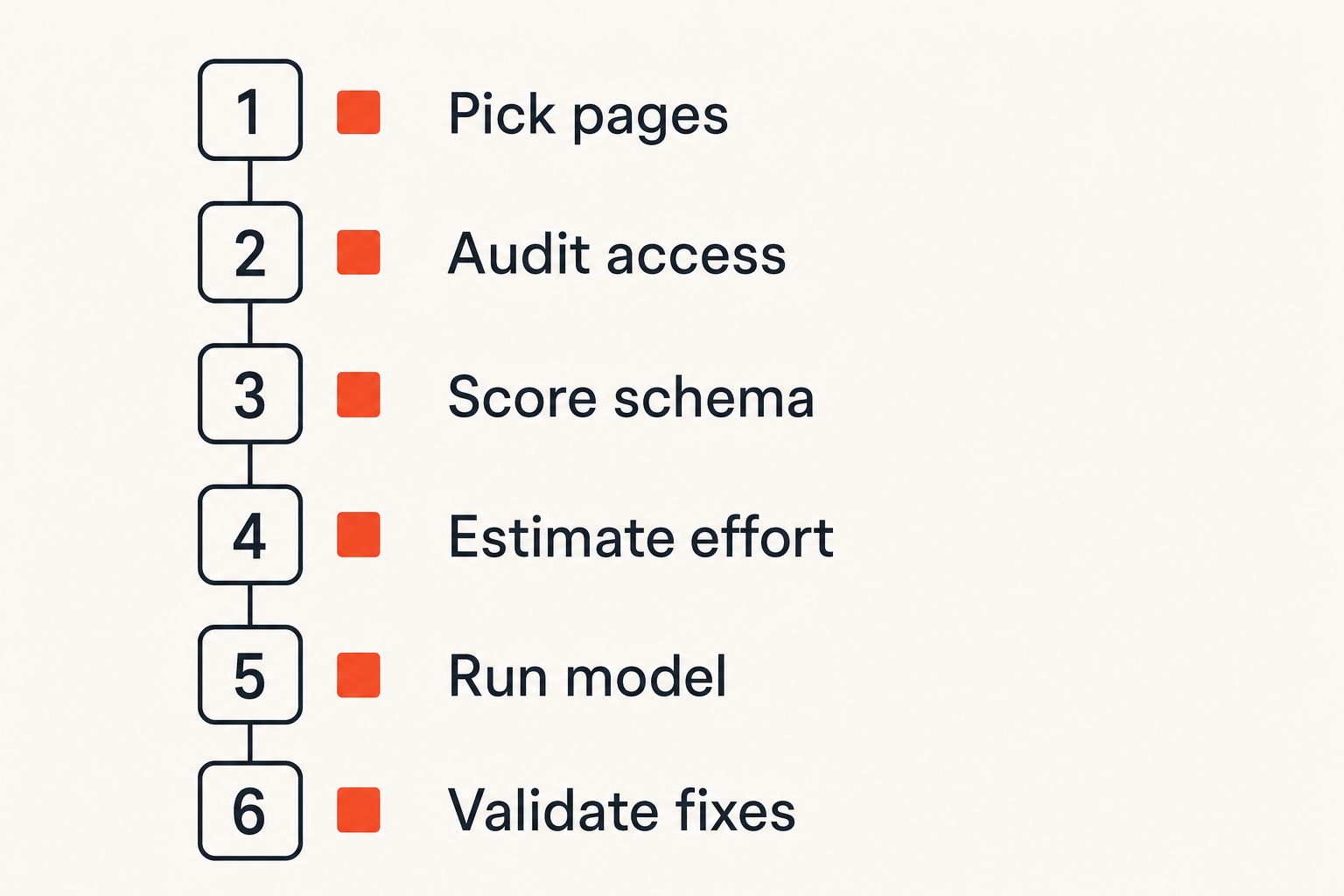
Here is a practical rollout sequence that works for mixed SEO, content, and engineering teams:
- Define the target answer surfaces, such as product comparisons, how-to answers, local recommendations, documentation answers, or category explanations.
- Select candidate pages and templates with business value.
- Audit crawler access, rendering, robots rules, canonical signals, and AI bot visibility.
- Score structured evidence, including schema, entity consistency, author signals, and organization context.
- Score citation usefulness, including answer clarity, examples, freshness, and source value.
- Estimate implementation cost across engineering, editorial, legal, and product review.
- Run scipy optimization minimize or a simpler constrained prioritization model.
- Convert the selected fixes into tickets, ship them, and update the model with observed results.
This sequence keeps the model close to implementation. It avoids the common failure mode where an audit becomes a static PDF nobody owns.
Ownership and handoffs
Ownership needs to be explicit. The SEO or AEO lead owns the prioritization model. Engineering owns technical fixes. Content owns answer quality. Product marketing owns positioning and entity clarity. Analytics owns measurement definitions.
The handoff should happen through tickets, not vague recommendations. A useful ticket includes the URL or template, the observed problem, the expected AEO impact, the implementation owner, the acceptance criteria, and the measurement plan.
For example: AI crawler-visible HTML does not include the primary answer block on comparison pages. Move the answer summary into server-rendered HTML. Acceptance criteria: crawler fetch shows the summary text without interaction, schema still validates, and canonical remains unchanged.
Metrics that should change
Do not expect one metric to prove everything. AEO is an evidence stack. Useful metrics include AI crawler accessibility, successful fetch rates, rendered text parity, schema validation, entity consistency, number of answer-ready pages, citation observations, referral patterns where available, and assisted conversion indicators.
The most important early metrics are operational. Are more high-value pages accessible? Are more pages structured clearly? Are answer blocks visible? Are fewer important pages blocked or ambiguous?
Business metrics lag. Operational metrics tell you whether the system is becoming more eligible for citation.
Product fit for crawlproof.com
Where CrawlProof fits in the loop
CrawlProof fits before and after the optimization model. Before the model, it helps identify what AI crawlers and answer engines can actually find on a URL: content, schema, robots rules, AI bot access, and positioning. After fixes ship, it helps validate whether the crawler-visible state changed.
That is important because a prioritization model is only as good as its inputs. If you score pages based on browser-visible content but AI crawlers see something different, your optimization logic is built on the wrong site.
The product is not a replacement for strategy. It is an inspection layer for the parts of AEO that are easy to assume and expensive to get wrong.
How this supports AEO operations
AEO operations need a feedback loop: inspect, prioritize, implement, validate, repeat. CrawlProof supports the inspection and validation parts of that loop, which makes the scipy optimization minimize workflow more grounded.
Instead of asking whether a page feels ready, you can ask better questions. Can AI crawlers access it? Is the important content visible? Does the schema describe the visible page? Are there robots or rendering issues? Is the page positioned clearly enough to be cited?
Those answers become model inputs. The model then helps decide what to fix first.
When to bring in a human fix
Automation can identify many problems, but some fixes need human judgment. If your product category is ambiguous, your content lacks a defensible point of view, or your site has conflicting entity signals, a tool can surface the issue but a human needs to resolve it.
Human review is also useful when the model recommends high-risk changes. Robots rules, template changes, canonical logic, and large content consolidations deserve careful review before deployment.
The best setup is not tool versus human. It is tool-assisted operations with clear ownership.
Closing the loop on scipy optimization minimize
Make the model boring and repeatable
The best version of this workflow is boring. Inputs are updated on a schedule. Scores have definitions. Constraints match real capacity. The solver output is reviewed by owners. Tickets ship. Validation updates the next run.
That is how scipy optimization minimize becomes useful for AEO. Not as a novelty, but as a structured way to choose among crawler fixes, schema improvements, content rewrites, and technical cleanup.
If the model produces surprising results, inspect the assumptions. If it produces obvious results, it may still be valuable because it documents why those obvious fixes deserve priority.
The practical takeaway
AEO is not just content production. It is an architecture and workflow problem. AI answer engines need retrievable pages, clear entities, structured evidence, and useful answers. Your team needs a way to decide which improvements matter first.
Scipy optimization minimize gives you a practical framework for that decision. Define the objective, map the features, add real constraints, run the model, review the output, ship the work, and validate the crawler-visible result.
The closing point is simple: scipy optimization minimize is not the AEO strategy. It is the prioritization discipline that helps your AEO strategy survive contact with limited time, limited engineering capacity, and changing AI crawler behavior.
Try crawlproof.com
CrawlProof helps site owners and marketers see how AI answer engines and LLM crawlers discover, understand, and cite their content. Try crawlproof.com.