Security operations AI answer engines are now part of the buying journey whether security vendors planned for them or not. A CISO asks an assistant how to reduce alert fatigue. A SOC manager asks which exposure management signals belong in triage. A practitioner asks for a sample detection workflow. The answer may include your brand, your competitor, or nobody from your category.
Teams think the problem is ranking for more security keywords. The real problem is whether AI answer engines can understand your security operations expertise well enough to reuse it with confidence.
That changes the conversation. This is not just a content calendar problem. It is an architecture problem across crawl access, entity clarity, schema, source-of-truth pages, evidence, freshness, and operational language. If your best SOC knowledge lives in PDFs, gated decks, vague product pages, or webinar transcripts with no structure, AI systems have very little to work with.
The practical question is simple: can an answer engine inspect your site and determine what you know, who it helps, when it applies, and why it should be cited?
Table of contents
Why security operations belongs in AI answer engine strategy

Search intent is turning into task intent
Classic SEO often starts with a keyword and asks how to rank a page. AI answer engines start closer to a task. The user is not only searching for alert fatigue. They are asking how to redesign triage, which signals to prioritize, how to connect exposure data to detection, or how to justify a SOC automation project.
That matters because security operations buyers do not evaluate content like casual readers. They look for specificity. They notice whether an article understands SIEM noise, detection engineering backlogs, enrichment gaps, case ownership, false positive handling, escalation paths, and validation.
A page that says a platform improves visibility may rank for a broad query. It may still be useless to an answer engine trying to explain how a SOC should route identity alerts after an impossible travel event.
Practical rule: write for the operational decision, not the abstract keyword. If the page does not help someone choose, configure, investigate, or validate something, it is probably weak AEO material.
SOC content is workflow content
Security operations knowledge is usually procedural. It describes how signals move from telemetry to detection to triage to response to reporting. That is exactly the kind of material answer engines can summarize, compare, and cite when it is structured well.
The mistake teams make is treating SOC content as brand narrative. They publish pages about unified visibility, autonomous defense, or next-generation operations. Those phrases may sound familiar, but they do not expose a workflow. They do not tell a model what inputs exist, what decision happens next, what output is expected, or what failure mode the team is trying to avoid.
A useful way to think about it is this: every strong security operations page should contain a mini operating model. It should say who owns the step, what data is needed, what tool or process consumes it, what good output looks like, and where the handoff breaks.
AEO is an architecture decision
Answer engine optimization is not a magic formatting layer added after publishing. For security operations topics, it is the information architecture that makes expertise machine-readable and human-usable at the same time.
That includes crawlable HTML, consistent terminology, schema markup, canonical pages, internal linking, clear authorship, updated dates, examples, tables, and concise definitions embedded inside deeper workflow pages.
When security content is architected this way, AI systems have cleaner source material. Website visitors also get a better experience because the page answers the real operational question instead of circling around it.
How security operations AI answer engines interpret your site
Security operations AI answer engines need to identify entities before they can reason about your content. Entities include product categories, techniques, job roles, data sources, standards, workflows, and sometimes vendor names. If your site uses five different labels for the same capability, you are making entity extraction harder.
For example, a site might use exposure management, attack surface management, vulnerability prioritization, and proactive risk operations interchangeably. Those terms can overlap, but they are not identical. If the page does not explain the relationship, an answer engine may treat the content as vague or inconsistent.
This is where simple technical hygiene helps. Use stable page titles. Define terms once, then reuse them consistently. Build hubs around actual topics rather than campaign slogans. Connect related pages with descriptive internal links.
They look for provenance and operational context
AI systems are more likely to use content that looks attributable and grounded. In security operations, provenance is not only about author bios. It is about whether the claim is tied to a workflow, a scenario, an example, or an observable pattern.
A statement like SOC teams need automation is too generic. A better passage explains that enrichment automation can reduce manual lookups during triage by pulling asset criticality, identity context, recent vulnerability exposure, and related alerts into the case before analyst review. That gives the answer engine a usable explanation.
The team at threatcrush.com often frames SOC improvement around signals, ownership, validation, and response workflows because those are the details that separate real security operations from brochure language.
Freshness matters more when the topic changes fast
Security operations changes quickly. New attack techniques, telemetry sources, AI-assisted analyst workflows, cloud identity patterns, and regulatory expectations all shift the language buyers use. Old pages can still be useful, but only if they are maintained.
What breaks in practice is the orphaned evergreen article. It was accurate two years ago, but it references stale tools, old assumptions, or outdated response models. Answer engines may still crawl it, but the page becomes a weak candidate for current answers.
Freshness does not mean rewriting everything every month. It means showing a maintained editorial system: updated dates, changelog notes for major revisions, current examples, and links to newer related resources.
Build an AEO architecture for SOC buyers
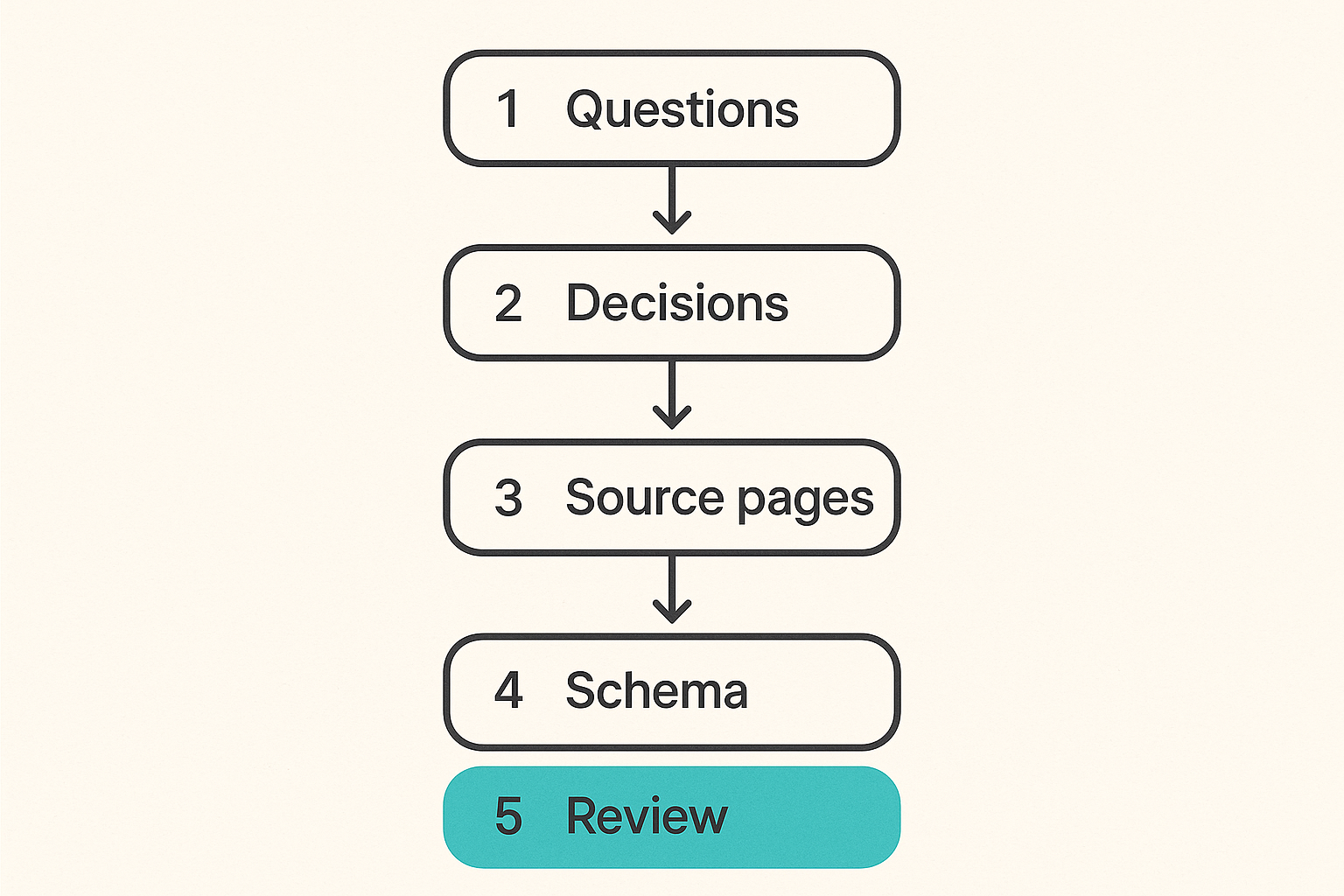
Map questions to operating decisions
The best AEO architecture starts with buyer questions, but not in the shallow FAQ sense. Map each question to the decision behind it.
| How do we reduce alert fatigue? |
Which alerts should be suppressed, enriched, routed, or redesigned? |
Workflow guide with triage matrix |
| What is exposure management? |
How should proactive risk signals affect SOC priorities? |
Concept page plus integration runbook |
| Do we need SOAR? |
Which response steps are safe to automate? |
Decision table and implementation checklist |
| How should we handle identity alerts? |
Which identity events require escalation versus enrichment? |
Investigation playbook |
| What SOC metrics matter? |
Which metrics show speed, coverage, quality, and business risk? |
Metrics framework with examples |
That changes the page plan. You are not creating one article per keyword. You are building a library of operating decisions that answer engines can reuse.
Create source-of-truth pages
A source-of-truth page is the canonical explanation of a topic on your site. It should be broad enough to define the concept and specific enough to explain how it works in production.
For security operations, useful source-of-truth pages often cover topics such as alert triage, detection engineering, SOC automation, exposure management, incident response handoffs, threat intelligence usage, and analyst workflows.
Each page should include:
- A concise definition near the top.
- The problem it solves and what it does not solve.
- Inputs, outputs, owners, and systems involved.
- Common implementation patterns.
- Failure modes.
- Links to deeper examples, templates, or use cases.
Practical rule: if you want an AI answer engine to cite you for a topic, create one durable page that deserves to be the canonical explanation of that topic on your domain.
Use schema to reduce ambiguity
Schema markup will not compensate for weak content, but it can help machines interpret strong content. For SOC content, the useful starting points are usually Article, FAQPage where appropriate, BreadcrumbList, Organization, Person, SoftwareApplication for product pages, and HowTo only when the page genuinely provides a step-by-step process.
The practical question is not whether schema is a ranking trick. It is whether your markup reinforces the same entities and relationships already visible in the page.
Bad schema creates mismatch. A page positioned as a thought leadership article should not be marked up as a product if it does not describe product functionality. A generic FAQ block should not be used to hide thin answers. Keep markup honest and consistent.
Signals that matter for security operations AI answer engines
Crawler access and page renderability
If AI crawlers cannot fetch your content, they cannot cite it. That sounds obvious, but many sites accidentally block important pages through robots rules, JavaScript rendering issues, aggressive bot protection, redirect chains, or gated resource patterns.
Security companies are especially prone to this because they often run strict web defenses. That is reasonable. The mistake is not security control. The mistake is having no visibility into which legitimate crawlers are blocked, challenged, slowed, or served incomplete pages.
Renderability also matters. If your core explanation is buried in client-side components that do not render cleanly, an answer engine may see a shell rather than the substance of the page.
Clear topical ownership
Answer engines need to understand what your site is authoritative about. A security vendor publishing occasional generic posts on every hot topic can dilute the signal. A site with a coherent cluster around SOC workflows, detection operations, or exposure-driven response is easier to interpret.
Topical ownership comes from depth and structure. One page on alert fatigue is not a cluster. A cluster includes the causes of alert fatigue, triage design, detection quality, enrichment patterns, suppression rules, analyst metrics, escalation paths, and validation methods.
That depth helps both humans and machines. It shows that the site is not borrowing the topic for traffic. It has operating knowledge.
Citation-ready evidence
Citation-ready content is easy to quote accurately. It uses clear claims, specific examples, and well-labeled sections. It avoids hiding the main point behind inflated language.
Compare these two passages:
| Our solution transforms SOC productivity with AI. |
A SOC automation workflow should enrich alerts with asset, identity, vulnerability, and related-event context before analyst review. |
| Security teams need unified visibility. |
Alert triage breaks when SIEM events lack ownership, asset criticality, user context, or recent exposure data. |
| AI is the future of cyber defense. |
AI assistance is most useful when it drafts summaries, groups related alerts, suggests next steps, and leaves approval with the analyst. |
The second column gives an answer engine something concrete to reuse. It also gives a buyer something concrete to evaluate.
Workflow: turn SOC expertise into answer-ready assets
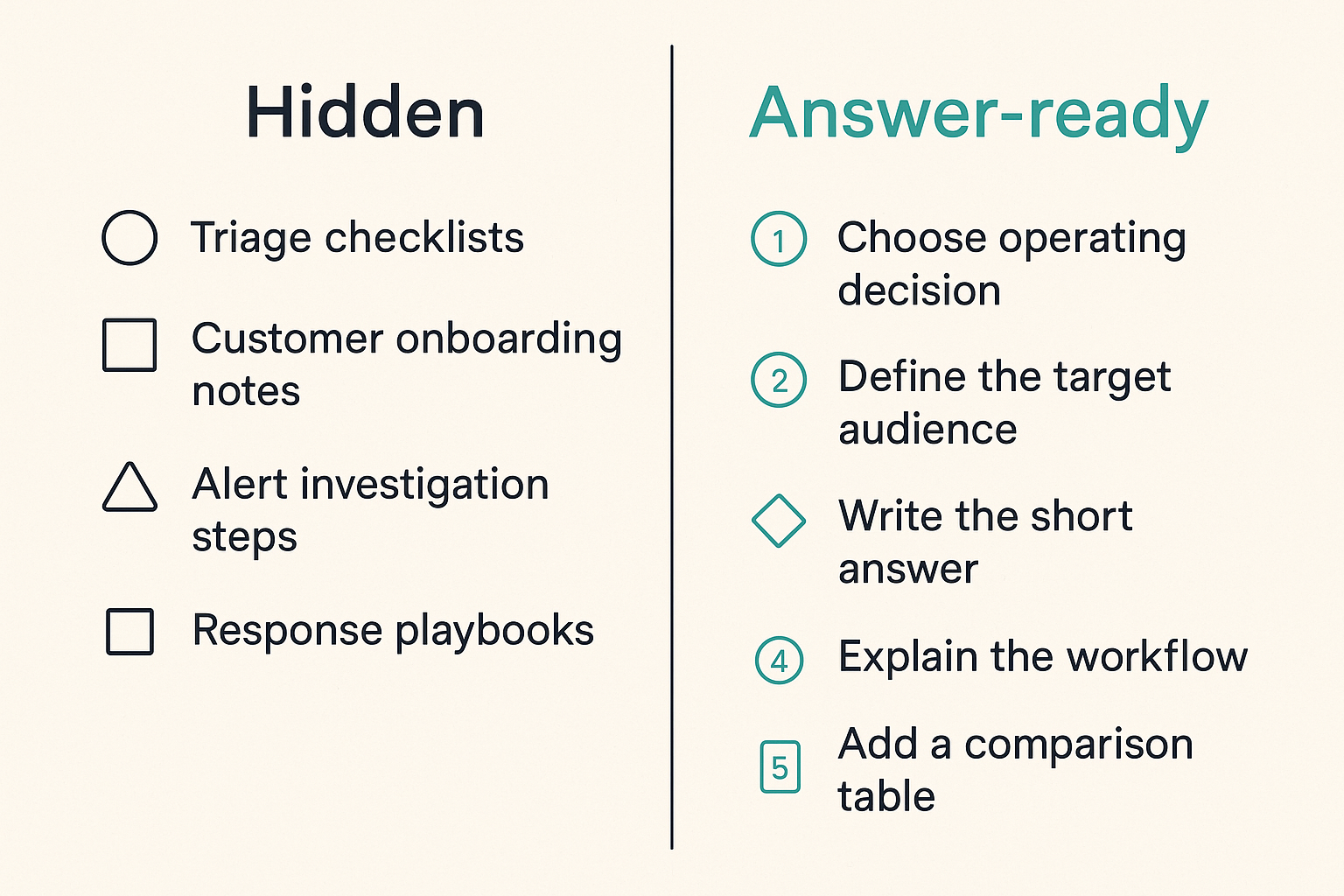
Start with internal workflows
Do not start by asking the content team to write more blogs. Start by collecting the workflows your subject matter experts already use. Sales engineers, detection engineers, incident responders, customer success teams, and product managers usually have the best raw material.
Look for assets such as:
- Triage checklists.
- Customer onboarding notes.
- Alert investigation steps.
- Response playbooks.
- Architecture diagrams.
- Demo scripts.
- Support explanations.
- Post-incident lessons learned.
These documents often contain the language answer engines need: inputs, decision points, constraints, and examples. The job is to sanitize, structure, and publish the reusable parts.
Publish in reusable units
AEO-friendly SOC content is modular. One long page can work, but only if it is clearly sectioned. Answer engines often need to extract a specific explanation, comparison, or process from the page.
A practical publishing sequence looks like this:
- Choose one operating decision, such as how to prioritize alerts using exposure context.
- Define the target audience, such as SOC manager, detection engineer, or CISO.
- Write the short answer in the first few paragraphs.
- Explain the workflow with inputs, steps, owners, and outputs.
- Add a comparison table or decision matrix.
- Include failure modes and edge cases.
- Add schema and internal links to related source-of-truth pages.
- Check crawler access, rendering, and indexability.
- Review the page quarterly or when the workflow changes.
Practical rule: every answer-ready page should contain a short answer, a workflow, a comparison, and a failure-mode section. That combination makes the content useful beyond normal ranking.
Add a review loop
Security operations content ages differently from lifestyle or basic SaaS content. A new detection source, cloud identity pattern, regulatory requirement, or attacker technique can change the practical advice.
Build review triggers into the workflow. Review a page when a product capability changes, when a common customer question changes, when a major industry event shifts terminology, or when logs show AI crawlers repeatedly visiting an older page.
The review loop does not need to be heavy. A quarterly check is often enough for evergreen pages. High-change topics may need faster updates.
What works for SOC AEO content
Decision tables beat vague positioning
Decision tables work because they expose judgment. They show when to use one approach over another. This is valuable in security operations because most teams are not choosing between good and bad. They are choosing between tradeoffs.
For example, a SOC automation page can compare enrichment, containment, notification, ticket creation, and analyst approval. Each row can explain risk, owner, automation suitability, and rollback considerations.
That is more useful than saying automation accelerates response. It shows where automation belongs and where it should stop.
Runbooks make expertise visible
Runbooks are strong AEO assets when they are written for public education rather than internal secrets. A public runbook does not need to expose sensitive detection logic or customer data. It can explain the shape of an investigation.
A good public runbook might cover:
- What triggers the investigation.
- Which data sources are checked first.
- What enrichment is needed.
- Which findings indicate benign activity.
- Which findings require escalation.
- What gets documented in the case.
This turns abstract expertise into a workflow that answer engines can understand and buyers can evaluate.
Versioned pages preserve trust
Versioning is underrated. If a page explains a SOC metric framework, detection maturity model, or AI analyst workflow, the reader should know when it was last updated and what changed.
You do not need a software-style changelog on every blog post. But for core source-of-truth pages, a short updated note helps. It tells both humans and machines that the page is maintained.
Versioning is especially useful for topics involving AI in the SOC. The language is moving quickly, and old claims can look careless.
What fails in practice
Generic platform pages blur the entity
The most common failure mode is the platform page that tries to own every term at once. It mentions SIEM, SOAR, XDR, exposure management, threat intelligence, AI, compliance, automation, and incident response without explaining how any of them connect.
Humans skim it and leave. Answer engines struggle to extract a precise answer. The page is technically about security operations, but it does not demonstrate operational understanding.
What works is narrower and deeper. A page about AI-assisted alert triage should explain that workflow. A page about exposure-driven SOC prioritization should explain that workflow. You can connect them later through hubs and internal links.
Blocked or hidden content creates blind spots
Another failure mode is hiding the best content. Teams put the strongest material in PDFs, gated reports, embedded slides, videos without transcripts, or customer-only portals. Those assets may still be valuable for sales, but they are weak discovery surfaces for answer engines.
If the public HTML page only says download the report, the answer engine may not get the actual insight. If a webinar contains the best explanation of your approach but there is no transcript or structured summary, the content is effectively invisible.
The fix is not to ungate everything. The fix is to publish a strong public summary page with the core concepts, definitions, tables, and workflow excerpts. Then the gated asset can go deeper.
Unowned claims age badly
Security teams often publish claims that nobody owns after launch. This is risky in AEO because old content can be rediscovered and reused. Claims about AI capabilities, detection coverage, response speed, or threat behavior should have an owner.
What breaks in practice is accountability. Marketing publishes the page, product changes, legal reviews a new claim elsewhere, and the original article keeps circulating. Months later, an answer engine cites stale language.
To avoid this, assign topics to owners. Detection content should have a detection reviewer. Incident response content should have a response reviewer. Product capability claims should have product and legal review. This is not bureaucracy. It is hygiene.
Measure whether answer engines can use your security operations content
Inspect crawler behavior
You cannot manage what you cannot see. Start with server logs and analytics that show visits from known AI crawlers and user agents. Look for which pages they request, how often they return, whether they receive 200 responses, and whether important pages are skipped.
Crawler behavior will not tell you every downstream answer. But it tells you whether your site is available to the systems that might include you. If key pages are never crawled, your content architecture has a discovery problem.
Also inspect response behavior. Are crawlers hitting redirects? Are they challenged by bot protection? Are they fetching pages that rely on scripts for the main content? Are they receiving truncated or error pages?
Test answer inclusion carefully
Testing AI answers is messy. Different tools, sessions, models, geographies, and prompts can produce different outputs. Do not build your entire strategy around one screenshot.
Instead, create a repeatable prompt set around your operating decisions. Test prompts such as:
- How should a SOC reduce false positives without missing real incidents?
- How can exposure management data improve alert triage?
- What is a practical SOC automation workflow for identity alerts?
- Which metrics show whether detection engineering is improving?
Track whether your brand is mentioned, whether your concepts appear, whether competitors are cited, and whether the answer uses language similar to your source-of-truth pages. Treat this as directional evidence, not a perfect rank tracker.
Tie AEO to useful business outcomes
The goal is not only to appear in AI answers. The goal is to influence qualified buyers before they reach a demo request, analyst call, or vendor shortlist.
Useful outcomes include:
- More branded searches after AI-assisted research.
- More visits to source-of-truth pages.
- Higher engagement from technical buyers.
- Better sales conversations because prospects already understand your point of view.
- Fewer repetitive education calls.
- More inbound questions around the workflows you actually solve.
This is where AEO becomes a business workflow, not a vanity channel.
Governance for security claims in AI answers
Assign ownership by topic
Governance sounds heavy until a stale claim appears in a buyer conversation. Security operations content needs clear ownership because the claims can affect trust.
Create a topic ownership map. It can be simple:
| Detection engineering |
Detection lead |
Product marketing |
New data source or rule logic change |
| SOC automation |
Product manager |
Security architect |
Workflow or integration change |
| Incident response |
IR lead |
Legal or compliance |
Regulatory or process change |
| AI analyst assistance |
AI product owner |
Legal and security |
Capability or risk language change |
This keeps pages accurate without slowing every update.
Separate education from product claims
Educational content and product claims can live near each other, but they should not be confused. A page explaining alert triage best practices should be useful even if the reader never buys the product. A product page can then explain how the product supports that workflow.
This separation helps answer engines because it clarifies intent. It also helps readers trust the material. If every paragraph turns into a pitch, the page becomes less useful as a source.
The practical question is whether the page could stand as an explanation. If not, it is probably not strong AEO content.
Keep evidence close to the claim
Do not make readers hunt for support. If you claim that a workflow reduces manual triage steps, explain which steps are removed or automated. If you claim that exposure context improves prioritization, show the before-and-after decision path.
Evidence can be qualitative. You do not need to invent statistics. In fact, do not. Use examples, process diagrams, sample fields, decision tables, and clear assumptions.
Practical rule: never publish a security operations claim that cannot be tied to a workflow, example, capability boundary, or review owner.
Where CrawlProof fits in the security operations AI answer engines workflow
See how AI crawlers reach your content
CrawlProof is built for site owners and marketers who need to understand how AI answer engines and LLM crawlers interact with their sites. For security operations content, that visibility is critical because the strongest pages are often the most technical, the most protected, or the easiest to accidentally hide.
The value is not just knowing that a crawler visited. The value is seeing whether your source-of-truth pages are reachable, whether important content is being missed, and whether your site architecture gives answer engines a clean path through your expertise.
Operationalize schema and llms.txt
AEO depends on signals that are easy to neglect when teams are moving fast. Schema markup, crawler guidance, page structure, and emerging standards such as llms.txt all need operational attention.
For a SOC vendor or security publisher, this means making your technical content legible without weakening your security posture. You want crawlers to reach public educational assets, not sensitive internal systems. You want machine-readable structure, not accidental exposure.
CrawlProof helps make that conversation concrete. Instead of debating AEO in the abstract, teams can inspect crawler behavior, review discoverability gaps, and prioritize fixes.
Close the loop between content and discoverability
The best content strategy will underperform if answer engines cannot discover the content. The best technical setup will not help if the content is vague. You need both.
A practical operating model looks like this:
- Build source-of-truth pages around security operations workflows.
- Structure those pages with clear definitions, examples, tables, and schema.
- Verify crawler access and rendering.
- Monitor AI crawler behavior over time.
- Refresh pages when workflows, terminology, or capabilities change.
- Test whether answers reflect your point of view.
That is the real work behind security operations AI answer engines. Not hype. Not keyword stuffing. A clean system that lets machines and buyers understand what your team knows.
Try crawlproof.com
CrawlProof helps website owners understand AI crawler behavior, AEO readiness, schema markup, and llms.txt so their content can be discovered and cited by AI answer engines. Try crawlproof.com and see how your security operations AI answer engines workflow looks from the crawler side.