Sintra AI is showing up in more website, marketing, and operations conversations because teams want AI systems to do more than draft copy. They want assistants that help publish faster, answer customers, summarize expertise, and turn messy business knowledge into usable content.
Teams think the problem is choosing the right AI tool. The real problem is building a website workflow that AI answer engines can understand, crawl, trust, and cite.
That changes the conversation. If your site has thin pages, blocked crawlers, weak schema, unclear entity signals, and no answer-ready content structure, adding Sintra AI or any other assistant does not fix discoverability. It may only help you produce more content that answer engines still ignore.
The practical question is not whether Sintra AI is useful. The practical question is where it sits in your answer engine optimization architecture, what inputs it depends on, and how you validate that AI crawlers can actually find the evidence you are publishing.
Table of contents
Why Sintra AI Is an AEO Architecture Question
What people are actually trying to solve
Most teams do not wake up wanting another AI subscription. They want fewer blank pages, faster campaigns, cleaner internal knowledge, better customer answers, and more visibility when buyers ask AI systems for recommendations.
That is why Sintra AI becomes interesting. It suggests a practical operator promise: use AI assistants to reduce manual work across marketing, sales, support, and operations. For website owners, the obvious next thought is whether this helps with AI search and answer engines.
It can, but only if the rest of the system is ready.
AEO is not just prompt writing. If you need the short version of how answer engine optimization differs from classic search optimization, this primer on what AEO is and why it is not SEO is a useful baseline. The important point here is that AI visibility depends on retrievable evidence, not just publish velocity.
When a team adopts an AI assistant, it usually changes the content pipeline. Drafts move faster. Pages multiply. FAQs get generated. Product pages get rewritten. Internal documentation starts becoming public-facing material.
That is useful, but it creates a new bottleneck: can crawlers parse the output, identify the source, and map the content to a real entity?
The mistake teams make is treating generated or assisted content as the final asset. In practice, the final asset is the crawlable page plus its metadata, schema, internal links, canonical signals, update history, and positioning against answer intent.
Practical rule: If an AI-assisted page cannot be crawled, extracted, and verified, it is not an AEO asset. It is just text on a URL.
The wrong question to ask first
The wrong first question is: can Sintra AI write content for my website?
A better first question is: what must be true about my website for any AI system to understand and cite my content?
That pushes the conversation into architecture. You need to know which pages answer which questions, which entities those pages represent, which claims are supported, and which bots can access the page. Sintra AI may help produce or organize material, but your website still has to serve that material in a machine-readable way.
Related reading from our network: teams dealing with synthetic content risk face a similar workflow problem in security operations, where the issue is not just detection but signal, triage, and response design in AI content threat detection.
Sintra AI in the AI Discovery Stack
Assistant layer versus source layer
A useful way to think about it is this: Sintra AI belongs in the assistant layer. Your website belongs in the source layer.
The assistant layer helps people do work. It drafts, summarizes, categorizes, suggests, rewrites, and automates. The source layer is what external systems can inspect. It includes HTML, content structure, schema markup, feeds, robots directives, sitemaps, llms.txt, and public evidence.
AI answer engines do not cite your internal assistant workflow. They cite public sources they can retrieve and trust.
That distinction matters. If you use Sintra AI to create a strong answer but publish it into a weak page template, the answer may never become visible to AI crawlers. If you use it to summarize product positioning but bury the result behind JavaScript-only rendering or inconsistent canonicals, you create work without durable discoverability.
Where website evidence enters the workflow
Evidence enters through public URLs. That sounds obvious, but many teams still operate as if answer engines can infer everything from brand presence alone.
They cannot rely on vibes. They need sources.
For a website, evidence usually means:
- A clear page title and heading hierarchy.
- Short answer sections that directly resolve common questions.
- Structured data that identifies organizations, products, articles, FAQs, authors, and breadcrumbs.
- Internal links that connect supporting pages.
- Fresh timestamps where freshness matters.
- Consistent naming across the site.
- Crawl rules that do not accidentally exclude AI bots.
Sintra AI can help create or organize some of this. It cannot make a hidden or ambiguous source trustworthy by itself.
What Sintra AI cannot fix for you
What breaks in practice is ownership. Marketing assumes developers handled crawlability. Developers assume SEO owns schema. SEO assumes content owns facts. Content assumes the AI tool handled the structure.
Nobody owns the end-to-end path from assistant output to answer engine citation.
Sintra AI cannot fix:
- A robots.txt file that blocks important crawlers.
- Product pages with missing or invalid schema.
- Duplicate pages with conflicting claims.
- Content that answers no specific question.
- Pages that require client-side rendering before the main answer appears.
- Brand entities that are named differently across templates.
That does not make the tool useless. It means the tool has to be placed inside a workflow with validation.
What AI Answer Engines Need Before They Cite You
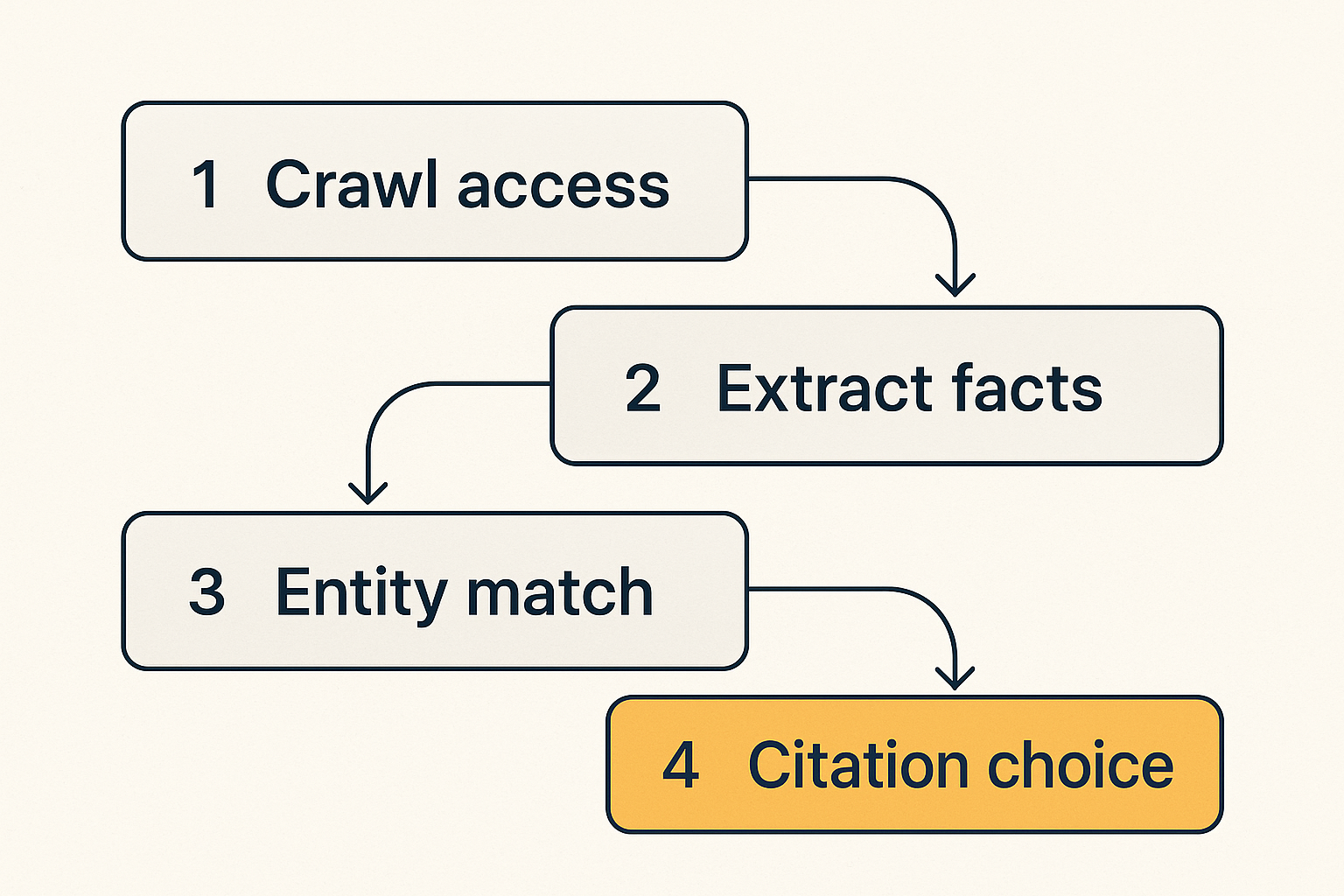
Crawl access
Before anything else, an answer engine needs access. If your content cannot be fetched, it cannot be considered. This includes classic crawlers, AI-specific bots, and indirect discovery through search indexes, feeds, or linked pages.
Do not assume access is fine because Google can crawl you. AI crawler behavior is uneven, and different systems use different fetchers, indexes, and partnerships. In 2026, site owners need to treat AI bot access as its own operational check.
Look at:
- robots.txt rules for AI-related user agents.
- CDN and WAF blocks that challenge non-browser clients.
- rate limits that reject legitimate crawler bursts.
- pages that return different content to bots and users.
- server errors on older or low-traffic URLs.
Practical rule: Crawlability is not a one-time SEO setting. It is a production dependency for AI visibility.
Answer engines prefer facts they can extract cleanly. That does not mean every page should become a bullet list, but it does mean your key information should not be trapped in vague prose.
Good extractable facts include:
- Product name, category, audience, pricing model, and use cases.
- Service area, turnaround time, eligibility, and constraints.
- Author expertise and publication dates.
- Clear definitions and direct answers.
- Comparison points against alternatives.
The mistake teams make is publishing content that sounds persuasive to humans but is vague to machines. For example, saying your platform helps teams grow faster is weak. Saying your platform audits LLM crawler access, schema, robots rules, and answer-ready content is stronger because the claims are concrete.
Entity confidence
AI systems need to know who you are, what you offer, and how your pages relate to known entities. Entity confidence comes from consistency.
If your homepage says one thing, your about page says another, your schema uses a different organization name, and your author bios are missing, you are making the model reconcile avoidable ambiguity.
For AEO, entity confidence is built through repetition with precision:
- Use the same brand name across core templates.
- Mark up Organization, WebSite, Article, Product, Service, and Person where appropriate.
- Keep social profiles and external references consistent.
- Avoid renaming products casually across pages.
- Connect supporting articles back to canonical product or service pages.
Source freshness
Freshness matters differently by topic. A recipe may not need weekly updates. A technical guide on AI crawlers, schema, or tool workflows does.
If you publish a Sintra AI workflow guide and never revisit it, the page can drift quickly. Tools change. Bots change. answer surfaces change. Your own product positioning changes.
Freshness signals do not have to be fake. Do not update dates without substance. Instead, maintain pages when the operating reality changes: new crawler names, new schema fields, new llms.txt conventions, new AI assistant behavior, or new internal workflow steps.
Sintra AI Versus AEO Infrastructure
Sintra AI may help with production work: ideation, drafting, summarization, research organization, and repetitive content operations. That can be valuable for small teams that have more expertise than writing time.
But production speed is only one part of AI discoverability. If you publish twice as many pages with the same structural problems, you scale the problem.
Good production tooling should feed a controlled publishing process. It should help create source material, not bypass review, structure, or validation.
Related reading from our network: publishers exploring AI content monetization run into similar architecture questions around provenance, licensing, payment events, and settlement, covered in this practical guide to AI content blockchain payment architecture.
Infrastructure that helps attribution
AEO infrastructure is different. It exists to make your site understandable to external systems.
That includes:
- Crawl access management.
- Schema validation.
- llms.txt and AI guidance files.
- Server-rendered key content.
- Canonical URL discipline.
- Page-to-intent mapping.
- Monitoring for bot access and extraction failures.
This is the layer that turns content into attributable evidence. Without it, AI assistants may help you produce more words, but answer engines may still cite competitors with cleaner sources.
Comparison table
| Main job | Helps humans create, organize, and automate work | Helps crawlers discover, parse, and trust pages |
| Primary user | Marketer, founder, operator, support lead | SEO, developer, content strategist, site owner |
| Output | Drafts, summaries, workflows, campaign assets | Crawlable pages, schema, files, validation reports |
| Risk if neglected | Slow production and repetitive manual work | Invisible content and weak citation eligibility |
| Success signal | Faster internal execution | More reliable AI crawler understanding |
The two layers should not compete. They should connect. Use an assistant to accelerate the work, then use AEO infrastructure to make sure the work becomes findable evidence.
Build Content Sintra AI Can Safely Reuse
Write answer blocks not essays only
Long-form content still matters, but AI answer engines often need compact answer units. If a page takes 900 words to answer a simple question, the useful fact may be hard to isolate.
A practical page structure is:
- Direct answer near the top.
- Short explanation of the operating context.
- Steps, checklist, or comparison table.
- Evidence or examples.
- Related internal links.
- Clear next action.
This helps humans skim and machines extract. It also gives tools like Sintra AI cleaner source material if your team later uses internal pages to generate summaries, support answers, or campaign briefs.
Separate claims from opinions
AEO rewards clarity. Your site can have a point of view, but claims should be separated from interpretation.
Weak structure:
- We are the best platform for modern teams.
Better structure:
- CrawlProof audits AI crawler access, robots rules, schema markup, page content extraction, and answer positioning.
- Our point of view: teams should validate what AI crawlers can see before scaling AI-assisted content.
The first bullet is a concrete claim. The second is an opinion or strategic stance. Both are useful, but they serve different roles.
Practical rule: Make factual claims easy to quote and strategic opinions easy to attribute.
Add proof paths for important statements
If you publish a page about Sintra AI, AEO, or AI assistant workflows, link claims to supporting pages. Answer engines need paths. So do human reviewers.
Proof paths can include:
- Product documentation.
- Changelog entries.
- Methodology pages.
- Case studies.
- Author bios.
- Glossary entries.
- Technical configuration pages.
Internal links are not just SEO plumbing. They tell AI systems which pages support which statements. A page that claims expertise but links nowhere looks weaker than a page that connects to a coherent knowledge base.
Technical Controls That Affect LLM Crawlers
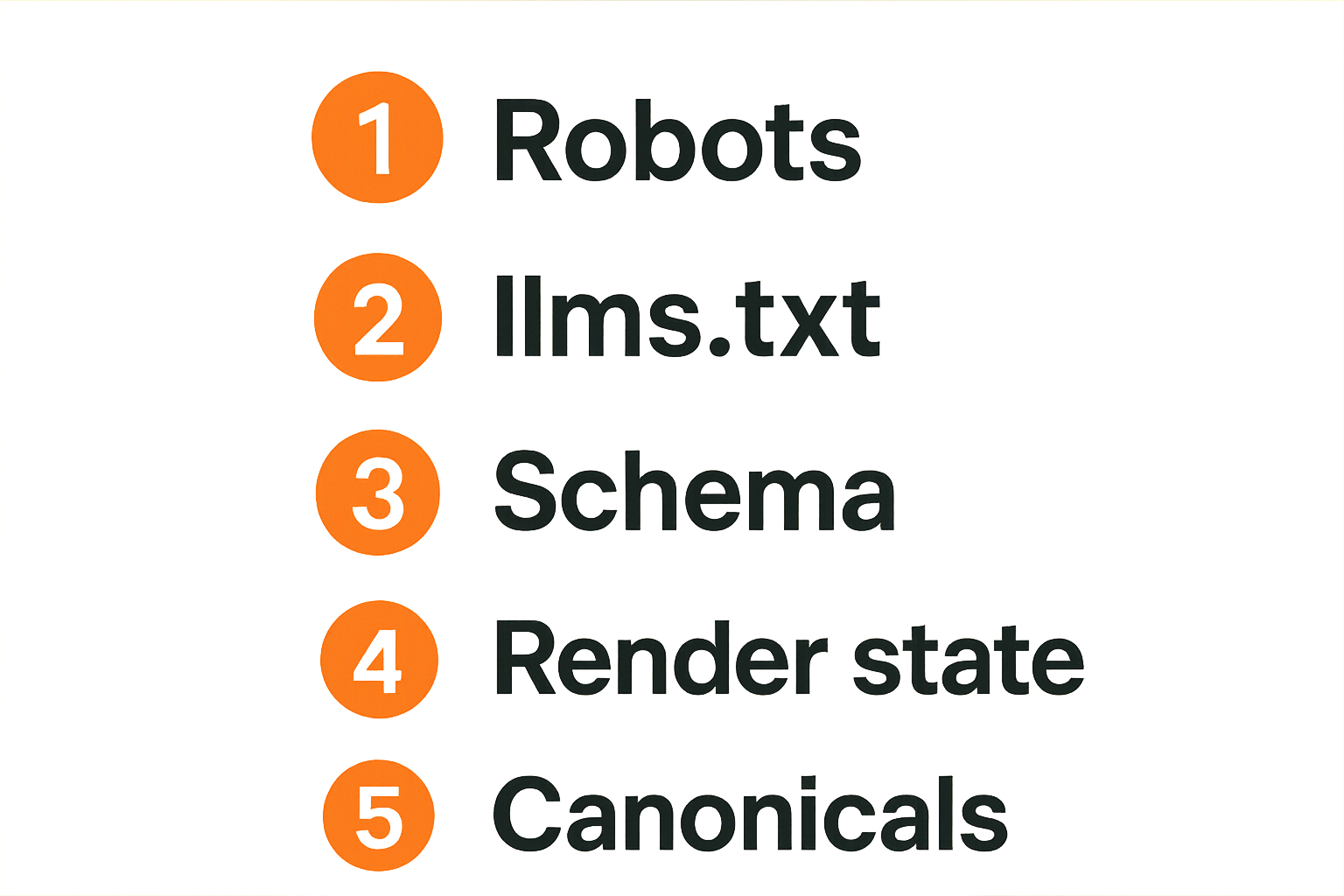
Robots rules and AI bot access
Robots rules are now a business decision, not just a technical default. Some site owners want broad AI visibility. Some want selective access. Some want to block training but allow search-like retrieval. The ecosystem is still messy, so policies need review.
At minimum, know what you are doing. Many teams block AI bots by copying old templates or aggressive bot rules without realizing the visibility tradeoff.
Check:
- Whether important AI user agents are allowed or disallowed.
- Whether your CDN blocks bots before robots.txt is even read.
- Whether staging rules accidentally reached production.
- Whether noindex tags conflict with the page role.
- Whether canonical tags point to the intended URL.
llms.txt and structured guidance
llms.txt is an emerging convention for giving AI systems a clearer map of what matters on your site. It is not magic. It does not force citation. But it can reduce ambiguity by pointing crawlers and assistants toward canonical summaries, docs, product pages, policies, or high-value resources.
If you are new to the file pattern, this guide to llms.txt and skill.md explains what these files are and what teams usually put in them.
A simple llms.txt mindset:
- Prioritize canonical resources.
- Avoid dumping every URL.
- Use plain, stable descriptions.
- Keep it updated when core pages change.
- Align it with sitemap and internal linking strategy.
The mistake teams make is treating llms.txt as a replacement for good pages. It is guidance, not a substitute for crawlable, structured, useful content.
Schema markup and page state
Schema helps machines understand page type and relationships. It is especially useful when page templates contain repeated UI elements, marketing copy, navigation, and dynamic modules.
For website owners and content teams, the practical schema set often includes:
- Organization.
- WebSite.
- Article or BlogPosting.
- FAQPage where appropriate.
- Product or Service.
- BreadcrumbList.
- Person for authors or experts.
Do not add schema that contradicts the visible page. Do not mark every marketing sentence as an FAQ. Do not use Product schema for things that are not products. Bad markup creates distrust and debugging overhead.
Related reading from our network: the same architecture-first thinking shows up outside marketing too, such as storage, network, and workflow tradeoffs in computer systems technology for streaming and home media.
Measurement: How to Know If AI Systems Understand You
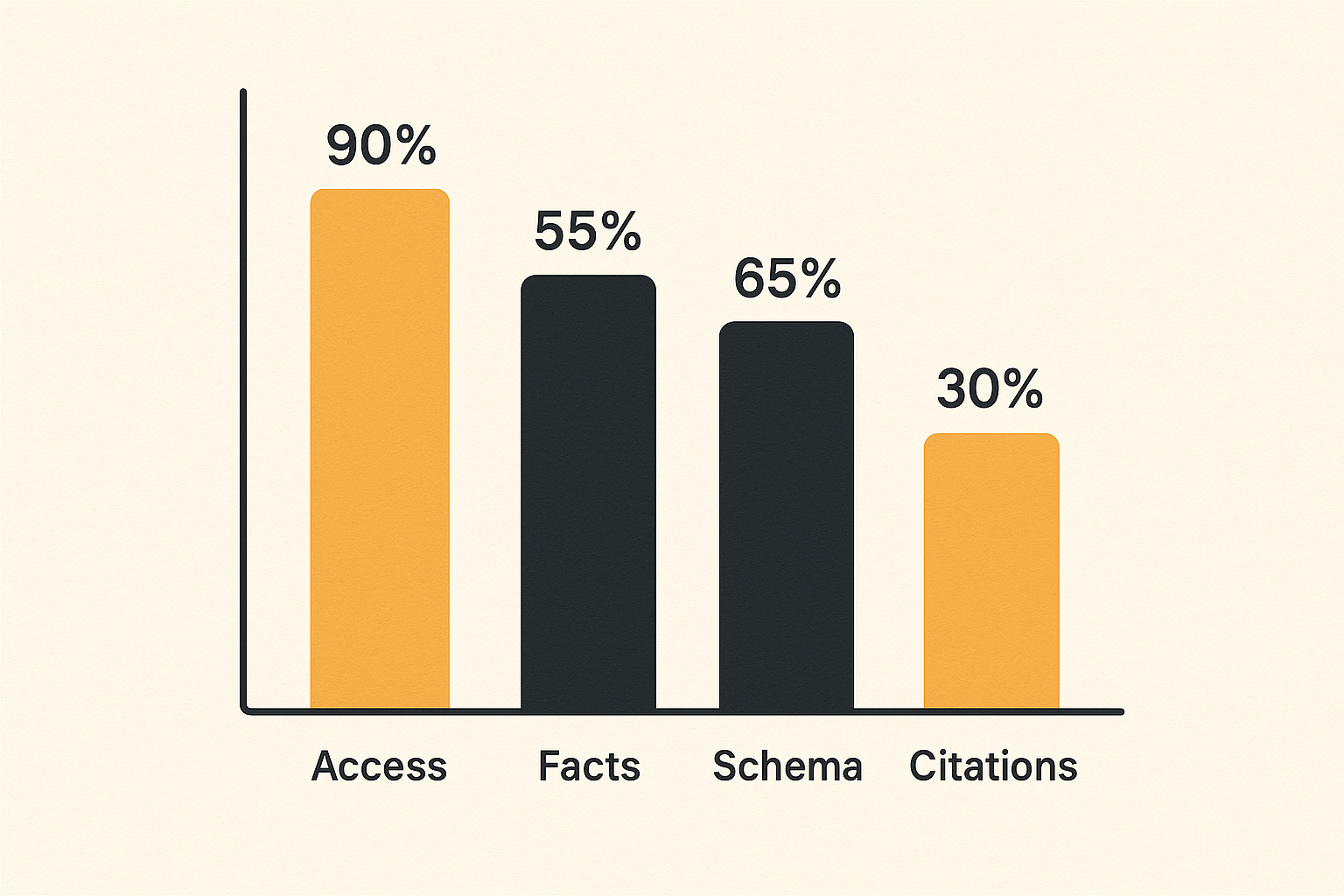
Crawl visibility
You cannot improve what you cannot observe. Start with crawl visibility: can bots reach the pages that matter?
Look at server logs, CDN logs, bot analytics, and AEO audit tools. You want to know which user agents request which pages, what status codes they receive, and whether important resources are blocked.
Useful checks include:
- 200 status on canonical pages.
- No unexpected 403, 401, 429, or 5xx responses.
- Consistent content returned to crawlers and users.
- No accidental disallow rules.
- Clean canonical and indexability signals.
Citation readiness
Citation readiness is not the same as ranking. It means a page contains clear, extractable, attributable material that an answer engine could quote or summarize.
A citation-ready page usually has:
- A direct answer to a specific question.
- Clear entity references.
- Supporting details and constraints.
- Author or organization context.
- Freshness signals when relevant.
- Internal proof paths.
If your page cannot answer what it is about in the first few sections, it is not citation-ready. It may still rank in classic search, but AI answer engines often need tighter evidence.
Query coverage
Map your pages to real answer intents. Do not just list keywords. List the questions an AI assistant might receive.
Examples:
- What is Sintra AI used for?
- Can Sintra AI help with website content?
- How do I make AI-generated content discoverable by answer engines?
- What should I check before scaling AI-assisted publishing?
- How do llms.txt and schema affect AI crawler visibility?
Then identify which page is the best answer for each query. If no page owns the question, create or improve one. If five pages compete, consolidate or clarify.
Evidence drift
Evidence drift happens when your published facts fall out of sync with reality. It is common in AI tooling because interfaces, pricing, crawler policies, and platform capabilities change quickly.
Set a review cadence for pages that discuss fast-moving topics. The goal is not to chase every trend. The goal is to avoid stale claims that reduce trust.
A lightweight review queue can track:
- Last reviewed date.
- Owner.
- Core claims.
- Linked evidence.
- Schema status.
- Crawl status.
- Next review trigger.
Implementation Workflow for Website Teams
Step 1 audit what assistants see
Start with the current site. Before you publish more AI-assisted content, inspect what answer engines and LLM crawlers can actually see.
A practical audit sequence:
- Select 10 to 20 pages that matter commercially.
- Fetch each page as a crawler, not as a logged-in browser.
- Check rendered text, headings, metadata, schema, canonical tags, and robots signals.
- Identify which answer intents each page should satisfy.
- Record missing facts, weak structure, blocked resources, and conflicting claims.
This step prevents a common failure: using Sintra AI to generate new material while old high-value pages remain unreadable or ambiguous.
Step 2 map pages to answer intents
For each important page, define the job. One page may support multiple intents, but it should have a primary one.
Example mapping:
| Homepage | What does this company do? | Clear entity and offering summary |
| Product page | Who is this for and what problem does it solve? | Product or Service schema and concrete use cases |
| Blog guide | How should I solve this workflow problem? | Direct answer, steps, examples, author context |
| Comparison page | Which option fits my use case? | Balanced criteria and explicit constraints |
| Documentation | How do I implement this? | Accurate steps and stable URLs |
The practical question is whether every important buyer question has a page that can answer it directly.
Step 3 ship markup and files
Once the map exists, fix the machine-readable layer. This is where developers and SEO teams need to work together.
Implementation checklist:
- Add or correct schema on core templates.
- Confirm canonical tags and indexability.
- Update robots.txt deliberately.
- Publish or revise llms.txt.
- Ensure key content is available in initial HTML or reliably rendered.
- Add internal links from supporting pages to canonical pages.
- Update sitemaps when page sets change.
Do not make this a one-off project. New templates, CMS plugins, CDN rules, and redesigns can break these controls.
Step 4 validate and repeat
After shipping, validate. Fetch pages again. Check schema again. Test answer blocks. Review logs. Search for inconsistencies.
This is where many teams stop too early. They publish the page and assume the system works. But AEO is closer to an operational loop than a campaign launch.
A simple monthly loop:
- Review top commercial pages.
- Check crawler access and extraction.
- Update stale claims.
- Add missing answer blocks.
- Repair schema and internal links.
- Log changes and owners.
Failure Modes When Teams Treat Sintra AI as the Strategy
Polished outputs on weak sources
The most common failure mode is polished output attached to weak source pages. The copy improves, but the page still lacks structure, evidence, and crawlability.
Symptoms:
- Lots of new blog posts with no internal linking plan.
- Rewritten service pages with missing schema.
- AI-generated FAQs that do not match real customer questions.
- Claims with no proof path.
- Pages that sound similar to competitors because the source inputs were generic.
What works is using AI assistance to accelerate a defined content brief. What fails is letting the assistant define the strategy from thin inputs.
Blocked crawlers and invisible pages
Another failure mode is technical invisibility. The team invests in content but blocks or degrades the crawler path.
Common causes:
- WAF challenges on non-browser clients.
- robots.txt copied from a conservative template.
- noindex tags left from staging.
- JavaScript rendering that hides the main answer.
- canonical tags pointing to less useful duplicates.
- login walls around content meant to be cited.
The page may look fine to a human stakeholder. It may even pass a casual browser check. But if an AI crawler cannot fetch and parse it, the content does not participate in answer engine discovery.
No owner for AI visibility
AI visibility sits between teams, which makes it easy to ignore. SEO owns keywords. Content owns drafts. Developers own templates. Legal owns AI access policy. Leadership owns positioning. No one owns the complete system.
Assign an owner or working group for AEO operations. They do not need to do every task, but they need authority to coordinate content, technical fixes, and measurement.
Good ownership includes:
- A page inventory.
- A crawler access policy.
- Schema standards.
- Content briefs mapped to answer intents.
- Review cadence for fast-changing topics.
- Reporting on what changed and what remains blocked.
Practical rule: If nobody owns the path from published page to AI-readable evidence, AI visibility will degrade by default.
Use CrawlProof before content automation
The best time to audit your site is before you scale AI-assisted publishing. If Sintra AI is helping your team produce more material, you want to know whether the foundation can support that volume.
CrawlProof is built for the source-layer question: what can LLM crawlers and answer engines actually find on your pages, and what are they likely to miss?
That matters because the expensive failure is not slow writing. The expensive failure is publishing a large body of AI-assisted content into templates that cannot be understood or cited.
What works
What works is a workflow that connects production and validation:
- Use Sintra AI or another assistant to draft, summarize, and organize material.
- Edit the output into answer-ready sections with concrete claims.
- Publish into templates with clean headings, metadata, schema, and internal links.
- Audit the URL from an AI crawler perspective.
- Fix blocked access, weak extraction, missing schema, or unclear positioning.
- Recheck after major CMS, CDN, or content changes.
CrawlProof helps with the fourth and fifth steps by showing site owners what AI crawlers can see, including content, schema, robots rules, AI-bot access, and positioning. If you want to inspect a specific URL from that perspective, the auditor at Try crawlproof.com is the direct starting point.
What fails
What fails is treating any one tool as the whole system.
Sintra AI does not replace crawl diagnostics. Schema does not replace useful content. llms.txt does not replace internal linking. AEO audits do not replace editorial judgment. Each layer has a job.
For website owners, SEO professionals, content strategists, and developers, the operating model is straightforward: produce better source material, expose it cleanly, guide crawlers toward the right pages, and verify the result.
Sintra AI can be part of that workflow, especially for teams that need leverage. But the site still has to carry the evidence. In 2026, the winners in AI discovery will not be the teams that publish the most AI-assisted text. They will be the teams whose websites make the right facts easiest for answer engines to retrieve, trust, and cite.
Try crawlproof.com
CrawlProof helps site owners and marketers understand how AI answer engines and LLM crawlers discover and cite their content. Use it to audit crawl access, schema, robots rules, llms.txt signals, and answer readiness before you scale your Sintra AI workflow.