If you publish a page targeting xoloitzcuintli price, you are not just answering how much a rare dog costs. You are competing to become the source an AI answer engine trusts when it gives a price range, explains why the range varies, and decides which site to cite.
Teams think the problem is writing a better dog breed article. The real problem is building a page that machines can crawl, parse, validate, and reuse without losing the business context.
That changes the conversation. The practical question is not only what should the page say. It is whether your website exposes the right facts, in the right structure, with enough freshness and trust signals for answer engines to quote it.
This article uses xoloitzcuintli price as the working example because it is the kind of long-tail, high-intent query where many sites still rely on old SEO habits. In 2026, that is not enough. If you need the broader baseline first, our guide to what AEO is and why it is not SEO frames the shift from ranking pages to being selected as an answer source.
Table of contents
Why xoloitzcuintli price is an AEO problem
The mistake teams make is treating a price query as a copywriting assignment. They add a range, mention a few factors, place an affiliate link, and wait for traffic. That worked better when the goal was to rank a page and let humans do the interpretation.
AI answer engines behave differently. They compress your page into facts. They compare those facts against other pages. Then they decide whether your site is useful enough to cite or silently mine.
The query has too many moving parts
A real xoloitzcuintli price answer depends on size, pedigree, health testing, breeder reputation, location, travel, registration, coat type, age, and whether the dog is purchased from a breeder, rescue, or private owner. A single number is not an answer. It is a liability.
A useful way to think about it is this: the price range is the headline, but the qualifiers are the product. If your page says xoloitzcuintli puppies cost 2,000 to 4,000 dollars but does not explain the conditions behind that range, an answer engine has to infer too much.
The answer engine sees a supply chain
The machine is not reading your article like a person. It is building a supply chain of claims. One paragraph says price. Another says health screening. A table mentions breeder costs. A schema block identifies the page topic. A crawl rule allows or blocks access. A timestamp signals whether the information is current.
What breaks in practice is that these signals often disagree. The visible page says updated 2026. The schema still says 2024. The FAQ says one price range. The intro says another. The answer engine does not call your editor. It discounts the source.
The business risk is misattribution
For breeders, marketplaces, pet publishers, and niche affiliate sites, the risk is not only lower traffic. It is being summarized incorrectly. If an AI assistant quotes a stale range and attributes it to your brand, you inherit the support problem without winning the visitor.
Practical rule: If a page gives a price range, it also needs machine-readable context explaining when that range applies.
What answer engines need before they cite a price page
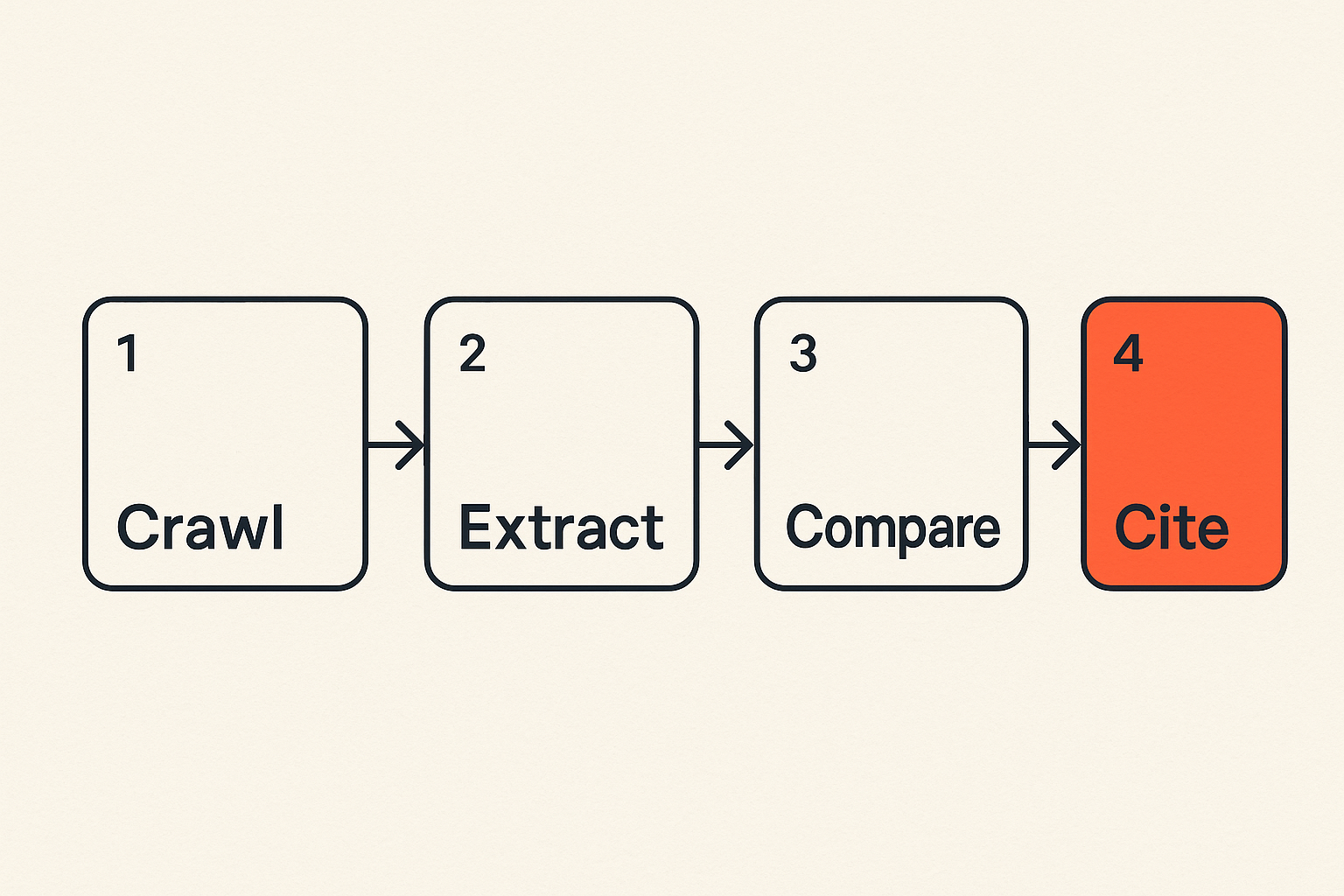
Answer engines do not cite pages because the prose is nice. They cite pages when the extraction path is clear, the page has evidence, and the answer can survive compression. For xoloitzcuintli price content, that means your page has to be structured like a reliable input, not just a readable article.
Crawlable facts beat polished copy
The page needs visible, indexable facts near the content they support. Do not bury the price range inside an image, a calculator widget, or JavaScript that only loads after a user interaction. Crawlers are better than they used to be, but relying on client-side behavior for core facts is still unnecessary risk.
Put the primary answer in text. Then reinforce it with a table, FAQ, and structured data. The goal is not repetition for SEO. The goal is consistency across extraction surfaces.
Confidence comes from corroboration
Answer engines prefer claims that can be checked against surrounding context. If your article says xoloitzcuintli price varies widely, show the reasons in a table. If you mention health testing, define what that includes. If you reference adoption fees, separate them from breeder pricing.
Corroboration does not mean inventing citations or stuffing authority signals. It means making the logic visible. Many teams skip this because it feels obvious to humans. It is not obvious to extraction systems.
Freshness must be explicit
Price content decays. Even if the breed is niche, transportation costs, demand, breeder availability, veterinary expenses, and regional markets change. A visible updated date is helpful, but it is not enough if the rest of the page does not support it.
Use a short freshness block:
- Last reviewed date
- What changed in the latest review
- Region or market assumptions
- Whether the range applies to puppies, adults, rescues, or show prospects
Practical rule: A stale price page usually fails twice: first in the answer engine, then in the inbox when confused users ask why the numbers do not match reality.
Build the price page as a data product
The page is not a blog post with a table added. It is a small data product. It has inputs, assumptions, outputs, and maintenance rules. That mindset is what separates a citeable answer from commodity content.
Separate the range from the reasons
Your core answer should be compact:
Most xoloitzcuintli buyers should expect breeder pricing to fall within a defined range, while adoption or rescue fees may be much lower. Prices vary based on health testing, pedigree, size, age, region, and breeder practices.
Then break the reasons into stable rows:
- Breeder reputation
- Health testing and veterinary care
- Registration and pedigree
- Travel or shipping
- Puppy versus adult dog
- Pet quality versus show prospect
This lets answer engines lift the summary without losing the qualifiers.
Show what the price excludes
The practical question is not only what does the dog cost. It is what the buyer will pay after the initial purchase. A page that ignores lifetime costs will often produce a shallow AI answer.
Include a section for non-purchase costs:
- Initial veterinary visit
- Vaccines and preventives
- Spay or neuter decisions where applicable
- Training
- Travel crates
- Insurance or emergency fund
- Breed-specific skin care considerations
You are not trying to make the page longer. You are reducing ambiguity.
Create reusable answer blocks
AEO content needs blocks that survive being quoted. A reusable block is short, self-contained, and does not require the reader to inspect the whole page.
Example structure:
- Direct answer in two sentences
- Price factor table
- Caveat for geography and age
- Updated date
- FAQ for edge cases
The block should make sense if an assistant extracts only that portion.
Schema for xoloitzcuintli price pages
Schema will not rescue weak content. It can, however, make good content less ambiguous. For xoloitzcuintli price pages, schema should confirm the page type, entity, questions answered, and update metadata.
Use structured data to remove ambiguity
You may not have a perfect schema type for every pricing scenario, but you can still clarify the page. Article schema can describe the content. FAQ schema can mark common questions where appropriate. Breadcrumb schema can show the site hierarchy. Organization schema can identify the publisher.
A simple implementation map:
- Article or BlogPosting for the page
- FAQPage for genuine FAQ content
- BreadcrumbList for navigation
- Organization for publisher identity
- dateModified aligned with the visible updated date
The mistake teams make is adding schema as a decorative layer. Schema should mirror the page, not tell a parallel story.
Avoid fake precision
Do not encode a precise price if the real answer is a range. Do not imply an offer if you are publishing an informational article. Do not mark an affiliate marketplace page like a breeder listing unless it actually behaves like one.
Fake precision creates brittle answers. It may work briefly, but when a model compares your page against better-structured sources, the inconsistency becomes a reason not to cite you.
Add local and entity context
If your site serves a specific country, state, or market, say so. A xoloitzcuintli price page for buyers in the United States may not apply to readers in Mexico, the UK, or Australia. Geography belongs in the visible content and, where appropriate, in structured data.
Entity clarity matters too. Use the breed name consistently. Include the common spelling and avoid making the page look like it is about generic hairless dogs if it is specifically about the Xoloitzcuintli.
Practical rule: Schema should make your visible answer easier to verify, not create a second answer that only machines can see.
llms.txt and crawler access rules
AEO is partly content and partly access. If answer engines cannot find the page, or cannot understand which pages matter, the best rewrite will underperform.
Expose the important paths
Emerging files like llms.txt give site owners a way to point AI systems toward useful content paths. They are not magic. They are routing hints. But routing matters when your site has many thin archive pages, duplicate tags, or faceted URLs.
For a pricing content cluster, an llms.txt style file might point to:
# Useful pages for AI crawlers
/pricing/xoloitzcuintli-price/
/breeds/xoloitzcuintli/
/guides/dog-buyer-costs/
If you are new to this layer, our post on llms.txt and skill.md explains what these files are for and what to put in them.
Do not block the evidence
Robots rules, CDN settings, bot protection, and JavaScript rendering can all hide important context. The page may look fine in a browser while a crawler sees only a shell.
Check whether the following are accessible without a logged-in session:
- Main article copy
- Tables
- FAQ sections
- Structured data
- Images with useful alt text
- Internal links to supporting pages
- Updated date
Security and privacy teams face similar tradeoffs when access rules block the wrong actors; related reading from our network: coupon codes for encrypted messaging apps is a useful adjacent example of privacy controls changing the user workflow.
Monitor AI bot access
You do not need perfect attribution for every model crawler to start learning. Server logs can show whether known AI crawlers are requesting important pages, whether they get 200 responses, and whether they are being challenged or throttled.
Look for patterns:
- Important pages never requested
- Repeated 403 or 429 responses
- Crawlers hitting tag pages but not canonical guides
- Crawlers fetching HTML but not linked resources
- Sudden drops after a firewall change
Content workflow for volatile price queries
The practical question is who owns the page after it ships. Many teams can publish one good price page. Fewer teams can keep it citeable for two years.
Assign an owner
Every volatile query needs an owner. That owner does not have to be a developer or subject matter expert, but they need authority to request updates, validate facts, and coordinate technical fixes.
Ownership should cover:
- Price range review
- Schema consistency
- Internal link health
- Crawl access checks
- FAQ accuracy
- Support feedback from real users
Without ownership, the page becomes nobody's problem until traffic or leads drop.
Set a refresh cadence
Not every page needs weekly review. But price pages should not wait for an annual content audit. For niche pricing content, a quarterly review is often a practical starting point. High-value commercial pages may need monthly checks.
Refresh does not mean rewriting everything. It means confirming that the answer still reflects reality and that the technical signals still agree.
Keep an editorial change log
A short change log helps humans and machines. It shows that the page is maintained and gives editors a way to understand why a range changed.
Example:
Reviewed: 2026-06-17
Change: clarified breeder versus rescue pricing
Reason: support questions confused adoption fees with puppy pricing
Next review: 2026-09-17
Teams in unrelated niches run into the same coordination issue when offers, eligibility, and local rules change; related reading from our network: coupon codes for local networks is a good operational analogy.
Implementation workflow from audit to validation
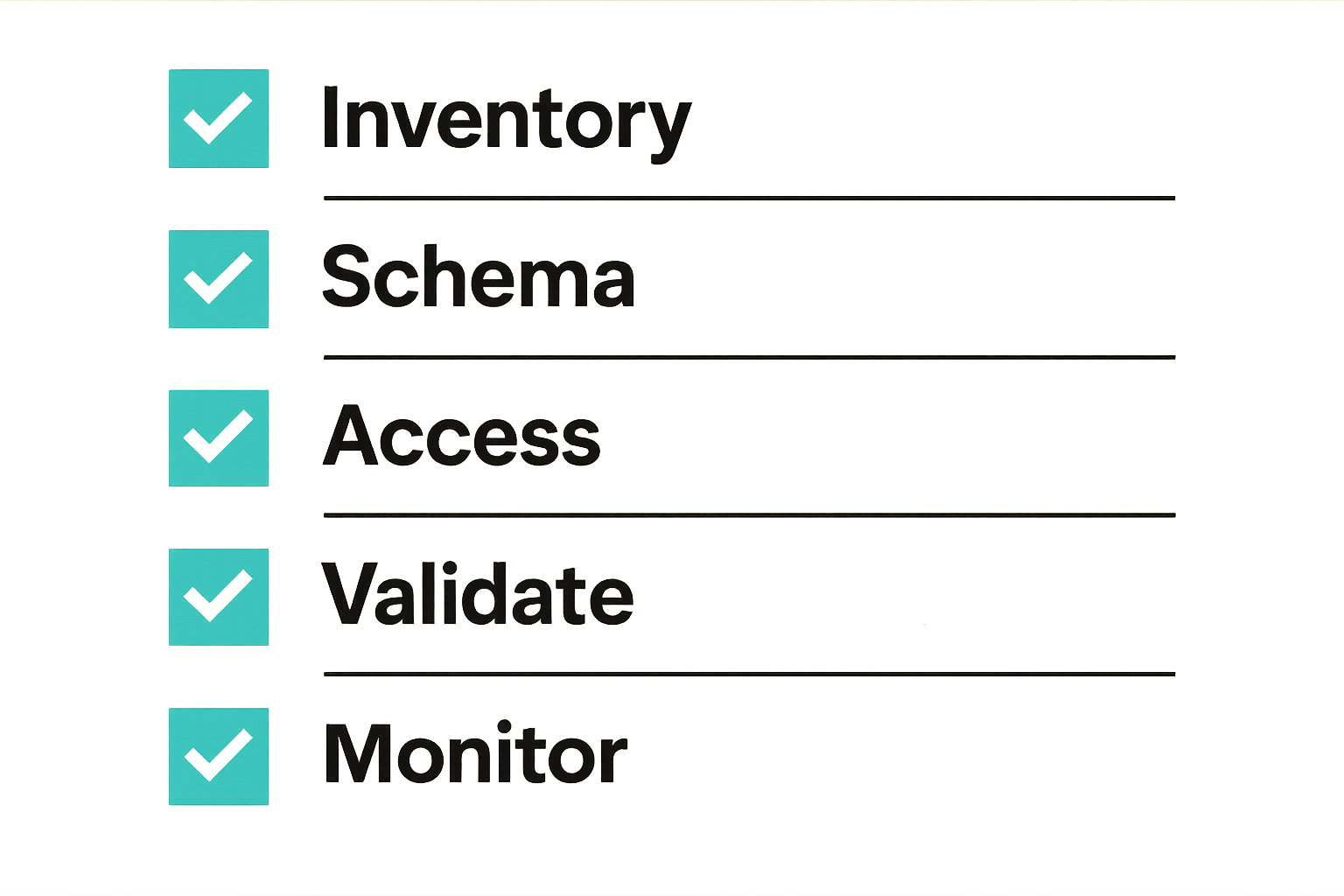
The workflow matters more than the tool list. AEO breaks when content, schema, access rules, and analytics live in separate work queues. You need a sequence that turns a vague optimization goal into testable changes.
Inventory the current page
Start by capturing what exists now. Do not rewrite first. Inventory first.
- Fetch the page as a normal browser user.
- Fetch the page with JavaScript disabled.
- Inspect rendered HTML for the price answer.
- Extract structured data and compare it with visible content.
- Check robots.txt and relevant bot rules.
- Review internal links into and out of the page.
- Capture the current AI answer for the target query.
- Note whether your site is cited, summarized, ignored, or contradicted.
This sequence creates a baseline. Without it, you cannot tell whether the update improved crawlability or only changed the prose.
Patch the template
For most teams, the fix belongs in the template, not only the article. If one price page has inconsistent dates, weak schema, or hidden FAQs, your other price pages probably do too.
Patch the template for:
- Visible direct answer block
- Price factor table
- Updated date and review note
- FAQ rendering in HTML
- Schema output tied to the same fields editors use
- Canonical URL and breadcrumb consistency
- Clean internal links to supporting guides
What works is making the editor fill structured fields that power both the page and the schema. What fails is asking editors to maintain the same fact in five places.
Test like a crawler
After updating, test the page as if you are not allowed to interpret it generously. Can you extract the answer from the HTML? Can you identify the entity? Can you tell whether the page is current? Can you see the price range without running a complex script?
Then test the actual answer environment. Ask multiple assistants the same query. Save the outputs. Look for whether your page is cited, whether the price range is correct, and whether the assistant uses your qualifiers.
Practical rule: If your validation process requires a human to explain what the page really means, the page is not ready for answer engines.
Common failure modes and what breaks
Most AEO failures are boring. That is why they persist. The site looks fine, the article reads fine, and the dashboard still shows some impressions. Under the surface, the answer engine cannot confidently use the page.
Thin affiliate pages lose context
Affiliate pages often optimize for the click and skip the context. They may mention xoloitzcuintli price but never explain the buying scenario. That makes the page easy to summarize badly and hard to cite confidently.
If the page exists mainly to push users to another marketplace, add enough context to make the price answer stand on its own. Otherwise, the AI answer may use a competitor's explanation and ignore your page.
Blocked assets hide meaning
Important facts sometimes live in accordions, images, client-rendered tables, or scripts blocked by bot protection. Humans see the answer. Crawlers see fragments.
This is common after performance or security updates. A developer ships a CDN rule. A marketer sees no visual change. A month later, answer visibility drops because the crawler path changed.
Stale ranges create support debt
Stale price ranges are not just ranking problems. They create bad expectations. Users arrive expecting one number and encounter another. Sales, support, or editorial teams then spend time explaining the mismatch.
That feedback loop should trigger a page update. If users keep asking the same clarification, the answer block is incomplete.
What works versus what fails
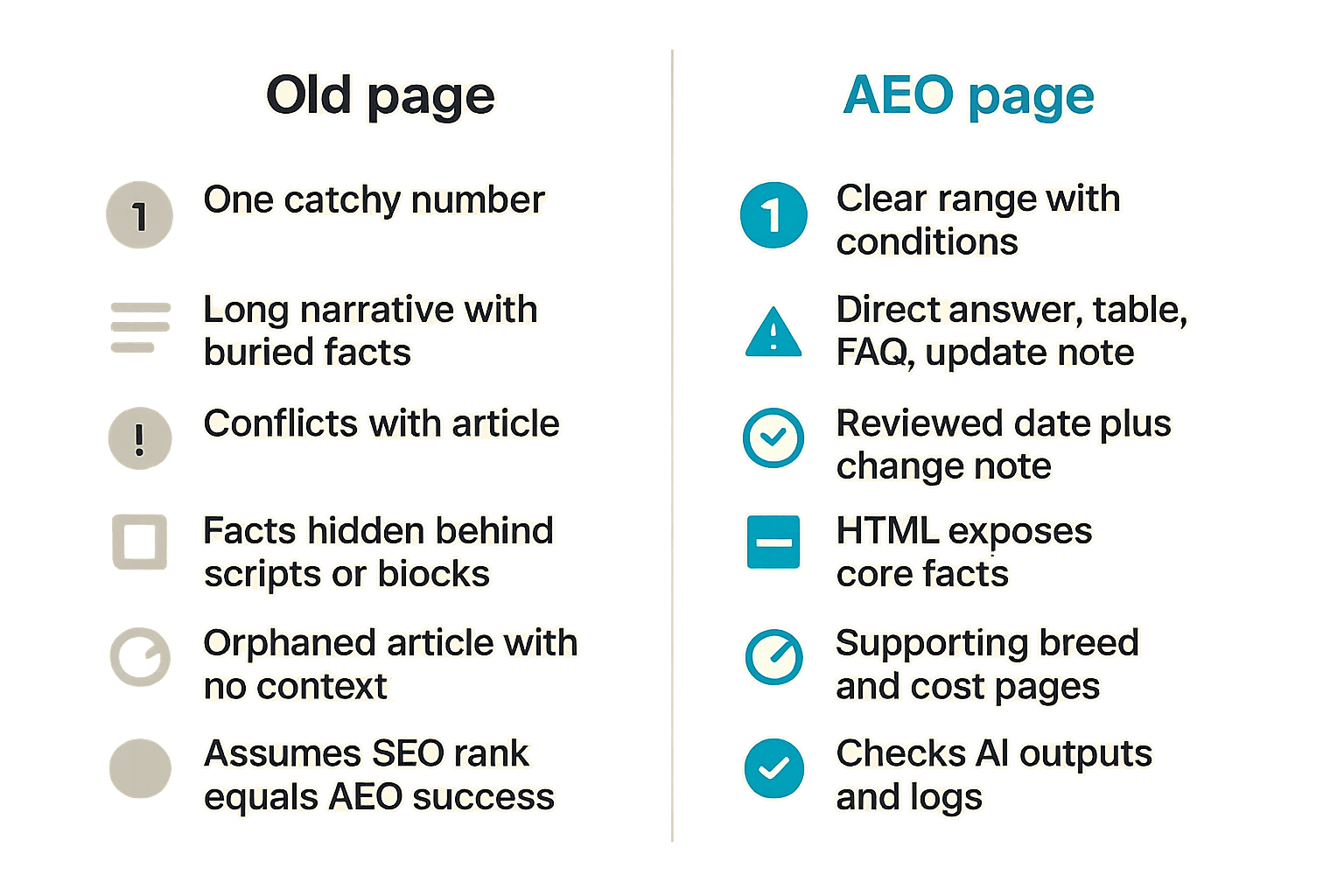
AEO rewards pages that are boring in the right ways: clear, consistent, crawlable, maintained. It punishes pages that are clever in ways machines cannot verify.
The comparison table
| Price answer | Clear range with conditions | One catchy number without context |
| Page structure | Direct answer, table, FAQ, update note | Long narrative with buried facts |
| Schema | Mirrors visible content | Conflicts with the article |
| Freshness | Reviewed date plus change note | Updated date with no evidence |
| Crawler access | HTML exposes core facts | Facts hidden behind scripts or blocks |
| Internal links | Supporting breed and cost pages | Orphaned article with no context |
| Validation | Checks AI outputs and logs | Assumes SEO rank equals AEO success |
The better page answers the next question
A person asking about xoloitzcuintli price usually has follow-up questions:
- Why are some puppies more expensive?
- Are rescues cheaper?
- Does size affect cost?
- Are hairless dogs more expensive to maintain?
- What costs show up after purchase?
- How do I avoid scams?
The better page anticipates these questions. It does not force an assistant to stitch the answer together from other sites.
The support impact is real
When answer engines summarize your page accurately, the users who reach you are better qualified. They understand the range, the caveats, and the next step. When the summary is wrong, your team pays for the confusion.
This is why AEO should sit close to support and sales feedback, not only the SEO calendar.
Traditional SEO metrics still matter, but they do not fully describe answer engine visibility. A page can lose clicks and gain influence if AI systems cite it. It can also gain impressions while being summarized incorrectly.
Track citation checks
Create a recurring check for your target prompts. For this example:
- What is the average xoloitzcuintli price in 2026?
- How much does a Xoloitzcuintli puppy cost?
- Why are Xoloitzcuintli dogs expensive?
- Is adopting a Xoloitzcuintli cheaper than buying from a breeder?
Record whether your site is cited, whether the answer is accurate, and which part of your page appears to be used. Do not overreact to one model response. Watch patterns.
Read server logs
Logs are not glamorous, but they show whether crawlers are actually reaching the page. Segment requests by known bot user agents where possible. Compare response codes before and after technical changes.
Useful fields include:
- URL requested
- User agent
- Status code
- Crawl frequency
- Last successful request
- Redirect chains
- Cache or firewall behavior
If a crawler repeatedly hits your homepage but never your pricing guide, the issue may be discovery. If it requests the page and gets blocked, the issue is access. If it crawls successfully but never cites you, the issue may be content confidence.
Map the conversion path
AEO does not end at the answer. If an assistant cites your page and sends a qualified user, the landing experience still has to work. Make sure the page offers a logical next step: contact a breeder, compare costs, read a buying guide, subscribe, request an audit, or save the page.
Do not optimize only for the citation. Optimize for the human who arrives after already receiving a partial answer.
Product fit for crawlproof.com
CrawlProof is built around a simple premise: site owners need to see what AI crawlers and answer engines can actually find, not what the CMS preview shows. That is especially useful for pages like xoloitzcuintli price, where the visible article, structured data, and crawler access all have to agree.
Where an audit fits
An AEO audit should sit between content planning and engineering cleanup. It answers practical questions:
- Can AI crawlers access the page?
- Is the main answer visible in HTML?
- Does schema match the content?
- Are important pages discoverable?
- Are robots and bot rules helping or hurting?
- Is the page positioned as a citeable source?
This is not a replacement for editorial judgment. It is the technical inspection that tells your team whether the page can be used by answer engines in the first place.
When human cleanup helps
Automated checks can find many problems. Humans still need to decide what the answer should say, how much uncertainty to include, and which business assumptions matter. If your page affects leads, compliance, support, or brand trust, do not leave those decisions to a generic content refresh.
The best workflow is combined: audit the crawl and structure, fix the template, rewrite the answer blocks, validate in AI systems, then monitor changes over time.
The same pattern shows up outside AEO. Remote teams, for example, often think the issue is screen sharing when the real issue is permissions, recovery, and support workflow; related reading from our network: Samsung TV remote workflows for remote teams makes the same architecture point in a different environment.
For AEO, the equivalent mistake is thinking the UI is the page. The real system includes crawl permissions, rendered HTML, schema, internal links, freshness signals, and the downstream answer experience.
Closing checklist for xoloitzcuintli price visibility
If you want a xoloitzcuintli price page to be citeable in 2026, stop treating it like a static article. Treat it like a maintained answer asset.
Final pre publish check
Before publishing or refreshing the page, confirm:
- The first screen gives a direct, qualified price answer.
- The range is separated from the factors that affect it.
- The page distinguishes breeder pricing from adoption or rescue fees.
- The updated date matches schema dateModified.
- FAQ content is visible in HTML.
- Structured data mirrors visible content.
- Robots and bot rules allow useful access.
- Supporting internal links give the page context.
- AI answer checks are saved before and after launch.
- There is an owner and refresh cadence.
That is the operational difference between content that merely ranks and content that answer engines can trust.
Try crawlproof.com
CrawlProof helps site owners and marketers see how AI answer engines and LLM crawlers discover, understand, and cite their content. If xoloitzcuintli price visibility depends on crawlability, schema, access, and freshness, Try crawlproof.com.